This is an editorial analysis. Not financial advice. Data verified as at 21 July 2026.
What MAS Announced for the August 2026 Savings Bond
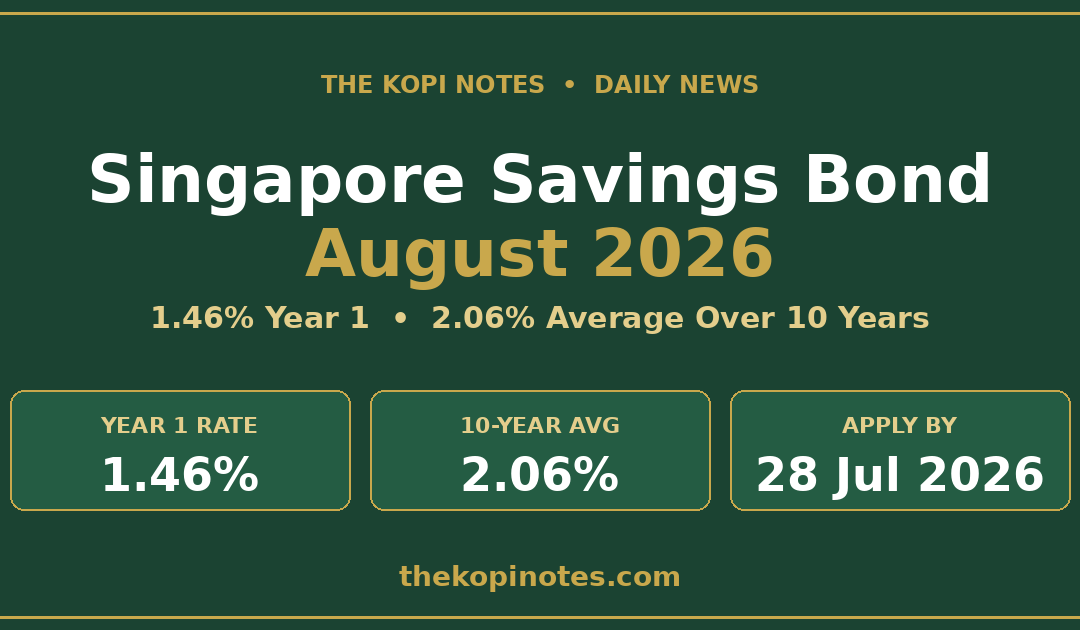
On 1 July 2026, MAS announced the August 2026 Singapore Savings Bond (issue code GX26080T, also shown as SBAUG26). If you hold this bond for a single year, you earn 1.46%. Hold it for the full 10 years and your average annual return steps up to 2.06%. Interest is paid every six months into your bank account, the bond is fully backed by the Singapore Government, and you can redeem in any month with no penalty and no loss of principal.
The Savings Bond uses a “step-up” coupon: the interest rate rises the longer you hold. The table below shows the official coupon for each year and the average return you lock in if you redeem at the end of that year.
| Year held | Coupon that year | Average return p.a. if redeemed |
|---|---|---|
| Year 1 | 1.46% | 1.46% |
| Year 2 | 1.75% | 1.60% |
| Year 3 | 1.80% | 1.67% |
| Year 4 | 1.80% | 1.70% |
| Year 5 | 1.90% | 1.74% |
| Year 6 | 2.11% | 1.80% |
| Year 7 | 2.27% | 1.86% |
| Year 8 | 2.43% | 1.93% |
| Year 9 | 2.58% | 1.99% |
| Year 10 | 2.72% | 2.06% |
Source: MAS issuance details, GX26080T. In cash terms, S$10,000 held for the full 10 years pays out roughly S$2,080 in total coupons before any reinvestment. You can invest from as little as S$500, in multiples of S$500, up to an individual holding limit of S$200,000 across all SSB issues. Applications are made through DBS/POSB, OCBC or UOB internet banking (with a CDP account) or through your SRS operator.
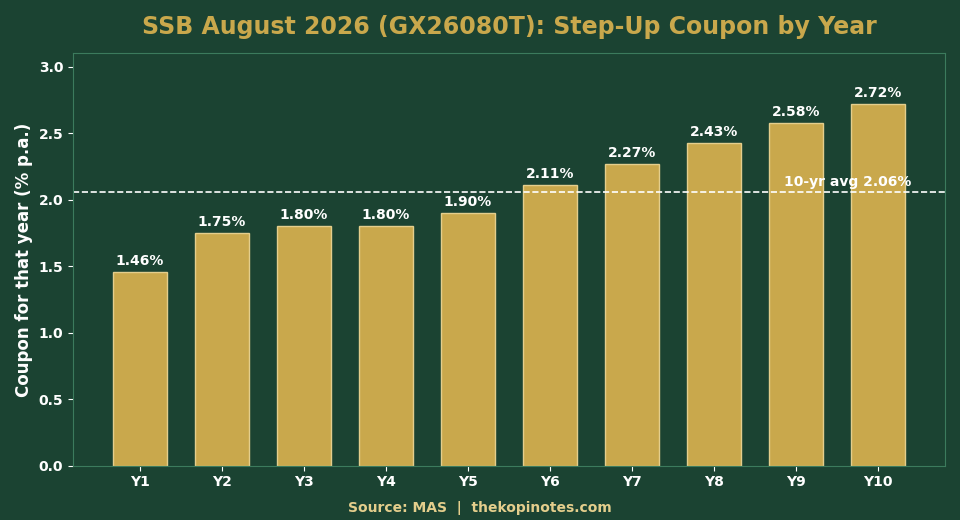
What this means for Singapore retail investors: the August 2026 SSB lets you park money in a government-backed instrument, keep monthly liquidity, and lock in a modest but rising return. But at 1.46% for the first year, the near-term payout is low, so this issue rewards patience far more than short parking. If you are new to the product, start with our complete Singapore Savings Bond guide.
August 2026 SSB vs T-Bills, Fixed Deposits and CPF
The SSB does not exist in a vacuum. Singapore retail investors weighing where to put cash are really choosing between four safe options: the Savings Bond, the 6-month Treasury bill, a bank fixed deposit, and their CPF accounts. Here is how they stack up right now.
| Instrument | Indicative rate (p.a.) | Lock-in / liquidity | Key notes |
|---|---|---|---|
| SSB Aug 2026 – Year 1 | 1.46% | Redeem any month, no penalty | Rises to 2.06% avg over 10 years |
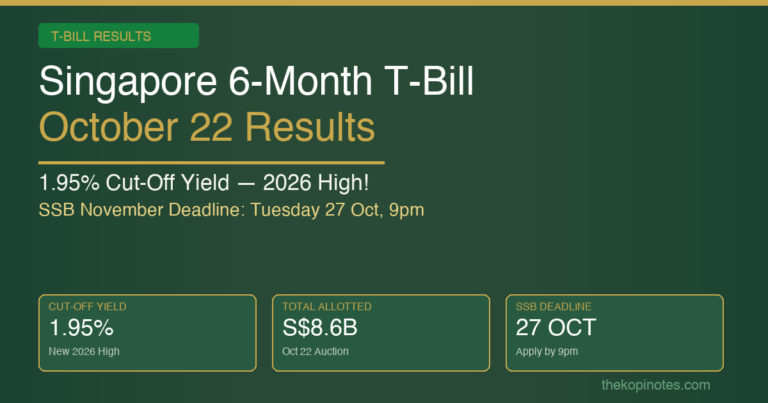
| 6-month T-bill (BS26114W) | 1.55% | Locked 6 months | Cut-off yield, 16 Jul 2026 auction |
| Best 12-month fixed deposit | ~1.50%–1.65% | Locked 12 months | Promo rates, min placement applies |
| CPF Ordinary Account | 2.50% | Restricted (retirement use) | Floor rate, Q3 2026 |
| CPF Special / MediSave / RA | 4.00% | Restricted (retirement use) | Floor rate, Q3 2026 |
Sources: MAS auctions and issuance; CPF Board interest rates, 1 Jul–30 Sep 2026. Fixed deposit figures are indicative best-in-market promotional rates and change frequently.
Two things stand out. First, the latest 6-month T-bill cut-off yield of 1.55% is actually higher than the SSB’s 1.46% first-year rate, so for money you can lock away for six months, the T-bill currently pays more. Second, CPF remains untouchable at 2.5% to 4.0%, but that money is earmarked for housing and retirement, not flexible cash.
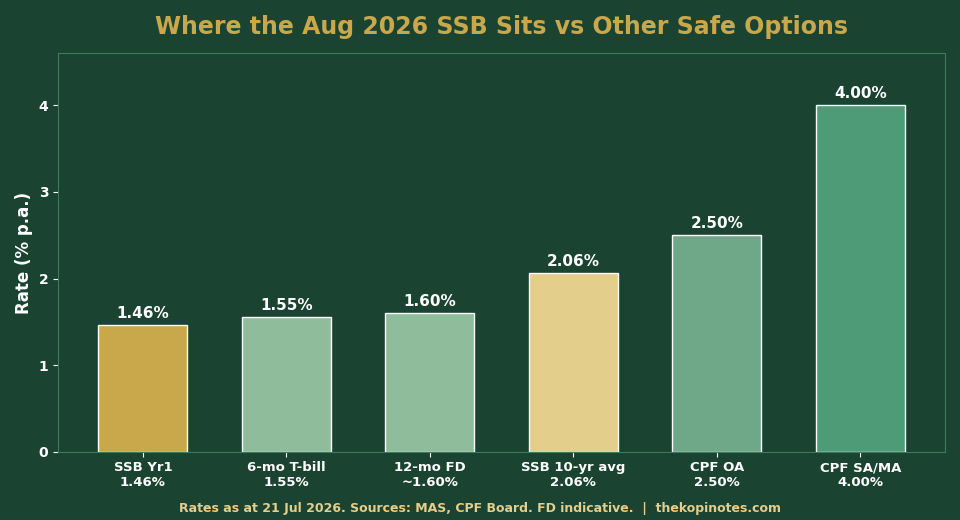
What this means for Singapore retail investors: if your holding period is under a year, the 6-month T-bill or a top fixed deposit edges out the SSB on headline rate today. The SSB wins when you value the ability to redeem in any month without penalty and want your rate to step up over the medium term. Many investors hold all three – T-bills for locked 6-month cash, SSB for flexible medium-term savings, and a hurdle savings account for daily balances. Our calculators and tools hub can help you model the trade-offs.
Why SSB Rates Keep Drifting Lower in 2026
The August 2026 issue continues a gentle downtrend. The July 2026 SSB carried a 10-year average return of 2.11%; August slipped to 2.06%. To understand why, remember how the rate is set: SSB coupons are derived from the yields of Singapore Government Securities (SGS) of matching tenors, averaged over the month before the issue. When SGS yields fall, so do SSB rates.
Through the first half of 2026, Singapore’s short-term risk-free rates have stayed contained. The 6-month T-bill has hovered around 1.4%–1.55%, and headline inflation has remained within the 1%–2% band that lets MAS keep its exchange-rate-based policy steady. A firm Singapore dollar and ample banking-system liquidity have kept local yields structurally below comparable US rates. The result: risk-free returns for savers are drifting down, not up.
What this means for Singapore retail investors: the “easy” era of 3%-plus risk-free cash yields has faded. If falling rates on cash instruments concern you, this is the moment to revisit your asset allocation rather than chase the last basis point. Locking in a longer SSB position now fixes today’s step-up schedule for a decade, insulating part of your portfolio from further rate cuts. Investors focused on income may also look at dividend-paying S-REITs or broad-market ETFs for the growth portion of their portfolio, accepting higher volatility for higher expected returns.
Should You Apply Before the 28 July 2026 Deadline?
Timing matters. The application window for GX26080T opened on the first business day of July and closes at 9.00pm on 28 July 2026. The bond is issued on 3 August 2026 and will appear in your CDP or SRS account shortly after. Because current rates are low, demand tends to be softer, so applicants generally receive close to their full requested amount – unlike the high-rate 2022 issues, when allotments were capped.
A few practical strategies for TKN readers:
- Build a bond ladder. Rather than committing a lump sum at one rate, spread purchases across several monthly issues so your portfolio blends different step-up schedules and you keep optionality as rates move.
- Use it as a flexible emergency fund. Because you can redeem in any month with principal intact, the SSB works well for the portion of your rainy-day fund you want earning slightly more than a bank account.
- Consider your SRS. Idle SRS cash earns almost nothing; channelling it into SSB puts it to work while staying liquid within the scheme.
- Mind the S$200,000 cap. This is a per-person limit across all SSB holdings, so plan large allocations accordingly.
What this means for Singapore retail investors: if you want penalty-free flexibility and a rate that rises over time, applying before 28 July is straightforward and low-risk. If instead you have a clear 6- or 12-month horizon and no need for early access, compare the current T-bill and fixed deposit rates first – they may pay more for that specific window. There is no wrong answer here, only a matching of instrument to time horizon. You can keep track of upcoming issues and rates alongside CPF moves in our CPF and cash strategy section.
Bottom Line for SG Investors
The August 2026 Singapore Savings Bond is a solid, boring, do-its-job instrument – exactly what a safe cash allocation should be. At 1.46% in year one and 2.06% averaged over 10 years, it will not make you rich, and for sub-one-year money the 6-month T-bill (1.55%) and top fixed deposits currently pay slightly more. Its real edge is flexibility: penalty-free monthly redemption, a step-up rate that climbs to 2.72% by year 10, and iron-clad government backing. Use it for the flexible, medium-term slice of your safe money, ladder your entries, and keep your growth ambitions in diversified equities and REITs rather than in cash. If you want in on this issue, apply before 9.00pm on 28 July 2026.
Frequently Asked Questions
What is the interest rate for the August 2026 Singapore Savings Bond?
The August 2026 SSB (GX26080T) pays 1.46% in year one and steps up to an average of 2.06% per year if held for the full 10 years, with the year-10 coupon reaching 2.72%.
When is the application deadline for the August 2026 SSB?
Applications close at 9.00pm on 28 July 2026. The bond is issued on 3 August 2026 and reflected in your CDP or SRS account shortly after.
How much can I invest in the August 2026 Savings Bond?
You can invest from S$500, in multiples of S$500, up to an individual holding limit of S$200,000 across all SSB issues you hold.
Is the SSB better than a 6-month T-bill right now?
It depends on your horizon. The latest 6-month T-bill cut-off yield of 1.55% is higher than the SSB’s 1.46% first-year rate, so the T-bill pays more for locked 6-month cash. The SSB wins if you value penalty-free monthly redemption and a rate that steps up over time.
Can I lose money on the Singapore Savings Bond?
No. The SSB is fully backed by the Singapore Government and you always receive your principal plus any accrued interest when you redeem, in any month, with no penalty.
Can I use my SRS or CPF to buy the SSB?
You can buy SSB with cash (via a CDP account) or with SRS funds. CPF funds cannot be used to buy the Singapore Savings Bond.
Why did the SSB rate fall compared with July 2026?
SSB rates track Singapore Government Securities yields. The July 2026 issue averaged 2.11% over 10 years; August slipped to 2.06% because underlying SGS yields eased amid contained inflation and a steady MAS policy stance.
This article was researched with the help of AI. While we strive to keep all information accurate and up to date, there may be errors. If you notice any discrepancies, please contact us.