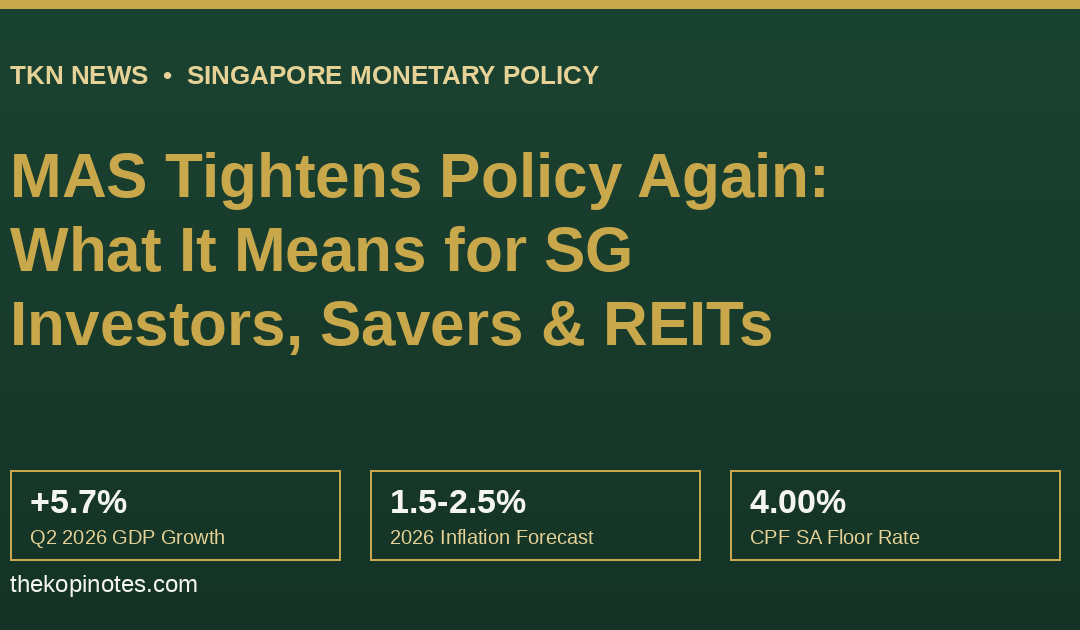
MAS tightened monetary policy for the second straight quarter on 27 July 2026, letting the Singapore dollar strengthen further to cap inflation, which it now expects to stay elevated into early 2027. For SG investors, that means firmer SGD, resilient cash yields, and fresh pressure on REIT valuations.
This is an editorial analysis. Not financial advice. Data verified as at 30 July 2026.
What MAS Just Announced
On 27 July 2026, the Monetary Authority of Singapore (MAS) said it would increase the rate of appreciation of the Singapore dollar nominal effective exchange rate (S$NEER) policy band “very slightly,” with no change to the width of the band or where it is centred. This is the second consecutive tightening move this year, following a more aggressive adjustment after the April 2026 macroeconomic review.
The mechanics matter more than they sound. Singapore doesn’t use interest rates as its primary policy lever — MAS manages the exchange rate instead. A steeper appreciation slope means the SGD is allowed to strengthen faster against a trade-weighted basket of currencies, which makes imports cheaper and helps cap imported inflation. It’s a quieter tool than a rate hike, but the effect on your wallet is just as real.
Why Inflation Is Ticking Up Again
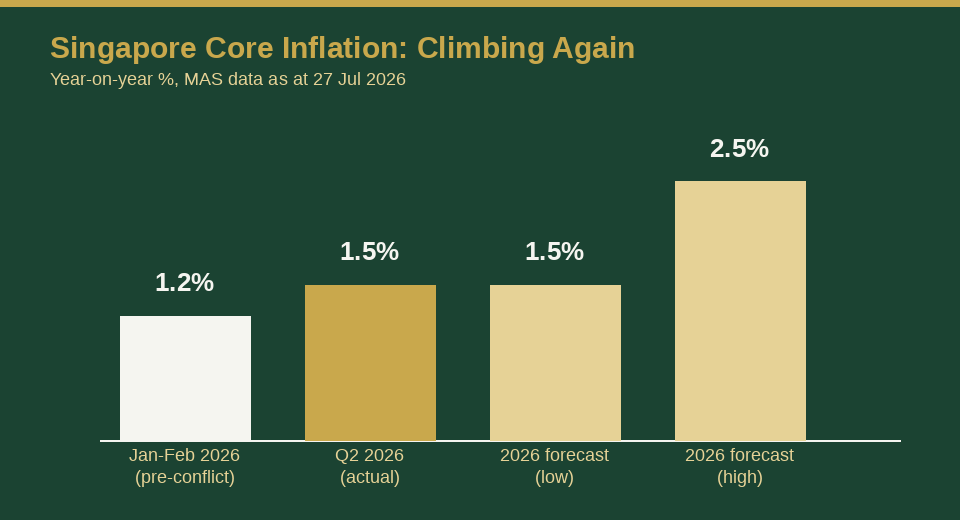
MAS core inflation came in at 1.5% year-on-year in Q2 2026, up from 1.2% in the January-to-February period before the Middle East conflict disrupted shipping lanes and pushed oil prices higher. The central bank has held its full-year 2026 forecast for both core inflation and headline CPI-All Items inflation at 1.5% to 2.5% — a range it had already raised from 1% to 2% following April’s review.
MAS flagged three specific pressure points for the rest of 2026: higher electricity and gas costs from elevated energy prices, rising food and retail prices as imported costs pass through, and potential agricultural disruption from El Niño weather patterns affecting Singapore’s food import sources. The silver lining is that MAS expects inflation to “ease more discernibly” in the second half of 2027 as global energy prices gradually moderate.
Growth, meanwhile, has surprised on the upside. The Ministry of Trade and Industry’s advance estimate put Q2 2026 GDP growth at 5.7% year-on-year, powered by AI-related investment flowing through Singapore’s electronics and technology supply chain. A newly imposed 12.5% US tariff on Singapore exports is expected to have only a marginal effect, cushioned by tariff-exempt electronics shipments.
What This Means for Your Savings and Fixed Deposits
A stronger, more tightly managed SGD doesn’t directly set deposit rates, but it does reinforce the “higher-for-longer” backdrop that’s kept Singapore cash yields resilient even as global rate-cut chatter continues elsewhere. If you’re sitting on idle cash, this is a reasonable environment to lock in a rate rather than leave money in a low-yield account.
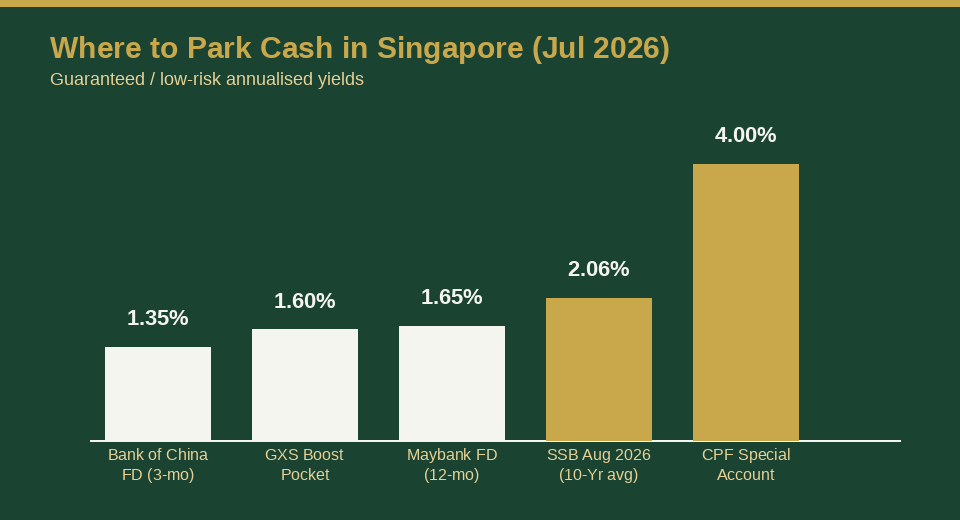
Here’s where the best guaranteed-return options stood as of late July 2026:
| Instrument | Rate (p.a.) | Tenor / Notes |
|---|---|---|
| Maybank Fixed Deposit | 1.65% | 12 months, min S$20,000 |
| GXS Boost Pocket | 1.60% | 12 months, min S$100 |
| Bank of China Fixed Deposit | 1.35% – 1.55% | 3 to 12 months (as at 28 Jul 2026) |
| Singapore Savings Bond (Aug 2026 issue) | 1.46% (Yr 1) / 2.06% (10-Yr avg) | Step-up to 2.72% by Year 10 if held to maturity |
| CPF Special Account | 4.00% (floor) | Pegged to 12-month average 10-Year SGS yield + 1%, subject to 4% floor |
Notice the SSB’s 10-year average actually slipped from 2.11% in the July issue to 2.06% for August — a reminder that even “risk-free” yields are drifting down at the long end, even as MAS tightens the currency band. If you want to track how each new SSB tranche stacks up before you apply, TKN’s SSB interest calculator lets you model the step-up schedule against a fixed deposit of the same tenor. For a deeper dive on bank-by-bank FD comparisons, see our UOB fixed deposit rate guide.
The REIT Angle: Higher-for-Longer Rates vs Retail Inflows
S-REITs are caught in a tug-of-war. On one hand, retail investors poured a reported S$925 million into S-REITs up to late May 2026, and CPFIS eligibility keeps expanding — Elite UK REIT’s SGD counter was added to the CPF Investment Scheme list from 9 June 2026, giving CPF Ordinary Account holders another income-focused option. On the other hand, the FTSE ST REIT Index underperformed the broader Straits Times Index in the first half of 2026, as Middle East-driven oil price spikes and MAS’s higher inflation forecast weighed on sentiment.
The read-through from this latest tightening move is nuanced. A firmer SGD and a higher “risk-free” yield curve (FDs and SSBs both offering 1.5%+ with zero credit risk) raise the bar S-REIT distribution yields need to clear to look attractive on a relative basis. That’s a headwind for REIT valuations, particularly for more leveraged or overseas-asset trusts sensitive to financing costs. But it’s not a reason to abandon the sector — it’s a reason to be selective about balance sheet strength and distribution coverage. If you hold S-REITs through a CPFIS- or SRS-eligible ETF wrapper, our Lion-Phillip S-REIT ETF guide breaks down how the CLR ETF’s diversified basket has weathered similar rate environments.
CPF Members: Why the SA’s 4% Floor Still Wins
Amid all this rate noise, the CPF Special Account’s 4% per annum floor — guaranteed and government-backed — remains one of the more attractive “risk-free” instruments available to Singaporeans, comfortably ahead of every FD and SSB rate in the table above. It’s worth remembering that from 2025, the SA was closed to members aged 55 and above under the SA Closure Scheme, with savings transferred to top up the Retirement Account first; new contributions for workers above 55 now flow to the OA and MediSave Account instead. For members still contributing to their SA, this tightening cycle is a useful reminder to check whether idle Ordinary Account cash earning a lower rate could be better allocated. Our CPF OA vs SA interest rate breakdown and 2026 CPF contribution guide cover the mechanics in more detail, including how the new $8,000 Ordinary Wage ceiling (effective January 2026) affects your monthly allocation.
Should You Rethink Your Overseas ETF Allocation?
A steeper SGD appreciation path has a direct, practical implication for anyone dollar-cost-averaging into USD-denominated ETFs like CSPX or VWRA: a stronger SGD means your Singapore dollars buy more units for the same outlay, effectively lowering your entry cost in SGD terms. It also means unhedged gains on existing holdings are translated back at a less favourable rate when the SGD strengthens. Neither effect should drive a wholesale change in strategy — currency moves from a single policy statement are incremental, not dramatic — but it’s a reasonable moment to review whether your overseas equity allocation still matches your risk appetite given elevated local inflation eating into real returns. TKN’s ETF investing guide walks through how to weigh SGD-hedged versus unhedged share classes.
Bottom Line for SG Investors
MAS’s second consecutive tightening move confirms the central bank is taking the current inflation uptick seriously, even as Singapore’s economy grows faster than expected. For retail investors, the practical takeaways are straightforward: cash and near-cash instruments (FDs, SSBs, CPF SA) remain genuinely competitive and worth using for your emergency fund or short-term goals; S-REITs face a modestly higher bar to clear on valuation grounds, which argues for selectivity over broad-based buying; and a firming SGD is a mild tailwind for anyone still building an overseas ETF position. None of this changes a sound long-term plan — it’s a reason to rebalance at the margins, not to overhaul your portfolio.
Frequently Asked Questions
What did MAS announce on 27 July 2026?
MAS increased the rate of appreciation of the Singapore dollar’s policy band “very slightly,” the second consecutive quarterly tightening in 2026 after a larger move in April, in response to core inflation rising to 1.5% year-on-year in Q2 2026.
Why does MAS use the exchange rate instead of interest rates?
Singapore is a small, trade-dependent economy where import prices have an outsized effect on inflation. MAS manages the S$NEER policy band’s slope, width, and centre to influence how fast the SGD strengthens or weakens against a basket of trading-partner currencies, which in turn shapes imported inflation.
What is Singapore’s inflation forecast for 2026?
MAS has maintained its 2026 forecast for both core inflation and headline CPI-All Items inflation at 1.5% to 2.5%, with price pressures expected to ease more noticeably from the second half of 2027.
How does MAS tightening affect fixed deposit and SSB rates?
MAS’s exchange-rate tool doesn’t set deposit rates directly, but it reinforces a higher-for-longer backdrop that has kept local cash yields resilient. As of late July 2026, top FD rates ranged from about 1.35% to 1.65% p.a., while the August 2026 Singapore Savings Bond offered a 10-year average yield of 2.06%.
Are S-REITs a bad investment right now?
Not necessarily, but they face a tougher relative comparison. The FTSE ST REIT Index underperformed the Straits Times Index in the first half of 2026 as oil-driven inflation concerns weighed on the sector, even as retail investors continued adding money (S$925 million into S-REITs up to late May 2026). Selectivity on balance sheet strength matters more in this environment.
Does a stronger Singapore dollar help or hurt my CSPX or VWRA investments?
A stronger SGD lowers your entry cost when buying USD-denominated ETFs like CSPX or VWRA, since each Singapore dollar buys more units. It can modestly reduce the SGD value of unhedged gains on existing holdings, though this effect is typically small relative to underlying market moves.
What is the CPF Special Account interest rate in 2026?
The CPF Special Account earns a minimum of 4% per annum, pegged to the 12-month average yield of 10-year Singapore Government Securities plus 1%, subject to a 4% floor. This remains higher than every major FD and SSB rate available in Singapore as of July 2026.
This article was researched with the help of AI. While we strive to keep all information accurate and up to date, there may be errors. If you notice any discrepancies, please contact us.