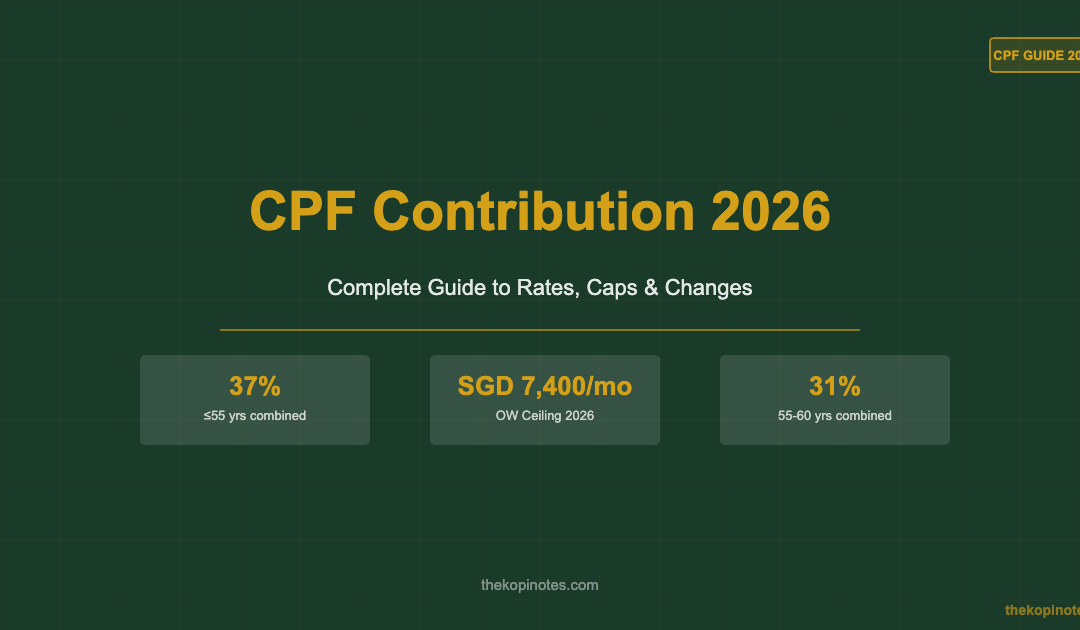
CPF Contribution 2026: Complete Guide to Rates, Caps & Changes
Your full 2026 breakdown — contribution rates by age group, the new OW ceiling, AW ceiling formula, senior worker changes, and what it all means for your take-home pay.
CPF contribution 2026 rates range from 37% combined for employees aged 55 and below (20% employee + 17% employer), to 13.5% for those above 70 years old. From January 2026, Singapore’s Ordinary Wage (OW) ceiling rose to SGD 7,400 per month — up from SGD 6,800 in 2025. Senior worker rates also increased across all age bands above 55 as part of the government’s retirement adequacy roadmap.
Not financial advice. All figures are for educational reference only. Data as at January 2026 unless noted.
- CPF 2026 rate for workers aged 55 and below: 37% total (20% you + 17% employer)
- OW ceiling increased to SGD 7,400/month from Jan 2026 — more of your salary is CPF-eligible
- Senior worker rates rose again: 55–60 age group now sees a combined 31% contribution rate
Free download: The Singapore Money Playbook — 7 money mindset shifts written for Singapore, with the CPF-adjusted retirement number most guides get wrong (PDF + Notion).
Table of Contents
Contents — Click to expand
- What Is CPF Contribution?
- CPF Contribution Rates 2026 (Full Table by Age)
- Ordinary Wage (OW) Ceiling 2026
- Additional Wage (AW) Ceiling 2026
- CPF Allocation Rates: Where Does Your CPF Go?
- 2026 Senior Worker CPF Changes
- How CPF Affects Your Take-Home Pay (Worked Examples)
- How to Grow Your CPF in 2026
- Frequently Asked Questions
What Is CPF Contribution?
CPF stands for the Central Provident Fund — Singapore’s mandatory savings scheme for citizens and permanent residents (PRs). Every month, both you and your employer contribute a percentage of your salary into your CPF accounts.
These contributions fund three separate accounts: the Ordinary Account (OA) for housing and investments, the Special Account (SA) for long-term retirement savings, and the MediSave Account (MA) for medical expenses and healthcare insurance premiums.
CPF contributions are compulsory for all Singapore citizens and PRs in employment. They apply to your ordinary wages (regular monthly salary) up to the OW ceiling, and to additional wages (like bonuses) up to a separate AW ceiling. Understanding these ceilings is key — because they determine exactly how much of your income is CPF-eligible each month.
Both you and your employer contribute separately. The combined amount builds your retirement nest egg over the decades. Even if you think CPF is “locked away,” it earns guaranteed risk-free interest — 2.5% per year on your OA and 4% per year on your SA and MA.
CPF Contribution Rates 2026 (Full Table by Age)
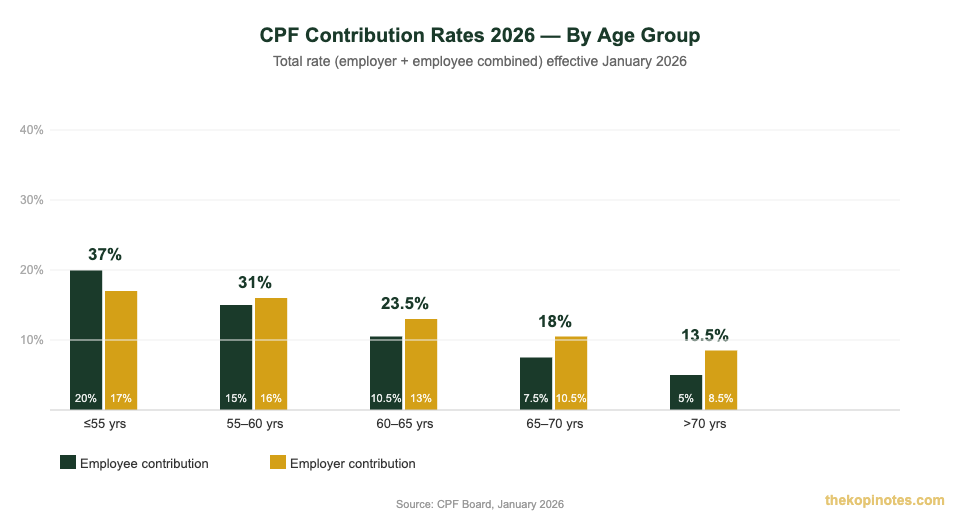
Here are the full CPF contribution rates effective from January 2026. The rates are tiered by age — younger workers contribute more as a percentage, reflecting a longer runway before retirement.
| Age Group | Employee Rate | Employer Rate | Total Rate |
|---|---|---|---|
| 55 years & below | 20% | 17% | 37% |
| 55 to 60 years | 15% | 16% | 31% |
| 60 to 65 years | 10.5% | 13% | 23.5% |
| 65 to 70 years | 7.5% | 10.5% | 18% |
| Above 70 years | 5% | 8.5% | 13.5% |
Source: CPF Board, January 2026. Rates apply to ordinary wages up to the monthly OW ceiling of SGD 7,400.
The rates for workers aged 55 and below remain unchanged at 37% total. The increases this year are concentrated among senior workers — part of a multi-year government initiative to bring older workers’ CPF rates closer to the full working-age rate. More on those changes further below.
Ordinary Wage (OW) Ceiling 2026
The Ordinary Wage ceiling is the monthly salary cap on which CPF contributions are calculated. From January 2026, this ceiling is SGD 7,400 per month — up from SGD 6,800 per month in 2025.
If your monthly salary is SGD 7,400 or below, your entire salary is CPF-eligible. If you earn more than SGD 7,400, only the first SGD 7,400 per month attracts CPF contributions on the ordinary wage side.
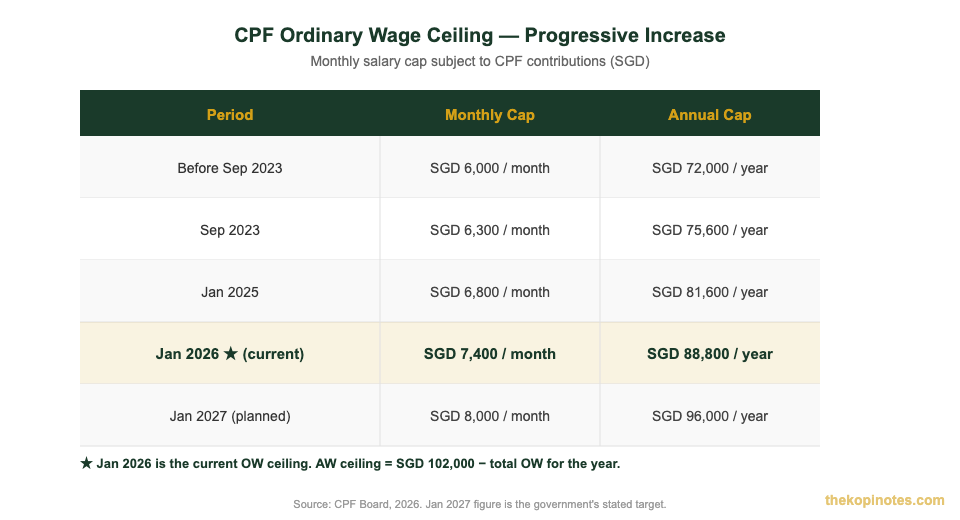
This increase is part of a progressive roadmap announced by the government to raise the CPF salary ceiling from SGD 6,000 (the pre-2023 rate) to SGD 8,000 by January 2027. The goal is to ensure CPF retirement savings keep pace with rising salaries in Singapore.
| Effective Date | Monthly OW Ceiling | Annual Equivalent |
|---|---|---|
| Before Sep 2023 | SGD 6,000 | SGD 72,000 |
| Sep 2023 | SGD 6,300 | SGD 75,600 |
| Jan 2025 | SGD 6,800 | SGD 81,600 |
| Jan 2026 (current) | SGD 7,400 | SGD 88,800 |
| Jan 2027 (planned) | SGD 8,000 | SGD 96,000 |
Source: CPF Board, 2026. Jan 2027 is the government’s stated target, subject to confirmation.
What does this mean in practice? If you earn SGD 7,400 or more per month, your employee CPF deduction increased from SGD 1,360 (2025: SGD 6,800 × 20%) to SGD 1,480 (2026: SGD 7,400 × 20%) per month. That’s SGD 120 more per month taken from your take-home pay — but SGD 120 more going into your OA for housing and retirement.
Additional Wage (AW) Ceiling 2026
Besides your monthly salary, CPF also applies to additional wages — bonuses, variable commissions, Annual Wage Supplements (AWS), and other non-regular payments. The AW ceiling limits how much of your total annual additional wages attract CPF contributions.
The formula is simple:
For a full-year employee earning at or above the SGD 7,400 OW ceiling in 2026:
- Total OW subject to CPF = SGD 7,400 × 12 = SGD 88,800
- AW ceiling = SGD 102,000 − SGD 88,800 = SGD 13,200
This means if you earn at the OW ceiling all year, only your first SGD 13,200 of bonuses is CPF-eligible. Any bonus above SGD 13,200 does not attract CPF contributions for either you or your employer — it is fully take-home.
For lower earners whose full salary is below the OW ceiling, the AW ceiling is higher — leaving more bonus income subject to CPF and building up more retirement savings.
CPF Allocation Rates: Where Does Your CPF Go?
Once your CPF contributions are received, they are split across three accounts based on your age. Each account serves a different purpose and earns a different interest rate.
| Age Group | Ordinary Account (OA) | Special Account (SA) | MediSave (MA) |
|---|---|---|---|
| Below 35 | 23% | 6% | 8% |
| 35 to 45 | 21% | 7% | 9% |
| 45 to 55 | 19% | 8% | 10% |
| 55 to 65 | Varies | — (SA closed) | Varies |
| Above 65 | Varies | — (SA closed) | Varies |
Source: CPF Board, 2026. Figures shown are as a % of gross wage. SA no longer receives new contributions for members aged 55 and above following the 2025 SA closure scheme.
Your OA earns at least 2.5% per year. Your SA earns at least 4% per year (for those under 55). Your MA also earns at least 4% per year. There is an extra 1% interest on the first SGD 60,000 of combined CPF balances (with up to SGD 20,000 from OA). This bonus interest is why early CPF top-ups and voluntary contributions can compound powerfully over time.
2026 Senior Worker CPF Changes
The most notable CPF development in 2026 is the increase in contribution rates for workers above 55. Singapore has been raising these rates each year since 2022 as part of the Senior Worker CPF Contribution Rate roadmap.
The 2026 increase means more goes into your CPF if you are in these age brackets. For employers, it means slightly higher staff costs. The tradeoff is more retirement savings for Singapore’s ageing workforce.
Here is a snapshot of the 2026 rates for senior workers compared to earlier targets:
| Age Group | Employee (2026) | Employer (2026) | Combined |
|---|---|---|---|
| 55–60 years | 15% | 16% | 31% |
| 60–65 years | 10.5% | 13% | 23.5% |
| 65–70 years | 7.5% | 10.5% | 18% |
| Above 70 years | 5% | 8.5% | 13.5% |
Source: CPF Board, January 2026.
For a 57-year-old worker earning at the OW ceiling of SGD 7,400/month, their employer now contributes SGD 1,184 per month (16% × SGD 7,400). That is more than in previous years — all going towards their CPF LIFE payout in retirement.
How CPF Affects Your Take-Home Pay (Worked Examples)
Let us run through two real Singapore scenarios to show exactly what CPF contributions look like in 2026.
Example 1 — Age 30, salary SGD 4,500/month
Since SGD 4,500 is below the SGD 7,400 OW ceiling, the full amount is subject to CPF.
- Your contribution: SGD 4,500 × 20% = SGD 900 (deducted from your salary)
- Employer contribution: SGD 4,500 × 17% = SGD 765 (paid on top)
- Your take-home pay: SGD 4,500 − SGD 900 = SGD 3,600
- Total CPF credited to your accounts: SGD 1,665/month
Example 2 — Age 48, salary SGD 10,000/month
Since SGD 10,000 exceeds the OW ceiling, only SGD 7,400 is CPF-eligible.
- Your contribution: SGD 7,400 × 20% = SGD 1,480 (deducted from salary)
- Employer contribution: SGD 7,400 × 17% = SGD 1,258 (paid on top)
- Your take-home pay: SGD 10,000 − SGD 1,480 = SGD 8,520
- Total CPF credited: SGD 2,738/month
Want to model your full retirement CPF trajectory? The Singapore retirement calculator factors in current contribution rates and projects your OA and SA balances over time.
How to Grow Your CPF in 2026
Mandatory contributions are just the floor. Here are four strategies to maximise what your CPF does for you.
1. Voluntary cash top-ups (MediSave and SA/RA)
You can top up your CPF accounts with cash voluntarily at any time. Topping up your SA (if you are under 55) earns you 4% guaranteed interest — better than most Singapore savings accounts. You also receive personal income tax relief of up to SGD 8,000 per year for self top-ups, and another SGD 8,000 for topping up a family member’s CPF. These are among the most tax-efficient moves available to Singapore residents.
2. CPF Investment Scheme (CPFIS)
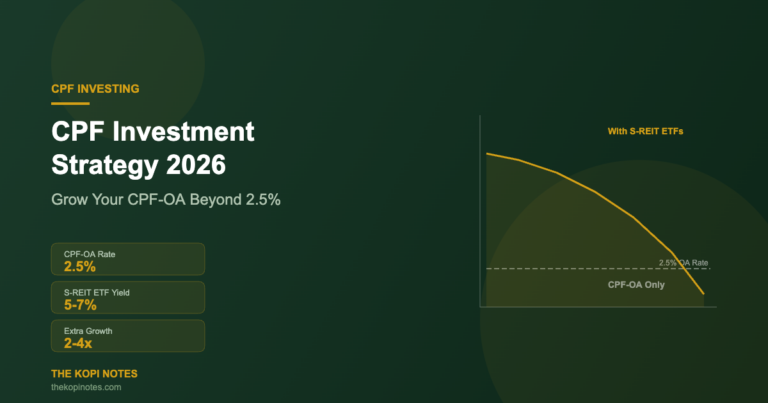
Once your OA balance exceeds SGD 20,000 and your SA exceeds SGD 40,000, you can invest the excess through the CPF Investment Scheme. Approved instruments include certain SGX-listed ETFs, unit trusts, and Singapore Government Securities. Read the detailed CPF investment strategy Singapore guide to see which instruments make the most sense given CPF’s guaranteed 2.5%–4% floor.
3. Pair CPF with SRS for dual tax relief
The Supplementary Retirement Scheme (SRS) runs alongside CPF as a voluntary tax deferral account. You can contribute up to SGD 15,300 per year (Singapore citizens and PRs) and invest those funds in stocks, ETFs, and unit trusts. Platforms like Syfe and Endowus both accept SRS funds and offer diversified SRS-eligible portfolios — including low-cost index fund options that complement your CPF’s risk-free component.
4. Think beyond CPF for passive income
CPF is the bedrock, but building passive income Singapore streams outside CPF gives you flexibility before age 55. S-REITs, dividend stocks, and Singapore Savings Bonds are popular choices among local investors to layer income on top of CPF LIFE payouts. A balanced approach across CPF and liquid investments is what most Singapore financial planners recommend for retirement readiness.
Frequently Asked Questions
What is the CPF contribution rate in 2026 for employees below 55?
For employees aged 55 and below, the CPF contribution rate in 2026 is 20% from the employee and 17% from the employer, for a combined total of 37%. This rate is applied to ordinary wages up to the monthly ceiling of SGD 7,400. This rate has remained unchanged from previous years — the 2026 increases only affect workers aged above 55.
What is the CPF ordinary wage ceiling in 2026?
The CPF Ordinary Wage (OW) ceiling in 2026 is SGD 7,400 per month, effective from January 2026. This means CPF contributions on regular monthly salary are only calculated on the first SGD 7,400, even if you earn more. The ceiling increased from SGD 6,800 in 2025 as part of a roadmap to reach SGD 8,000 by January 2027.
How does the CPF additional wage ceiling work in 2026?
The Additional Wage (AW) ceiling determines how much of your annual bonuses is subject to CPF. The formula is: AW Ceiling = SGD 102,000 minus your total ordinary wages subject to CPF for the year. For a full-year employee earning at the SGD 7,400 OW ceiling, the AW ceiling in 2026 is SGD 102,000 − (SGD 7,400 × 12) = SGD 13,200. Bonuses above this amount are not CPF-eligible for either party.
Did CPF contribution rates change in 2026 for senior workers?
Yes. CPF contribution rates for workers above 55 were increased in January 2026 as part of the Senior Worker CPF Contribution Rate roadmap. The 55–60 age group now has a combined rate of 31% (15% employee + 16% employer). The 60–65 group is at 23.5% (10.5% + 13%), 65–70 at 18% (7.5% + 10.5%), and above 70 at 13.5% (5% + 8.5%). These rates are higher than in 2025.
Can I use my CPF to invest in ETFs and stocks?
Yes — through the CPF Investment Scheme (CPFIS). Once your OA balance exceeds SGD 20,000 and SA exceeds SGD 40,000, you can invest the surplus in approved instruments including Singapore-listed ETFs (such as the Nikko AM STI ETF and SPDR STI ETF), unit trusts, Singapore Government Securities, and certain bonds. US-listed ETFs like CSPX or VWRA are not CPF-eligible as they are foreign-listed instruments.
What happens to my CPF Special Account after age 55?
From 2025 onwards, the CPF Special Account (SA) was closed for members aged 55 and above under the SA Closure Scheme. Upon turning 55, your SA savings were transferred — first to top up your Retirement Account (RA) to the Full Retirement Sum (FRS), with any excess going to your OA. New CPF contributions for workers above 55 no longer go to the SA; they are allocated to the OA and MediSave Account instead.
How can I reduce my CPF deductions legally?
CPF contributions on your ordinary wages are mandatory for Singapore citizens and PRs — you cannot opt out of them. However, you can choose to receive income through structures that are not classified as ordinary wages, such as director’s fees (which are additional wages with a separate ceiling) or dividends from a company you own. These situations are complex and you should consult a tax professional for advice specific to your circumstances.
Plan Your Retirement Beyond CPF
CPF is your foundation. Build on it with smart investments. Use our tools and referral links below.
This article was researched with the help of AI. While we strive to keep all information accurate and up to date, there may be errors. If you notice any discrepancies, please contact us.