Tiger Brokers Singapore Review 2026: Fees, Features & Is It Safe?
Tiger Brokers (Singapore) Pte. Ltd. is a MAS-licensed online brokerage offering access to Singapore, US, Hong Kong, China A-share, and Australian markets from a single app. Commission starts at 0.03% on SGX stocks (minimum S$0.99 per order), with no minimum deposit, no custody fees, and no inactivity charges — making it one of the lowest-cost platforms for retail investors in Singapore.
Not financial advice. All figures are for educational reference only. Data verified as at 8 July 2026.
- Tiger Brokers charges 0.03% commission on SGX stocks — minimum S$0.99 per order
- MAS-licensed (CMS100061-1); client funds held in segregated accounts with DBS Singapore
- Tiger Vault earns up to 3.7% p.a. on idle cash (indicative, via Money Market Funds)
What is Tiger Brokers Singapore?
Tiger Brokers is the retail trading platform of UP Fintech Holding Limited — a Nasdaq-listed fintech group (ticker: TIGR). In Singapore, it operates through Tiger Brokers (Singapore) Pte. Ltd. (UEN: 201810449W), which launched here in 2019.
The platform targets everyday investors who want low-cost access to global markets — Singapore stocks, US ETFs, Hong Kong blue chips, and China A-shares, all inside one app. It is not a bank, but Tiger Vault (cash management) and the Tiger BOSS debit card extend its usefulness beyond stock trading.
Tiger Brokers is listed on the MAS Financial Institutions Directory under a Capital Markets Services Licence. It is a regulated entity — not a pop-up fintech.
Is Tiger Brokers Safe? Regulation & Custody
Tiger Brokers (Singapore) holds a Capital Markets Services Licence (CMS100061-1) under the Securities and Futures Act, regulated by the Monetary Authority of Singapore (MAS). This is the same regulator that oversees Singapore’s banks and major financial institutions.
Here is what that means for your money in practice:
- Client funds are segregated. Under SFA Section 104, your cash and securities are kept separate from Tiger Brokers’ own assets. If the company ran into trouble, your assets are not at risk from company liabilities.
- Custodian bank: DBS Singapore. Your cash is deposited with DBS, one of the world’s strongest-rated banks.
- Negative balance protection. You cannot lose more than you deposit.
- Two-factor authentication and encryption protect your account.
Tiger Brokers is also regulated by ASIC in Australia (AFSL 505213), and its parent UP Fintech is subject to SEC oversight as a US-listed company. That multi-jurisdiction footprint adds accountability.
Tiger Brokers Fees & Commission Breakdown
This is where Tiger Brokers earns its reputation. Fees are among the lowest in Singapore across multiple markets. Everything below comes directly from Tiger Brokers’ official pricing page, verified as at 8 July 2026.
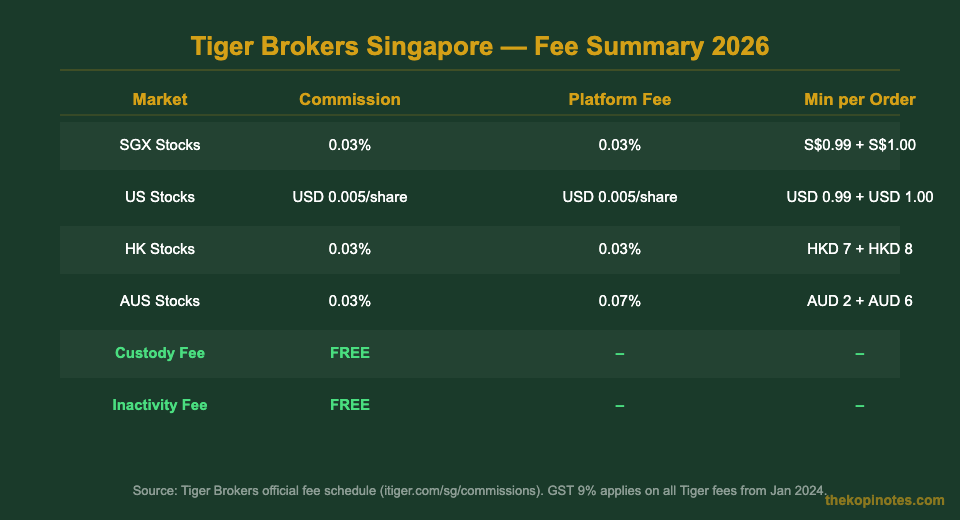
Three things every Tiger Brokers investor must know about fees:
- GST (9%) applies on all Tiger fees from 1 January 2024. Add 9% to every Tiger fee when calculating your real cost.
- SGX exchange fees are charged on top. The exchange levies a Trading Fee (0.0075%) and Clearing Fee (0.0325%) — about 0.04% combined — on every SGX trade. These are pass-through charges, not Tiger Brokers’ earnings.
- Custody fees are waived. SGX normally charges S$2 per quarter. Tiger Brokers has waived this for all accounts until further notice.
Source: Tiger Brokers official fee schedule, itiger.com/sg/commissions, as at 8 July 2026.
What Does a Real SGX Trade Cost You?
Here is the total out-of-pocket cost for a typical SGX stock order at different sizes (Tiger fees + SGX exchange fees, before GST):
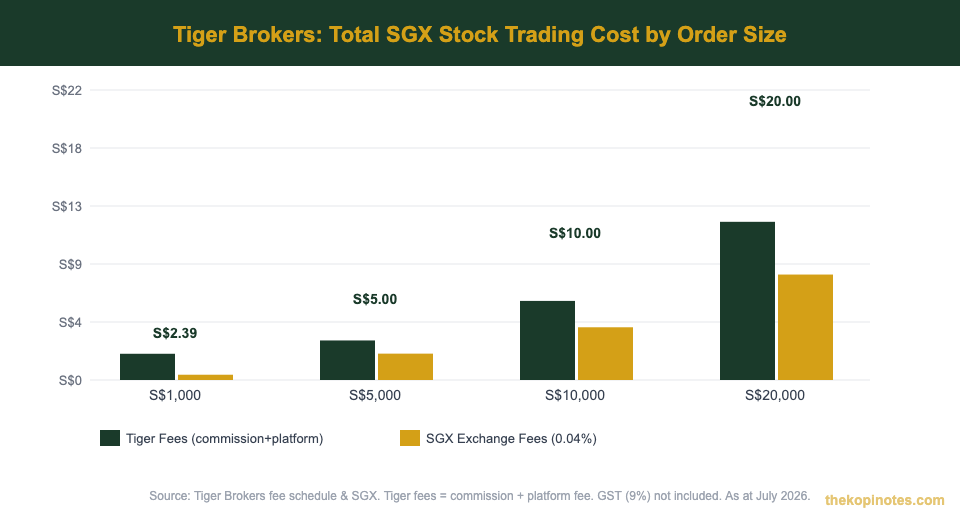
At a S$5,000 order, the total cost (excluding GST) is around S$5.00 — that is 0.10% of trade value. For context, traditional brokerages like DBS Vickers charge 0.18–0.28% or more. Tiger Brokers is meaningfully cheaper.
Source: Tiger Brokers fee schedule (Tiger fees) + SGX (exchange fees). Excludes 9% GST. As at July 2026.
Account Types: Cash vs Margin
Tiger Brokers offers two account types in Singapore:
| Feature | Cash Account | Margin Account |
|---|---|---|
| Who can open | Age 18+ (students included) | Age 21+, full-time employed or retired |
| Leverage | None | Up to 4× |
| Short selling | Not available | Available |
| Minimum deposit | None | None |
Source: Tiger Brokers account types page, itiger.com/sg/help/detail/account-types. As at July 2026.
For most retail investors, a Cash Account is the right starting point. You can upgrade to Margin later if you qualify. Margin amplifies both gains and losses — only consider it once you fully understand the risks.
Markets & Products Available
Tiger Brokers gives you access to five major markets from one app:
- Singapore (SGX): Stocks, ETFs, REITs, DLCs, Warrants, Listed Bonds
- United States: Stocks, ETFs, Fractional Shares, Options, US Treasuries
- Hong Kong: Stocks, Warrants, CBBCs
- China A-Shares: Shanghai and Shenzhen via Northbound Stock Connect
- Australia (ASX): Stocks and ETFs
The fractional shares feature stands out. You can buy US stocks like Apple or Amazon with as little as US$1 — no need to buy a full share. Commission is waived on fractional trades below 1 share; only a 1% platform fee (capped at US$1) applies.
Tiger Brokers also supports CPF and SRS investing — a significant advantage for long-term Singapore investors. If you are building a retirement portfolio and want to understand how much of your CPF to put into equities, start with the Singapore retirement calculator before deploying any CPF funds.
Tiger Vault: Earn on Idle Cash
Tiger Vault lets your uninvested cash work for you. It invests in Money Market Funds managed by Fullerton, Phillip, and CSOP Asset Management.
Key things to know before using Tiger Vault:
- The yield is based on a 7-day annualised figure from Money Market Fund performance — it is not fixed and will fluctuate with interest rates
- Same-day redemption is available if you redeem before the daily cut-off time
- Tiger Vault is not a bank deposit and is not covered by the Singapore Deposit Insurance Corporation (SDIC)
- No minimum investment amount
At 3.7%, Tiger Vault is competitive with high-yield savings accounts and fixed deposits in Singapore. The trade-off is that it is a fund, not a deposit. For a broader look at where to park cash in Singapore, check our guide to the best investments in Singapore.
Tiger Brokers vs moomoo vs IBKR
Tiger Brokers is not alone in the low-cost brokerage space. Here is a comparison of the three most popular options among Singapore retail investors. Fee structures for moomoo and IBKR are indicative — verify against official sites before trading.
| Feature | Tiger Brokers | moomoo SG | IBKR SG |
|---|---|---|---|
| SGX Commission | 0.03%, min S$0.99 | 0.03%, min S$0.99 | 0.08%, min S$2.50* |
| US Stock Commission | USD 0.005/share, min USD 0.99 | ~USD 0.005/share | USD 0.005/share, min USD 1.00* |
| Custody Fee (SGX) | Free (waived) | Free | Free |
| CPF/SRS Investing | Yes | Yes | No |
| Cash Management | Tiger Vault (~3.7%) | moomoo Cash Plus | IBKR savings rates |
| MAS Licensed | Yes | Yes | Yes |
*Indicative figures — verify current moomoo and IBKR fees at their official websites before trading. Tiger Brokers fees verified from itiger.com/sg/commissions as at 8 July 2026.
On paper, the SGX fee differences between Tiger and moomoo are negligible. The real differences come down to platform experience, available markets, and promotions. For a detailed comparison, read our IBKR vs Tiger Brokers comparison. For moomoo specifically, see our moomoo Singapore review.
How to Open a Tiger Brokers Account
Opening a Tiger Brokers account is fully online and takes about 15 minutes. Here is the step-by-step:
- Download the Tiger Trade app on iOS or Android, or visit tigerbrokers.com.sg.
- Tap Sign Up and enter your email or phone number.
- Verify your identity — you need your NRIC (Singapore citizens and PRs) or passport (foreigners), plus a selfie.
- Choose an account type — Cash Account for most beginners; Margin Account if you are 21+, employed, and want leverage.
- Fund your account — no minimum deposit required. PayNow, bank transfer, and DDA Fast Deposit are all supported.
- Start trading — SGX, US, HK, China A-shares, and AU stocks are available immediately after approval.
Before you sign up, check the Tiger Brokers referral code and sign-up promotions page — current promos can be worth hundreds of dollars in vouchers or stock rewards, typically requiring a minimum first deposit of S$3,000+.
Pros, Cons & Our Verdict
| Pros | Cons |
|---|---|
|
|
Bottom line: Tiger Brokers is an excellent choice for cost-conscious Singapore investors who want multi-market access without overpaying in fees. If you trade SGX and US stocks regularly, it is hard to beat on price. The Tiger Vault is a genuinely useful add-on for idle cash. For active traders needing access to a wider global universe or more sophisticated margin tools, IBKR edges ahead — but for most everyday investors, Tiger Brokers hits the right balance of cost, features, and regulatory comfort.
If you are building a long-term portfolio rather than actively trading, consider pairing Tiger Brokers (for direct stock and ETF buying) with a robo-advisor like Syfe for automated, diversified portfolios.
Frequently Asked Questions
Is Tiger Brokers Singapore safe?
Yes. Tiger Brokers (Singapore) Pte. Ltd. is licensed by MAS under a Capital Markets Services Licence (CMS100061-1). Client funds and securities are held in segregated accounts separate from company assets, with DBS Singapore as custodian bank. The company is also regulated by ASIC in Australia and its parent UP Fintech is SEC-listed. Your money has multiple layers of regulatory protection.
What are Tiger Brokers' fees for SGX stocks?
Tiger Brokers charges a 0.03% commission (minimum S$0.99/order) plus a 0.03% platform fee (minimum S$1.00/order) for SGX stocks. The SGX also levies a Trading Fee of 0.0075% and Clearing Fee of 0.0325%. All Tiger fees are subject to 9% GST from January 2024. Custody fees (normally S$2/quarter) are waived until further notice.
Does Tiger Brokers have a minimum deposit?
No minimum deposit is required to open or maintain a Tiger Brokers account. However, welcome promotions typically require a minimum first deposit (often S$3,000 or more) to unlock bonuses. Check the current promotion terms on the Tiger Brokers referral and promotions page before signing up.
What is Tiger Vault and is it safe?
Tiger Vault is a cash management product that invests your idle cash in Money Market Funds managed by Fullerton, Phillip, and CSOP. As at April 2026, the indicative 7-day annualised yield was up to 3.7%. Tiger Vault is not a bank deposit and is not covered by SDIC. The yield is not guaranteed and will change with market conditions. Same-day redemption is available before the daily cut-off time.
Can I use CPF or SRS to invest with Tiger Brokers?
Yes. Tiger Brokers supports both the CPF Investment Scheme (CPFIS) and Supplementary Retirement Scheme (SRS) for eligible SGX-listed stocks, ETFs, and REITs. Note that only approved securities under CPFIS qualify for CPF investing — not every SGX stock is eligible. SRS investing has fewer restrictions.
How does Tiger Brokers compare to moomoo and IBKR?
All three are MAS-licensed low-cost brokers. For SGX stocks, Tiger Brokers and moomoo charge similar rates (around 0.03% commission). IBKR charges around 0.08% for SGX stocks but is often cheaper for high-volume US stock traders with tiered pricing. Tiger Brokers and moomoo suit most retail investors best, offering local promotions, cleaner interfaces, and CPF/SRS support. IBKR is better for sophisticated traders needing access to a wider global universe. See our full IBKR vs Tiger Brokers comparison for a detailed breakdown.
This article was researched with the help of AI. While we strive to keep all information accurate and up to date, there may be errors. If you notice any discrepancies, please contact us.