Best Investment in Singapore for Foreigners (2026 Guide)
ETFs, REITs, T-bills, SRS, and fixed deposits — a complete guide for expats and foreign residents investing in Singapore.
Singapore is one of the best places in the world for foreigners to invest. There is no capital gains tax, no dividend income tax for most investors, and no estate duty. Foreigners can access most of the same investment options as Singapore citizens — including index ETFs, S-REITs, T-bills, and the SRS retirement account — through local brokers like Interactive Brokers, Syfe, and Moomoo.
Not financial advice. All figures are for educational reference only. Data as at July 2026 unless noted.
- Foreigners in Singapore can invest in ETFs, S-REITs, T-bills, SSBs, fixed deposits, and even open an SRS account — CPF is the only major exception.
- Singapore’s zero capital gains tax and zero dividend income tax make it one of the most investor-friendly countries for expats.
- The best starting point for most foreigners: a UCITS ETF like VWRA via IBKR for long-term growth, plus Singapore T-bills for safe short-term cash returns.
Table of Contents
Contents — Click to expand
- What Foreigners Can and Cannot Access in Singapore
- How Investing in Singapore Works for Foreigners
- Best Investment Options for Foreigners in Singapore
- Side-by-Side Comparison of Investment Options
- Step-by-Step: How to Start Investing as a Foreigner
- Risks and Key Considerations
- Frequently Asked Questions
What Foreigners Can and Cannot Access in Singapore
Here is the good news first: as a foreigner living and working in Singapore, you can invest in almost everything a Singapore citizen can. The stock exchange, the bond market, the real estate investment trusts — all open to you.
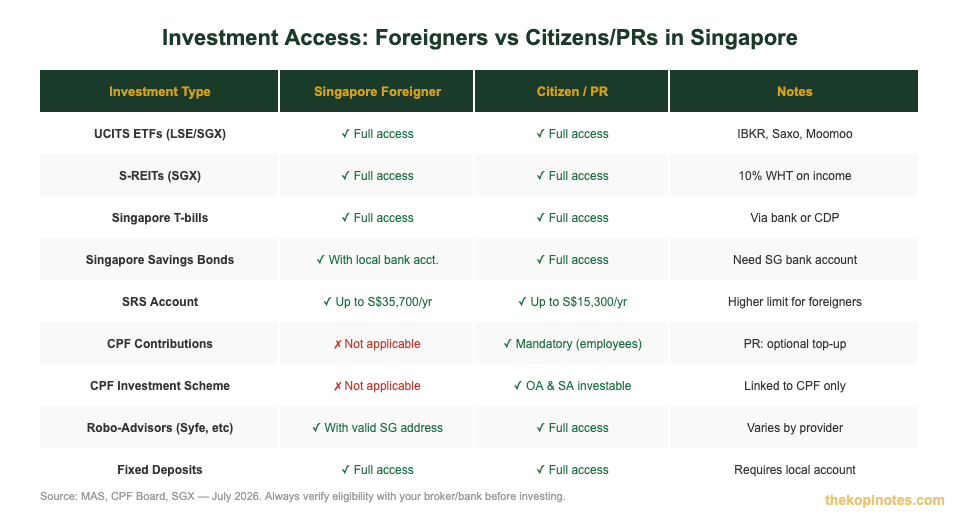
The main exception is CPF, the Central Provident Fund. CPF contributions are mandatory for Singapore citizens and Permanent Residents (PRs) employed locally. If you are a foreigner on an Employment Pass, S Pass, or other work visa, CPF does not apply to your salary. That means you also cannot access the CPF Investment Scheme (CPFIS), which allows citizens and PRs to invest their CPF savings in approved unit trusts, ETFs, and stocks.
However, you get something citizens do not: a higher SRS (Supplementary Retirement Scheme) contribution limit. While Singaporeans can contribute up to S$15,300 per year to SRS, foreigners can contribute up to S$35,700 per year — more than double. Contributions reduce your taxable income in Singapore, which can be meaningful if you pay employment income tax here.
Everything else — ETFs, S-REITs, Singapore T-bills, Singapore Savings Bonds, robo-advisors, fixed deposits — is fully accessible to foreigners with a valid Singapore address and a local bank account.
How Investing in Singapore Works for Foreigners
Singapore’s investment infrastructure is designed to attract global capital. The Monetary Authority of Singapore (MAS) licenses all brokers, fund managers, and financial institutions operating here. That means the platforms you use — IBKR, Syfe, Moomoo, Saxo — are tightly regulated.
To invest in Singapore, you typically need:
- A local bank account — DBS, OCBC, UOB, or CIMB are common choices for foreigners. Some can be opened before you arrive in Singapore; most require an in-person visit with your employment pass and passport.
- A brokerage account — For SGX-listed stocks, REITs, and local ETFs, you link a brokerage account to a Central Depository (CDP) account. For international ETFs (like VWRA on the London Stock Exchange), you can use an international broker like Interactive Brokers (IBKR) without needing a CDP account.
- Proof of Singapore address — Your residential address in Singapore, shown via a bank statement, employment letter, or utility bill. Most brokers require this for KYC (Know Your Customer) compliance.
Setting this up takes one to two weeks. Once done, you can buy and sell investments just like any Singapore resident.
Tax position for foreigners: Singapore does not tax capital gains, so any profit you make from selling stocks, ETFs, or property (subject to Additional Buyer’s Stamp Duty rules) is tax-free. Dividend income is also not taxed at the individual investor level in Singapore — dividends are taxed at the corporate level before they reach you. The key exception is S-REIT distributions, which are subject to a 10% withholding tax for individual non-resident investors — versus 17% for non-resident companies. This is still very competitive versus most other markets.
One important caveat: your home country may tax foreign-sourced income. If you are from the US, UK, Germany, or Australia, check your domestic tax obligations before investing. US citizens in particular must be cautious about PFIC rules, which apply to foreign-domiciled ETFs like VWRA.
Best Investment Options for Foreigners in Singapore
Here is how each major investment type stacks up for foreigners in 2026:
1. UCITS ETFs on the London Stock Exchange (LSE)
This is the gold-standard choice for most non-US foreigners in Singapore. UCITS ETFs — like VWRA (Vanguard FTSE All-World UCITS ETF) and CSPX (iShares Core S&P 500 UCITS ETF) — are Ireland-domiciled funds listed on the LSE. They offer:
- No US estate tax risk — US-domiciled ETFs like VOO expose non-US investors to a 40% estate tax on US assets above USD 60,000. UCITS ETFs are not US situs assets, so this risk disappears entirely.
- Lower withholding tax — Ireland has a favourable tax treaty with the US. US dividend withholding tax on UCITS ETFs is 15%, versus 30% for a US-domiciled ETF held by a non-US investor.
- Broad global diversification — VWRA tracks the FTSE All-World index (3,700+ companies across 49 countries). One fund, the whole world.
You buy UCITS ETFs via Interactive Brokers (IBKR). Open an account online, fund it via FAST transfer from your local bank, and you can own VWRA within a few days. IBKR’s commission is USD 1.70 per trade for LSE-listed ETFs — the lowest available in Singapore.
US citizens and Green Card holders cannot use UCITS ETFs due to PFIC rules. If this applies to you, consult a US tax adviser before investing.
2. S-REITs (Singapore Real Estate Investment Trusts)
S-REITs are listed on the SGX and must distribute at least 90% of their income to unitholders. For foreigners, they offer a reliable stream of SGD-denominated income. The average yield across the S-REIT sector is around 5–7% as at mid-2026, which is attractive versus fixed deposits.
The key tax point: S-REIT distributions are subject to a 10% withholding tax for individual non-resident investors (as at July 2026, under the current incentive scheme). This is deducted at source — you receive the net amount automatically.
You can buy S-REITs via a local CDP-linked brokerage (DBS Vickers, Moomoo, Tiger Brokers) or through IBKR. Moomoo Singapore offers commission-free SGX trading, which reduces your cost further. Use the best S-REITs in Singapore 2026 guide to identify quality names.
3. Singapore T-bills
Singapore Treasury bills (T-bills) are short-term government securities issued by the Singapore government. They are effectively zero-risk in SGD terms — the Singapore government has an AAA credit rating. The yield as at July 2026 is approximately 3.5–3.7% per annum for 6-month T-bills.
Foreigners with a local bank account (DBS/POSB, OCBC, or UOB) can apply for T-bills via internet banking during each auction. There is no CDP account required. The minimum investment is S$1,000. T-bill interest income is not taxed in Singapore for individual investors.
4. SRS (Supplementary Retirement Scheme)
If you are paying income tax in Singapore, opening an SRS account is one of the highest-ROI moves you can make as a foreigner. Every dollar you contribute to SRS reduces your assessable income — giving you an immediate tax rebate equal to your marginal tax rate.
For example, if you earn S$200,000 per year and contribute S$35,700 to SRS, you reduce your tax bill by approximately S$5,600 at the 16% marginal rate. That is a guaranteed 15.7% return on the first year’s contribution, before any investment gains.
Inside SRS, you can invest in SGX-listed stocks, REITs, unit trusts, and selected ETFs. At retirement (or when you leave Singapore permanently), you withdraw at a 50% tax concession on the withdrawal amount. Use the passive income Singapore guide for strategies on building SRS wealth.
5. Singapore Savings Bonds (SSB)
SSBs are government-guaranteed bonds that pay a step-up interest rate over 10 years. Foreigners with a local bank account (DBS/POSB, OCBC, or UOB) can apply via ATM or internet banking. The maximum holding per person is S$200,000. You can redeem early with no penalty, making SSBs more flexible than fixed deposits. The 10-year average yield as at July 2026 is approximately 2.7–3.0% per annum.
6. Fixed Deposits
Fixed deposits at local banks offer predictable, guaranteed returns in SGD. Rates range from 2.5% to 3.2% per annum for 12-month tenors as at mid-2026. The downside: your money is locked up for the tenor period. For emergency fund parking, T-bills or SSBs are more flexible. Fixed deposits are better when rates are rising and you want to lock in a specific rate.
7. Robo-Advisors (Syfe, Endowus, StashAway)
Singapore’s robo-advisory platforms allow you to invest in globally diversified ETF portfolios with minimal setup. Most accept foreigners with a valid Singapore address. Syfe and Endowus both offer SGD-denominated portfolios of globally diversified ETFs, with management fees starting at 0.35% per annum. If you want a hands-off option and don’t want to use IBKR directly, these are a good starting point. Use our Syfe referral code to get your management fees waived for the first S$30,000 for six months.
Side-by-Side Comparison of Investment Options
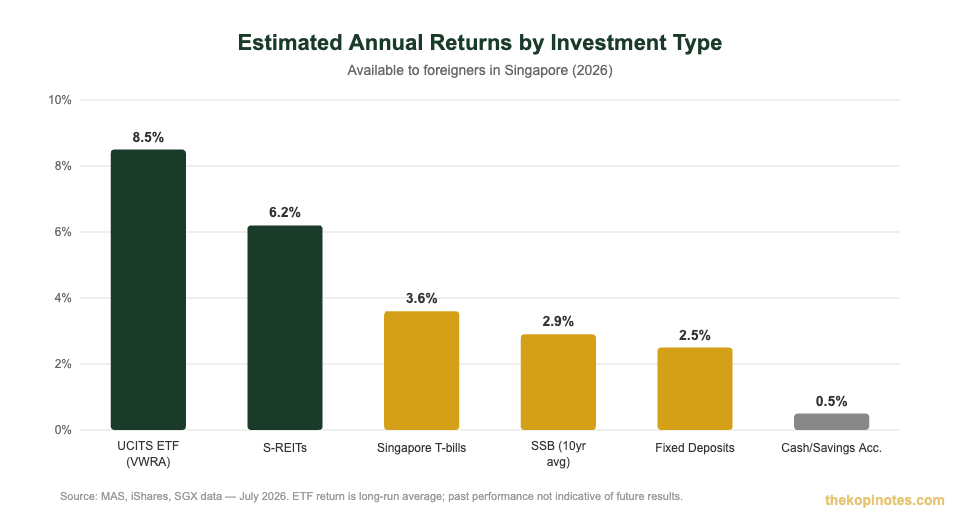
Here is how the main investment options compare for foreigners in Singapore in 2026. Use this as a quick reference when deciding where to allocate your money.
| Investment | Est. Return p.a. | Risk Level | Min. Amount | Liquidity | SRS-Compatible |
|---|---|---|---|---|---|
| UCITS ETFs (VWRA) | ~7–10%* | Medium–High | ~SGD 130/unit | High | Limited** |
| S-REITs | ~5–7% yield | Medium | ~SGD 100–500 | High | Yes |
| Singapore T-bills | ~3.5–3.7% | Very Low | S$1,000 | Medium | No |
| Singapore Savings Bonds | ~2.7–3.0% | Very Low | S$500 | High | No |
| Fixed Deposits | ~2.5–3.2% | Very Low | S$1,000 | Low | No |
| Robo-Advisors | ~5–9%* | Medium | S$1–100 | High | Via SRS mode |
*ETF and robo-advisor returns are long-run historical averages — not guaranteed. Past performance does not predict future results. **Some UCITS ETFs are accessible inside SRS through select brokers; check with your provider. Source: MAS, MoneySense, broker fee schedules — July 2026.
Step-by-Step: How to Start Investing as a Foreigner in Singapore
Here is a practical sequence to follow when you first arrive in Singapore as a working professional:
Step 1: Open a local bank account (Week 1–2)
Start with DBS or OCBC. You need this account as the funding base for everything else — T-bills, SSBs, SRS, and your brokerage transfers. Bring your employment pass, passport, and an employment letter from your company. Some banks offer e-KYC for foreigners; others require an in-branch visit.
Step 2: Open a brokerage account (Week 2–4)
For international ETFs (VWRA, CSPX): open an Interactive Brokers account online. It takes about one week to verify. Fund via FAST transfer from your local bank. IBKR has no minimum deposit requirement.
For SGX-listed stocks and S-REITs: open a Moomoo Singapore account or a DBS Vickers account. Moomoo offers commission-free SGX trading and is the most cost-effective option for S-REIT investing. Use the moomoo Singapore review to understand the platform before signing up.
Step 3: Open an SRS account (if you pay Singapore income tax)
Once you have a local bank account, you can open an SRS account at DBS, OCBC, or UOB. The process takes 10 minutes online. Contribute before 31 December each year to reduce your taxable income. Check the CPF investment strategy article for context on how SRS fits into a broader Singapore retirement plan.
Step 4: Build your core portfolio
A simple starting allocation for a foreigner in Singapore with a 10+ year horizon:
- 60–80% in VWRA via IBKR — global equity exposure, low cost, no US estate tax risk
- 10–20% in Singapore T-bills / SSBs — safe SGD liquidity buffer, currently yielding ~3.5%
- 0–20% in S-REITs — if you want SGD income, REITs provide regular quarterly distributions
Review and rebalance annually. Use the Singapore retirement calculator to model how your portfolio grows over time.
Step 5: Max your SRS annually
If you are paying income tax in Singapore, contribute S$35,700 to SRS before 31 December each year. Invest the SRS balance in a low-cost ETF via your bank’s SRS investment platform. At some local banks, you can buy the Endowus SRS portfolio or a low-cost unit trust directly.
Risks and Key Considerations for Foreign Investors
Investing in Singapore is straightforward, but there are risks specific to foreigners that you should understand before committing capital.
Currency risk
Most investments in Singapore are priced in SGD. If your home currency weakens against SGD, your returns look better in home-currency terms; if it strengthens, they look worse. VWRA is priced in USD on the LSE, so you also have USD/SGD exposure there. Over the long run, currency fluctuations tend to average out, but short-term moves can be significant — up to 10–15% per year.
Home-country tax obligations
Singapore may not tax your investment income, but your home country might. US citizens and Green Card holders are taxed on worldwide income by the IRS, regardless of where they live. UK, Australian, and many European residents may also owe home-country taxes on foreign investment income. Always consult a tax adviser in your home country before investing large sums.
US PFIC rules (for US persons)
US citizens and Green Card holders cannot hold UCITS ETFs like VWRA without facing punitive US tax treatment under Passive Foreign Investment Company (PFIC) rules. If this applies to you, stick to US-domiciled ETFs (VOO, VT) via a US brokerage account — and accept the US estate tax exposure above USD 60,000. See a US tax adviser for the right approach.
Repatriation planning
When you eventually leave Singapore, you can repatriate your investment proceeds freely. Singapore has no capital controls. However, large transfers may require documentation for your home country’s AML/KYC requirements. Plan your exit strategy — especially for S-REIT holdings, which may take time to sell at a fair price during volatile markets.
REIT withholding tax changes
The 10% withholding tax incentive for S-REIT distributions to individual non-resident investors has been extended periodically by the Singapore government. Check the investing in REITs Singapore guide for the latest status. If the incentive expires, the rate reverts to the standard 17% — reducing your net yield by roughly 1–2 percentage points depending on the REIT.
Disclaimer: The information in this article is for educational purposes only and does not constitute financial, tax, or legal advice. Always consult a qualified professional before making investment decisions. Data as at July 2026.
Frequently Asked Questions
Can foreigners invest in Singapore?
Yes, foreigners in Singapore can invest in most asset classes — including index ETFs, S-REITs, Singapore T-bills, Singapore Savings Bonds, fixed deposits, and robo-advisory portfolios. The only major exception is CPF (Central Provident Fund), which is restricted to Singapore citizens and Permanent Residents. Singapore’s zero capital gains tax and absence of dividend income tax at the individual level make it one of the most attractive investing environments in the world for foreigners.
What is the best investment in Singapore for foreigners?
For most non-US foreigners with a long time horizon (10+ years), the best investment is a UCITS ETF like VWRA (Vanguard FTSE All-World UCITS ETF) bought via Interactive Brokers. VWRA gives you global equity diversification, is Ireland-domiciled (so no US estate tax risk), and has a low expense ratio of 0.22% p.a. For safe short-term returns in SGD, Singapore T-bills currently yield around 3.5–3.7% p.a. A combination of VWRA and T-bills covers most investors’ needs. US citizens have different considerations due to PFIC rules — consult a US tax adviser.
Can foreigners open an SRS account in Singapore?
Yes. Any foreigner who is at least 18 years old, earns employment income in Singapore, and pays income tax here can open a Supplementary Retirement Scheme (SRS) account. Foreigners actually enjoy a higher annual contribution limit — S$35,700 per year — compared to Singapore citizens and PRs, who are limited to S$15,300 per year. SRS contributions reduce your taxable income in Singapore, providing an immediate tax saving at your marginal tax rate. You can open an SRS account at DBS, OCBC, or UOB.
Do foreigners pay tax on investment returns in Singapore?
Singapore does not levy capital gains tax on individuals, so profits from selling stocks, ETFs, or REITs are tax-free in Singapore. Dividend income from Singapore companies and most ETFs is also not taxed at the individual level in Singapore — dividends are distributed from after-tax company profits. The main exception is S-REIT distributions, which are subject to a 10% withholding tax for individual non-resident investors (as at July 2026). Note: your home country may tax your foreign investment income separately — always check with a tax adviser in your home country.
Can foreigners buy Singapore T-bills and Savings Bonds?
Yes. Foreigners with a local bank account at DBS/POSB, OCBC, or UOB can apply for Singapore T-bills via internet banking or ATM during each auction window. The minimum investment is S$1,000. Singapore Savings Bonds (SSBs) are similarly available to foreigners with a local bank account, with a minimum investment of S$500 and a maximum holding of S$200,000. Both instruments are issued and backed by the Singapore government and are effectively risk-free in SGD terms. Neither CPF nor SRS accounts are required to access T-bills or SSBs.
Which broker is best for foreigners investing in Singapore?
For international ETFs (VWRA, CSPX on the LSE), Interactive Brokers (IBKR) is the most cost-effective option — commission is approximately USD 1.70 per trade, with no account minimum and no inactivity fee for accounts over USD 100,000. For SGX-listed stocks, REITs, and local ETFs, Moomoo Singapore offers commission-free SGX trading and is ideal for S-REIT investors. For a fully hands-off experience, Syfe’s managed portfolios are beginner-friendly and accept foreigners with a valid Singapore address. Use the Endowus referral code for a fee waiver on your first year if you prefer a fund-based approach via SRS.
Ready to Start Investing in Singapore?
Open a brokerage account today and make your money work harder in Singapore. Use our referral links for exclusive sign-up bonuses.
This article was researched with the help of AI. While we strive to keep all information accurate and up to date, there may be errors. If you notice any discrepancies, please contact us.