Dividend Investing in Singapore (2026 Guide)
How to build passive income with S-REITs, dividend stocks, and ETFs
Dividend investing in Singapore means building a portfolio of assets — primarily S-REITs, SGX-listed dividend stocks, and UCITS ETFs — that pays you regular cash income without selling a single share. Singapore investors enjoy a major structural advantage: there is no dividend withholding tax on locally sourced dividends, so every dollar paid out lands in your account in full. A well-structured dividend portfolio targeting 5–6% yield can generate $5,500–$6,000 per year on a $100,000 portfolio — roughly $450–$500 a month in passive income.
Not financial advice. All figures are for educational reference only. Data as at June 2026 unless noted.
- Singapore has no dividend tax on local income — every dollar of dividends is yours to keep
- S-REITs typically yield 5–7%, dividend stocks 3–5%, and LSE-listed dividend ETFs 2–3%
- Start with $10,000–$20,000, diversify across 3–4 sectors, and reinvest dividends to compound growth
📋 Table of Contents
- Why dividend investing works in Singapore
- The three main dividend asset classes
- S-REITs: your highest-yield option
- SGX dividend stocks worth considering
- Dividend ETFs for hands-off investors
- How to build your dividend portfolio
- How much income can you expect?
- Risks every dividend investor must know
- Frequently asked questions
Why Dividend Investing Works Especially Well in Singapore
Most investors around the world pay tax on every dividend they receive. In the US, qualified dividends are taxed at 15–20%. In Australia, it’s up to 47%. Singapore is different. Under Singapore’s one-tier tax system, companies pay corporate tax on profits before distributing dividends. By the time the money reaches you, no further tax is due. You keep 100% of every dividend paid.
This tax advantage changes the maths meaningfully. A 5% yield in Singapore is worth more than a 6% yield in a country where dividends are taxed at 20%. You’d need to earn 6.25% pre-tax elsewhere just to match the after-tax return of a 5% Singapore dividend.
There’s one exception worth knowing. If you own US-listed ETFs or US stocks directly, the US government withholds 30% of dividends at source before they reach you. That’s why Singapore investors typically prefer London Stock Exchange (LSE)-listed UCITS ETFs for international equity exposure — the withholding tax drag is significantly lower (0–15% depending on the underlying market).
Beyond tax, Singapore investors benefit from a deep and mature dividend ecosystem. SGX lists over 40 Real Estate Investment Trusts (REITs), plus dozens of blue-chip stocks with long track records of paying dividends. The Singapore Exchange itself has dividend yields above 4%. You don’t need to look far to build a meaningful income portfolio.
The Three Main Dividend Asset Classes in Singapore
There are three primary routes to dividend income in Singapore. Each offers a different risk-return trade-off, and the best portfolios typically combine all three.
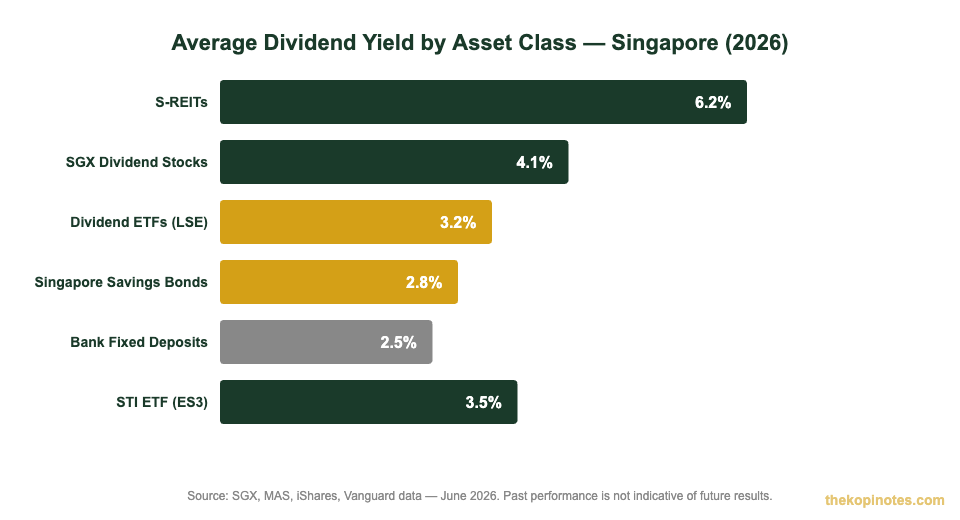
Source: SGX, MAS, iShares, Vanguard data — June 2026. Past performance is not indicative of future results.
The chart above shows where each asset class sits on the yield spectrum. S-REITs lead at an average 6.2%, but come with property-sector concentration risk. Dividend ETFs are lower-yielding but highly diversified. SGX dividend stocks sit in the middle — offering individual company exposure with familiar Singapore brands.
S-REITs: Your Highest-Yield Option for Dividend Investing
S-REITs (Singapore Real Estate Investment Trusts) are the bedrock of dividend investing in Singapore. They are legally required to distribute at least 90% of their taxable income as dividends each year. That legal mandate — combined with no dividend tax — makes them uniquely attractive for income investors.
As at June 2026, the average S-REIT yield is approximately 6.2%. Some sectors yield higher: industrial REITs and healthcare REITs tend to offer more stable distributions, while hospitality REITs can offer higher yields with more variability tied to travel demand.
| S-REIT Sector | Example REITs | Typical Yield Range | Stability |
|---|---|---|---|
| Industrial | Mapletree Industrial Trust, AIMS APAC REIT | 5.5–7% | High |
| Commercial / Office | CapitaLand Integrated Commercial Trust (CICT) | 5–6.5% | Medium-High |
| Retail | Frasers Centrepoint Trust, Lendlease REIT | 5–7% | Medium |
| Healthcare | Parkway Life REIT, First REIT | 4.5–6% | High |
| Hospitality | CDL Hospitality Trusts, Far East Hospitality | 6–9% | Low-Medium |
Source: SGX REIT data, company distributions — June 2026. Yields are indicative and change with unit price movements.
For a deeper look at the best S-REITs available today, read our guide on best S-REITs in Singapore 2026. We cover gearing ratios, distribution track records, and which sectors to favour right now.
One important concept: REITs are sensitive to interest rates. When interest rates rise, REIT unit prices often fall (because higher rates increase borrowing costs and make fixed-income alternatives more attractive). The distribution per unit (DPU) — that’s the REIT equivalent of a dividend — may hold steady, but the yield-on-cost for new buyers rises as the price falls. This is why many investors use rate cycles to time their REIT purchases.
SGX Dividend Stocks Worth Considering
Beyond REITs, SGX lists several blue-chip companies with long track records of paying dividends. These tend to be less sensitive to interest rates than REITs, and their dividends are paid from operating profits rather than a legal distribution requirement.
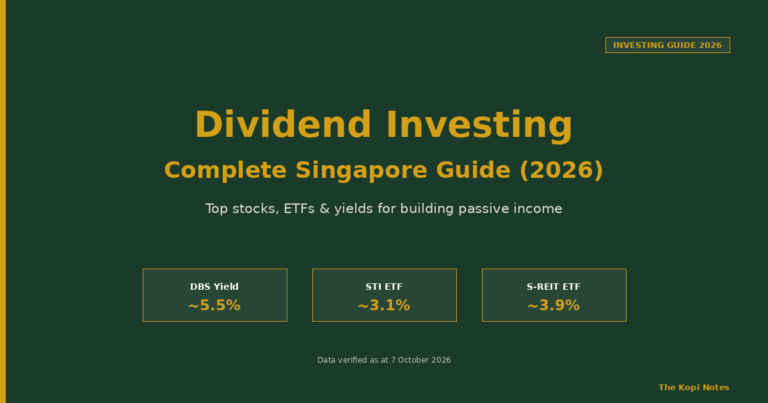
The three Singapore banks — DBS, OCBC, and UOB — have become the cornerstone of many dividend portfolios. All three raised their dividends significantly between 2023 and 2026 as net interest margins expanded. As at June 2026, DBS yields approximately 5.3%, OCBC around 5.8%, and UOB around 5.5%.
Other names worth researching include Singapore Telecommunications (Singtel), Keppel Corporation, ComfortDelGro, and Singapore Exchange (SGX). These are not purely high-yield plays, but they offer dividend growth potential alongside yield — a combination that can outperform pure high-yield over a decade.
| Stock | Sector | Approx. Yield (Jun 2026) | Dividend Frequency |
|---|---|---|---|
| DBS Group | Banking | ~5.3% | Quarterly |
| OCBC Bank | Banking | ~5.8% | Semi-annual |
| UOB | Banking | ~5.5% | Semi-annual |
| Singapore Exchange (SGX) | Financials | ~4.1% | Quarterly |
| Singtel | Telecoms | ~4.8% | Semi-annual |
Source: SGX company announcements, Bloomberg consensus data — June 2026. Yields change daily with share price movements. Not a recommendation to buy.
Dividend ETFs: The Hands-Off Route to Dividend Investing
If picking individual stocks or REITs feels overwhelming, dividend ETFs offer a simpler path. You buy one fund and instantly own dozens of dividend-paying companies, diversified across sectors and geographies.
For Singapore investors, the key decision is whether to use locally-listed ETFs or LSE-listed UCITS ETFs. LSE-listed funds are generally preferred for international exposure because they avoid the US estate tax trap and benefit from more favourable dividend withholding tax treatment on non-US holdings.
Popular options include the Vanguard FTSE All-World High Dividend Yield ETF (VHYL), which is listed on the London Stock Exchange and distributes quarterly dividends at approximately 3.2% yield as at June 2026. For purely Singapore equity exposure, the SPDR STI ETF (ES3) and the Nikko AM STI ETF track the Straits Times Index and yield around 3.5%.
If you prefer a robo-advisor to manage your dividend portfolio, platforms like Syfe offer income-focused portfolios that blend S-REITs and dividend stocks automatically. Syfe’s REIT+ portfolio, for example, is built specifically around S-REIT dividend income with automatic quarterly rebalancing. Use our Syfe referral code and sign-up bonus to waive management fees for your first $30,000 for 6 months.
Alternatively, Endowus offers income-focused fund portfolios using institutional share classes at lower costs than retail platforms. You can also invest CPF OA funds through Endowus — an option not available on most brokerages. See our Endowus referral code for a fee waiver on your first deposit.
How to Build Your Dividend Portfolio Step by Step
Building a dividend portfolio is not complicated, but it does require a deliberate approach. Here’s a practical framework that works for most Singapore investors starting out.
Step 1: Choose your broker. You need a brokerage account to buy SGX-listed REITs and stocks. IBKR (Interactive Brokers) is the lowest-cost option for regular investors, charging a flat $1.50–$3.00 commission per SGX trade with no minimum. If you prefer a local bank broker, DBS Vickers, OCBC Securities, and UOB Kay Hian all work fine — costs are higher, but the platform is more familiar. Use our FSMOne referral code if you want a broker that also offers fund access alongside stocks and REITs.
Step 2: Decide your target yield. A realistic blended yield for a diversified Singapore dividend portfolio is 4.5–6%. Chasing yields above 7% usually means taking on more risk — highly leveraged REITs, cyclical sectors, or companies with unsustainable payout ratios. Set a target and stick to it.
Step 3: Diversify across at least 3 sectors. Don’t put everything in industrial REITs or all three banks. Spread across REIT sectors (industrial, commercial, healthcare), dividend stocks (banks, telecoms, infrastructure), and optionally a dividend ETF for international exposure.
Step 4: Reinvest dividends when possible. The power of dividend investing comes from compounding. If you reinvest each quarterly dividend payment back into the portfolio, your income stream grows exponentially over time. A 5.5% yield compounding for 20 years turns a $50,000 portfolio into approximately $145,000 in invested capital — and generates $7,975 per year by the end, compared to $2,750 at the start.
Step 5: Review quarterly, not daily. Dividend investing is a long-term strategy. Unit prices will fluctuate — that’s normal and expected. What matters is whether your companies are maintaining or growing their distributions. Review DPU or dividend announcements each quarter and only act if there’s a fundamental change to the business.
Use our Singapore retirement calculator to model how much passive income you’ll need in retirement, and work backwards to the portfolio size you need to build.
How Much Dividend Income Can You Realistically Expect?
This is the question every new dividend investor asks. The honest answer: it depends entirely on your portfolio size and the yield you target. Here are real-world scenarios at a blended 5.5% yield — a number achievable today with a diversified mix of S-REITs and dividend stocks.
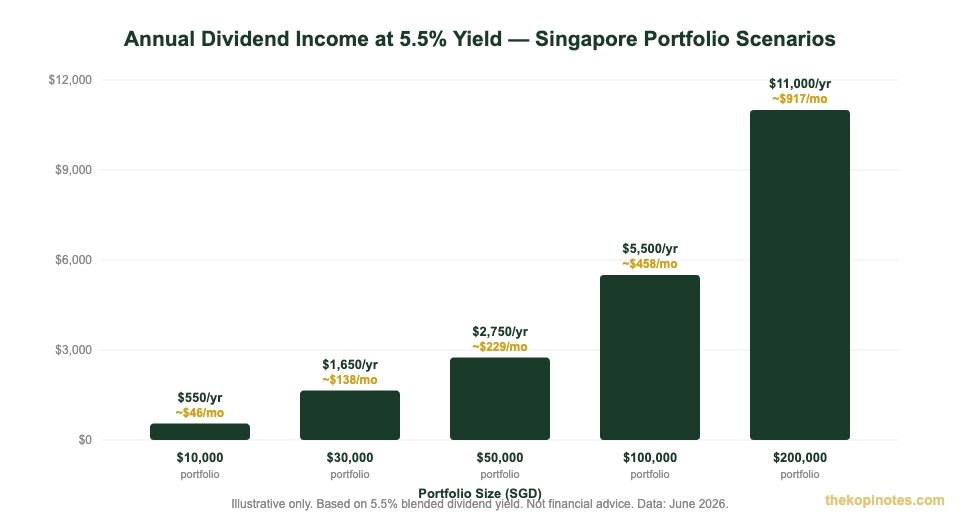
Illustrative only. Based on 5.5% blended yield. Not financial advice. Data: June 2026.
To earn $1,000 per month ($12,000 per year) in dividend income at 5.5% yield, you need a portfolio of approximately $218,000. That’s the cold hard maths of income investing. It takes time and consistent contributions to get there — but the compounding effect means each year becomes easier than the last.
Most Singaporeans starting out don’t have $200,000 to deploy immediately. That’s fine. Start with $10,000–$20,000, invest consistently each month (dollar-cost averaging), and let time and reinvested dividends do the heavy lifting. Someone who invests $1,000 per month at 5.5% yield and reinvests dividends can reach the $218,000 mark in roughly 12–13 years.
For those who want to accelerate their passive income journey, explore our guide on passive income in Singapore 2026 — it covers dividend investing alongside other income streams like Singapore Savings Bonds and T-bills.
Risks Every Dividend Investor Must Understand
Dividend investing is not risk-free. Before committing capital, understand these key risks.
Dividend cuts. Companies and REITs can reduce or suspend distributions. This happened widely during COVID-19 — several retail REITs cut their DPUs by 30–50% in 2020. A dividend cut typically causes the unit price to fall simultaneously, hurting you twice. Always check a REIT’s gearing ratio (debt-to-asset ratio) and interest coverage ratio before buying. Higher gearing means less headroom if rents fall or interest costs rise.
Interest rate risk. REITs and dividend stocks are sensitive to interest rate movements. Rising rates increase REITs’ borrowing costs, compress margins, and make fixed income look more attractive by comparison. Between 2022 and 2024, many S-REITs fell 20–30% in unit price as the US Federal Reserve hiked rates aggressively. If you’re holding for income, temporary price falls matter less — but if you need to sell, timing matters.
Concentration risk. A portfolio of only Singapore assets is heavily exposed to Singapore’s economic cycle and the SGD. Consider diversifying into globally-diversified dividend ETFs or international dividend stocks to reduce single-country risk.
Currency risk (for international holdings). If you own LSE-listed ETFs, your returns are partly denominated in GBP or USD. A weakening GBP reduces your SGD-equivalent returns even if the underlying dividends are stable. This is a manageable risk for long-term investors, but worth being aware of.
Inflation erosion. If your dividend income grows at 2% per year but inflation runs at 3%, your real purchasing power is declining. Prioritise assets with dividend growth potential — banks and quality REITs that can grow their DPU over time — not just the highest current yield.
For a broader picture of where dividend investing fits into a full retirement plan, read our CPF investment strategy guide — which covers how CPF OA, SRS, and taxable accounts can work together as part of a Singapore retirement income plan.
Frequently Asked Questions: Dividend Investing Singapore
Is dividend income taxed in Singapore?
No. Singapore operates a one-tier corporate tax system. Companies pay tax on their profits before distributing dividends. Once distributed, dividends are tax-exempt in the hands of Singapore resident investors — regardless of how much you receive. This applies to SGX-listed stocks and S-REITs. However, if you receive dividends from foreign companies (e.g. US stocks held directly), those may be subject to withholding tax in the source country before reaching you.
What is a good dividend yield in Singapore?
A blended portfolio yield of 4.5–6% is considered healthy and sustainable for a diversified Singapore dividend portfolio. S-REITs average 5.5–6.5%, Singapore banks yield 5–6%, and dividend ETFs yield 2.5–3.5%. Yields consistently above 7–8% should be treated with caution — they often reflect a falling unit price or unsustainable payout ratio rather than genuine income strength. Always check whether the DPU is stable or growing, not just the current yield figure.
How much do I need to invest to earn $1,000 a month in dividends?
At a 5.5% blended yield, you need approximately $218,000 invested to generate $12,000 per year — or $1,000 per month. At a higher yield of 6.5%, you’d need around $185,000. Most investors build to this level gradually through monthly contributions, dividend reinvestment, and capital growth. Starting with $10,000 and adding $1,000 per month at 5.5% yield with reinvestment puts you at the $218,000 mark in roughly 12–13 years.
Should I use a robo-advisor or self-manage my dividend portfolio?
Both approaches work. Self-managing via a brokerage like IBKR or FSMOne gives you lower costs (no management fee) and full control over which REITs and stocks you hold. Robo-advisors like Syfe or Endowus are better for investors who want automation, rebalancing, and a professionally managed income portfolio without the research overhead. Syfe’s REIT+ is a strong option for pure S-REIT exposure with quarterly rebalancing. Endowus is better if you want to invest CPF OA funds alongside cash. The management fee (typically 0.4–0.65% per year) is the trade-off for convenience.
What is the difference between S-REITs and dividend stocks?
S-REITs (Real Estate Investment Trusts) must distribute at least 90% of their taxable income — that legal requirement gives them structurally high and predictable yields. They invest in physical real estate (malls, offices, warehouses, hospitals) and their income comes from property rents. Dividend stocks, by contrast, are regular companies that choose to pay dividends from operating profits. They have no mandatory payout requirement, so dividends can be cut more easily. S-REITs tend to yield more (5.5–7%) than dividend stocks (3.5–5.5%), but are more sensitive to interest rate movements due to their debt-heavy structure.
Are Singapore Savings Bonds a good alternative to dividend investing?
Singapore Savings Bonds (SSBs) offer a government-backed, risk-free return currently around 2.5–3.0% per year (step-up interest over 10 years). They are excellent as a cash allocation within a broader income portfolio — particularly for the portion of your savings you cannot afford to risk. However, they cannot match the 5–6% yield available from S-REITs and dividend stocks. The right approach for most investors is to combine both: use SSBs or T-bills for capital-protected income, and REITs/dividend stocks for higher-yield growth income. Read our Singapore Savings Bonds guide for current rates and how to apply.
Disclaimer: This article is for educational purposes only and does not constitute financial advice. Dividend yields and asset prices are subject to change. Past performance is not indicative of future returns. Always conduct your own due diligence or consult a licensed financial adviser before making investment decisions. TKN may earn referral fees from broker links on this page.
This article was researched with the help of AI. While we strive to keep all information accurate and up to date, there may be errors. If you notice any discrepancies, please contact us.