Critical Illness Insurance Cost in Singapore 2026: Why the Same $100k Coverage Ranges From $296 to $3,411 a Year
A real 2026 premium comparison, and what actually drives the price
Critical illness insurance in Singapore can cost anywhere from S$296 to over S$3,400 a year for the exact same S$100,000 sum assured. The gap comes down to how many conditions a plan covers, whether it pays out once or multiple times, and whether premiums stay level or climb with age. Real 2026 quotes show a healthy 35-year-old paying up to 11.5x more for a “comprehensive” plan than a basic Big 3 plan.
Not financial advice. All figures are for educational reference only. Data verified as at 25 July 2026 against SingSaver’s live comparison table plus the official Great Eastern, AIA, FWD, and LIA websites.
- Same age, same S$100k sum assured, but premiums swing from S$296.20 to S$3,411 a year — insurer and plan scope matter more than most buyers realise.
- More conditions covered doesn’t mean proportionally higher cost — Great Eastern’s 53-condition plan is actually cheaper per condition than AIA’s 104-condition plan.
- Yearly renewable plans look cheap today but climb every year; level-premium plans cost more upfront but stay flat — know which one you’re buying.
Table of Contents
1. What Actually Drives Your CI Premium
2. Real 2026 Premiums Compared: 6 Insurers, Same $100k Cover
3. Why More Conditions Doesn't Mean Proportionally Higher Cost
4. Level Premium vs Yearly Renewable Term (YRT)
5. The Real Cost of Waiting to Buy
6. Multi-Pay and Multi-Claim Plans: Worth the Extra Cost?
7. Singapore's S$256,000 Protection Gap
8. How to Choose Without Overpaying
9. Frequently Asked Questions
What Actually Drives Your CI Premium
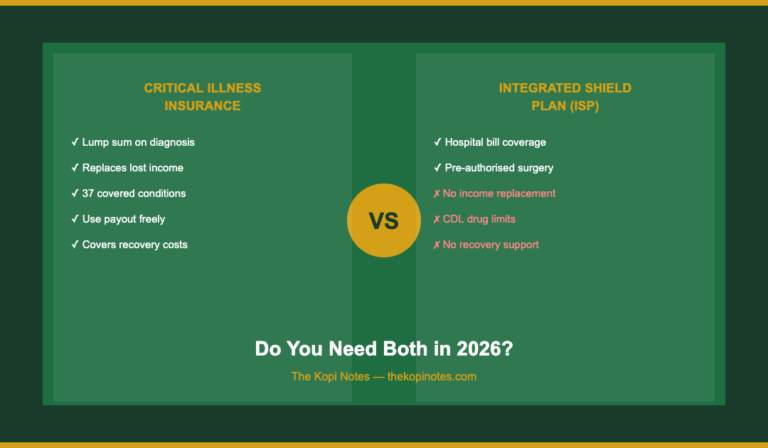
Critical illness (CI) insurance pays out a lump sum if you’re diagnosed with a covered condition, like cancer, a heart attack, or a stroke. But two people the same age can pay wildly different premiums for what looks like similar coverage.
Six factors decide your price. Here’s what actually matters, roughly in order of impact:
1. Age. The older you are, the higher your risk of a critical illness. Premiums usually jump hardest from your early 40s onward, when cancer and cardiovascular risk climbs.
2. Sum assured. A S$100,000 payout costs roughly double a S$50,000 payout, all else equal. It’s close to linear.
3. Condition scope. This is the big one, and it’s the one most comparison articles skip. A plan covering only cancer, heart attack, and stroke (“Big 3”) costs far less than one covering all 37 LIA-standardised critical illness definitions, or beyond.
4. Payout structure. Plans that pay out once (“single-pay”) cost less than plans that let you claim multiple times for different illnesses (“multi-pay” or “multi-claim”).
5. Premium type. Yearly renewable term (YRT) plans start cheap and rise every year. Level-premium plans cost more from day one but stay flat for the policy term.
6. Smoking status and gender. Smokers typically pay 20-50% more. Female premiums for CI plans also tend to run 10-20% lower than male premiums at the same age, reflecting differing illness-risk profiles used in insurer pricing.
Real 2026 Premiums Compared: 6 Insurers, Same $100k Cover
Here’s what that actually looks like in practice. The table below pulls real, currently-listed annual premiums for a defined buyer profile: a healthy, non-smoking 35-year-old, S$100,000 sum assured (except where footnoted).
| Plan | Coverage Scope | Annual Premium |
|---|---|---|
| FWD Big 3 Critical Illness | Cancer, heart attack, stroke (all stages); renewable to 85 | S$296.20 |
| Tiq 3 Plus Critical Illness | Cancer, heart attack, stroke; optional heart/neuro rider; renewable to 85 | S$342 |
| GREAT Critical Cover (to 65) | 53 conditions, early/intermediate/critical stage | S$646.20 |
| GREAT Critical Cover (to 85) | 53 conditions, early/intermediate/critical stage | S$1,173.60 |
| Singlife Comprehensive CI | Full-stage payouts, multi-claim benefit; level premium (doesn’t rise with age) | S$1,052 |
| AIA Beyond Critical Care* | 104 conditions with riders, incl. 5 mental illnesses; 100% premium refund at expiry; renewable to 85 | S$3,411 |
Source: SingSaver “Best Critical Illness Insurance Plans in Singapore” (July 2026). Figures for a 35-year-old non-smoking female, S$100,000 sum assured, except *AIA figure is for a 35-year-old non-smoking male. These are list premiums as quoted by the aggregator at time of writing and exclude any promo codes — always request a personalised quote before buying, since your actual premium depends on your health declaration.
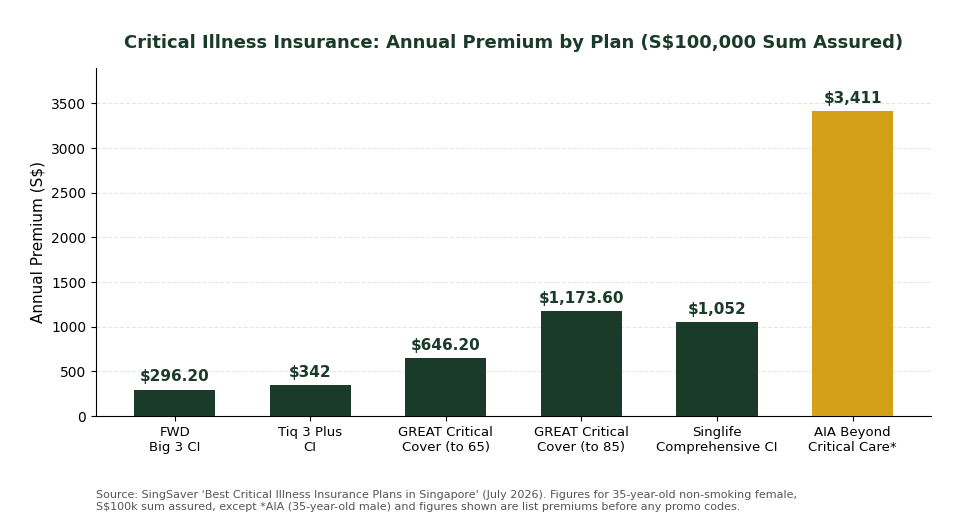
Notice the pattern? The three cheapest plans (FWD, Tiq, GREAT-to-65) all cover a narrower set of conditions or a shorter renewal age. The three priciest (GREAT-to-85, Singlife, AIA) either extend coverage further, add multi-claim benefits, or bundle in extras like a premium refund.
None of these plans is objectively “better.” A Big 3 plan at S$296.20 might be exactly right if your budget is tight and you mainly want protection against the conditions responsible for roughly 90% of CI claims in Singapore. A comprehensive plan costs more because it’s doing more.
Why More Conditions Doesn’t Mean Proportionally Higher Cost
Here’s the part that surprised us when we actually crunched the numbers. You’d expect a plan covering 104 conditions to cost roughly 35x more than a plan covering 3 conditions (104 ÷ 3). It doesn’t.
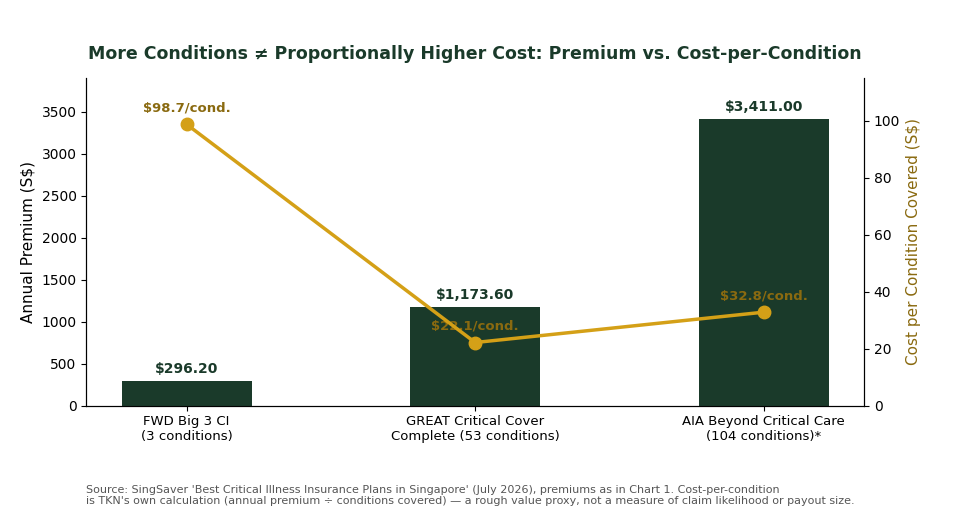
We divided each plan’s annual premium by the number of conditions it covers, to get a rough “cost per condition” figure. It’s not a perfect measure since conditions aren’t equally likely to be claimed, but it’s a useful sanity check.
| Plan | Conditions Covered | Annual Premium | Cost per Condition |
|---|---|---|---|
| FWD Big 3 CI | 3 | S$296.20 | S$98.73 |
| GREAT Critical Cover Complete (to 85) | 53 | S$1,173.60 | S$22.14 |
| AIA Beyond Critical Care | 104 | S$3,411 | S$32.80 |
Source: Premiums as sourced in the comparison table above. Condition counts verified directly against each insurer’s official product page: Great Eastern, AIA, FWD. Cost-per-condition is TKN’s own calculation (annual premium ÷ conditions covered), not an insurer-published metric.
By this rough measure, Great Eastern’s 53-condition plan is actually the best “value per condition” of the three, cheaper per condition than both the narrower FWD plan and the broader AIA plan. AIA’s higher cost per condition likely reflects its extra features: a 100% premium refund at policy expiry and mental illness coverage, which FWD and GREAT don’t offer.
The lesson here: don’t just compare headline premiums. Ask what each plan actually adds for the extra dollars, and whether that feature matters for your situation.
Level Premium vs Yearly Renewable Term (YRT)
Most of the plans in our comparison table use a Yearly Renewable Term (YRT) structure. Your premium goes up every year as you get older, but the insurer can’t deny your renewal or reassess your health, so you’re guaranteed to stay covered.
Singlife Comprehensive CI is different. It’s a level-premium plan, meaning the S$1,052 you pay this year is roughly what you’ll pay every year going forward, for the same coverage. That’s why it looks pricier than FWD or Tiq today, but it could work out cheaper by your 50s or 60s, when a YRT plan’s premium has climbed several times over.
Here’s a simplified way to think about it: a YRT plan is like renting month-to-month at a rate that rises with inflation. A level-premium plan is like a fixed-rate mortgage. You pay more upfront for predictability later.
So which should you pick? If you need coverage for a defined period, say, until your kids are financially independent, or until your mortgage is paid off, a YRT plan is usually cheaper overall. If you want CI protection for life, or you’re worried about affording sharply rising premiums in your 60s, a level-premium plan removes that risk.
The Real Cost of Waiting to Buy
Every CI plan gets more expensive the older you are when you buy it. That’s true whether it’s YRT or level-premium, because your starting age locks in your entry-level risk pricing.
There’s a second, less obvious cost of waiting: eligibility. CI insurance requires a health declaration. If you develop a pre-existing condition, high blood pressure, diabetes, or a family history flagged at underwriting, you could face a premium loading, an exclusion on that specific condition, or in some cases, a declined application altogether.
That’s the real argument for buying early, even a basic Big 3 plan. Locking in your insurability while you’re young and healthy is arguably more valuable than the small monthly saving from delaying a purchase.
Multi-Pay and Multi-Claim Plans: Worth the Extra Cost?
A standard, single-pay CI plan pays out once, then typically ends. If you’re diagnosed with cancer and later develop a heart condition, a single-pay plan won’t cover the second event.
Multi-pay (or multi-claim) plans, like Singlife Comprehensive CI or GREAT Critical Cover’s Protect Me Again rider, let you claim again for a different condition, or in some cases a recurrence of the same one. This costs more because survival rates for many cancers and cardiac events have improved. You’re statistically more likely to face a second, unrelated critical illness later in life than in past decades.
Whether this is worth paying for depends on your existing coverage. If you already have a large Death/Total Permanent Disability payout from a term life plan, plus solid Integrated Shield Plan hospitalisation cover, a single-pay CI plan may be sufficient. If CI insurance is your main financial buffer against a health crisis, the extra cost of multi-claim protection is easier to justify.
For a closer look at how the 2026 rider changes affect payout structures, see our guide to critical illness insurance rider changes.
Singapore’s S$256,000 Protection Gap
An industry survey cited by the Straits Times, based on Life Insurance Association (LIA) data, put the average Singaporean’s critical illness protection gap at around S$256,000. That figure represents estimated lost earnings from taking time off work to recover from a serious illness, not medical bills.
Here’s why that number matters when you’re weighing premium cost against coverage: even the priciest plan in our comparison, AIA Beyond Critical Care at S$3,411 a year for S$100,000 of cover, still leaves most people well short of closing that gap. Buying “the cheapest plan” and buying “enough coverage” are two separate decisions.
If you haven’t worked out how much CI coverage you personally need, our guide to how much critical illness insurance you need walks through a step-by-step framework based on income, treatment costs, and existing cover.
How to Choose Without Overpaying
Here’s a practical checklist before you commit to a CI plan:
Start with your budget floor, not the cheapest plan. Work out the maximum monthly premium you can sustain for 20-30 years, since most CI plans run that long or longer.
Check the renewal age. A plan that stops at 65 leaves you exposed exactly when critical illness risk peaks. Compare the “to 85” or “to 99” versions even if they cost more.
Confirm whether it’s YRT or level premium. Ask your adviser or read the product summary on CompareFirst (LIA’s official comparison portal) for the premium structure, not just the current-year price.
Decide if you need multi-claim. If you already have an early critical illness (ECI) plan or a solid Death/TPD payout elsewhere, single-pay may be enough.
Get a personalised quote before comparing. The premiums in this article are for one defined profile. Your actual quote depends on your age, gender, smoking status, and health declaration. Always request a real illustration before deciding.
You can also use our Insurance Gap Calculator to see how CI coverage fits into your overall protection needs alongside term life and hospitalisation insurance, or check our retirement planning calculator to see how a critical illness event could affect your long-term savings trajectory.
Frequently Asked Questions
Why does critical illness insurance cost so differently between insurers for the same coverage?
Mostly because of condition scope, not the insurer’s overall pricing. A plan covering 3 conditions (like FWD Big 3) will always cost less than one covering 53 or 104 conditions, even at the same S$100,000 sum assured and the same age. Payout structure (single-pay vs multi-claim) and premium type (YRT vs level) also move the price significantly.
Does critical illness insurance premium increase with age?
For Yearly Renewable Term (YRT) plans, yes — your premium rises every year as you get older, particularly from your 40s onward as cancer and cardiovascular risk increases. Level-premium plans, like Singlife Comprehensive CI, are the exception: the premium you lock in stays the same for the life of the policy.
What's the difference between level premium and yearly renewable term (YRT) CI plans?
A level-premium plan charges a fixed premium for the entire policy term, so it costs more upfront but never rises. A YRT plan starts cheaper but increases every year at renewal. Over a 20-30 year horizon, a YRT plan can end up costing more in total, especially past age 50.
Can I pay for critical illness insurance with CPF or MediSave?
No. Standalone critical illness policies and CI riders in Singapore are a cash-only expense under current MediSave rules. You cannot use CPF Ordinary Account, Special Account, or MediSave funds to pay CI premiums.
What is the LIA Critical Illness Framework?
It’s a standard set of 37 critical illness definitions maintained by the Life Insurance Association of Singapore (LIA), which every member insurer must use for their “severe stage” CI benefit. It was last amended in the LIA CI Framework 2024, effective by 1 October 2025, so that the same diagnosis triggers the same claim outcome regardless of which insurer you’re with.
Is a cheaper CI plan always worse value?
Not necessarily. Our own cost-per-condition calculation found Great Eastern’s 53-condition plan actually offers better value per condition covered than AIA’s 104-condition plan, once you account for AIA’s extra features like a premium refund and mental illness coverage. Cheaper plans are only worse value if they leave you exposed to a real gap in your specific needs.
Should I buy a Big 3 CI plan or a comprehensive multi-condition plan?
Cancer, heart attack, and stroke account for the large majority of CI claims in Singapore, which is why Big 3 plans exist as a lower-cost option. If your budget is tight, a Big 3 plan is a reasonable starting point. If you can afford more, a comprehensive plan or an early critical illness (ECI) plan that pays out at earlier disease stages offers broader protection.
How much critical illness coverage do I need?
A common industry benchmark is 4x your annual income, adjusted upward for expected treatment costs and any existing debt. We cover the full step-by-step calculation, using your own income and expenses, earlier in this article’s coverage-amount discussion above.
Does smoking affect my CI insurance premium?
Yes. Smokers typically pay 20-50% more than non-smokers for the same CI coverage, reflecting the higher statistical risk of cancer and cardiovascular illness. Some insurers offer a “quit smoking incentive” that switches you to non-smoker rates if you stay smoke-free for a set period, often around 3 years, after policy start.
Where can I see how often CI claims actually get paid out?
Our breakdown of LIA’s Q1 2026 critical illness claims data covers approval rates and the most commonly claimed conditions across the industry, which is useful context when weighing how much you’re paying against your actual claim odds.
Get Your Full Financial Picture Sorted
Critical illness insurance is one piece of the puzzle. Pair it with disciplined investing to build a real financial buffer.
Disclaimer: This article is for educational purposes only and does not constitute financial or insurance advice. Premiums quoted are illustrative, sourced from third-party comparison data as at July 2026, and will vary based on your individual health declaration, age, gender, and smoking status at the time of application. Always obtain a personalised quote and read the actual policy contract before purchasing. The Kopi Notes may earn a referral fee from some of the links on this page.
Get Free Insurance Advice
Speak with a licensed insurance advisor. No obligation, no cost.
By submitting this form, you agree to our Privacy Policy.
This article was researched with the help of AI. While we strive to keep all information accurate and up to date, there may be errors. If you notice any discrepancies, please contact us.