Critical Illness Insurance vs Integrated Shield Plan Singapore 2026
Do You Need Both? Here’s the Gap Most Singaporeans Miss
Data verified as at 30 August 2026 | Category: Life Insurance
Most Singaporeans assume their Integrated Shield Plan (ISP) has them fully covered. It doesn’t — and the gap can be financially devastating.
If a cancer diagnosis forced you to stop working for 12 months, your ISP would pay the hospital bills. But not the income you can no longer earn. Not the non-subsidised immunotherapy drugs that cost S$8,000 a month. Not your children’s school fees, mortgage, or daily expenses.
That’s exactly the gap Critical Illness (CI) insurance is designed to fill. This guide explains the difference between CI insurance and ISP, where each one falls short, and whether you need both in 2026.
Table of Contents
Jump to a Section
- What Your Integrated Shield Plan Actually Covers
- The Critical Gaps ISP Leaves Behind
- What Critical Illness Insurance Covers
- The Key Difference: Hospital Bills vs Income Replacement
- Real Scenario: Cancer Diagnosis — ISP vs CI
- How Much CI Coverage Do You Need?
- What About Disability Income Insurance?
- The Verdict: Do You Need Both?
- Frequently Asked Questions
What Your Integrated Shield Plan Actually Covers
Singapore’s ISP system is built on two layers. MediShield Life is the mandatory base plan from CPF Board, covering basic hospitalization in Class B2/C wards at public hospitals. On top of that, you can purchase a private ISP rider from an approved insurer (AIA, Great Eastern, Prudential, Singlife, NTUC Income, or AXA) to upgrade your coverage.
An ISP is excellent at what it does. For acute hospitalization — surgery, inpatient care, ICU, inpatient day surgery, and approved outpatient cancer treatments — it provides substantial coverage, especially in a private or restructured hospital.
What ISP genuinely covers well:
- Hospitalization and surgery at restructured or private hospitals
- Approved outpatient cancer drug treatments on the MOH Cancer Drug List (CDL)
- Pre- and post-hospitalization consultations (within limits)
- Day surgery procedures
Note: From 1 April 2026, new ISP riders are no longer permitted to cover the minimum deductible set by MOH, and the co-payment cap has been raised to a minimum of S$6,000. This means you will pay more out-of-pocket even with a comprehensive rider.
For more detail on how ISP works, see our Complete Guide to Shield Plans in Singapore.
The Critical Gaps ISP Leaves Behind
ISP is powerful for hospitalisation — but it was never designed to replace your income, fund your recovery at home, or pay for treatments outside its approved drug list. Here’s what it doesn’t cover:
| Coverage Gap | ISP | CI Insurance |
|---|---|---|
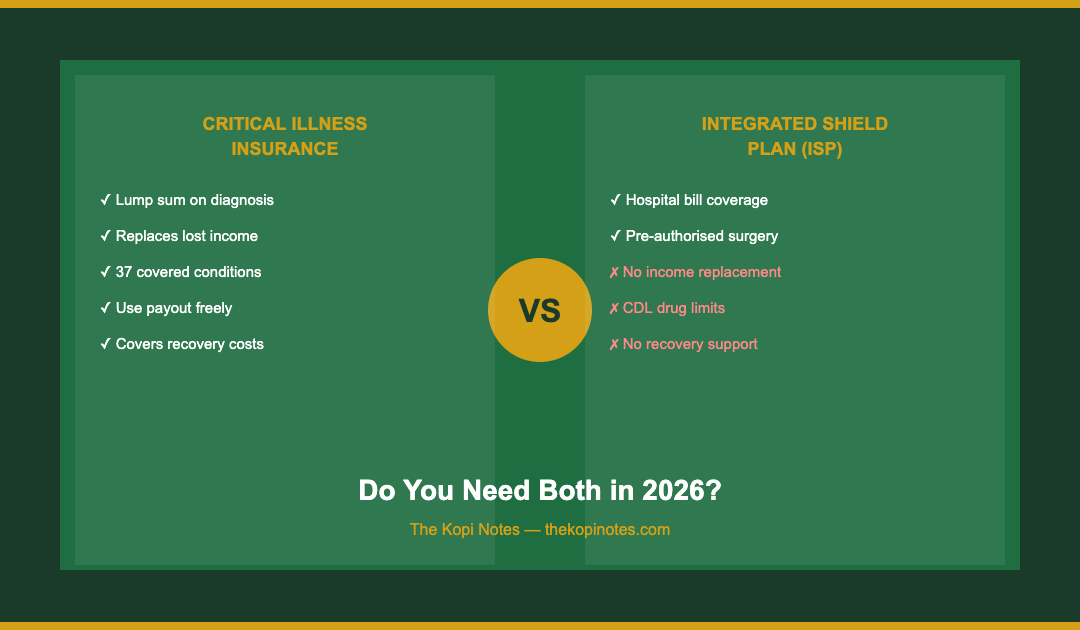
| Income replacement during recovery | ✗ Not covered | ✓ Lump sum payout |
| Non-CDL cancer drugs | ⚠ Capped (S$5k–S$30k/yr) | ✓ Use payout freely |
| Home nursing / caregiver costs | ✗ Not covered | ✓ Use payout freely |
| Mortgage / household expenses | ✗ Not covered | ✓ Use payout freely |
| Specialist follow-up consultations | ⚠ Within limits only | ✓ Use payout freely |
| Alternative / integrative medicine | ✗ Not covered | ✓ Use payout freely |
| Overseas treatment | ✗ Generally not covered | ✓ Use payout freely |
The LIA Protection Gap Study (2022) found that the average working Singaporean has an income protection gap of 80% in the event of a critical illness — meaning only 20% of the income they would lose is covered by existing plans. ISP alone does nothing to close this gap.
What Critical Illness Insurance Covers
CI insurance pays a lump sum cash benefit when you are diagnosed with any of the 37 standard critical illnesses defined by the Life Insurance Association Singapore (LIA). These definitions were last updated under the LIA CI Framework 2024, effective from 1 October 2025, to align with advances in medical technology.
The 37 LIA standard conditions span four main categories: cancers, cardiovascular events, neurological conditions, and organ failure. Whether you buy from AIA, Great Eastern, or Singlife, the clinical definition of “Major Cancer” or “Stroke with Permanent Neurological Deficit” is identical across all LIA member insurers.
The top three conditions account for over 90% of CI claims in Singapore:
- Major Cancer — any malignancy with uncontrolled growth and spread
- Heart Attack of Specified Severity — acute myocardial infarction with evidence of myocardial damage
- Stroke with Permanent Neurological Deficit — cerebrovascular incident causing permanent neurological impairment
Once diagnosed and after surviving a 7 to 30-day survival period (varies by insurer and plan), the full sum assured is paid — no receipts, no hospital billing, no prior authorisation required. You use the money however you need.
Note: Most CI plans have a waiting period of 30–90 days from the policy start date. Claims cannot be made for conditions diagnosed during this waiting period.
Some plans also offer early-stage CI coverage, which pays a partial benefit (typically 25–50% of sum assured) for early-stage cancers, mild strokes, or angioplasty — conditions that don’t yet meet the severe LIA standard definitions. For a detailed guide on early vs major CI plans, see our Best Critical Illness Insurance Singapore 2026 comparison.
The Key Difference: Hospital Bills vs Income Replacement
The simplest way to understand the distinction:
- ISP pays the hospital — for your surgery, ward stay, and approved treatments.
- CI insurance pays you — a lump sum to replace income, cover uncovered treatments, and maintain your family’s standard of living.
A cancer diagnosis doesn’t just create medical bills. It typically means 6–18 months of significantly reduced or zero income, caregiver arrangements, lifestyle modifications, and often expensive treatments that fall outside what ISP covers. ISP was designed to ensure you receive treatment; CI insurance was designed to ensure your life doesn’t collapse while you recover.
Think of them as two different insurance problems with two different solutions. Having one without the other leaves a major vulnerability.
Real Scenario: Cancer Diagnosis — ISP vs CI
Illustrative example based on typical treatment costs in Singapore (2026).
Priya is 38, earns S$7,500/month, and is diagnosed with Stage 3 breast cancer. She has a comprehensive ISP with a private hospital A-ward rider.
| Cost / Need | ISP Pays | CI (S$200k) Pays |
|---|---|---|
| Surgery + hospitalization (total bill: ~S$60,000) | ✓ Covered (after deductible + co-pay) | ✓ Can top up gaps |
| 12 months income loss (S$7,500 × 12 = S$90,000) | ✗ Zero | ✓ S$200k covers this and more |
| Non-CDL immunotherapy (S$8,000/month × 6) | ⚠ Capped per rider limit | ✓ Use payout freely |
| Home caregiver (S$2,000/month × 6) | ✗ Zero | ✓ Use payout freely |
| Mortgage and family expenses during recovery | ✗ Zero | ✓ Use payout freely |
With only ISP, Priya faces a potential six-figure shortfall in income and non-covered costs. With CI insurance (S$200,000 sum assured), the lump sum covers income replacement and uncovered treatment costs — giving her the financial breathing room to focus on recovery.
How Much CI Coverage Do You Need?
A common rule of thumb is 3–5× your annual income as your CI sum assured, or a minimum of S$100,000 to S$300,000 for most working Singaporeans. The logic: a major CI event typically causes 1–3 years of income disruption, plus significant uncovered medical costs.
Factors that affect how much you need:
- Monthly expenses and dependents — the more you need to maintain, the higher your sum assured should be
- Existing savings / emergency fund — a larger buffer reduces the CI sum needed
- Your ISP coverage tier — a better ISP rider reduces out-of-pocket medical costs, so CI insurance can focus more on income replacement
- Debt obligations — outstanding mortgage or loans need servicing even when you’re not working
Use our CI Insurance Premium Calculator to estimate what a given sum assured would cost at your age, and our Insurance Gap Calculator to assess your current protection shortfall.
For a full breakdown of the coverage amount decision, see our guide on How Much Critical Illness Insurance You Need in Singapore.
What About Disability Income Insurance?
There is a third layer of protection worth considering: Disability Income (DI) insurance. While CI insurance pays a lump sum for any of the 37 LIA-defined conditions, DI insurance pays a monthly income if you are unable to work due to any illness or injury — not just the 37 CI conditions.
The key distinction: a severe back injury or a mental health condition may prevent you from working for years, but neither qualifies for a CI payout. DI insurance fills that gap.
CI insurance and DI insurance are complementary, not competing. The ideal coverage stack for most Singaporeans looks like this:
- MediShield Life + ISP — hospital bills and approved treatments
- CI Insurance — lump sum for major illness income replacement and uncovered costs
- DI Insurance — monthly income protection for any illness or injury preventing work
For more detail, see our guide on Disability Income Insurance Singapore 2026.
The Verdict: Do You Need Both ISP and CI Insurance?
For most working Singaporeans — yes. They solve two fundamentally different problems:
- ISP ensures you receive the best medical treatment without crushing hospital bills
- CI insurance ensures your life doesn’t collapse financially while you recover
The only scenarios where CI insurance might be less critical: if you have significant liquid assets (S$500,000+) that could cover both lost income and uncovered costs, or if your employer provides a generous group CI plan. For most Singaporeans, neither condition applies.
Start with a comprehensive ISP, then layer CI insurance on top. If budget allows, add DI insurance for complete income protection coverage. Once you have CI insurance and peace of mind established, consider growing your savings and investments through platforms like Endowus (referral code 2V343) or Syfe (referral code SRPRFFFCD) — so your wealth keeps working even when you can’t.
Frequently Asked Questions
What is the main difference between CI insurance and an Integrated Shield Plan?
Can my ISP cover all cancer drug treatments?
Does CI insurance pay if I'm in hospital?
How soon does CI insurance pay out after diagnosis?
Is there a waiting period before I can claim CI insurance?
Can I use CPF to pay for CI insurance premiums?
Does having CI insurance affect my ISP premiums?
How much CI insurance do I need?
What's the difference between CI insurance and Disability Income insurance?
Get Free Insurance Advice
Speak with a licensed insurance advisor. No obligation, no cost.
By submitting this form, you agree to our Privacy Policy.
This article was researched with the help of AI. While we strive to keep all information accurate and up to date, there may be errors. If you notice any discrepancies, please contact us.