Critical Illness Insurance vs Personal Accident Insurance Singapore (2026)
Which One Does Your Financial Plan Actually Need?
Data verified as at 8 October 2026. Sources: CPF Board (March 2026), MoneySense/MAS Basic Financial Planning Guide, Life Insurance Association (LIA) Singapore, MoneySmart 2026.
Most Singaporeans know they need insurance. But when it comes to critical illness (CI) insurance versus personal accident (PA) insurance, the confusion is real — and costly.
CI and PA insurance sound similar but protect you from completely different risks. Buy the wrong one and you could be left exposed to the exact financial gap you were trying to close.
This guide cuts through the jargon. By the end, you will know exactly what each policy covers, who needs what, and whether you should have both.
Quick answer: CI insurance pays out when you are diagnosed with a serious illness. PA insurance pays out when you are injured or killed in an accident. They are complements, not substitutes — and most Singaporeans with dependents benefit from having both.
Table of Contents
Table of Contents — Click to Expand
What Is Critical Illness Insurance?
Critical illness insurance pays you a lump sum when you are diagnosed with a serious medical condition from a standard list. In Singapore, this list is defined by the Life Insurance Association (LIA) Singapore, which standardised definitions for 37 critical conditions across all insurers — with updated definitions taking effect from 1 October 2025.
The 37 LIA-standard conditions include major cancer, heart attack of specified severity, stroke with permanent neurological deficit, coronary artery by-pass surgery, end-stage kidney failure, permanent paralysis of limbs, major organ transplant, and 30 more conditions.
Standard CI plans cover these 37 conditions at the severe or late stage. Early CI plans cover additional early-stage and intermediate-stage conditions — for example, early-stage cancer or a minor heart attack. Multi-pay (multi-claim) plans allow you to claim multiple times across different conditions.
Key point: The lump sum is paid regardless of your actual medical bills. It is meant to replace lost income, cover treatment costs over time, and ease the financial burden of long-term recovery.
MAS/MoneySense/CPF guidance (verified March 2026): The MAS Basic Financial Planning Guide and MoneySense recommend being insured against critical illness for at least 4 times your annual income. For someone earning $5,000/month, that is a minimum of $240,000 in CI coverage.
What Is Personal Accident Insurance?
Personal accident insurance pays out when you are injured, disabled, or killed as a direct result of an accident. The keyword is accident — illness, disease, and pre-existing conditions are excluded.
A typical PA plan covers: Accidental death (lump sum to beneficiaries), Total permanent disability (TPD) (100% of sum assured if permanently unable to work), Partial permanent disability (percentage of sum assured by schedule), Accidental medical expenses (reimbursement for hospital, clinic, physiotherapy, TCM), and Daily hospital allowance (typically $50–$400 per day for each day hospitalised due to an accident).
What PA insurance does NOT cover: cancer, heart attack, stroke, or any illness — no matter how serious. If you are hospitalised due to illness, PA insurance pays nothing.
2026 cost benchmarks (MoneySmart listings):
- FWD Plan A: ~$142/year for $100,000–$200,000 accidental death coverage
- MSIG: ~$180/year
- Allianz Accident Protect Plus Silver: ~$171/year
Premiums vary by age, occupation class, sum insured, and plan tier. Higher-risk occupations attract higher premiums or exclusions.
CI vs PA Insurance: Key Differences at a Glance
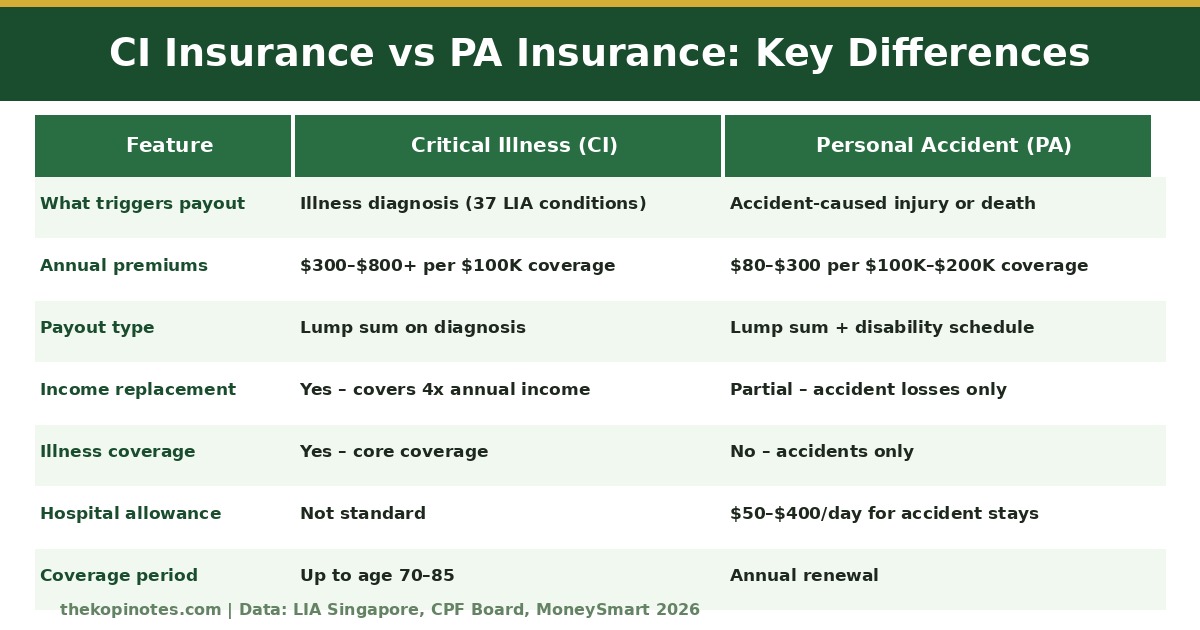
| Feature | Critical Illness (CI) | Personal Accident (PA) |
|---|---|---|
| Payout trigger | Illness diagnosis (37 LIA conditions) | Accident-caused injury or death |
| Annual premiums | ~$300–$800+ per $100K coverage | ~$80–$300 per $100K–$200K coverage |
| Illness covered? | Yes — core purpose | No — accidents only |
| Accidents covered? | No (separate policy needed) | Yes — core purpose |
| Income replacement | Yes — lump sum for 4-5x income | Partial — accident losses only |
| Daily hospital cash | Not standard (add-on available) | $50–$400/day for accident stays |
| Coverage period | Up to age 70–85 | Annual renewal |
| Premium increases with age? | Yes — buy young to lock in lower rates | Yes — but stays affordable longer |
Sources: CPF Board (March 2026), LIA Singapore, MoneySmart 2026 plan listings. Premiums are indicative; get personalised quotes from licensed insurers.
Who Should Buy Critical Illness Insurance?
CI insurance is a priority if you are the primary breadwinner, have dependents (children, elderly parents, a non-working spouse), are self-employed or freelance with no employer group cover, have a family history of cancer, heart disease, or stroke, or do not have adequate employer-provided group CI coverage.
The core risk CI protects against: The average critical illness recovery period is 3–5 years. During this time, you may be unable to work, yet household expenses continue — mortgage, childcare, utilities, daily living. Without a CI payout, you may deplete savings or go into debt. MediShield Life and Integrated Shield Plans (IPs) cover hospitalisation and surgical bills — but they do not replace your income or cover long-term treatment costs.
Realistic CI coverage target for someone earning $5,000/month:
- Minimum (MAS/CPF guideline): 4x annual income = $240,000
- Comfortable: 5x annual income = $300,000 (covers a 5-year recovery)
- Add your remaining mortgage balance if you are the sole borrower
For financial planning alongside your insurance, consider Endowus (code: 2V343) for CPF-eligible investing or Syfe (code: SRPRFFFCD) for income-focused portfolios.
Who Should Buy Personal Accident Insurance?
PA insurance is particularly valuable if you work in a higher-risk occupation (construction, delivery, logistics), are active in sports or outdoor activities, want affordable additional coverage to complement existing health and life insurance, need daily cash when hospitalised from an accident, or are a younger adult (accidents are a leading cause of death and disability for those under 40).
PA limitations to know: PA does not replace income if you cannot work due to illness (only accidents). It is not a substitute for disability income insurance for long-term inability to work. Common exclusions include extreme sports, war, and self-inflicted injury. Higher occupation classes pay more or face coverage restrictions.
Note on overlap with IP: If you already have an Integrated Shield Plan, it handles hospitalisation costs up to plan limits. PA’s daily allowance and medical expense reimbursement complement your IP specifically for accident-related stays, covering co-payments and other gaps.
How Much Coverage Do You Need?
For Critical Illness Insurance: The authoritative benchmark comes from the MAS Basic Financial Planning Guide, as cited by CPF Board (March 2026):
“Be insured against critical illness for at least 4 times your annual income.” — MAS/MoneySense Basic Financial Planning Guide, as cited by CPF Board (March 2026)
| Monthly Income | Annual Income | Minimum CI Coverage (4x) | Recommended (5x) |
|---|---|---|---|
| $3,000 | $36,000 | $144,000 | $180,000 |
| $5,000 | $60,000 | $240,000 | $300,000 |
| $8,000 | $96,000 | $384,000 | $480,000 |
| $12,000 | $144,000 | $576,000 | $720,000 |
For Personal Accident Insurance: A common approach — Accidental death: at minimum $100,000 (match your life insurance shortfall). Medical expenses: $5,000–$30,000 per accident (supplement your IP). Daily allowance: $50–$400/day based on your daily expenses. Coverage of $100,000–$200,000 accidental death at $80–$300/year is cost-effective for most Singaporeans.
Can You Have Both? (Yes — Here Is Why)
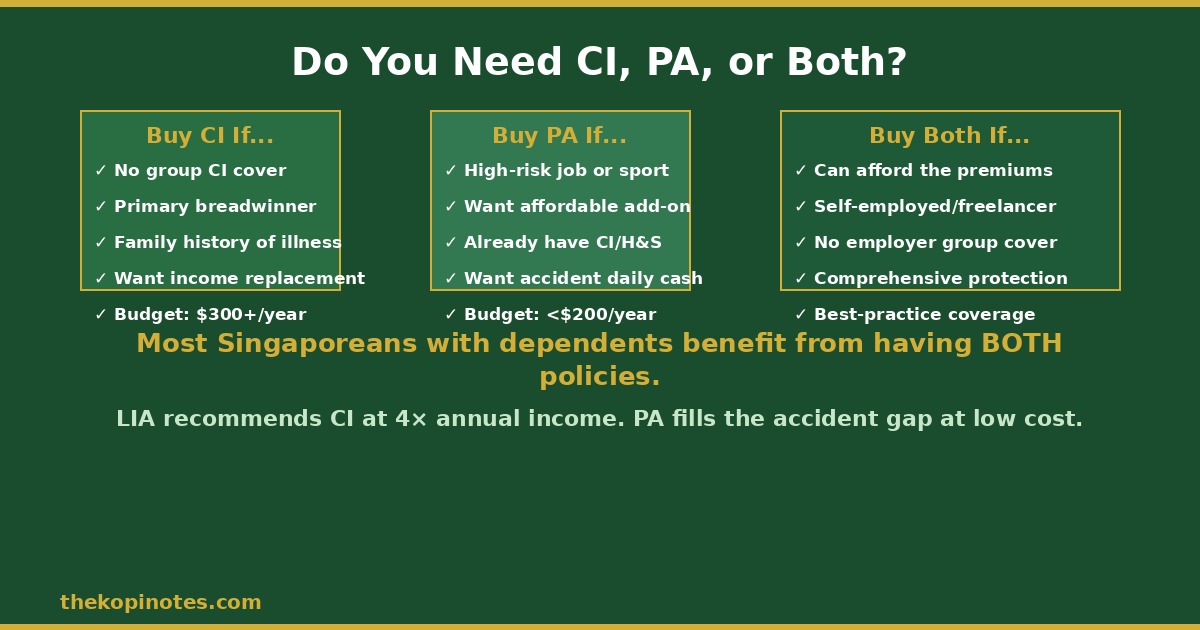
CI and PA insurance are complements, not substitutes. They cover different risks and having both creates a more complete protection layer.
Scenario 1 — Cancer diagnosis: CI pays your $300,000 sum assured. PA pays nothing (illness, not accident). Your CI payout covers 2+ years of replacement income and treatment costs not covered by your IP.
Scenario 2 — Road accident injury: A car knocks you off your bicycle; you are hospitalised for 10 days with a fractured wrist. PA pays $100/day x 10 days = $1,000 hospital allowance + $3,500 medical expenses. CI pays nothing (no illness diagnosis). PA fills the gap your IP’s co-payment leaves.
Scenario 3 — Accident causing total permanent disability: A workplace accident leaves you with TPD. PA pays 100% of sum assured ($200,000). Your CI policy may also pay out if you meet CI’s TPD definition — you could collect from both independently.
Start with CI if you can only afford one. The financial impact of a critical illness (years of lost income + long-term treatment) is statistically much greater than accident-only scenarios. Then add PA as an affordable complement.
Suggested order of protection for most Singaporeans:
- MediShield Life / Integrated Shield Plan (hospitalisation)
- Term Life Insurance (death and TPD for dependents)
- Critical Illness Insurance (income replacement for illness)
- Personal Accident Insurance (affordable accident complement)
- Disability Income Insurance (long-term income replacement)
Where to Get Started With Your Financial Plan
Insurance works best as part of a broader financial plan. TKN readers use these platforms to manage investments alongside their protection portfolio:
- Endowus (code: 2V343) — CPF-eligible robo-advisor for building your retirement fund alongside insurance coverage
- Syfe (code: SRPRFFFCD) — income-focused portfolios that complement your CI protection plan
- FSMOne (code: P0544985) — compare investment products alongside ETF investing
- MariBank (code: 2DCT80WQ) — high-yield savings for your emergency fund (the cash buffer beneath your insurance)
Note: These are referral links. TKN may earn a commission at no cost to you. Always consult a licensed financial adviser before purchasing any insurance product.
Frequently Asked Questions
Is critical illness insurance the same as personal accident insurance?
Do I need both CI and PA insurance in Singapore?
How much critical illness insurance do I need in Singapore?
Does my MediShield Life or Integrated Shield Plan replace CI insurance?
How much does PA insurance cost in Singapore in 2026?
Does PA insurance cover a heart attack while exercising?
Can I claim from both CI and PA insurance for the same event?
Get Free Insurance Advice
Speak with a licensed insurance advisor. No obligation, no cost.
By submitting this form, you agree to our Privacy Policy.
This article was researched with the help of AI. While we strive to keep all information accurate and up to date, there may be errors. If you notice any discrepancies, please contact us.