Dividend Investing: A Complete Guide for Singapore Investors (2026)
Top dividend stocks, ETFs, yields, and a step-by-step guide to building passive income in Singapore.
Dividend investing means buying shares in companies or funds that pay regular cash distributions — and collecting that income on top of price growth. For Singapore investors, dividends from Singapore-listed companies are tax-exempt at the individual level under Singapore’s one-tier tax system, making them one of the most efficient ways to build passive income in Singapore alongside CPF, REITs, and Singapore Savings Bonds.
Not financial advice. All figures are for educational reference only. Data verified as at 7 October 2026.
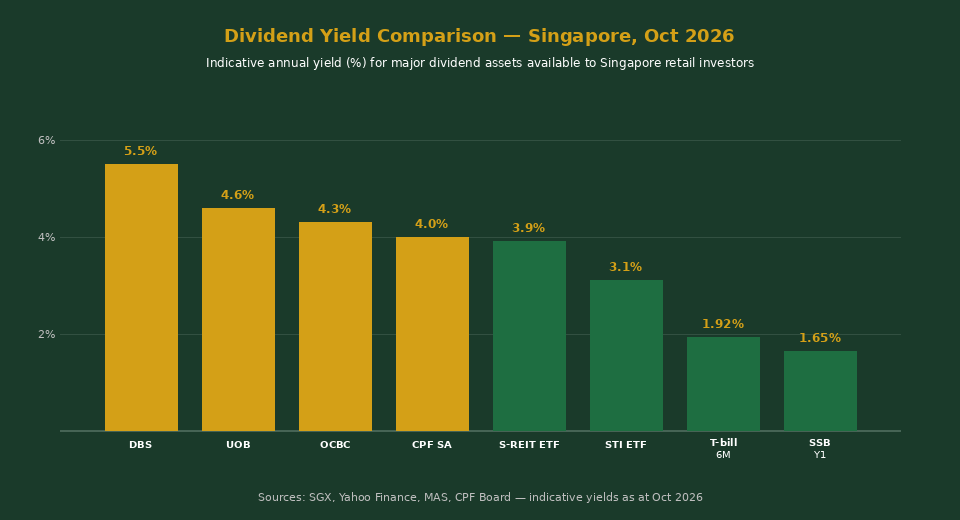
- Singapore banks (DBS ~5.5%, UOB ~4.6%, OCBC ~4.3%) offer some of the highest blue-chip dividend yields locally as at Oct 2026.
- Singapore-source dividends are tax-exempt for individual investors — no withholding tax at shareholder level.
- The STI ETF (ES3) offers instant diversification across 30 blue chips at ~3.1% yield as at October 2026.
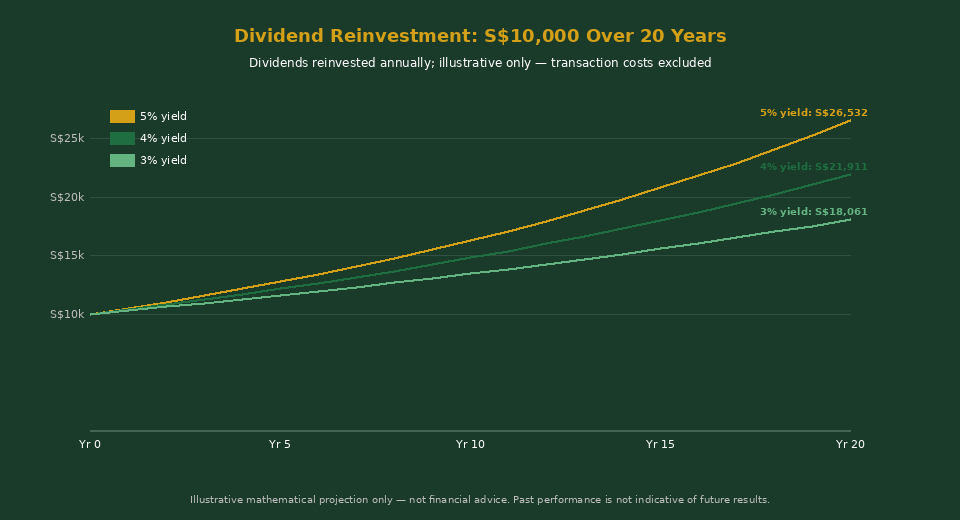
- Reinvesting dividends compounds income over time: S$10,000 at a 5% yield grows to ~S$26,500 after 20 years with full reinvestment.
What Is Dividend Investing?
Dividend investing is a strategy focused on buying stocks, ETFs, or REITs that pay out a portion of their profits as regular cash distributions to shareholders. Instead of relying solely on share price appreciation, dividend investors build a stream of income that arrives whether markets are rising or falling.
Every dividend has several components worth understanding:
Dividend per share (DPS) is the actual cash amount paid per share. If DBS pays S$1.62 per share in a year and the share price is S$30, the trailing yield is 5.4%.
Dividend yield is DPS divided by the current share price, expressed as a percentage. Yield moves inversely to price: as a stock rises, its yield on the same DPS falls. A very high yield can signal either a generous payout policy or a falling share price — context matters.
Payout ratio is the proportion of earnings paid out as dividends. A company paying 60% of earnings as dividends retains 40% for reinvestment. Very high payout ratios — above 80-90% for most companies — may be unsustainable if earnings dip.
Ex-dividend date is the cutoff date for eligibility. You must own shares before this date to receive the upcoming dividend. Buying on or after the ex-dividend date means the seller, not you, receives the next distribution.
Dividend investing is sometimes contrasted with growth investing, which prioritises companies that reinvest most earnings for future expansion. In practice, many Singapore investors combine both — holding blue-chip dividend payers like banks for income, alongside growth-oriented global equity ETFs for capital appreciation over the long term.
Why Dividend Investing Works Especially Well in Singapore
Singapore has one of the most dividend-friendly tax environments among developed economies. Under the one-tier corporate tax system, Singapore companies pay corporate tax on their profits. When those after-tax profits are distributed as dividends to individual shareholders, no further tax is levied. There is no dividend withholding tax and no personal income tax on Singapore-source dividends received by individual Singapore tax residents.
This is a meaningful structural advantage. Compare it to receiving dividends from US stocks — typically subject to a 30% withholding tax for Singapore residents (or 15% under the US-Singapore tax treaty for those who file the relevant forms). Every dollar of Singapore-source dividend income lands in your account in full.
Second, Singapore’s mature financial sector — dominated by three large, consistently profitable banks — provides a concentrated source of high-quality dividends. DBS, OCBC, and UOB have maintained or grown their dividends through multiple cycles. As at October 2026, all three yield between 4.3% and 5.5%, competitive with much higher-risk instruments in other markets.
Third, Singapore-listed REITs are required to distribute at least 90% of taxable income as dividends to retain their tax-transparent status. This makes S-REITs structurally reliable dividend payers, though their yields are more sensitive to interest rate movements. For a deeper look at accessing REIT income through a diversified vehicle, see our Singapore REIT ETF guide.
Top Dividend Stocks and ETFs in Singapore (2026)
The table below summarises the key dividend options available to Singapore retail investors as at October 2026. Yields are indicative based on trailing or forward dividend estimates and change as prices and dividend policies evolve.
| Stock / ETF | SGX Ticker | Type | Approx. Yield | Notes |
|---|---|---|---|---|
| DBS Group | D05 | Bank | ~5.5% | Singapore’s largest bank; highest yielder of the three |
| UOB | U11 | Bank | ~4.6% | Consistent dividend growth; ASEAN-focused |
| OCBC | O39 | Bank | ~4.3% | Diversified financial services; wealth management arm |
| STI ETF | ES3 | Index ETF | ~3.1% | Tracks 30 blue chips; diversified, low cost, ~S$5.74/unit |
| Lion-Phillip S-REIT ETF | CLR | REIT ETF | ~3.9% | Broad S-REIT exposure; yield sensitive to interest rates |
Source: SGX, Yahoo Finance, company investor relations pages — indicative forward/trailing yields as at 6-7 October 2026. Yields change daily; verify current figures before investing.
A few things worth noting. The three banks dominate Singapore’s dividend landscape by size, liquidity, and yield, making them the bedrock of many Singapore income portfolios. The STI ETF offers a simpler alternative: one purchase gives you DBS, OCBC, UOB, and 27 other blue-chip companies, with dividends paid roughly twice a year. The trade-off is a slightly lower blended yield, since the index includes companies with lower payout ratios. For investors who want a managed approach to dividend income, robo-advisors like Syfe offer income-focused portfolios — see their Syfe referral code and sign-up bonus page for current offers.
How to Evaluate a Dividend Stock
A high yield is attractive but it is not the only metric that matters. A company paying an unsustainable dividend — one funded by debt, asset sales, or a payout ratio above 100% of earnings — will eventually cut it. Here are five metrics experienced dividend investors check before committing capital.
| Metric | What It Measures | Healthy Benchmark |
|---|---|---|
| Dividend Yield | Annual DPS divided by share price | 3–7% for SG blue chips; above 8% warrants scrutiny |
| Payout Ratio | DPS divided by earnings per share | Below 80% for most sectors; REITs and utilities can sustain 90%+ |
| Dividend Growth Rate | Annual percentage increase in DPS | Consistent 3–8% over 5+ years is a positive signal |
| Free Cash Flow Coverage | FCF divided by total dividends paid | Above 1.0x — company generates enough cash to fund the payout |
| Dividend History | Consistency across economic cycles | 5+ years with no cuts; maintained or grown through downturns preferred |
Source: Standard financial analysis frameworks. DPS, EPS, and FCF data are available in company annual reports and SGX investor relations filings. Benchmarks are guidelines, not guarantees.
Yield traps are a particular risk. When a stock’s price falls sharply, its historical DPS produces a very high yield — attracting yield-seeking investors just before the company cuts the dividend. Always verify the payout ratio and earnings trend before buying into an unusually high yield. A 10% yield on a company with a 120% payout ratio and declining profits is a warning sign, not a bargain.
Dividend growth rate often matters more than absolute yield for long-term investors. A stock yielding 3% today but growing its DPS by 8% per year will outperform a 5% yielder with flat DPS — after seven years, the growing dividend delivers a higher yield on original cost, and the total return advantage compounds further from there.
Building a Dividend Portfolio: Step-by-Step
Step 1: Define your income goal. A target of S$1,000 per month in dividend income requires approximately S$300,000 invested at a 4% blended yield. Knowing your target gives you a clear accumulation milestone and prevents over-concentrating in the highest yielders at the expense of quality.
Step 2: Decide on your income vs. growth split. Most Singapore investors benefit from a hybrid approach — some dividend stocks or ETFs for income, plus growth-oriented assets for capital appreciation. A common starting split for mid-career investors is 50% dividend-focused, 50% growth; those closer to retirement often tilt further toward income.
Step 3: Choose your vehicles. Buying DBS, OCBC, or UOB directly gives you the highest yields and full transparency on what you own, but comes with concentration risk — three banks in one sector, one country. The STI ETF gives you 30 blue-chip companies for one transaction at a lower but more diversified yield. The Lion-Phillip S-REIT ETF adds higher yields with broader REIT exposure, though with greater interest rate sensitivity.
Step 4: Start a regular savings plan. Most Singapore brokerages (DBS Invest-Saver, Phillip POEMS, FSMOne, Syfe) offer Regular Savings Plans (RSPs) that automatically buy chosen ETFs monthly for fees of 0.5–1% per transaction. RSPs automate dividend investing and remove the temptation to time the market. For capital-guaranteed options to complement your portfolio, compare Singapore T-bills (currently ~1.92% for 6-month as at 24 Sep 2026) and Singapore Savings Bonds (Oct 2026 issue: 1.65% Y1, 2.32% 10-year average).
Step 5: Reinvest dividends during accumulation. In the early years, reinvesting every distribution maximises compounding. The chart below illustrates how S$10,000 invested at different yields could grow over 20 years — the difference between spending and reinvesting is material by Year 10.
Step 6: Review and rebalance annually. Yields change as prices move. Check once or twice a year whether your portfolio’s actual yield and allocation still match your target. Trim overweight positions and add to laggards. For a framework integrating your CPF savings with your investment portfolio, see our guide on CPF investment strategy.
Tax Treatment of Dividends in Singapore
Singapore’s one-tier corporate tax system makes dividend investing particularly tax-efficient for residents.
Singapore-source dividends (SGX-listed companies, S-REITs, Singapore ETFs): Tax-exempt at the individual shareholder level. When a Singapore company distributes dividends from after-tax profits, individual investors receive the full amount with no personal income tax. This applies to dividends from DBS, OCBC, UOB, and all SGX-listed companies, including distributions from the STI ETF and Lion-Phillip S-REIT ETF.
Foreign-source dividends (US stocks, UK stocks, global ETFs): Dividends from non-Singapore-listed stocks are subject to withholding tax by the source country before you receive them. US stocks incur a 30% withholding tax (reducible to 15% under the US-Singapore tax treaty). This is why many Singapore investors use UCITS ETFs listed on the London Stock Exchange for US equity exposure — Irish-domiciled UCITS ETFs benefit from a reduced 15% US withholding tax rate under the US-Ireland tax treaty, lowering the drag on global dividend income.
CPF interest rates as at Q3-Q4 2026: The CPF Ordinary Account earns 2.5% per annum and the Special Account earns 4.0% per annum, per CPF Board’s official announcement. The SA rate of 4.0% has been extended until 31 December 2027. CPF interest is guaranteed and compounds tax-free within your account, though it is not accessible until retirement age. For a complete strategy on how CPF fits alongside dividend investing, see our CPF investment strategy guide.
Common Mistakes Dividend Investors Make in Singapore
Chasing the highest yield without checking sustainability. A 9% yield on a company with declining earnings and a 110% payout ratio is not generous — it is a dividend cut waiting to happen. Always verify payout ratio, earnings trend, and free cash flow before buying.
Over-concentrating in the three banks. DBS, OCBC, and UOB offer excellent yields, but building a portfolio that is 80-90% Singapore banks means your income stream is highly correlated. A regulatory change, a property market shock, or a regional economic downturn could affect all three simultaneously. Balance bank holdings with REITs, ETFs, or other sectors.
Ignoring the ex-dividend date. Buying shares on or after the ex-dividend date means you miss the upcoming distribution. Check the ex-dividend date on SGX’s website before timing a purchase for income.
Spending dividends during the accumulation phase. Reinvesting every distribution is almost always more powerful than spending it during your wealth-building years. The chart above shows the compounding difference at 3%, 4%, and 5% yields over 20 years — the gap between spending and reinvesting widens significantly over time.
Ignoring currency risk on foreign dividends. US stocks and global ETFs pay dividends in USD. A strengthening SGD quietly erodes the SGD value of those distributions over time — a risk easily overlooked by investors focused only on the yield percentage.
Ready to Start Earning Dividends?
Use these referral codes when opening a brokerage account to qualify for welcome bonuses on your first qualifying deposit.
Frequently Asked Questions
Are dividends from Singapore stocks tax-free?
Yes, for individual investors. Under Singapore’s one-tier corporate tax system, dividends paid from the after-tax profits of Singapore-incorporated companies are exempt from personal income tax at the shareholder level. This applies to dividends from all SGX-listed companies including DBS, OCBC, UOB, as well as distributions from Singapore-listed ETFs and REITs. There is no dividend withholding tax for Singapore residents on Singapore-source dividends.
Which Singapore dividend stocks offer the highest yield in 2026?
As at October 2026, Singapore’s three banks offer the highest yields among blue-chip stocks: DBS (~5.5%), UOB (~4.6%), and OCBC (~4.3%). These are indicative forward/trailing yields that change as share prices and dividend policies evolve. Always verify current figures on SGX or through your brokerage before investing.
What is a safe dividend payout ratio?
For most Singapore companies, a payout ratio below 80% of earnings is considered sustainable. REITs and utilities can sustain higher ratios (90%+) because their earnings are based on stable contractual income. A payout ratio consistently above 100% is a red flag — the company is paying out more than it earns, which requires either asset sales or debt to sustain, and typically precedes a dividend cut.
Should I choose dividend stocks or dividend ETFs?
Individual stocks like DBS, OCBC, and UOB offer the highest Singapore dividend yields, but come with concentration risk — three banks in one sector. ETFs like the STI ETF give you 30 companies for one purchase at a slightly lower blended yield (~3.1%), with broader diversification. Many Singapore investors hold both: the banks directly for yield, and an ETF for diversification. The right split depends on your portfolio size, risk tolerance, and willingness to monitor individual stocks.
Is dividend investing better than putting money in T-bills or SSBs?
They serve different purposes. Singapore T-bills (currently ~1.92% for 6-month as at Sep 2026) and Singapore Savings Bonds (Oct 2026: 1.65% Y1, 2.32% 10-year avg) offer capital safety and predictable returns. Dividend stocks offer higher potential yields but come with capital risk — your S$30 DBS share could fall to S$25. A balanced approach uses T-bills and SSBs for the safe, short-to-medium term portion of savings, and dividend stocks or ETFs for higher-return long-term exposure.
How do I reinvest dividends automatically in Singapore?
Most Singapore brokerages do not offer formal Dividend Reinvestment Plans (DRIPs) like US brokerages do. The practical approach is to collect dividends into your brokerage cash balance and manually reinvest them the next time you make your regular monthly purchase. Some robo-advisors like Syfe automatically reinvest distributions in their income-focused portfolios, achieving the same compounding effect without manual action.
Can I start dividend investing with a small amount in Singapore?
Yes. The STI ETF (ES3) traded at approximately S$5.74 per unit as at 6 October 2026, so you can start for a very small amount through a brokerage Regular Savings Plan (RSP) from as little as S$100 per month. For individual bank stocks like DBS (around S$30 per share), the minimum purchase is one board lot of 100 shares (~S$3,000), though some platforms offer fractional share purchases for smaller amounts.
Not financial advice. Data verified as at 7 October 2026 against: SGX and Yahoo Finance indicative yields for DBS (D05), OCBC (O39), UOB (U11), STI ETF (ES3 ~S$5.74/unit), and Lion-Phillip S-REIT ETF (CLR ~S$0.76/unit); MAS T-bill auction result dated 24 Sep 2026 (6-month cut-off yield 1.92%); CPF Board Q3-Q4 2026 official interest rate announcements (OA 2.5%, SA 4.0% extended to 31 Dec 2027); MAS SSB October 2026 issue (Y1 1.65%, 10-year avg 2.32%). All yields move daily. The dividend reinvestment chart is an illustrative mathematical projection and not a forecast. The Kopi Notes may earn referral fees when you sign up using our codes.
This article was researched with the help of AI. While we strive to keep all information accurate and up to date, there may be errors. If you notice any discrepancies, please contact us.