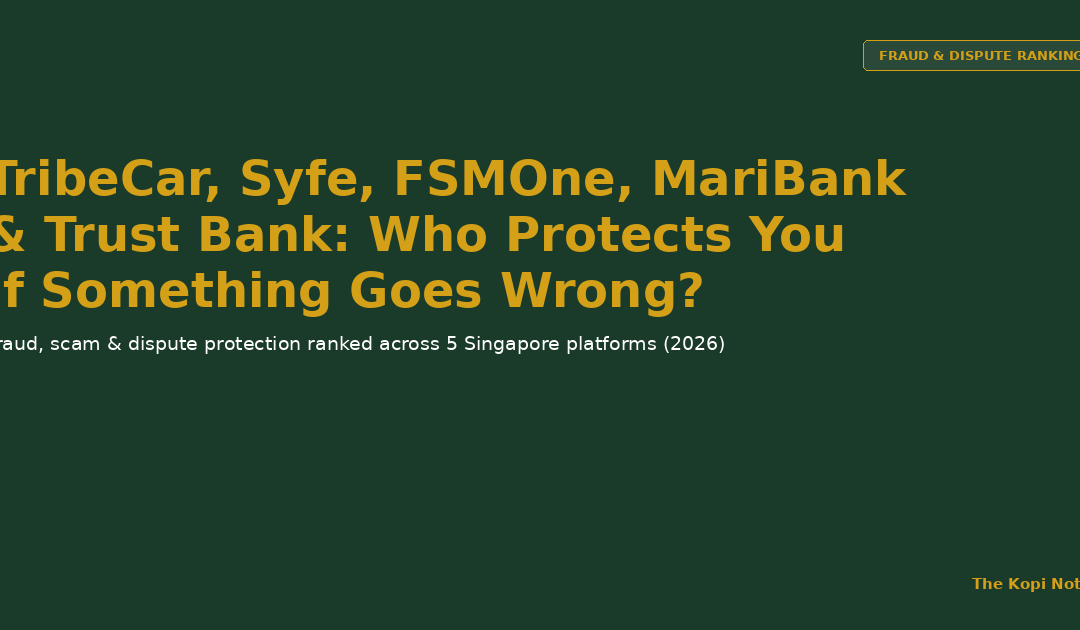
TribeCar + Syfe + FSMOne + MariBank + Trust Bank: Ranking Fraud & Dispute Protection (2026)
If something goes wrong on one of these 5 platforms, you are not equally protected. Here’s exactly which ones MAS actually backs — and which ones you’re on your own with.
If you use TribeCar, Syfe, FSMOne, MariBank and Trust Bank together, these 5 platforms do not protect you equally if something goes wrong. MariBank and Trust Bank are full banks covered by MAS’s Shared Responsibility Framework (SRF), which can compensate phishing-scam victims. Syfe and FSMOne are MAS-regulated and ring-fence your money, but sit outside the SRF. TribeCar isn’t a regulated financial institution at all, so disputes are handled entirely at the company’s discretion.
Not financial advice. All figures and regulatory references are for educational reference only and current as at October 2026.
Table of Contents
Contents — Click to expand
- Quick Answer: Who’s Actually Covered?
- The 3 Regulatory Tiers These 5 Platforms Fall Into
- Tier 1: MariBank & Trust Bank — Covered by the Shared Responsibility Framework
- Tier 2: Syfe & FSMOne — Regulated and Ring-Fenced, But No SRF
- Tier 3: TribeCar — Outside the Regulatory Perimeter
- Protection Score: All 5 Platforms Ranked
- What This Means for How You Split Your Money Across These 5
- Frequently Asked Questions
Quick Answer: Who’s Actually Covered?
Readers who run the full TribeCar + Syfe + FSMOne + MariBank + Trust Bank stack usually assume that because every platform asks for NRIC verification, Singpass login, or OTP confirmation, they’re all backed by the same safety net if an account gets compromised. They aren’t. Singapore’s Monetary Authority of Singapore (MAS) runs a specific compensation mechanism — the Shared Responsibility Framework (SRF) — that applies to banks and telcos for a narrow category of phishing scams. MariBank and Trust Bank, as licensed digital full banks, fall under it. Syfe and FSMOne, as Capital Markets Services (CMS) licence holders rather than banks, do not. TribeCar, a private car-sharing marketplace with no MAS licence of any kind, sits completely outside the regulatory perimeter that protects the other four.
That doesn’t mean Syfe, FSMOne or TribeCar are unsafe to use — Syfe and FSMOne are required to ring-fence client money by law, and TribeCar requires driving licence and NRIC verification before you can book a car. But “regulated” and “SRF-covered” are not the same thing, and the gap matters most in the one scenario you hope never happens: someone else gets into your account.
The 3 Regulatory Tiers These 5 Platforms Fall Into
Before ranking individual platforms, it helps to see the structural split. These five services fall into three distinct categories under Singapore law, and each category has a different answer to “what happens if I’m scammed.”
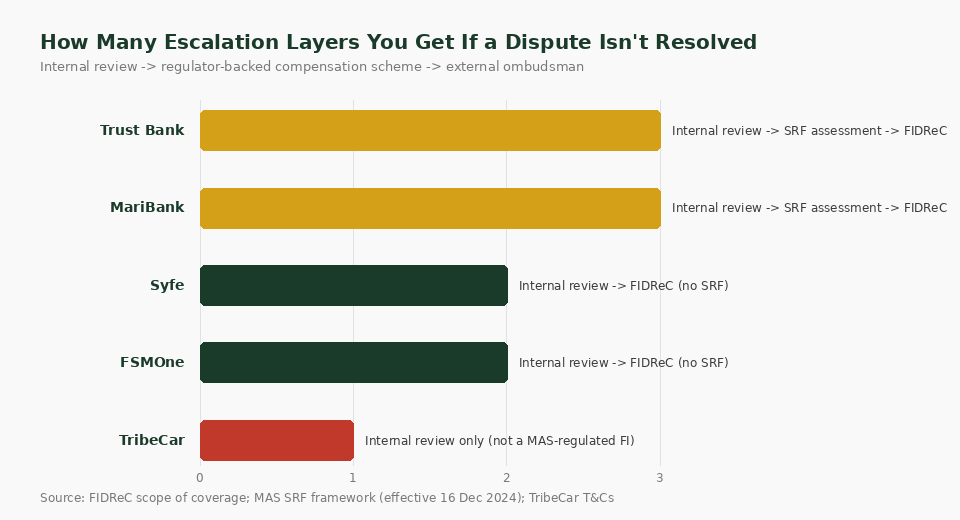
| Platform | What It Is | MAS Status | SRF Covered? | Dispute Body |
|---|---|---|---|---|
| MariBank | Digital full bank | MAS-licensed bank | Yes | Internal review → SRF assessment → FIDReC |
| Trust Bank | Digital full bank | MAS-licensed bank | Yes | Internal review → SRF assessment → FIDReC |
| Syfe | Robo-advisor / brokerage | MAS CMS licence holder | No | Internal review → FIDReC |
| FSMOne | Brokerage (iFAST) | MAS CMS licence holder, CDP agent | No | Internal review → FIDReC |
| TribeCar | Car-sharing marketplace | Not MAS-regulated | No | Internal review only (CASE / Small Claims Tribunal as last resort) |
Source: MAS Shared Responsibility Framework (effective 16 December 2024); MariBank and Trust Bank SRF disclosure pages; FIDReC membership scope (October 2026).
Tier 1: MariBank & Trust Bank — Covered by the Shared Responsibility Framework
MariBank and Trust Bank are both full banks licensed by MAS, which puts them inside the Shared Responsibility Framework that MAS and IMDA implemented from 16 December 2024. The SRF requires covered banks to enforce a cooling-off period of at least 12 hours before high-risk activities can be performed whenever a digital security token is activated on a new device or there’s a login from an unrecognised device, and to send real-time alerts for outgoing payments and other high-risk account activity. If a phishing scam succeeds despite those safeguards, the SRF applies a “waterfall” test: the bank bears the full loss if it breached its anti-scam duties; if the bank met its duties but the telco involved breached its own, the telco pays; if both met their duties, the loss falls on the consumer.
Crucially, the SRF only covers a specific category of loss: digitally-enabled phishing scams, where a scammer impersonates a legitimate entity (bank, government agency) and tricks the victim into entering their credentials on a fake site, which the scammer then uses to transact. It does not cover malware-based scams, scams where the victim knowingly authorises a payment to the scammer (such as most romance or investment scams), or cases where credentials are stolen by non-digital means. That distinction catches a lot of people out — “I got scammed” and “I’m covered by the SRF” are not automatically the same thing, even on a bank that participates in the framework.
On the practical side, MariBank’s safety profile includes a published SRF process: report an unauthorised transaction via the 24-hour hotline or in-app live chat, and MariBank commits to an investigation outcome within 21 business days (up to 45 business days for complex cases). If you disagree with the outcome and have new evidence, you can request a further review; if you remain unsatisfied, the next step is the Financial Industry Disputes Resolution Centre (FIDReC). Trust Bank publishes its own SRF commitments on the same 12-hour cooling-off and real-time alert duties, with the same FIDReC escalation path if its internal review doesn’t resolve the dispute. Neither bank guarantees automatic compensation — the SRF waterfall still depends on whether the bank (and you) met your respective anti-scam duties — but both give you a MAS-mandated process and a regulator-recognised compensation scheme to fall back on.
Tier 2: Syfe & FSMOne — Regulated and Ring-Fenced, But No SRF
Syfe and FSMOne are not banks — they hold a Capital Markets Services (CMS) licence from MAS, covering fund management, dealing in capital markets products, and (for FSMOne, via parent company iFAST) custodial services. That licence requires them to keep client money and assets strictly segregated from company funds. Syfe holds client cash in trust accounts with MAS-regulated banks such as DBS and HSBC, while your investments sit with regulated custodians — Saxo Capital Markets or Interactive Brokers depending on the product — fully ring-fenced from Syfe’s own creditors. FSMOne’s parent, iFAST Financial, is a licensed custodian under MAS and acts as a CDP Approved Depository Agent, maintaining a sub-account with the Central Depository on behalf of each client for SGX-listed holdings; bond and unit trust holdings are similarly segregated.
That segregation protects you if Syfe or FSMOne ever became insolvent — your money legally cannot be seized by the company’s creditors. What it does not give you is SRF-style scam compensation. Because the SRF is explicitly scoped to banks and telcos, an unauthorised trade or account takeover on Syfe or FSMOne doesn’t trigger the same waterfall test that applies to MariBank or Trust Bank. Your recourse is the platform’s own internal investigation, and if that doesn’t resolve things, FIDReC — which covers CMS licence holders as subscribed members, alongside banks and insurers, for disputes up to S$150,000 (raised from S$100,000 in July 2024). It’s a real, free, independent avenue — just one step short of what a bank account gives you.
Both platforms also recommend the basics that do most of the actual protecting day to day: enabling all app notifications so you catch suspicious activity immediately, locking a debit card instantly from within the app if it’s lost or compromised, and never reusing your login password elsewhere. Syfe’s safety profile is worth reading in full if you’re holding a meaningful Cash+ or equity balance there.
Tier 3: TribeCar — Outside the Regulatory Perimeter
TribeCar sits in a different category altogether: it’s a private car-sharing marketplace, not a financial institution, and holds no MAS licence of any kind. That has two consequences. First, there’s no Shared Responsibility Framework, no FIDReC jurisdiction, and no MAS-mandated dispute timeline — FIDReC’s coverage is limited to subscribed banks, insurers and capital markets firms, and a car-sharing company simply isn’t in scope. Second, if someone gains unauthorised access to your TribeCar account and makes bookings or racks up charges in your name, resolving it runs entirely through TribeCar’s own customer service process, on TribeCar’s own timeline, with no regulator-backed compensation scheme sitting behind it.
That’s a meaningful gap given how much money can sit exposed through TribeCar at any time — the refundable security deposit, plus whatever outstanding trip charges are pending. If an internal dispute with TribeCar can’t be resolved directly, the only external options are general consumer-protection channels: mediation through the Consumers Association of Singapore (CASE), or the Small Claims Tribunal for amounts within its limit — both slower and less structured than FIDReC, and neither comes with a published compensation framework the way the SRF does for banks. TribeCar does require driving licence and NRIC verification at signup, which raises the bar for someone opening a fraudulent account in your name in the first place — but once you’re logged in, account-level protection is down to TribeCar’s own security practices, not a regulatory backstop. If you’re also running TribeCar alongside other platforms in this same 5-way stack, it’s worth treating it as the weakest link for anything beyond the deposit amount you’re comfortable losing.
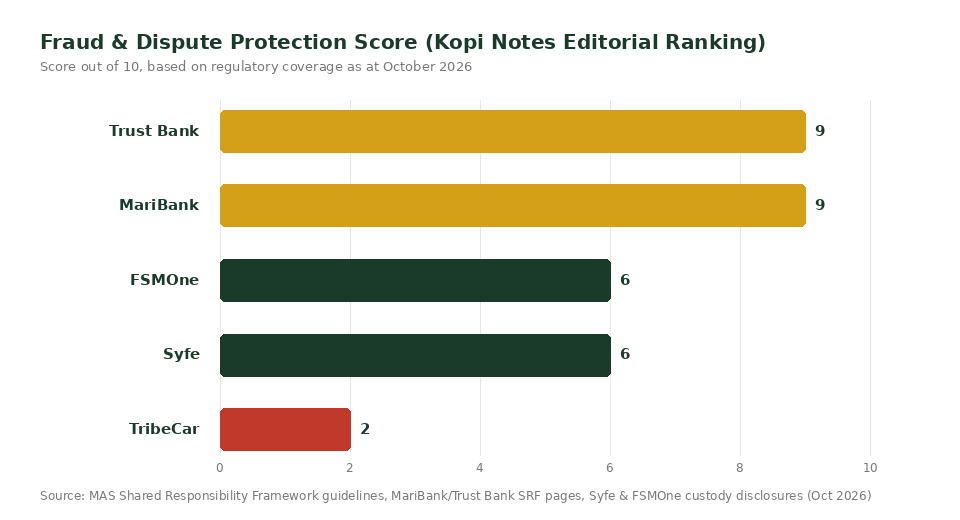
Protection Score: All 5 Platforms Ranked
To make the comparison concrete, here’s The Kopi Notes’ own editorial scoring (out of 10) for each platform, based purely on regulatory coverage as at October 2026 — not an official MAS or FIDReC rating. The score weighs three things equally: whether the platform is SRF-covered, whether client money is legally segregated, and how many independent escalation steps are available if the platform’s own decision doesn’t satisfy you.
MariBank and Trust Bank score highest (9/10) — full SRF coverage plus FIDReC, docked one point because the SRF waterfall is conditional, not a blanket guarantee. Syfe and FSMOne score 6/10 — strong money segregation and FIDReC access, but no SRF layer. TribeCar scores 2/10 — no segregation requirement, no SRF, no FIDReC, and only general consumer-protection channels as a last resort.
| Platform | Money Segregated? | SRF Covered? | External Recourse | Protection Score |
|---|---|---|---|---|
| Trust Bank | Yes (SDIC-insured deposits to S$100k) | Yes | FIDReC (up to S$150k) | 9 / 10 |
| MariBank | Yes (SDIC-insured deposits to S$100k) | Yes | FIDReC (up to S$150k) | 9 / 10 |
| Syfe | Yes (trust account + custodian ring-fencing, not SDIC) | No | FIDReC (up to S$150k) | 6 / 10 |
| FSMOne | Yes (CDP sub-account + custodian ring-fencing, not SDIC) | No | FIDReC (up to S$150k) | 6 / 10 |
| TribeCar | No (not a regulated requirement) | No | CASE mediation / Small Claims Tribunal only | 2 / 10 |
Source: The Kopi Notes editorial scoring, based on MAS SRF framework, SDIC deposit insurance scope, Syfe and FSMOne custody disclosures, and FIDReC claim limits (October 2026).
What This Means for How You Split Your Money Across These 5
This isn’t an argument for dropping Syfe, FSMOne or TribeCar — each earns its place in a 5-platform stack for reasons that have nothing to do with fraud protection (yield, fee structure, or simply not owning a car). It’s an argument for being deliberate about which balances sit where. A practical routing approach, in order of how much protection each tier carries:
Largest idle cash balances → MariBank or Trust Bank. SRF coverage plus SDIC deposit insurance up to S$100,000 per bank means your emergency fund and near-term cash sit behind the strongest combination of protections available across this stack. Splitting a large balance across both banks — rather than parking it all in one — also keeps you under the SDIC cap on each side.
Mid-term invested balances → Syfe and FSMOne. You accept market risk on anything actually invested regardless of platform, but the segregation rules mean a platform-level insolvency doesn’t touch your holdings. The gap versus the bank tier only bites in the specific unauthorised-access scenario — which is exactly why strong, unique passwords and 2FA matter more here than anywhere else in the stack.
TribeCar → deposit-sized exposure only. Since there’s no regulatory backstop at all, the sensible approach is to never let your realistic exposure — the refundable deposit plus any live trip charges — grow beyond what you’d be comfortable disputing entirely on your own, with TribeCar’s goodwill as the only mechanism.
If retirement-horizon planning is the next layer on top of this stack, our Singapore retirement calculator and guide to building passive income in Singapore both assume the same principle: know exactly what protects each dollar before you decide where it sits.
Not financial advice. Regulatory coverage, SDIC limits and FIDReC claim limits are accurate as at October 2026 and may change — always check each platform’s current disclosures before relying on this comparison.
Frequently Asked Questions
Does MAS's Shared Responsibility Framework cover MariBank and Trust Bank?
Yes. Both are full banks licensed by MAS, so they fall under the Shared Responsibility Framework that MAS and IMDA implemented from 16 December 2024. This requires them to enforce a cooling-off period of at least 12 hours on high-risk account activity after a new device login, send real-time transaction alerts, and share compensation liability with the customer and telcos under a defined waterfall if a covered phishing scam occurs.
Are Syfe and FSMOne covered by the Shared Responsibility Framework?
No. The SRF is scoped specifically to banks and telcos. Syfe and FSMOne hold Capital Markets Services licences from MAS rather than banking licences, so an unauthorised transaction on either platform doesn’t trigger the SRF waterfall. Your money is still legally segregated and ring-fenced under MAS custody rules, and you can still escalate unresolved disputes to FIDReC — it’s simply a different, narrower protection than what a bank account carries.
What happens if someone makes an unauthorised booking on my TribeCar account?
TribeCar isn’t a MAS-regulated financial institution, so there’s no SRF coverage and no FIDReC jurisdiction over the dispute. Resolution runs entirely through TribeCar’s own customer service process and internal investigation. If that doesn’t resolve things, your only external options are general consumer-protection channels like CASE mediation or the Small Claims Tribunal — both slower and without a published compensation framework.
How long does MariBank take to investigate an unauthorised transaction report?
MariBank states an investigation outcome within 21 business days of your report, extending up to 45 business days for complex cases. If you disagree with the outcome and have new supporting evidence, you can request a further investigation; if you remain unsatisfied with the final assessment, the next step is the Financial Industry Disputes Resolution Centre (FIDReC).
Can I take a dispute with Syfe or FSMOne to FIDReC?
Yes. FIDReC covers subscribed banks, insurers and capital markets services licence holders — which includes Syfe and FSMOne — for claims up to S$150,000 (raised from S$100,000 in July 2024). You generally need to go through the platform’s own internal complaints process first before FIDReC will take up the case.
Which of these 5 platforms offers the strongest fraud protection overall?
MariBank and Trust Bank rank highest because they combine SRF coverage, SDIC deposit insurance up to S$100,000, and FIDReC access. Syfe and FSMOne rank in the middle — MAS-regulated and ring-fenced, but without the SRF layer. TribeCar ranks lowest, since it carries none of the regulatory protections the other four share and relies purely on its own internal dispute process.
Open Your Accounts With Our Referral Codes
Sign up through these links for the current welcome bonuses on each platform.
This article was researched with the help of AI. While we strive to keep all information accurate and up to date, there may be errors. If you notice any discrepancies, please contact us.