T-Bill Singapore 2026: Competitive vs Non-Competitive Bidding Strategy & Q4 Yields Guide
Q4 2026 cut-off yields, bidding strategy, and whether to use CPF-OA or SRS for your next Singapore T-bill application.
The Singapore 6-month T-bill cut-off yield hit 1.92% p.a. at the 24 September 2026 auction — the highest level since early 2026, with the next auction on 8 October 2026 widely expected to price near 1.87–1.95%. T-bills (Treasury Bills) are short-term Singapore Government Securities issued by the Monetary Authority of Singapore (MAS), fully capital-protected and ideal for parking cash 6 months or less. The critical decision every investor faces is choosing between a non-competitive bid (guaranteed allotment at whatever rate clears) or a competitive bid (specify your minimum yield, risk missing out). This guide tells you exactly which to use in Q4 2026.
Not financial advice. All figures are for educational reference only. Yields as at September–October 2026 unless stated.
- Latest cut-off: 1.92% p.a. (24 Sep 2026) — up from 1.46% in July 2026
- October 8 auction (tomorrow): estimated 1.85–1.95% based on secondary market yields
- Non-competitive bids = guaranteed allotment, ideal for CPF-OA and SRS funds
- Competitive bids = cash only, higher yield risk, only worth it if you track auctions closely
- T-bill yields now above most fixed deposits but still below CPF OA (2.5%) and SSBs (~2.4–2.7%)
Table of Contents
Contents — Click to expand
- Q4 2026 T-Bill Cut-Off Yields — What the Data Shows
- How the Singapore T-Bill Auction Works
- Competitive vs Non-Competitive Bids: Full Comparison
- Which Bid Type Should You Use in Q4 2026?
- Using CPF-OA or SRS for T-Bills
- T-Bill vs SSB vs Fixed Deposit: Quick Q4 2026 Comparison
- How to Apply for the October 2026 T-Bill Auction
- Frequently Asked Questions
Q4 2026 T-Bill Cut-Off Yields — What the Data Shows
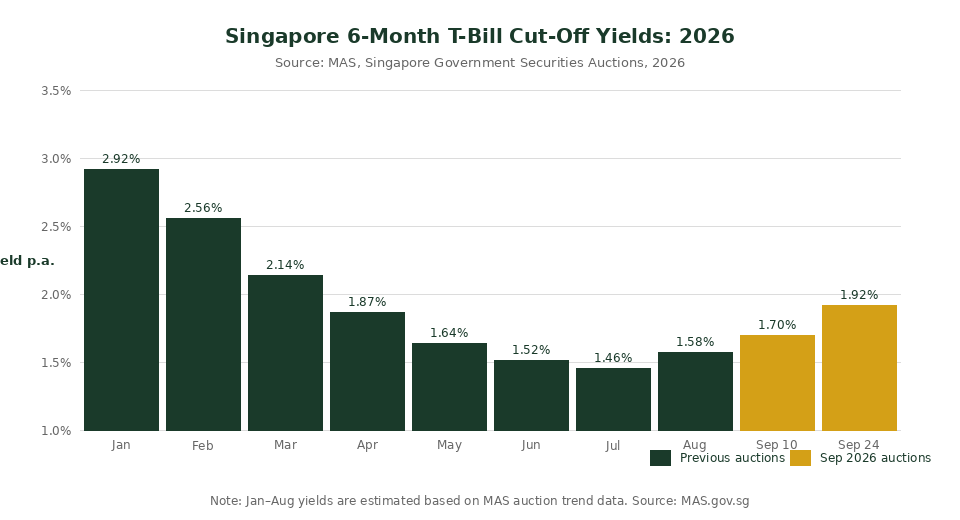
Singapore T-bill yields trended sharply lower in the first half of 2026 — from approximately 2.92% in January 2026 down to a trough of around 1.46% by the July 2026 auction — before rebounding as short-term money market rates globally responded to central bank signals. The 24 September 2026 auction closed at 1.92% p.a., a 22-basis-point jump from the 1.70% cut-off two weeks earlier. With the next auction on 8 October 2026, secondary market yields on the benchmark 6-month Singapore Government Security (SGS) were trading at approximately 1.87% as of 1 October 2026.
For context, here is how 2026 cut-off yields have evolved:
| Auction Date | Tenor | Cut-Off Yield | vs Prior Auction |
|---|---|---|---|
| January 2026 | 6-month | ~2.92% p.a. | – |
| March 2026 | 6-month | ~2.14% p.a. | ↓ from Jan high |
| May 2026 | 6-month | ~1.64% p.a. | ↓ continuing decline |
| July 2026 | 6-month | ~1.46% p.a. | ↓ 2026 trough |
| 10 Sep 2026 | 6-month | 1.70% p.a. | ↑ +24 bps |
| 24 Sep 2026 | 6-month | 1.92% p.a. | ↑ +22 bps — 2026 high |
| 8 Oct 2026 (next) | 6-month | ~1.85–1.95% est. | Auction tomorrow |
Source: MAS Singapore Government Securities Auction Results; GrowBeansprout T-bill tracker; The Kopi Notes, October 2026
The key takeaway: yields have recovered meaningfully from the H1 2026 lows but remain well below the CPF OA floor rate of 2.5% p.a. and competitive with short-term fixed deposits, which currently cluster around 1.6–1.9% for 6-month tenors.
How the Singapore T-Bill Auction Works
MAS issues 6-month T-bills on a fortnightly basis (approximately every 2 weeks), with a face value minimum of S$1,000 and subsequent multiples of S$1,000. The auction uses a uniform-price (Dutch) auction mechanism: all successful bidders receive the same cut-off yield, regardless of whether they bid above or below it.
The auction process in four steps:
- Application period: Opens 4 business days before the auction date; closes at 9pm on the auction eve
- Competitive bids sorted: MAS arranges competitive bids from lowest to highest yield (i.e. highest price to lowest); these are filled first until the issuance amount is reached
- Cut-off yield determined: The yield at which the last competitive unit is filled becomes the cut-off rate
- Non-competitive bids filled: All non-competitive applications receive the cut-off yield, subject to 40% issuance cap
The total issuance size for a typical 6-month T-bill auction ranges from S$3.5 billion to S$5 billion. If the auction is oversubscribed at the cut-off yield, allotments at that yield are prorated. Non-competitive applications that exceed 40% of the issuance are also prorated proportionally.
Competitive vs Non-Competitive Bids: Full Comparison
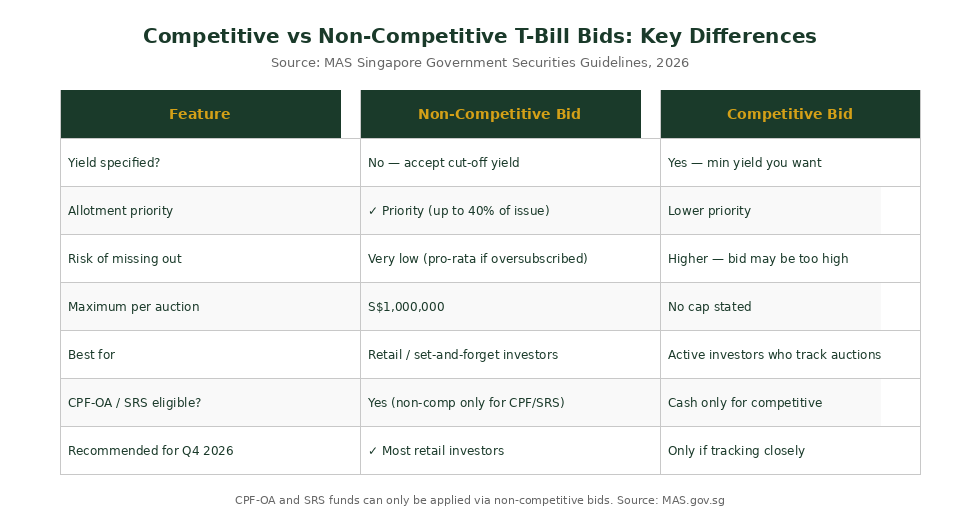
Understanding the mechanics of each bid type is the foundation of any T-bill strategy:
Non-Competitive Bids
A non-competitive application means you do not specify a yield. You simply state how much face value you want (in S$1,000 increments), and you agree in advance to accept whatever cut-off yield the auction determines. Non-competitive bids:
- Are given priority allotment up to 40% of the total issuance size
- If total non-competitive applications exceed that 40% cap, allotments are prorated (e.g. if 2× oversubscribed among non-comp bids, you receive ~50% of your application)
- Maximum application: S$1,000,000 per applicant per auction
- Are the only bid type eligible for CPF-OA and SRS funds
- Results are announced the day after the auction date
Competitive Bids
A competitive application means you specify the minimum yield you are willing to accept, expressed to 2 decimal places (e.g. 1.90%). Your bid will only be filled if the cut-off yield is equal to or higher than your specified yield. If the auction clears below your minimum, you miss out entirely and receive a full refund.
- Only available for cash applications (not CPF-OA or SRS)
- You can submit multiple competitive bids at different yields (e.g. S$20,000 at 1.85% and S$20,000 at 1.90%)
- Risk: if you bid too high and the cut-off clears below your minimum, you receive nothing
- Benefit: guarantees a minimum yield, useful if you have a hard floor return requirement
Which Bid Type Should You Use in Q4 2026?
For most Singapore retail investors, the answer in Q4 2026 is non-competitive. Here is the reasoning:
The yield spread between the non-competitive (cut-off) and a typical aggressive competitive bid is rarely more than 5–10 basis points for 6-month T-bills. On a S$50,000 application held for 6 months, a 10 bp difference translates to approximately S$25 extra interest — not worth the risk of missing an auction entirely and having your cash idle for an additional 2 weeks.
Use a competitive bid if:
- You actively monitor the T-bill secondary market (SGS daily closing yields published by MAS) and have a specific floor rate in mind
- You are investing large sums (above S$200,000) and the basis-point difference has material SGD impact
- You can tolerate a missed allotment (e.g. you have alternative short-term instruments ready)
Use a non-competitive bid if:
- You are using CPF-OA or SRS funds (non-comp is the only option)
- You want guaranteed allotment without monitoring auctions between the open and close
- Your application is under S$100,000 where the extra yield gain from competitive bidding is minimal in dollar terms
A practical tip used by many experienced TKN readers: apply non-competitively for the bulk of your T-bill holdings, and if you want a competitive slice, apply for a small tranche (e.g. S$10,000–S$20,000) competitively at a yield 2–5 bps below the latest secondary market rate — this gives you a high fill probability while capturing slightly more yield on a portion. You can learn more about short-term bond strategies in our Singapore Savings Bonds guide.
Using CPF-OA or SRS for T-Bills
Two funding sources that many investors overlook for T-bills are CPF Ordinary Account (CPF-OA) funds and Supplementary Retirement Scheme (SRS) funds. Both offer advantages:
CPF-OA T-Bill Strategy
CPF-OA earns 2.5% p.a. floor guaranteed. With T-bill yields currently at 1.92%, investing CPF-OA funds in T-bills is not recommended — you earn less than leaving the money in CPF-OA. This was the trade-off that made sense in 2022–2023 when T-bills were yielding 3.5–4.0%, well above the CPF OA floor. As of Q4 2026, the math no longer supports it unless T-bills surpass 2.5%.
If you want to optimise your CPF-OA, consider our CPF investment strategy guide for alternatives like the Endowus referral code for CPF-eligible funds.
SRS T-Bill Strategy
SRS funds earn only 0.05% p.a. when uninvested, so a T-bill at 1.92% is dramatically better than idle SRS cash. The SRS application process is identical to CPF-OA: non-competitive only, applied through your SRS operator bank (DBS/POSB, OCBC, UOB) via iBanking or ATM. You can invest up to your SRS account balance.
If you invest S$50,000 in SRS T-bills at 1.92% for 6 months, you would earn approximately S$480 in interest (before the slight discount calculation) tax-deferred within your SRS — versus essentially zero in the default SRS savings rate. For an SRS alternative that may offer higher returns, consider Syfe Cash+ Guaranteed, which targets 2.0–2.3% p.a. with daily liquidity.
T-Bill vs SSB vs Fixed Deposit: Quick Q4 2026 Comparison
| Instrument | Current Yield | Tenor | Key Feature |
|---|---|---|---|
| 6-Month T-Bill | 1.92% p.a. | 6 months | Capital-guaranteed, fortnightly auctions |
| SSB (Nov 2026 issue) | ~2.4–2.7% p.a.* | Up to 10 years | Flexible redemption anytime, no penalty |
| CPF OA | 2.5% p.a. | Ongoing | CPF floor rate, no investment needed |
| Best 6-Month Fixed Deposit | ~1.8–2.0% p.a. | 6 months | Bank-specific, min deposits may apply |
| Syfe Cash+ Guaranteed | ~2.0–2.3% p.a. | Flexible | Daily liquidity, T-bill backed |
| FSMOne Money Market Fund | ~1.8–2.1% p.a. | Daily | Same-day liquidity, no lock-in |
*SSB Nov 2026 issue rate estimated; apply via ATM or iBanking by October 28. Sources: MAS, SSB website, bank promotions, October 2026.
For most investors with cash to park for exactly 6 months, the T-bill at 1.92% is competitive — but not the top choice versus SSBs (better yield, flexible exit) or leaving CPF funds in OA (2.5% floor, zero effort). T-bills win when: you need a hard 6-month maturity, you are using SRS funds, or you want government-grade safety outside the CPF system.
How to Apply for the October 2026 T-Bill Auction
The 8 October 2026 auction application window opens from approximately 6 October and closes at 9pm on 7 October 2026 (auction eve). Here is how to apply:
- Via ATM: DBS/POSB, OCBC, or UOB ATM → “More Services” → “Fixed Income / SGS” → “T-Bills” → select amount and bid type
- Via iBanking: Log in to your bank’s internet banking → Invest → Singapore Government Securities → T-Bills → apply
- Via CDP: Online at CDP internet (cdp.sgx.com) using your bank-linked account
- For SRS: Log in to your SRS operator bank’s iBanking → SRS → Invest in T-Bills → non-competitive bid only
- For CPF-OA: Log in to bank iBanking → CPF Investment → T-Bills. Only available for non-competitive applications.
Minimum investment: S$1,000. Results are typically announced 1 business day after the auction. Proceeds (discounted face value) are returned to your bank account upon maturity.
If you are considering building a broader passive income strategy beyond T-bills, check our guides on passive income in Singapore 2026 and the Singapore retirement calculator to model your long-term income needs.
Frequently Asked Questions
What is the current Singapore T-bill cut-off yield in October 2026?
Should I use a competitive or non-competitive T-bill bid?
Can I use CPF-OA to invest in T-bills in 2026?
Can I use SRS funds to buy T-bills?
What happens if the T-bill auction is oversubscribed at the non-competitive level?
Is the Singapore T-bill safe? What is the risk?
How does the T-bill cut-off yield translate to my actual return?
Build Your Singapore Income Strategy Beyond T-Bills
T-bills are a great parking spot for short-term cash, but a complete passive income plan needs more. Explore dividend S-REITs, ETFs, and robo-advisors for your longer-term money:
- Best S-REITs in Singapore 2026 — 5–7% yield, tax-free dividends
- Singapore REIT ETF guide — diversified REIT exposure via one fund
- Retirement calculator — model your monthly passive income goal
This article was researched with the help of AI. While we strive to keep all information accurate and up to date, there may be errors. If you notice any discrepancies, please contact us.