Endowment Plan Laddering Strategy Singapore 2026: Build Guaranteed Income at Every Life Stage
Stagger your endowment plans across multiple tenors — 2Y, 5Y, 10Y, and 20Y+ — to unlock guaranteed payouts exactly when you need them.
An endowment plan laddering strategy means splitting your savings capital across endowment plans with different tenors — typically 2-year, 5-year, 10-year, and 20-year — so you receive guaranteed payouts at staggered intervals rather than all at once. Instead of locking everything into a single plan, you create a reliable income pipeline matched to your milestones: emergency fund, home down payment, education fund, and retirement top-up, all from the same guaranteed-return vehicle.
Not financial advice. All figures are for educational reference only. Data verified as at October 2026 unless noted.
- A 4-bucket ladder (2Y / 5Y / 10Y / 20Y) on S$50,000 generates an estimated S$68,674 in guaranteed payouts — a net gain of S$18,674 with zero market risk
- Short tenors (2–3Y non-par) deliver 1.88–2.20% p.a. fully guaranteed; longer tenors rely partly on par fund bonuses but can illustrate 3–4%+
- The key is starting all four plans at the same time — your capital keeps working while you wait for each rung to mature
- Use TKN’s retirement planning calculator to model your own ladder before committing
Table of Contents
What Is Endowment Plan Laddering?
Laddering is a capital allocation technique borrowed from fixed-income investing — the same concept you apply to Singapore Savings Bonds or T-bills, applied to endowment plans in Singapore. Instead of placing all your capital into a single product with a single maturity date, you split it across plans that mature at different points in time.
The core benefit is liquidity management with guaranteed returns. Each “rung” of the ladder matures at a planned date, releasing capital exactly when a goal comes due — without forcing you to surrender early (which typically means penalties) and without leaving money idle.
For Singapore investors, endowment plans are a natural fit for laddering because:
- Non-participating (non-par) plans offer fully guaranteed maturity values — the payout is contractually locked in from day one
- Short-tenor plans (2–3 years) are widely available from major insurers including DBS, OCBC, Singlife, Manulife, and Prudential
- There is no capital gains tax and no withholding tax on returns — unlike dividend stocks or REITs, your guaranteed return is your net return
- The Singapore Savings Bond alternative offers flexibility but falling rates — a locked-in endowment can beat SSB if purchased at the right moment
Why Ladder Instead of One Big Plan?
Putting all your capital into a single 10-year endowment plan looks efficient on paper — but in practice it creates three problems:
1. Liquidity risk: Life does not wait for your maturity date. A home purchase opportunity, a medical expense, or a retrenchment in year 7 means you face surrender charges and receive below-par value. A ladder keeps shorter-tenure plans maturing regularly, giving you penalty-free access every 2–3 years.
2. Rate lock-in risk: You commit to today’s rates for a decade. If rates rise in year 3 (as happened in 2022–2023), you cannot reinvest at the higher level. Shorter rungs allow you to reinvest each maturity at prevailing rates — exactly what T-bill laddering exploits.
3. Misalignment with goals: Different financial milestones have different timelines. A wedding fund needs 3 years. An education fund needs 12. Retirement top-up needs 20+. One plan cannot serve all these simultaneously.
The alternative — one plan per goal — is exactly what laddering does systematically. Each rung is purpose-built to mature at a defined goal date, using fully guaranteed returns where the tenure is short, and participating bonuses to boost returns on the longer end.
Guaranteed Returns by Tenor (2026)
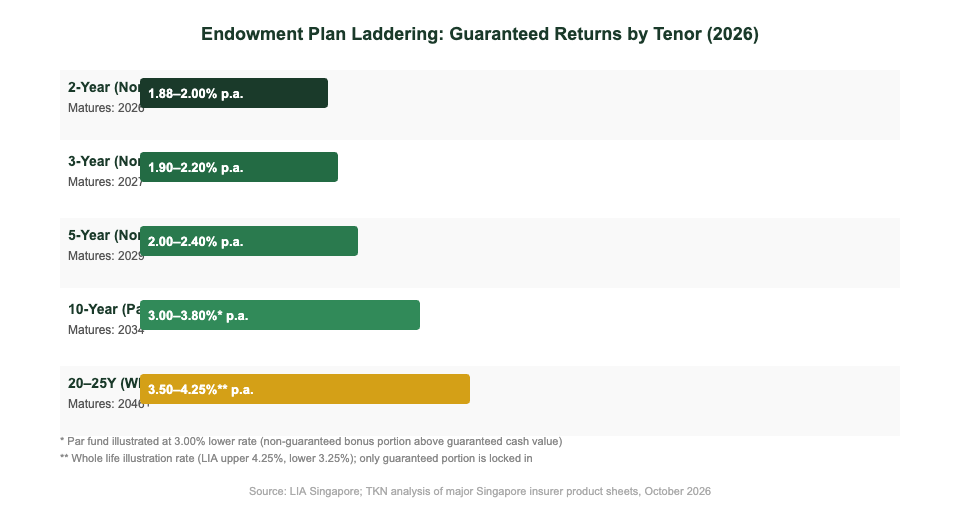
Not all endowment plan types offer the same return profile. The key distinction is between non-participating (non-par) plans — where the maturity value is fully guaranteed from day one — and participating (par) plans — where returns split into a guaranteed cash value and non-guaranteed bonuses from the insurer’s par fund.
For laddering purposes, use non-par plans for the short rungs (2–5 years) where you need certainty, and consider par plans for the longer rungs (10–25 years) where the illustrated upside from bonuses is worth the participation.
| Tenor | Plan Type | Indicative Rate (2026) | Guarantee? | Best Used For |
|---|---|---|---|---|
| 2–3 Years | Non-Par | 1.88–2.20% p.a. | Fully guaranteed | Emergency buffer, travel, wedding |
| 5 Years | Non-Par | 2.00–2.40% p.a. | Fully guaranteed | HDB down payment, home upgrade |
| 10 Years | Par (or non-par) | Guaranteed CV + non-guaranteed bonuses (illus. 3.00–3.80%) | Guaranteed portion only | Education fund, business capital |
| 20–25 Years | Par / Whole Life | Guaranteed CV + bonuses (illus. 3.50–4.25%+) | Guaranteed portion only | Retirement top-up, legacy |
Source: TKN analysis of Singapore insurer product sheets; LIA Singapore Illustrated Investment Rate of Return guidelines. Non-par rates sourced from DBS/Manulife, Singlife, Prudential product disclosures, October 2026. Par plan illustrated rates are subject to par fund performance and are not guaranteed. Always check your benefit illustration before committing.
The short-tenure non-par rates in October 2026 remain competitive at 1.88–2.20% p.a. fully guaranteed — higher than most savings accounts and comparable to T-bill cut-off yields at this point in the rate cycle, without T-bill reinvestment uncertainty.
Sample S$50,000 Ladder Portfolio
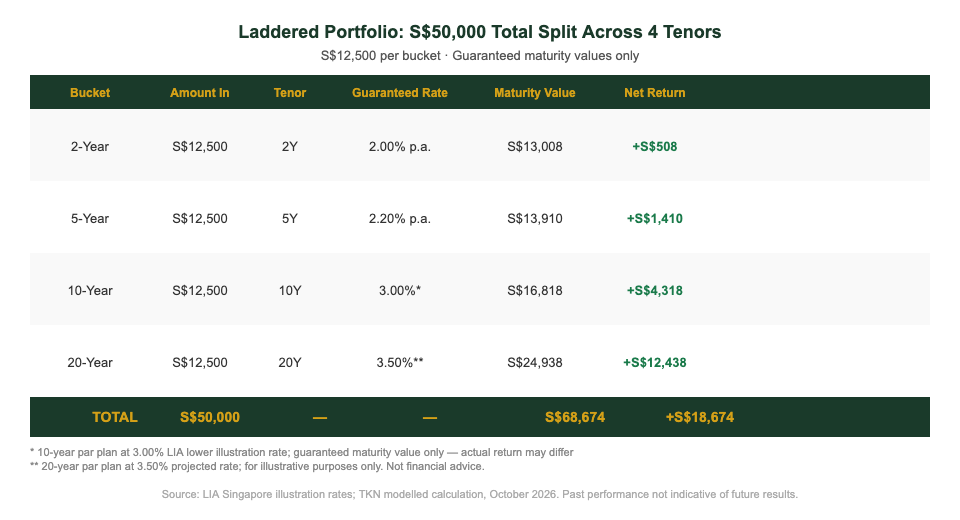
Here is a concrete illustration of how a Singapore investor might structure a S$50,000 endowment ladder. Each bucket is funded simultaneously — all four plans begin today. The capital in the longer buckets keeps compounding while the shorter ones mature and are redeployed.
Assumptions: S$50,000 split equally into 4 plans of S$12,500 each. Rates are indicative as at October 2026 based on published product disclosure sheets. Non-par guaranteed rates are used for 2Y and 5Y; illustrated rates (lower projection) are used for 10Y and 20Y par plans. This is a simplified illustration — actual maturity values will depend on the specific product chosen, your age, premium payment structure, and the insurer’s par fund performance for the longer tenors.
| Bucket | Capital In | Tenor | Rate Used | Maturity Value (est.) | Net Gain |
|---|---|---|---|---|---|
| Short-Term | S$12,500 | 2 Years | 2.00% p.a. (guaranteed) | ~S$13,008 | +S$508 |
| Medium-Short | S$12,500 | 5 Years | 2.20% p.a. (guaranteed) | ~S$13,910 | +S$1,410 |
| Medium-Long | S$12,500 | 10 Years | 3.00% p.a. (illus. lower rate) | ~S$16,818 | +S$4,318 |
| Long-Term | S$12,500 | 20 Years | 3.50% p.a. (illus. lower rate) | ~S$24,938 | +S$12,438 |
| TOTAL | S$50,000 | — | — | ~S$68,674 | +S$18,674 |
Source: TKN modelled calculation, October 2026. 2Y and 5Y maturity values calculated using guaranteed rates from published non-par product disclosures. 10Y and 20Y maturity values use LIA lower illustrated investment rates for par policies — these include non-guaranteed bonus assumptions and actual returns may be lower or higher. Not a guarantee of future performance. Always verify with your insurer’s benefit illustration before investing.
The S$18,674 total net gain represents a blended return of approximately 2.65% p.a. on the full S$50,000 over a weighted average holding period — and this is the conservative scenario using the LIA lower illustrated rate for the par plan rungs. If the par funds perform at the upper illustrated rate, the total would be considerably higher. All of this without any exposure to equity market volatility.
Compare this to leaving S$50,000 in a savings account at 2.0% p.a. for 2 years — you’d earn approximately S$2,020 in interest and then face reinvestment risk when rates change. The ladder locks in rates across a range of tenors simultaneously.
How to Build Your Endowment Plan Ladder in 5 Steps
Step 1 — Define your milestone map. List your financial goals and their target dates. House down payment in 5 years? Child’s university in 12 years? Retirement at 65? Each goal becomes one rung. This gives you the tenor structure before you look at any product.
Step 2 — Decide your total capital allocation. Laddering works best when each rung is funded adequately — generally a minimum of S$10,000 per plan to be worthwhile. If your total capital is S$30,000, a 3-rung ladder (2Y / 5Y / 10Y) may suit better than forcing 4 rungs.
Step 3 — Match plan types to tenors. Use non-par plans for 2–5 year rungs (certainty is worth the slightly lower ceiling). For 10+ year rungs, get benefit illustrations from at least 2–3 par plan providers and compare guaranteed cash values — not just illustrated totals. Understanding what the maturity payout actually guarantees is critical before signing.
Step 4 — Purchase all plans within the same month. The power of the ladder comes from all rungs running simultaneously. Staggering the start dates means the long-tenor plans benefit from less compounding time than intended. If cash flow is an issue (e.g., regular premium plans require monthly payments), map out the premium schedule before committing to ensure affordability across all rungs.
Step 5 — Plan what to do with each maturity. When Rung 1 (2Y) matures, do you reinvest into a new 5-year plan, use it for the intended goal, or deploy it via Endowus or FSMOne into a diversified portfolio? Having this answer in advance prevents the maturity proceeds from sitting idle in a low-interest bank account.
Which Insurers Offer Which Tenors in Singapore?
The Singapore market is well-served across all tenor buckets. Here is where each major insurer plays as at October 2026. Note that product availability changes frequently — verify with each insurer or a licensed financial adviser before committing.
| Insurer | Short (2–3Y) | Medium (5Y) | Long (10Y+) | Notes |
|---|---|---|---|---|
| Singlife | ✅ Max Saver II (2.00% p.a.) | ✅ (check availability) | ✅ Par plans | Strong short-tenor guaranteed rates |
| DBS/Manulife | ✅ SavvyEndowment (~1.88% p.a.) | ✅ | ✅ | Accessible via DBS branches and iBanking |
| OCBC/Great Eastern | ✅ (2Y plans) | ✅ | ✅ GE PAR / Whole Life | Wide par fund range for longer tenors |
| Prudential | ✅ PRUAssure Growth (~1.70%) | ✅ | ✅ PRULink / Whole Life | Strong brand; check benefit illustration carefully |
| NTUC Income | ✅ | ✅ | ✅ Endowment / Whole Life | Co-op structure; check par fund track record |
Source: TKN analysis of publicly available product disclosures from Singlife, DBS/Manulife, Great Eastern, Prudential, NTUC Income websites, October 2026. Product availability and rates subject to change. Verify current offerings directly with each insurer or via a licensed financial adviser (FA) before purchasing.
A practical tip: for the short-tenor rungs, compare non-par guaranteed rates across at least 3 insurers before committing. For the longer-tenor par plan rungs, compare guaranteed cash values in the benefit illustration — not just the illustrated (non-guaranteed) totals. Two par plans can show identical illustrated returns but very different guaranteed floors, and the guaranteed floor is what you can actually count on.
Common Endowment Laddering Mistakes to Avoid
1. Laddering with regular premium plans without checking cashflow. Single premium plans fund each rung upfront and are simple to compare. Regular premium plans (e.g. S$500/month over 5 years) lock you into an ongoing commitment across multiple simultaneous plans. Ensure your monthly budget can sustain all rungs simultaneously before you commit to the ladder.
2. Comparing illustrated rates, not guaranteed rates, for short tenors. For a 2-year non-par plan, the illustrated rate IS the guaranteed rate (non-par has no non-guaranteed component). But some salespeople will present par plan illustrated totals alongside non-par guaranteed rates in the same table. Always ask: “What is the guaranteed maturity value?” and get it in the benefit illustration document.
3. Surrendering a rung early because of a surprise expense. This defeats the purpose. Before starting a ladder, ensure you have a separate emergency fund (typically 6 months of expenses) that sits outside the ladder entirely — so you never need to surrender an endowment plan early. The penalties for early surrender can wipe out 1–2 years of accumulated returns.
4. Ignoring the reinvestment plan for maturing rungs. When your 2-year rung matures, you will have ~S$13,000 in hand. If you spend it, the ladder collapses. If you leave it in a savings account, you lose compounding time. Have a pre-determined reinvestment rule: either redeploy into the next rung or allocate to a unit trust via FSMOne if your investment timeline has shortened.
5. Treating endowment laddering as a substitute for long-term equity exposure. A ladder delivers guaranteed, predictable returns in the 1.88–3.50%+ range. Over 20+ years, a diversified equity portfolio (ETFs) should outperform this — but without the guarantee. For long-term wealth building beyond your guaranteed floor, consider complementing your ladder with an equity allocation through Syfe or Endowus. Use TKN’s retirement planning calculator to see how both components work together toward your target retirement figure.
Frequently Asked Questions
What is an endowment plan laddering strategy?
How much do I need to start an endowment plan ladder in Singapore?
Is endowment laddering better than putting money in T-bills?
What happens if I need to surrender one rung of the ladder early?
Can I use SRS (Supplementary Retirement Scheme) funds for an endowment ladder?
Should I use non-par or par plans for the longer rungs?
How does endowment laddering compare to dividend investing for passive income?
Get Free Insurance Advice
Speak with a licensed insurance advisor. No obligation, no cost.
By submitting this form, you agree to our Privacy Policy.
This article was researched with the help of AI. While we strive to keep all information accurate and up to date, there may be errors. If you notice any discrepancies, please contact us.