How to Invest in Singapore When Interest Rates Fall: Your 2026 Action Plan
Singapore T-bill yields have dropped from 3.95% to 1.56%. Here is exactly what to do with your money now.
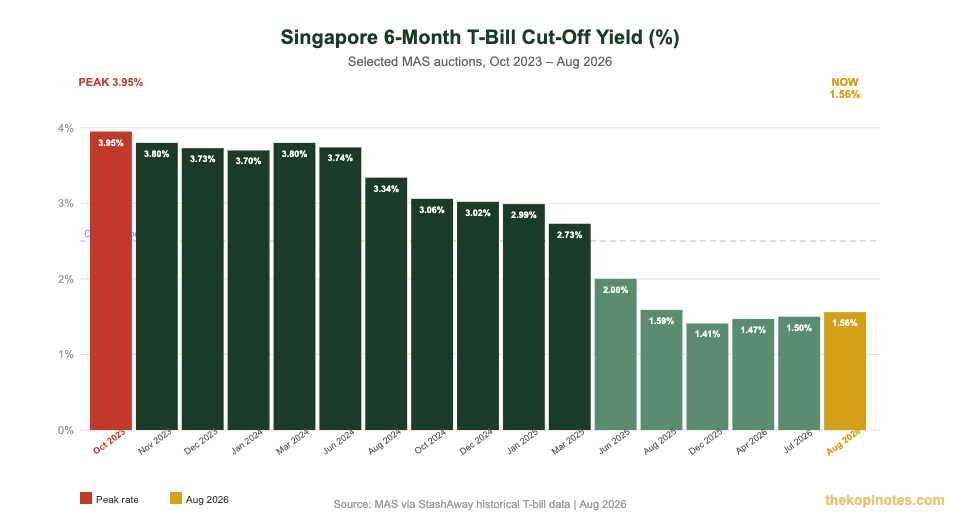
Singapore T-bill yields have fallen sharply — from a peak of 3.95% in October 2023 to just 1.56% in August 2026. If you parked money in T-bills or Singapore Savings Bonds to ride the high-rate environment, that era is over. This guide tells you where to move your money now, how to transition without losing ground, and which investment options make sense for Singapore investors in a falling-rate world.
Not financial advice. All figures are for educational reference only. Data verified as at August 2026 unless noted.
- T-bill yield has dropped to 1.56% — no longer a compelling place to park long-term savings.
- SSBs offer a better 10-year average of 2.06%, but locking up for equities makes more sense for most investors.
- The playbook: keep 3–6 months’ expenses in cash or SSBs, then shift idle T-bill money into low-cost global ETFs (CSPX/IWDA) or S-REITs for higher long-term returns.
Table of Contents
Contents — Click to expand
- Where Singapore Interest Rates Stand in 2026
- Why Falling Rates Change Your Investment Strategy
- Asset by Asset: What to Do as Rates Fall
- The Transition Plan: Moving Out of T-Bills Step by Step
- Common Mistakes When Interest Rates Fall
- Best Platforms to Make the Shift in Singapore
- Frequently Asked Questions
Where Singapore Interest Rates Stand in 2026
Two years ago, Singapore investors were spoilt for choice. Six-month T-bills were paying close to 4%. Singapore Savings Bonds (SSBs) offered a 10-year average return above 3%. Even money market funds were yielding 3.5%+. You did not need to take any risk to earn a decent return.
That picture has changed completely. Here is where key Singapore rates stand as of August 2026:
| Instrument | Rate (Aug 2026) | Change vs Peak (2023) | Liquidity |
|---|---|---|---|
| 6-Month T-Bill | 1.56% | ↓ from 3.95% | Locked 6 months |
| SSB Year 1 | 1.46% | ↓ from 3.3%+ | Flexible (1-month exit) |
| SSB 10-Yr Average | 2.06% | ↓ from 3.5%+ | Flexible (1-month exit) |
| CPF OA | 2.5% (floor) | Unchanged | Locked until withdrawal rules apply |
Source: MAS, CPF Board, August 2026. T-bill yield from Aug 13 auction. SSB from GX26080T issue.
The CPF OA’s 2.5% floor — which used to look mediocre compared to a 3.8% T-bill — now looks quite attractive. And the CPF SA and MA floors of 4% have not moved at all, which explains why CPF investment strategy matters more, not less, in this environment.
This is not a small dip. The 6-month T-bill yield has fallen by more than 2.3 percentage points from its peak. On a SGD 100,000 investment, that is SGD 2,300 less per year in risk-free return. You need to rethink your cash allocation.
Why Falling Rates Change Your Investment Strategy
When T-bill rates were near 4%, doing nothing was a reasonable strategy. You could sit in T-bills, roll them every six months, earn decent returns without any market risk, and wait for better opportunities. That strategy made sense in 2022 and 2023.
At 1.56%, it no longer makes sense for long-term money. Here is why.
Singapore’s core inflation was 1.6% in June 2026 (MAS projects a full-year 2026 average of 1.5–2.5%). At a 1.56% T-bill yield, you are at best barely keeping pace with current inflation — and if inflation tracks the upper end of the MAS forecast, you are actually losing purchasing power. Your SGD 100,000 earns SGD 1,560 a year from a T-bill, but at 2.5% inflation you need SGD 2,500 in returns just to stand still.
This is the fundamental problem with holding too much in low-yield cash instruments when rates fall: the nominal return looks positive, but the real return can be negative.
The good news is that falling interest rates typically benefit equities and bonds. Here is the basic logic:
- Lower rates reduce borrowing costs for companies and households, supporting economic growth and corporate earnings.
- Future earnings get discounted at a lower rate, which increases the present value of stocks — a key reason equity markets often rise when central banks cut rates.
- Bond prices rise when yields fall — if you hold bonds or bond funds, their market value increases as rates drop.
- REITs benefit from lower financing costs — Singapore REITs borrow to fund property purchases; lower rates improve their distribution capacity and support valuations.
None of this is guaranteed. Markets price in rate expectations before the actual cuts happen. But the general principle holds: if you have been sitting in T-bills for the past two years and rates are now falling, the opportunity cost of staying in cash is rising.
Asset by Asset: What to Do as Rates Fall
Not all money should move at once. Here is a practical breakdown of each asset class and how to think about it in the current environment:
6-Month T-Bills
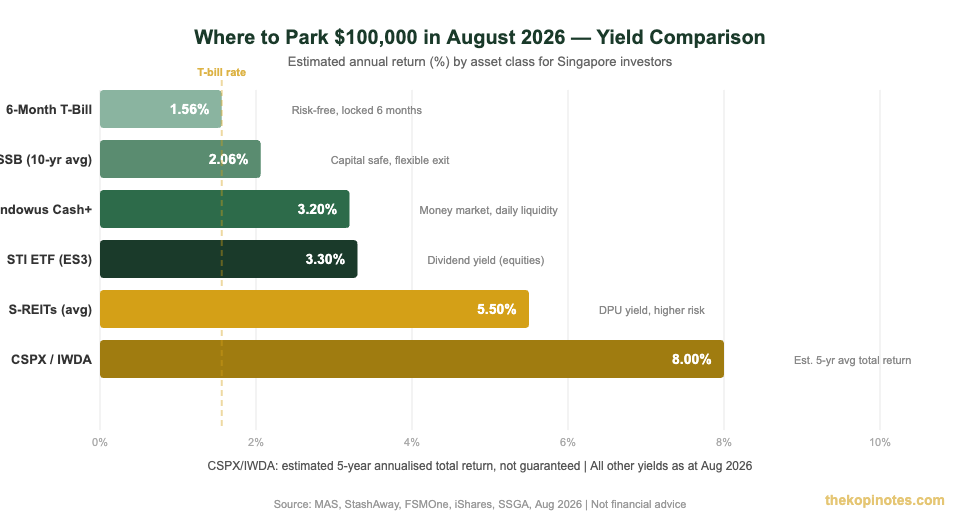
At 1.56%, T-bills are only appropriate for money you genuinely need back within six months — for example, a house down payment due next year or a planned large expense. For everything else, you are accepting inflation-beating negative real returns in exchange for certainty. Most investors should be actively reducing their T-bill allocation if they do not have a short-term need for the funds.
Singapore Savings Bonds (SSBs)
SSBs at a 10-year average of 2.06% are safer than T-bills as a long-term hold — you can exit any month without penalty. However, 2.06% over 10 years still barely keeps pace with inflation. SSBs make sense as your emergency fund or for the conservative portion of a retirement portfolio. The individual limit is SGD 200,000 across all SSB issues. Use Singapore Savings Bonds guide for the full mechanics.
Money Market Funds / Cash Management Products
Platforms like Endowus Cash+, StashAway Simple, and Syfe Cash+ also lag inflation in 2026. They offer daily liquidity but yields have compressed to around 3–3.3% for the better-performing options. These are still better than T-bills for liquidity, but not a long-term solution.
STI ETF and Singapore Blue Chips
The STI ETF (ES3) yields around 3.3% in dividends (2026). Singapore bank stocks — DBS, OCBC, UOB — are well-capitalised and profitable, though their earnings are partially sensitive to interest rate margins. In a falling rate environment, net interest margin (NIM) compression is a headwind for banks. That said, the STI ETF’s diversification across banks, REITs, and Singtel means the impact is spread. Still a solid income play for SGD dividends.
Global ETFs (CSPX, IWDA)
CSPX and IWDA are the strongest long-term case for most Singapore investors in a falling-rate environment. Lower global interest rates historically support US and global equity markets. These ETFs also carry no Singapore-specific rate risk — their underlying companies (Microsoft, Apple, Nestlé, ASML) are global businesses that are not directly tied to Singapore T-bill movements. You can learn more about local vs global ETF choices here.
S-REITs
Singapore REITs are rate-sensitive in both directions. They suffered in 2023–2024 as rising rates increased their borrowing costs and made T-bills a more attractive income alternative. Now, as rates fall, S-REITs should benefit: lower debt costs improve distributions, and yield-seeking investors rotate back in. Average S-REIT yield is around 5–6% in 2026 — significantly above T-bill rates. The Singapore REIT ETF guide covers the easiest way to get diversified REIT exposure.
The Transition Plan: Moving Out of T-Bills Step by Step
Here is a practical action plan. This is not one-size-fits-all — adjust based on your timeline, risk tolerance, and whether this money is for retirement, a house, or general wealth-building.
Step 1: Keep 3–6 months of expenses in safe, liquid instruments.
Before doing anything else, ensure your emergency fund is intact. Park 3–6 months of expenses in SSBs or a money market fund — these give you flexibility to exit without penalty. Do not invest your emergency fund in equities, even in a falling-rate environment.
Step 2: Identify your T-bill money that has no specific short-term purpose.
If you have been rolling 6-month T-bills as a “parking” strategy, ask yourself honestly: do I need this money within 2 years? If not, this is your investable surplus. It should be doing more work for you than 1.56%.
Step 3: Decide on your allocation between equities and stable income.
A simple framework based on investment horizon:
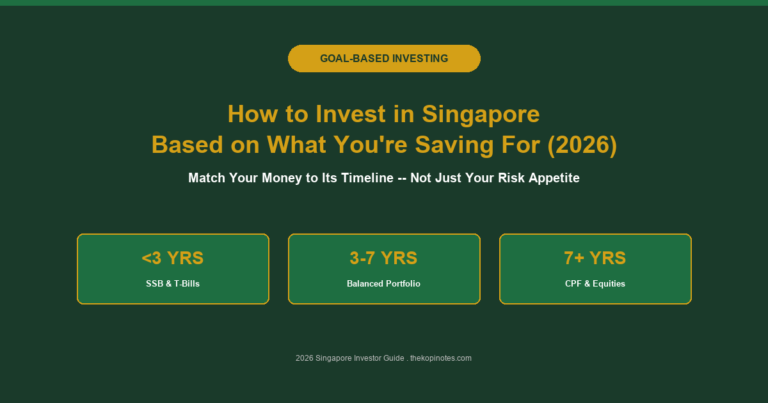
| Your Timeline | Suggested Split | Instruments |
|---|---|---|
| Under 2 years | 100% stable income | SSBs, money market funds |
| 2–5 years | 50–70% equities, 30–50% stable | CSPX/IWDA + SSBs + STI ETF |
| 5–15 years | 70–90% equities, 10–30% stable | CSPX/IWDA + S-REITs + SSBs |
| 15+ years (retirement planning) | 80–100% equities initially | CSPX/IWDA, shift to income as retirement nears |
This is a general framework, not personalised financial advice. Adjust based on your individual risk tolerance and goals.
Step 4: Deploy using dollar-cost averaging, not a lump sum.
If you have SGD 50,000 sitting in T-bills to redeploy, do not invest it all at once. Split it into 6–12 monthly tranches of SGD 4,000–8,000 and invest a fixed amount each month. This is dollar-cost averaging (DCA). You will buy more units when prices dip and fewer when they are high, smoothing out the entry risk. You can use the Singapore retirement calculator to model the long-term impact of different DCA amounts.
Step 5: Reinvest T-bill proceeds as they mature.
Your current T-bill will mature in around 6 months if you bought a 6-month bill. When it does, do not automatically roll it into a new T-bill. Pause, reassess, and direct the proceeds into your investment allocation plan from Step 3. This is the simplest, lowest-friction way to transition without making dramatic changes all at once.
Common Mistakes When Interest Rates Fall
The rate-cutting environment brings out some predictable investor behaviour. Here is what to watch out for:
Mistake 1: Staying in T-bills out of habit. Many investors started buying T-bills in 2022 when they were genuinely compelling. Now they just keep rolling them because it is familiar. Familiarity is not a strategy. At 1.56%, you are underperforming inflation. Review your T-bill position actively.
Mistake 2: Chasing yield by taking on too much risk. Falling T-bill yields push investors toward higher-risk products. Watch out for high-yield bonds, structured products, or unfamiliar instruments promising 5–8% with “guaranteed” returns. If a return looks too good and too safe, it is usually neither. Stick to well-understood instruments.
Mistake 3: Trying to time the bottom. Many investors wait for equity markets to “correct” before investing. The problem is that falling interest rates often support equity prices, so the correction may not come — or it may come and recover before you act. The data consistently shows that time in the market beats timing the market. Start deploying via DCA rather than waiting.
Mistake 4: Ignoring CPF. At 2.5% for OA and 4% for SA/MA, CPF rates now look more attractive relative to the market than they did in 2023. If you have been withdrawing CPF OA for investments in T-bills or SSBs, reconsider. The CPF SA at 4% (plus extra interest tiers) is now hard to beat on a risk-free basis. Check our CPF investment strategy for a full breakdown.
Mistake 5: Ignoring currency risk on global ETFs. CSPX and IWDA are priced in USD. If the SGD strengthens significantly as global rates fall, your ETF returns in SGD terms will be dampened. This is not a reason to avoid global ETFs — over 10+ years, currency movements tend to wash out and underlying equity returns dominate. But for money you need within 2–3 years, stick to SGD-denominated instruments.
Best Platforms to Make the Shift in Singapore
Moving from T-bills into equities or REITs requires the right platform. Here is what each is best for:
IBKR (Interactive Brokers) — best for directly buying CSPX and IWDA on the London Stock Exchange. Commission starts from USD 0.35 per trade on the tiered plan. Best for larger lump-sum investments and sophisticated investors comfortable with an international brokerage interface. Use referral code jianxiong368.
Syfe — best for automated investing into diversified portfolios including global equities and S-REITs. If you want a managed portfolio that automatically holds CSPX-type exposure plus REITs without having to buy each ETF individually, Syfe’s Core portfolios are worth considering. Use referral code SRPRFFFCD for a fee discount. Syfe also has a Cash+ product that bridges T-bill-like safety with better liquidity.
Endowus — best for CPF and SRS investors. You cannot buy CSPX directly with CPF OA funds, but Endowus lets you invest CPF OA and SRS money into globally diversified unit trusts at very competitive fees (flat 0.40% for CPF, 0.30% for SRS on the platform fee). Use referral code 2V343.
FSMOne — best for Regular Savings Plans into the STI ETF or other SGX-listed products. If you want to dollar-cost average into ES3 or local REITs without paying per-trade commissions, FSMOne’s RSP is one of the lowest-cost ways to do it. Use referral code P0544985.
Not financial advice. All figures are for educational reference only. Data verified as at August 2026. Referral codes may carry sign-up bonuses that TKN may benefit from.
Frequently Asked Questions
Should I stop buying T-bills now that yields are below 2%?
If you need the money within 6 months, T-bills at 1.56% still beat a standard savings account. But if your timeline is longer than that, 1.56% is below Singapore’s core inflation rate — meaning you are losing purchasing power in real terms. For any money you do not need within 6 months, you should be transitioning to higher-returning investments like global ETFs, S-REITs, or at minimum SSBs with a 10-year average of 2.06%.
Is the SSB a better option than T-bills right now?
SSBs offer two advantages over T-bills in the current environment: a better long-term average return (2.06% over 10 years vs 1.56% for 6-month T-bill), and full flexibility to exit in any given month without penalty. The trade-off is that the year-1 SSB rate of 1.46% is actually slightly below the current T-bill yield. For money you might need in 6–18 months, T-bills are marginally better. For longer-term safe money, SSBs win.
How does a fall in Singapore interest rates affect S-REITs?
S-REITs are typically positive beneficiaries of falling interest rates. Lower rates reduce their cost of borrowing, which improves distribution per unit (DPU). Lower rates also make the REIT yield of 5–6% more attractive relative to the risk-free rate (previously competing with T-bills at 3.8%, now competing with T-bills at 1.56%). Both effects support S-REIT valuations and income. However, REIT performance also depends on occupancy rates and rental growth — interest rates are just one driver.
Is it too late to buy global ETFs like CSPX after markets have already risen?
This is the fear that keeps many investors in T-bills long after rates fall. The problem is that global markets rarely go “too high” in a way that can be timed. Studies consistently show that the expected return from buying at an all-time high is actually close to average — because in the long run, markets trend upward. The real risk is staying in cash too long, not buying too soon. The practical answer: start with a small monthly DCA position, build up over 6–12 months, and accept that some months you will buy at higher prices and some at lower.
Can I use my SRS funds to invest when interest rates fall?
Yes — and you should. SRS contributions reduce your taxable income (up to SGD 15,300 for citizens and PRs, SGD 35,700 for foreigners in 2026), and the funds can be invested in unit trusts, ETFs, and shares. With T-bill yields falling, leaving SRS money in cash earns near-zero in the SRS account. The standard approach is to invest SRS funds through Endowus (which has a flat 0.30% SRS platform fee) into globally diversified portfolios or index funds. Use Endowus referral code 2V343 when setting up.
What if interest rates fall further — should I lock in SSB rates now?
SSBs are flexible — you can exit any month — so there is no penalty for buying now and leaving later if rates change. If you believe SSB rates will fall further (because MAS is expected to continue an accommodative stance), locking in the August 2026 issue at 2.06% 10-year average makes sense. Each SSB issue is allocated individually and rates reset monthly, so buying this month locks in the current step-up schedule. However, the individual limit across all SSB issues is SGD 200,000 combined.
How much of my portfolio should remain in 'safe' instruments?
The core rule: keep 3–6 months of living expenses in liquid, capital-safe instruments (SSBs, money market funds, or a high-interest savings account) regardless of interest rate levels. This is your emergency fund and it should never be invested in equities. Beyond that, how much stays in “safe” instruments depends on your timeline and risk tolerance. A rough guide: if your goal is 10+ years away, most of your surplus savings should be in growth assets. If it is 2–3 years away, keep 50–70% in stable instruments.
This article was researched with the help of AI. While we strive to keep all information accurate and up to date, there may be errors. If you notice any discrepancies, please contact us.