VWRA vs IWDA: FTSE All-World or MSCI World — Which Should Singapore Investors Buy? (2026)
Unlike most ETF match-ups, tax treatment is identical here. The real decision is emerging markets exposure, holdings breadth and a small TER gap — here’s the full breakdown.
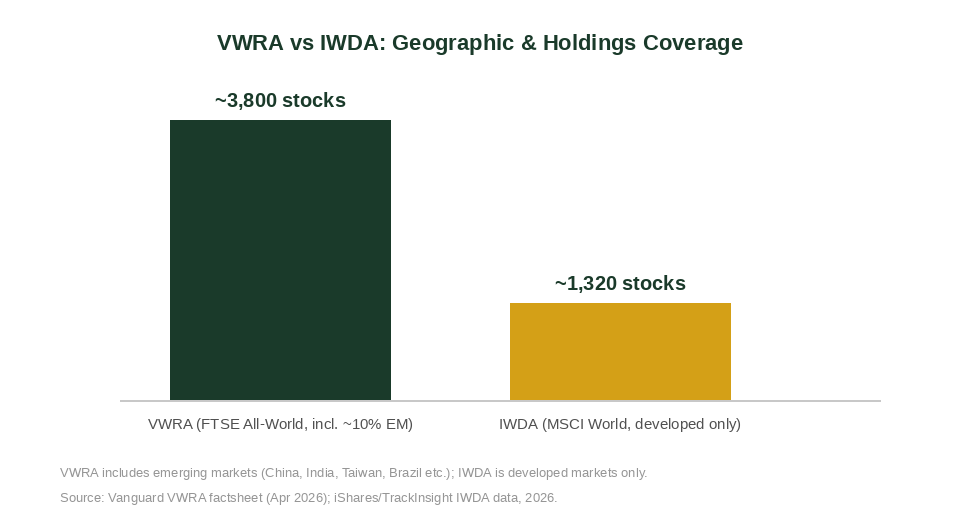
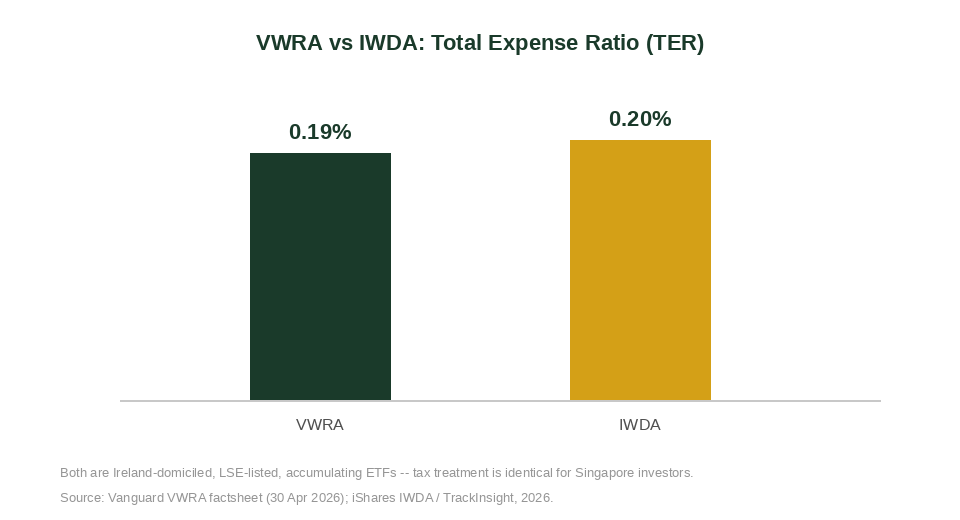
VWRA (Vanguard FTSE All-World UCITS ETF) and IWDA (iShares Core MSCI World UCITS ETF) are both Ireland-domiciled, LSE-listed, accumulating ETFs, so Singapore investors face identical withholding tax and no US estate tax exposure on either. The real difference: VWRA tracks ~3,800 stocks including roughly 8-10% emerging markets, while IWDA tracks ~1,300 developed-market-only stocks at a marginally lower 0.20% TER versus VWRA’s 0.19%.
Not financial advice. All figures are for educational reference only. Data verified as at October 2026 using Vanguard’s VWRA factsheet (30 April 2026) and iShares IWDA fund data unless otherwise noted.
Table of Contents
Quick Answer: VWRA or IWDA?
If you want one-fund-and-done global equity exposure that includes emerging markets like China, India, Taiwan and Brazil, pick VWRA. If you specifically want developed-market-only exposure — for example because you already hold a dedicated emerging markets or China ETF elsewhere and don’t want overlapping EM exposure, or you simply believe developed markets will outperform — pick IWDA. For most Singapore investors building a single-fund, globally diversified core holding, VWRA is the more common default because it is genuinely “the whole world in one ETF,” whereas IWDA deliberately leaves out roughly 10% of global market capitalisation.
Both ETFs are structured almost identically from a Singapore tax perspective: same domicile (Ireland), same exchange (London Stock Exchange), same accumulating structure that reinvests dividends automatically. This is unlike comparisons such as CSPX vs VOO, where tax treatment is the deciding factor — here, tax is a non-issue and the decision comes down entirely to what you want your portfolio to hold.
Key Differences at a Glance
| Feature | VWRA | IWDA |
|---|---|---|
| Full Name | Vanguard FTSE All-World UCITS ETF (Acc) | iShares Core MSCI World UCITS ETF (Acc) |
| Index Tracked | FTSE All-World Index | MSCI World Index |
| Coverage | Developed + Emerging Markets | Developed Markets Only |
| Number of Holdings | ~3,800 | ~1,320 |
| Domicile | Ireland | Ireland |
| Exchange | London Stock Exchange (LSE) | London Stock Exchange (LSE) |
| Structure | Accumulating | Accumulating |
| TER | 0.19% p.a. | 0.20% p.a. |
| Fund Size (AUM) | ~USD 70 billion (Apr 2026) | ~EUR 120 billion (2026) |
| US Estate Tax Risk | None | None |
Source: Vanguard VWRA factsheet (30 Apr 2026); iShares IWDA fund data / TrackInsight, 2026.
Diversification: Emerging Markets Is the Real Decision
The single biggest structural difference between these two ETFs is index coverage. VWRA tracks the FTSE All-World Index, which holds roughly 3,800 constituents spanning both developed markets (US, Japan, UK, Europe) and emerging markets (China, India, Taiwan, South Korea classified as EM under FTSE, Brazil, and others) — emerging markets typically make up roughly 8-10% of the index weight. IWDA tracks the MSCI World Index, which deliberately excludes all emerging markets and holds around 1,320 large and mid-cap stocks from 23 developed countries only.
Neither approach is “wrong” — it depends on what you believe about emerging market growth versus developed market stability, and whether you already hold EM exposure elsewhere. If VWRA is your only equity holding, you get built-in EM diversification without needing a separate fund. If you hold IWDA and want EM exposure, you’d need to add a dedicated emerging markets ETF on top — which adds a second ticker, a second set of fees, and a rebalancing decision you’ll need to revisit periodically.
Tax Comparison: Why It’s a Non-Issue Here
Unlike the CSPX vs VOO decision — where domicile and distribution structure create a real 15% vs 30% withholding tax gap for Singapore investors — VWRA and IWDA are both Ireland-domiciled, both LSE-listed, and both accumulating share classes. That means both benefit identically from the 15% US dividend withholding tax rate under the Ireland-US tax treaty (on the US-listed portion of their holdings), both reinvest dividends internally rather than distributing them, and neither carries any US estate tax exposure since neither is a US-situs asset. If you’ve already decided to invest through an Ireland-domiciled, LSE-listed, accumulating structure, you’ve already captured the tax efficiency — the remaining choice between VWRA and IWDA is purely about what the fund holds, not how it’s taxed.
Historical Performance Comparison
Because VWRA includes emerging markets and IWDA does not, their returns will diverge in any given year depending on whether emerging markets outperform or underperform developed markets. Emerging markets make up a relatively small slice of the FTSE All-World Index (roughly 8-10%), so over long holding periods (10+ years) the two funds have historically produced broadly similar cumulative returns — but year-to-year, a gap of several percentage points in either direction is normal and not a sign that either fund is mismanaged. 2025 was a year in which EM and developed market returns diverged more than usual, which is a useful reminder that short-term performance comparisons between these two funds say more about macro conditions that year than about the funds themselves.
The practical takeaway: don’t pick VWRA over IWDA (or vice versa) chasing last year’s return. Pick based on whether you want built-in emerging markets exposure as part of your core holding, since that structural choice is what actually drives the return difference over time.
Total Cost of Ownership
The TER gap between these two funds is negligible: VWRA at 0.19% versus IWDA at 0.20%, a difference of just 0.01 percentage points. On a SGD 50,000 position, that’s roughly SGD 5 a year — not a figure that should drive your decision either way. Both funds trade on the LSE in USD, so brokerage commissions and FX spread when converting SGD will be essentially identical regardless of which you choose. The only other cost difference worth noting: VWRA’s broader holdings base (3,800 vs 1,320) means marginally higher internal rebalancing and trading costs as the fund tracks a larger index, which is already reflected in the TER figures above.
Who Should Pick Which?
VWRA is the better default if: you want a single, globally diversified fund that covers both developed and emerging markets without needing to manage a second ETF; you’re building a simple one-fund or two-fund portfolio (for example, VWRA paired with a Singapore REIT ETF for local income exposure); or you want to avoid the rebalancing decisions that come with holding separate developed and emerging market funds.
IWDA may suit you better if: you specifically want to exclude emerging markets due to governance, currency or geopolitical risk concerns; you already hold a dedicated EM or China-focused ETF and want to avoid double-counting that exposure inside a broader global fund; or you’re building a more deliberate three-fund portfolio (developed markets, emerging markets, and bonds or REITs separately) and want precise control over each slice’s weighting. Either way, pair your choice with a retirement calculator to model long-term outcomes, and consider accessing either fund through Syfe, FSMOne or Endowus for a regular savings plan that automates monthly purchases.
Disclaimer: this comparison is for educational purposes only and does not constitute financial advice. Past performance of either index is not indicative of future results. Consider your own risk tolerance and investment horizon before deciding between a developed-markets-only or all-world allocation.
Frequently Asked Questions
What is the main difference between VWRA and IWDA?
VWRA tracks the FTSE All-World Index, covering around 3,800 stocks across both developed and emerging markets. IWDA tracks the MSCI World Index, covering around 1,320 stocks from developed markets only. Both are Ireland-domiciled, LSE-listed, accumulating ETFs with identical tax treatment for Singapore investors — the difference is purely in what each fund holds.
Which has lower fees -- VWRA or IWDA?
VWRA has a marginally lower TER at 0.19% per year versus IWDA’s 0.20%, as at their respective 2026 factsheets. The 0.01 percentage point gap is small enough that it should not be the deciding factor between the two — on a SGD 50,000 position, it works out to roughly SGD 5 per year.
For Singapore investors, is VWRA or IWDA more tax-efficient?
Neither has a tax advantage over the other. Both VWRA and IWDA are Ireland-domiciled, LSE-listed, accumulating share classes, so both benefit identically from the 15% US dividend withholding tax treaty rate and carry no US estate tax exposure for Singapore investors. Tax is not a differentiating factor in this comparison.
Can I switch from IWDA to VWRA without triggering tax?
Singapore does not levy capital gains tax on individual investors, so switching between IWDA and VWRA does not trigger a Singapore tax event. However, selling IWDA to buy VWRA means paying two sets of brokerage commissions and bid-ask spread, and you’ll crystallise any existing gain or loss on the IWDA position at that point — so consider the transaction cost before switching purely for a 0.01% TER difference.
Which is better for a long-term retirement portfolio -- VWRA or IWDA?
For most Singapore investors building a single-fund, globally diversified retirement portfolio, VWRA is generally the more common default because it provides built-in emerging markets exposure without needing a second fund. IWDA suits investors who have a specific reason to exclude emerging markets or who are managing EM exposure through a separate, dedicated fund.
Does VWRA or IWDA include Singapore stocks?
Singapore is classified as a developed market by both FTSE and MSCI, so both VWRA and IWDA include a small allocation to Singapore-listed companies. However, the weighting is tiny — typically well under 1% of either fund — so neither is a substitute for dedicated Singapore exposure through an STI ETF or S-REITs.
Ready to Start Investing in Global ETFs?
Open a brokerage account that supports LSE trading and build your core global equity holding today. Use our referral links for sign-up bonuses.
This article was researched with the help of AI. While we strive to keep all information accurate and up to date, there may be errors. If you notice any discrepancies, please contact us.