Nuclear ETF Singapore: Best Nuclear Energy Funds for 2026
Uranium and nuclear power ETFs explained — what they track, where to buy them, and which funds suit Singapore investors in 2026.
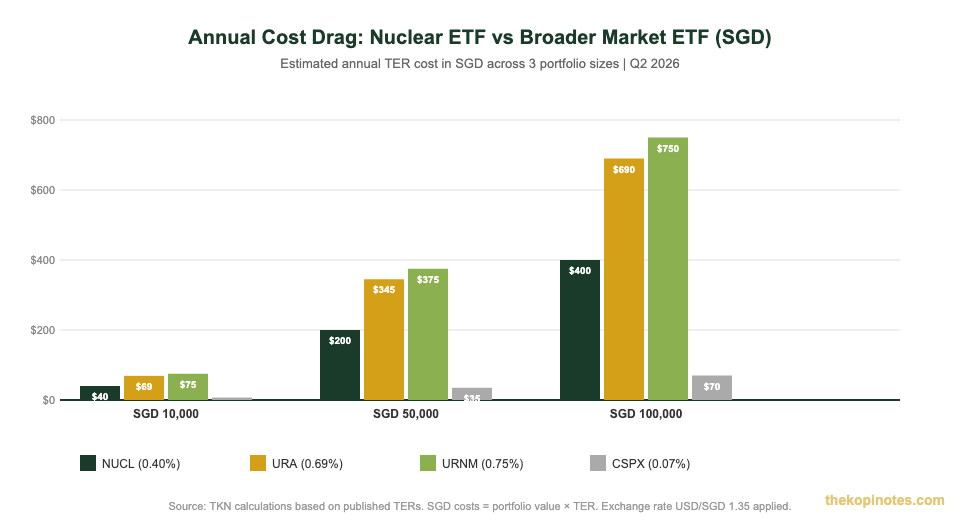
Nuclear ETFs give Singapore investors diversified exposure to uranium miners, nuclear power plant operators, and nuclear technology companies through a single listed fund. The best options in 2026 — including iShares NUCL, Global X URA, and Sprott URNM — are listed on US exchanges and accessible through brokers like Interactive Brokers and Saxo. They carry higher expense ratios (0.40%–0.75% p.a.) than broad index ETFs but capture a structurally driven energy transition theme.
Not financial advice. All figures are for educational reference only. Data as at Q2 2026 unless noted.
What Is Nuclear Energy Investing?
Nuclear energy investing involves gaining exposure to companies involved in the full nuclear fuel cycle — from uranium mining and enrichment, to reactor construction, operation, and decommissioning. Exchange-traded funds (ETFs) make this accessible to retail investors by bundling 20–50 companies into a single tradeable unit listed on a stock exchange.
Unlike buying individual uranium miners (such as Cameco or Kazatomprom), a nuclear ETF spreads risk across the supply chain. A typical nuclear ETF holds a mix of: pure-play uranium miners (high risk, high reward); nuclear power plant operators (more stable, utility-like returns); nuclear technology and engineering companies; and uranium royalty and streaming companies.
For Singapore investors, nuclear ETFs represent a thematic bet on the long-term role of nuclear power in the global energy mix. They do not pay meaningful dividends — most returns come from capital appreciation as uranium prices and nuclear-sector valuations shift.
Most nuclear ETFs relevant to Singapore investors are listed on US exchanges (NYSE Arca or Nasdaq). This means they are subject to US estate tax rules for non-US residents above USD 60,000, and dividends are subject to 30% withholding tax. Singapore investors should factor these costs in when comparing nuclear ETFs to UCITS-structured alternatives listed on the London Stock Exchange. As at Q2 2026, there is no major Ireland-domiciled UCITS nuclear ETF with significant AUM, so US-listed funds remain the primary access point.
Why Nuclear Is Trending in 2026
Nuclear power has undergone a significant rerating since 2022, driven by three structural forces that are accelerating in 2026:
1. AI Data Centre Power Demand
Hyperscalers — Microsoft, Google, Amazon, and Meta — have signed direct Power Purchase Agreements (PPAs) with nuclear operators, recognising that AI data centres require 24/7 baseload power that solar and wind cannot reliably provide. Microsoft’s deal with Constellation Energy to restart Three Mile Island (renamed the Crane Clean Energy Center) in 2024 was a landmark signal. As at Q2 2026, similar PPAs are being structured across the US, UK, and Southeast Asia.
2. NATO and European Energy Security
Europe’s move away from Russian gas has accelerated nuclear investment across France, the UK, Poland, the Netherlands, and Sweden. The EU’s inclusion of nuclear in its Taxonomy for Sustainable Finance in 2022 opened the door for ESG funds to hold nuclear assets — removing a historic structural headwind for the sector.
3. Small Modular Reactors (SMRs)
Companies like NuScale Power, Rolls-Royce, and X-Energy are advancing SMR designs that promise faster construction timelines and lower capital costs than traditional large reactors. Several Asian governments, including Singapore’s regional neighbours Indonesia and Vietnam, are studying SMR feasibility for their base-load power needs.
The uranium spot price rose from approximately USD 22/lb in 2020 to over USD 100/lb by early 2024, before pulling back to a range of USD 75–90/lb in 2025–2026 as new mine supply came online. This price action reflects a fundamental supply-demand imbalance: the world’s existing nuclear fleet requires roughly 180 million pounds of uranium per year, while primary mine production covers only about 140 million pounds — leaving a structural deficit filled by secondary supplies that are gradually being depleted. According to the World Nuclear Association, over 60 new reactors are under construction globally as at early 2026, all of which will require uranium feed when they come online over the next decade.
For Singapore investors seeking passive income Singapore diversification beyond S-REITs and dividend ETFs, nuclear energy offers genuine non-correlated exposure — its returns are driven by energy policy, uranium supply/demand, and geopolitical dynamics rather than interest rates or Singapore economic cycles.
Best Nuclear ETFs for Singapore Investors
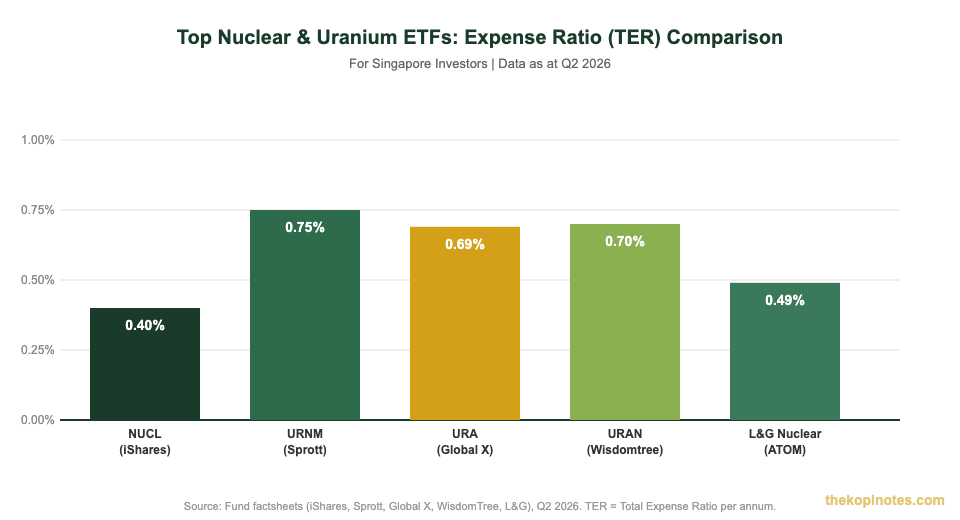
As at Q2 2026, five ETFs stand out for Singapore investors considering nuclear energy exposure. We assess each on exchange, TER, AUM, composition, and practical accessibility through Singapore-compatible brokers.
| ETF | Exchange | TER | AUM (approx) | Focus | Structure |
|---|---|---|---|---|---|
| NUCL (iShares) | NYSE Arca | 0.40% | ~USD 1.3B | Broad nuclear — operators + miners | US-domiciled |
| URA (Global X) | NYSE Arca | 0.69% | ~USD 2.1B | Uranium-heavy, includes Cameco | US-domiciled |
| URNM (Sprott) | NYSE Arca | 0.75% | ~USD 1.6B | Pure-play uranium miners only | US-domiciled |
| ATOM (L&G Nuclear Energy) | LSE | 0.49% | ~GBP 420M | Broad nuclear — UCITS structure | Ireland-domiciled UCITS |
| URAN (WisdomTree) | LSE | 0.70% | ~USD 300M | Uranium commodity ETP (physical-backed) | Jersey-domiciled ETP |
Source: Fund factsheets and issuer websites (iShares, Global X, Sprott Asset Management, L&G, WisdomTree), Q2 2026. AUM figures approximate. TER = Total Expense Ratio per annum.
Our pick for most Singapore investors: NUCL or ATOM. NUCL offers the lowest TER in the nuclear ETF universe at 0.40% p.a. and broad exposure spanning both operators and miners — reducing concentration risk. ATOM (L&G Nuclear Energy ETF, ticker: ATOM on LSE) is the UCITS-compliant alternative and is ideal for investors who want Ireland domicile to sidestep US estate tax concerns. Note that as a thematic fund, neither is suitable as a core portfolio holding — both are satellite positions alongside broader market ETFs like CSPX or VWRA.
Key Facts at a Glance: iShares NUCL vs L&G ATOM
| Metric | iShares NUCL | L&G ATOM (LSE) |
|---|---|---|
| Full Name | iShares Uranium & Nuclear ETF | L&G Nuclear Energy ESG ETF |
| Exchange | NYSE Arca (US) | London Stock Exchange |
| Domicile | USA | Ireland (UCITS) |
| TER (p.a.) | 0.40% | 0.49% |
| AUM (Q2 2026) | ~USD 1.3 billion | ~GBP 420 million |
| Holdings | ~30 companies | ~30 companies |
| Structure | Accumulating | Accumulating |
| US Estate Tax Risk | Yes (above USD 60k) | None |
| WHT on Dividends | 30% (US-domiciled) | 15% (Ireland-US treaty) |
Source: iShares factsheet, L&G factsheet, Q2 2026. WHT = withholding tax on fund-level dividends from US-listed underlying holdings.
For a Singapore investor with a SGD 50,000 nuclear ETF position (approx. USD 37,000 at 1.35 USD/SGD), the US estate tax threshold of USD 60,000 for non-US residents is not yet triggered by NUCL alone. However, if you hold other US-listed securities (individual stocks, VOO, QQQ), the aggregate counts toward that threshold. ATOM on the LSE eliminates this exposure entirely. Use our Singapore retirement calculator to model how a satellite thematic position like nuclear fits into your broader portfolio allocation.
How to Buy Nuclear ETFs in Singapore
Nuclear ETFs are accessible through standard brokerage accounts that provide access to US or UK stock exchanges. Here is how to buy the top options through Singapore-compatible brokers as at Q2 2026:
Interactive Brokers (IBKR) — Best for Cost Efficiency
IBKR offers the lowest trading costs for Singapore retail investors buying US or LSE-listed ETFs. Commission for US-listed ETFs is USD 0.005 per share (minimum USD 1 per trade), making it the most cost-effective option for positions above SGD 5,000. To buy NUCL: fund your IBKR account → select “Stocks/ETFs” → search ticker “NUCL” → choose NYSE Arca exchange → place market or limit order in USD. To buy ATOM on LSE: search “ATOM” → select London Stock Exchange → order executes in GBP.
Saxo Markets Singapore — Best for Beginners on US Markets
Saxo’s Singapore platform offers a clean interface for buying US-listed ETFs including NUCL, URA, and URNM. Commission is typically 0.08% of trade value with a USD 3 minimum. Saxo also offers margin products for experienced investors but these are not relevant for ETF accumulation strategies.
moomoo Singapore — Competitive Pricing
moomoo (operated by Futu Singapore) provides access to NYSE-listed ETFs including NUCL and URA. As at Q2 2026, moomoo offers commission-free US trades for the first 180 days for new account holders. After the promotional period, standard commission applies. Read our full moomoo Singapore review for current fee details. For moomoo account sign-up bonuses, check the Syfe referral code page for alternatives if you prefer a simpler robo-advisor experience.
Syfe Brokerage
Syfe’s brokerage platform supports US-listed stocks and ETFs, making NUCL and URA accessible. Syfe Brokerage charges 0.06% per trade (minimum USD 1.99) — competitive for larger orders. For investors who prefer thematic exposure without stock-picking, Syfe also offers thematic portfolios that include energy transition holdings. Use the Syfe referral code and sign-up bonus to get started with a reduced minimum or cash bonus.
CPF and SRS Compatibility
Nuclear ETFs listed on US exchanges (NUCL, URA, URNM) are not CPFIS-approved — you cannot use CPF Ordinary Account funds to buy them. ATOM on the LSE is also not CPFIS-eligible. These are cash-account investments only. SRS compatibility depends on your brokerage — check with your broker whether your SRS account can be used to purchase US-listed securities. For CPFIS-approved investing options, see our CPF investment strategy Singapore guide.
Practical Step-by-Step: Buying NUCL via IBKR
1. Open an IBKR account at interactivebrokers.com.sg (takes 3–5 business days to verify). 2. Fund with USD or SGD via bank transfer. 3. Log into Trader Workstation or the IBKR mobile app. 4. In the search bar, type “NUCL” and select the NYSE Arca listing. 5. Set order type (limit recommended) and quantity (NUCL trades at approximately USD 35–50 per unit as at Q2 2026 — minimum purchase is 1 unit). 6. Review and submit. Settlement is T+1 for US equities.
Risks to Consider
Nuclear ETFs are thematic, concentrated, and volatile. Singapore investors should understand the following risks before allocating:
Uranium Price Volatility: Uranium is thinly traded — the spot market is small relative to the contract market. A single large purchase by a utility or sovereign wealth fund can move prices significantly. URNM and URA are particularly sensitive to spot uranium price moves, as they hold pure-play miners whose earnings are leveraged to uranium prices.
Regulatory and Political Risk: Nuclear power is deeply political. A single high-profile incident (like Fukushima in 2011) can trigger regulatory shutdowns across entire countries, collapsing demand for uranium. Germany phased out nuclear entirely. This risk is asymmetric — upside from policy support is gradual; downside from a nuclear incident can be sudden and severe.
Concentration Risk: Most nuclear ETFs have heavy concentration in a few companies. URA, for instance, has had Cameco comprising 20–25% of the fund. Poor performance from a single major holding has an outsized impact on the fund’s returns.
Currency Risk: US-listed ETFs are priced in USD. Singaporeans investing in SGD terms are exposed to USD/SGD exchange rate movements. As at Q2 2026, USD/SGD is approximately 1.35 — a strengthening SGD would reduce SGD returns from USD-denominated holdings.
Long Time Horizon Required: Nuclear projects take 10–20 years from approval to power generation. The thesis is valid over a multi-decade horizon, but investors seeking returns within 1–3 years may find nuclear ETFs frustrating — they can underperform broad market ETFs for extended periods even if the long-term thesis is correct.
Given these risks, nuclear ETFs are best treated as a satellite allocation of 3–7% of a portfolio, paired with a core holding in a diversified global equity ETF. For comparison of S-REIT ETF options that offer dividend income, see our Singapore REIT ETF guide. For T-bill alternatives during risk-off periods, see our Singapore T-bills 2026 guide.
Disclaimer: This article is for educational purposes only and does not constitute financial advice. All investment decisions carry risk. Past performance is not indicative of future results. Consult a licensed financial adviser before making investment decisions.
Frequently Asked Questions
What is the best nuclear ETF for Singapore investors in 2026?
For most Singapore investors, iShares NUCL (NYSE Arca, TER 0.40%) is the best starting point due to its low expense ratio and broad exposure across both nuclear operators and uranium miners. If you want to avoid US estate tax risk on holdings above USD 60,000, consider L&G’s ATOM ETF on the London Stock Exchange (TER 0.49%, Ireland-domiciled UCITS). Sprott URNM is best for investors who want maximum leverage to uranium price movements, but it is more volatile and concentrated.
Can I buy nuclear ETFs using CPF or SRS funds in Singapore?
No — nuclear ETFs listed on US exchanges (NUCL, URA, URNM) and the L&G ATOM ETF on the LSE are not approved for CPFIS (CPF Investment Scheme). You cannot use your CPF Ordinary Account or Special Account to invest in these funds. SRS compatibility varies by broker; check with your brokerage whether SRS funds can be used for US or LSE securities. These are cash-account investments for most Singapore retail investors.
Is a nuclear ETF different from a uranium ETF?
Yes — nuclear ETFs and uranium ETFs have different compositions. A nuclear ETF (like iShares NUCL or L&G ATOM) holds a mix of uranium miners, nuclear power plant operators, and nuclear technology companies. A uranium-focused ETF (like Sprott URNM or Global X URA) concentrates specifically on uranium mining and royalty companies, giving higher leverage to uranium spot prices. Nuclear ETFs are generally less volatile; uranium ETFs can swing more dramatically with commodity prices. The WisdomTree URAN is unique as it is physically-backed by uranium — it holds actual uranium rather than mining company shares.
What is the minimum investment for a nuclear ETF in Singapore?
You can buy as little as 1 unit of any of these ETFs. As at Q2 2026, iShares NUCL trades at approximately USD 40–55 per unit (roughly SGD 54–74 at 1.35 USD/SGD). Global X URA trades at around USD 25–35 per unit. The practical minimum is set by your broker’s minimum commission — IBKR charges a minimum of USD 1 per US equity trade, making even small purchases cost-effective. For investors who prefer to start with smaller amounts, Syfe Brokerage allows fractional shares for some US-listed ETFs.
How has the nuclear ETF sector performed recently?
Nuclear ETFs experienced strong returns from 2020–2024 as uranium prices surged from USD 22/lb to over USD 100/lb, before consolidating in 2025. As at Q2 2026, uranium spot prices have stabilised in the USD 75–90/lb range. Nuclear ETF performance has been mixed in 2025–2026 compared to the broader market — NUCL and URNM delivered strong multi-year returns but underperformed the S&P 500 in the near term as the initial uranium price surge faded. Long-term investors see the current consolidation as a potential accumulation opportunity ahead of new reactor demand from AI data centres and SMR deployments in the late 2020s.
Are nuclear ETFs suitable for a retirement portfolio in Singapore?
Nuclear ETFs are thematic and volatile — they are not suitable as a core retirement holding. They are best used as a satellite allocation (typically 3–7% of a portfolio) alongside diversified core holdings such as a global equity ETF like CSPX or VWRA, and income-generating assets like S-REITs. If you are within 5–10 years of retirement, the volatility of a pure nuclear position may not be appropriate, and capital preservation instruments like Singapore Savings Bonds or T-bills may be more suitable for that portion of your portfolio. Use our Singapore retirement calculator to model different allocation scenarios.
Ready to Start Investing in ETFs?
Open a brokerage account and build your ETF portfolio today. Use our referral links for exclusive sign-up bonuses.
This article was researched with the help of AI. While we strive to keep all information accurate and up to date, there may be errors. If you notice any discrepancies, please contact us.