MediSave Limit 2026: Paying Private Hospital Bills After the New ISP Rider Co-Payment Rules
Updated: 9 October 2026 | Category: Integrated Shield Plans
Your MediSave Basic Healthcare Sum cap rose to $79,000 in 2026 — but when a private hospital bill lands, that balance barely makes a dent. The daily withdrawal limit is $500, capped at $55,000 annually. Worse, if you bought a new Integrated Shield Plan rider after 1 April 2026, you now face a minimum deductible of up to $3,500 and a 5% co-payment that cannot be waived — with the cap raised to $6,000 per year. Here’s exactly how these rules stack up on a real private hospital bill.
This article is for educational reference only and does not constitute financial or medical advice. Data verified as at 9 October 2026.
In This Article
What Changed in April 2026: The New ISP Rider Rules
From 1 April 2026, MOH introduced new design requirements for Integrated Shield Plan (ISP) riders sold by private insurers. If you purchased or renewed a rider on or after this date, your plan must now comply with several mandatory co-payment rules that fundamentally change how your private hospital bills get settled.
The Five Key Changes
1. Minimum deductible — no longer coverable by riders. The old arrangement where comprehensive riders covered your entire IP deductible is gone. New riders sold from April 2026 cannot cover the minimum IP deductible, which ranges from $1,500 to $3,500 per policy year depending on your ward class. For a private hospital stay, that means up to $3,500 comes out of your own pocket before insurance kicks in.
2. Minimum 5% co-payment — permanent. New riders must maintain a minimum co-payment of 5% on the claimable portion of your bill. This cannot be waived, even for the most premium plans available in the market.
3. Co-payment cap raised to $6,000 per year. The maximum co-payment you will pay in any policy year is now $6,000, up from the previous $3,000 cap. While this offers some protection against catastrophic bills, it doubles the maximum annual out-of-pocket exposure compared to pre-April 2026 rider designs.
4. Premium reductions of approximately 30%. In exchange for bearing more co-payment risk, new-design riders cost roughly 30% less than the legacy “as charged” riders they replace. For younger policyholders, this premium saving can be meaningful over decades.
5. Legacy riders preserved until April 2028. If you already held a comprehensive rider before April 2026, you can keep it — for now. But you cannot top up or change your coverage without triggering the new rules. All legacy riders must eventually be redesigned by April 2028.
| Feature | Legacy Rider (pre-Apr 2026) | New Rider (from Apr 2026) |
|---|---|---|
| Covers IP deductible? | Yes (fully) | No — $1,500–$3,500 excluded |
| Minimum co-payment | 0%–5% (varies by plan) | 5% (mandatory) |
| Co-payment cap (per year) | $3,000 | $6,000 |
| Annual premium (approx.) | Higher (~30% more) | ~30% lower |
| Legacy riders valid until | April 2028 | N/A (new design) |
Source: Ministry of Health (MOH) Singapore, Dollars and Sense (2026). For official guidance see moh.gov.sg.
For a deeper look at how these deductible changes affect different age groups and coverage tiers, see our analysis in how the 2026 MediSave limit interacts with your ISP deductible.
MediSave Limits for Private Hospital Bills
Understanding the MediSave limit in 2026 requires looking at two separate numbers: the Basic Healthcare Sum (BHS), which caps how much you can hold in your MediSave account, and the withdrawal limits, which govern how much you can actually draw down for a specific hospital bill.
Basic Healthcare Sum (BHS) 2026: $79,000
The BHS rose to $79,000 on 1 January 2026, up from $75,500 in 2025. This is the cap on your MediSave balance — any excess above this limit spills over to your Special Account (or Retirement Account for those over 55). Having $79,000 in MediSave does not mean you can withdraw $79,000 for a single hospital stay. The withdrawal limits are far more restrictive.
Daily Hospitalisation Withdrawal: $500/Day
For general inpatient hospitalisation charges (room and board), MediSave pays up to $500 per day per patient. For a five-day private hospital stay at $1,800 per room night, that’s just $2,500 from MediSave — covering less than 14% of room costs alone before surgeon and ancillary fees are added.
Annual Hospitalisation Cap: $55,000
There is also an annual MediSave withdrawal cap of $55,000 for all inpatient hospitalisation claims. For a person below 40, the per-admission limit begins at $25,000 and scales upward by age to $55,000 for those above 70. In practice, for private hospital bills, the ISP’s coverage (not MediSave) is doing the heavy lifting — MediSave handles only a modest portion.
ISP Premium Withdrawals: Age-Based Limits
Separately, you can use MediSave to pay your ISP premiums (the base plan, not the rider) up to an age-based Additional Withdrawal Limit (AWL). These limits increase as you age:
| Age Group | Max MediSave for ISP Premium (per year) | Typical Private Hospital ISP Premium |
|---|---|---|
| Under 40 | $300 | ~$700–$1,200 |
| 40–49 | $600 | ~$1,500–$2,500 |
| 50–64 | $900 | ~$3,000–$5,000 |
| 65–70 | $1,200 | ~$6,000–$10,000 |
| 71 and above | $1,500–$1,800+ | ~$10,000–$20,000+ |
Source: CPF Board, Additional Withdrawal Limits (AWL) for Integrated Shield Plans (2026). ISP premium figures are illustrative ranges across major insurers for private hospital coverage. Note: Rider premiums must be paid in cash — they cannot be paid from MediSave. Consult cpf.gov.sg for your specific account limits.
A key implication: the higher your age, the larger the gap between what MediSave covers and what your ISP premium actually costs. For those above 65 on a private hospital plan, the gap runs into thousands of dollars annually — all payable in cash. This is why building your MediSave to the $79,000 BHS well before retirement matters. Our guide to the BHS limit and ISP premiums in 2026 covers the age-by-age premium strain in detail.
How Much Does a Private Hospital Stay Actually Cost?
Private hospital rates in Singapore vary considerably by institution and procedure. To illustrate the interaction between MediSave limits and the new ISP rider rules, we use a realistic example: a 35-year-old admitted for five days at a private hospital for a planned abdominal procedure.
Sample Bill Breakdown ($28,000 total)
| Cost Component | Estimated Amount | MediSave Withdrawal? |
|---|---|---|
| Room & board ($1,800/day × 5) | $9,000 | $500/day → $2,500 from MediSave |
| Surgeon’s fee | $12,000 | Subject to surgical sub-limits |
| Anaesthetist fee | $3,000 | Partial MediSave coverage |
| Drugs, consumables & tests | $4,000 | Within ISP covered amount |
| TOTAL BILL | $28,000 | ~$2,500 from MediSave (daily limit) |
Illustrative example only. Private hospital rates vary by institution and procedure. Source: Singapore private hospital rate benchmarks (2026).
Notice that MediSave’s daily hospitalisation limit ($500/day) covers just $2,500 of the $28,000 bill — roughly 9%. The ISP and rider then determine how the rest is split between insurer and policyholder. This is where the April 2026 rider changes bite hardest.
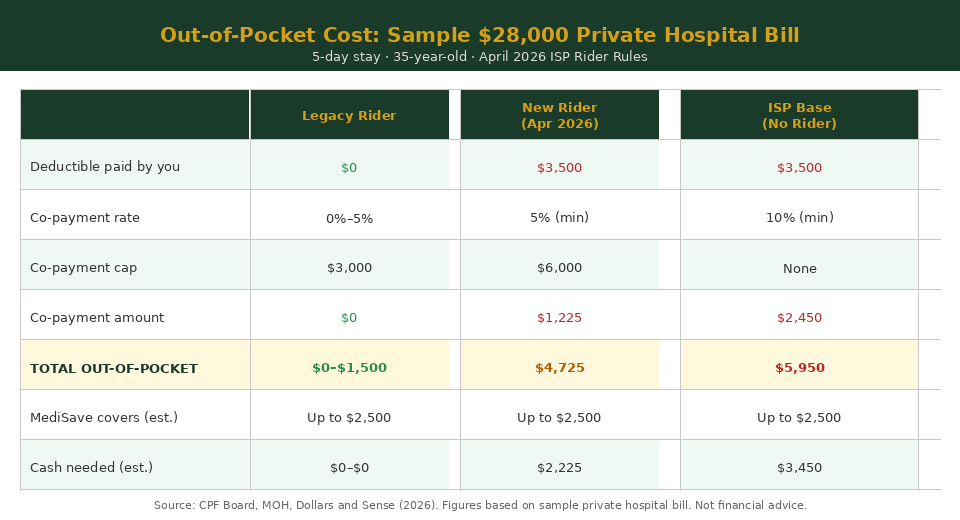
Out-of-pocket comparison for a $28,000 private hospital bill under different rider arrangements (2026). Source: CPF Board, MOH guidelines.
Bill Payment Flow: New Rider vs Legacy Rider
The single biggest misconception is that MediSave “covers” your hospital bill. In reality, MediSave is a modest top-up for daily room charges — the ISP does the heavy lifting. Here’s how the same $28,000 bill flows through each arrangement.
With a New Rider (purchased after 1 April 2026)
Step 1: MediSave pays $500/day × 5 days = $2,500 toward room charges.
Step 2: The mandatory deductible of $3,500 (private hospital class) applies. Since your new rider cannot cover this, it comes out of your pocket. After the $2,500 MediSave portion, you pay an additional $1,000 in cash to meet the deductible ($3,500 – $2,500).
Step 3: Remaining claimable amount: $28,000 – $3,500 deductible = $24,500.
Step 4: Mandatory 5% co-payment: 5% × $24,500 = $1,225 (well within the $6,000 annual cap).
Step 5: ISP covers the balance: $24,500 – $1,225 = $23,275.
Your total out-of-pocket: $3,500 (deductible) + $1,225 (co-pay) = $4,725, of which $2,500 can come from MediSave and $2,225 must be paid in cash.
With a Legacy Rider (purchased before 1 April 2026)
Step 1: MediSave pays $500/day × 5 days = $2,500.
Step 2: Your legacy rider covers the entire deductible — $0 out of your pocket.
Step 3: Depending on your plan design, the rider may cover the full remaining bill or maintain a minimal co-payment (0%–5%).
Step 4: On a comprehensive “as charged” legacy plan with 0% co-pay: ISP covers everything above MediSave.
Your total out-of-pocket: $0 to $1,500 (depending on legacy plan terms)
With No Rider (ISP base plan only)
Without a rider, MediShield Life co-insurance rates apply. The default MediShield Life co-payment is 10% on the claimable amount after the deductible. For a $28,000 bill: 10% × ($28,000 – $3,500) = $2,450 in co-payment, plus the $3,500 deductible = $5,950 total out-of-pocket. MediSave again covers $2,500 of this, leaving $3,450 in cash.
For a full breakdown of how the new rider co-payment rules compound across different bill sizes, see our deep-dive on the new ISP rider 2026 co-payment breakdown.
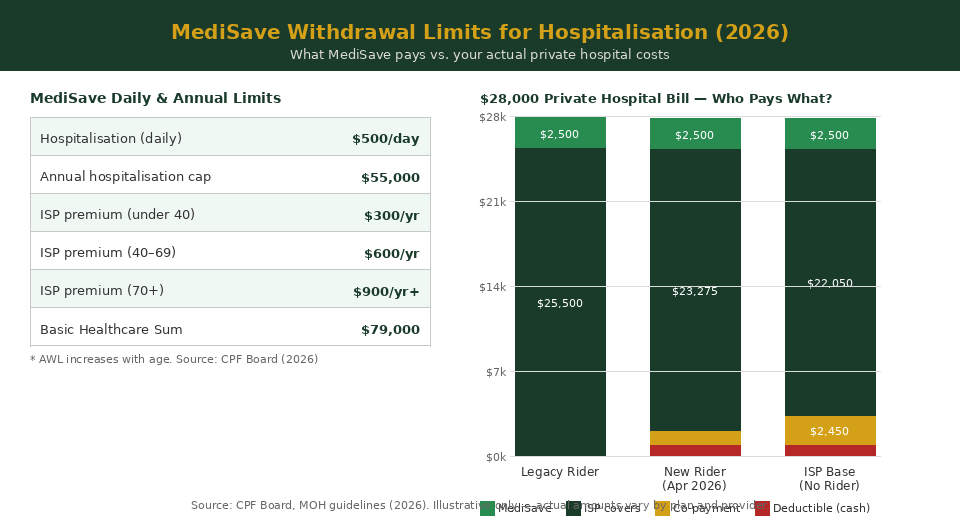
MediSave daily withdrawal limits (left) and stacked bill breakdown by payment source for three ISP rider scenarios (right). Source: CPF Board, MOH (2026).
Using Your $79,000 BHS Cap Wisely
The $79,000 BHS is not a spending limit — it’s a savings target. Once your MediSave balance reaches $79,000, your monthly CPF contributions to MediSave are redirected to your Special Account (or Retirement Account). The real question is not whether you have $79,000 in MediSave, but how that balance is being quietly depleted by ISP premiums each year.
Premiums Draw Down Your MediSave Quietly
Every year, your ISP base plan premium is deducted from MediSave up to the age-based Additional Withdrawal Limit (AWL). For a 45-year-old on a comprehensive private hospital plan, the annual ISP premium might be around $2,000. MediSave covers $600 of that; the remaining $1,400 must be paid in cash (or via GIRO). Your MediSave balance shrinks by $600 per year just for coverage maintenance — before you’ve set foot in a hospital.
Rider Premiums Are Always Cash
Critically, rider premiums cannot be paid from MediSave under any circumstances. Only the base ISP premium (covering the Integrated Shield Plan itself) qualifies for MediSave withdrawal, within the AWL. If your new rider costs $800 per year, that’s entirely a cash expense — and with the new riders costing roughly 30% less than the legacy “as charged” plans, the annual cash saving can be $200–$600 depending on your coverage tier and age.
A Practical Strategy: Treat MediSave as Floor, Not Ceiling
Because MediSave withdrawal for a private hospital bill is limited to ~$2,500 for a five-day stay, and your out-of-pocket with the new rider can reach $4,725, you need a cash buffer of at least $2,000–$3,000 available at short notice. The $79,000 BHS gives you a deep MediSave reserve for long-term premium payments and sustained hospitalisation — but it does not solve the immediate deductible-plus-co-payment gap that hits with a single private hospital admission under the new rider rules.
Planning ahead across different life stages is essential. Our MediSave limit 2026 life stage guide walks through how the BHS cap, ISP premiums, and hospitalisation risk intersect at ages 30, 45, 60, and 70.
Should You Keep Your Legacy Rider or Switch to a New Rider?
This is the most common question facing Singaporeans with ISP coverage today. The answer depends on your risk tolerance, cash reserves, and how likely you are to need private hospital care in the next few years.
The Case for Keeping Your Legacy Rider
If you or a family member has pre-existing conditions, frequent hospitalisation history, or simply prefers zero-surprise billing, keeping your legacy rider until April 2028 makes sense. The lower out-of-pocket exposure (potentially $0 vs $4,725+ per admission) can be worth the higher annual premium, especially if you expect one or more hospitalisation events in the next two years. Legacy riders also provide certainty: the deductible is covered, and co-payment is at the historical low rate.
The Case for Switching to a New Rider
If you are younger (under 40), in good health, and have a liquid cash buffer of at least $5,000–$10,000, the new rider’s lower premium — roughly 30% less — may be the better long-term deal. The $4,725 out-of-pocket exposure for a $28,000 bill is manageable if you have the savings. Over 20 years, the premium savings could compound into a meaningful sum.
What You Cannot Do
You cannot upgrade or top up a legacy rider without triggering the new design rules. If your current insurer offers a “comprehensive” legacy rider and you want to add extra coverage, any amendment will automatically bring the April 2026 co-payment requirements into play. Contact your insurer directly to understand what changes — if any — you can make without losing your legacy status. The private hospital coverage and MediSave guide explains the coverage tiers in detail.
Before making any decision, compare your current plan against the new options using our complete MediSave limit 2026 overview as a reference point.
Frequently Asked Questions
What is the MediSave daily withdrawal limit for private hospital stays in 2026?
Can MediSave cover the new $3,500 private hospital deductible?
How much do I pay out of pocket with a new ISP rider for a $28,000 private hospital bill?
What happens to my legacy ISP rider when April 2028 arrives?
Can I pay my ISP rider premium from MediSave?
Does the $79,000 BHS limit affect how much I can claim for a hospital stay?
Protect Your MediSave for What Matters
The April 2026 ISP rider changes mean more is coming out of your pocket at the hospital. Building your MediSave to the $79,000 BHS — and holding a cash buffer for deductibles — is now essential financial hygiene. Start with the right investment account to grow your liquid emergency fund.
Get Free Insurance Advice
Speak with a licensed insurance advisor. No obligation, no cost.
By submitting this form, you agree to our Privacy Policy.
This article was researched with the help of AI. While we strive to keep all information accurate and up to date, there may be errors. If you notice any discrepancies, please contact us.