How to Claim on Your Integrated Shield Plan in Singapore (2026 Guide)
A step-by-step walkthrough of filing an Integrated Shield Plan (IP) claim — including how the April 2026 rider changes affect what you pay.
An Integrated Shield Plan (IP) claim is how your private insurer pays a hospital bill on top of MediShield Life. You deal with one insurer, who claims from CPF Board on your behalf and tops up the rest. Since 1 April 2026, new IP riders no longer cover your deductible, and the co-payment cap rose to $6,000 a year. Here’s exactly how a claim works under the new rules.
Not financial or medical advice. All figures are for educational reference only, sourced from MOH and CPF Board. Data verified as at 1 August 2026.
- An IP claim bundles two payouts into one: MediShield Life (via CPF Board) and your private insurer’s top-up. You only deal with the insurer.
- Since 1 April 2026, new riders don’t cover your deductible. You pay more upfront before the rider kicks in — but rider premiums are 30-40% cheaper.
- See a panel doctor and get pre-authorisation for a cashless claim. Otherwise, you pay first and claim reimbursement afterwards.
Table of Contents
Contents — Click to expand
- What Counts as an Integrated Shield Plan Claim?
- Panel Doctors vs Non-Panel: Why It Changes Your Claim
- How the April 2026 Rider Changes Affect Your Claim
- How to Claim: Step-by-Step
- Using MediSave to Pay Your Claim
- Common Reasons Claims Get Rejected or Reduced
- Who Should Pay Extra Attention Right Now
- Frequently Asked Questions
What Counts as an Integrated Shield Plan Claim?
Your Integrated Shield Plan is made up of two parts stacked on top of each other. The base layer is MediShield Life, run by CPF Board. On top of that sits an additional private insurance component, run by your insurer, which covers higher ward classes and private hospitals.
You make a claim whenever you’re hospitalised, undergo day surgery, or (for some plans) certain outpatient treatments like chemotherapy or dialysis. Here’s the useful part: you don’t file two separate claims. Your private insurer is your single point of contact. It claims the MediShield Life portion from CPF Board on your behalf, then tops up the rest according to your plan.
According to the Ministry of Health, this single-insurer structure applies to every IP on the market — whether you’re with AIA, Great Eastern, Prudential, Singlife, NTUC Income, HSBC Life, or Raffles Health Insurance. MediShield Life covers you for life, including pre-existing conditions, even if the private layer of your plan excludes them.
Panel Doctors vs Non-Panel: Why It Changes Your Claim
Every insurer maintains a “main panel” of private specialists it works with closely. See a panel doctor, and you typically get pre-authorisation and a cashless claim. Go outside the panel, and the process — and your bill — can look quite different.
There’s also an industry-wide Extended Panel (EP) scheme. It lets you keep some panel-level benefits even with selected specialists who aren’t on your own insurer’s main panel. Panel sizes shift every year: Prudential’s main panel grew from 814 specialists in 2024 to 957 in 2025, while other insurers saw smaller moves, according to MOH’s published panel statistics.
The practical takeaway: before any non-emergency treatment, check whether your specialist is on your insurer’s main panel or EP. It affects whether you pay cash upfront or walk out with a cashless discharge.
How the April 2026 Rider Changes Affect Your Claim
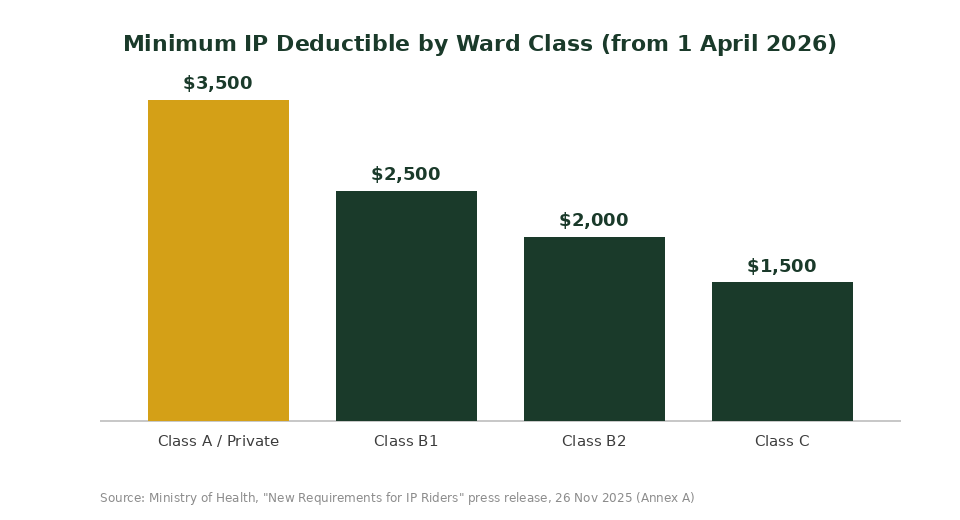
This is the part that actually changed how much cash leaves your pocket. From 1 April 2026, MOH introduced two new rules for IP riders sold from that date. First, new riders no longer cover your IP deductible — the fixed amount you must pay before insurance kicks in. Second, the co-payment cap (the most you pay in cash after that) was raised from a minimum of $3,000 to a minimum of $6,000 per year, excluding the deductible.
Your deductible depends on the ward class your IP targets. Here’s the current minimum, straight from MOH’s official notice.
| Ward Class Targeted | Minimum IP Deductible |
|---|---|
| Class A / Private | $3,500 |
| Class B1 | $2,500 |
| Class B2 | $2,000 |
| Class C | $1,500 |
Source: Ministry of Health, “New Requirements for Integrated Shield Plan Riders,” 26 November 2025 (Annex A).
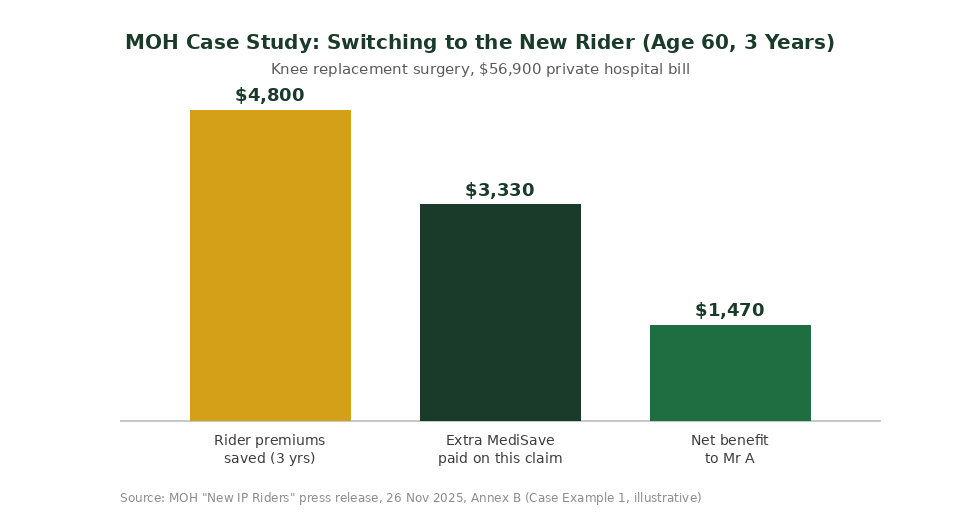
What does this mean at claim time? MOH published a worked example that makes it concrete. A 60-year-old policyholder (“Mr A”) switches from a legacy private hospital rider to a new rider in April 2026, saving 30% in premiums straight away. Three years later, he has knee replacement surgery in a private hospital, with a bill of $56,900.
Under the new rider, he pays his $3,500 deductible plus 5% co-payment on the rest — $6,170 in total, fully claimable from MediSave. That’s $3,330 more than he’d have paid on his old rider. But he had already banked $4,800 in premium savings over those three years. Net, he’s still $1,470 ahead, even after the bigger claim.
That’s not a one-off. MOH’s data shows private hospital IP policyholders with riders are 1.4 times as likely to make a claim, with claims that run 1.4 times larger than policyholders without riders. That over-consumption is exactly what the reform is trying to moderate. If you want the full switching decision — not just the claims mechanics — our ISP rider changes 2026 breakdown walks through it insurer by insurer.
How to Claim: Step-by-Step
There are two claim paths. Which one applies depends on where you’re treated and whether it’s planned or urgent.
Path 1: Cashless, with pre-authorisation (planned admissions)
This is the smoothest route, and it’s how most panel-doctor admissions work.
- Get a referral and diagnosis from your doctor, with the proposed treatment and estimated cost.
- Submit for pre-authorisation through your insurer’s app or portal, usually a few days before admission. Most insurers turn this around within 1–3 working days.
- Get approval confirming what’s covered, your deductible, and your estimated co-payment.
- Check in and get treated. The hospital bills your insurer directly for the covered portion.
- Pay only your share — deductible plus co-payment — at discharge, either in cash or via MediSave where eligible.
Path 2: Reimbursement (non-panel, emergency, or overseas treatment)
If you’re not pre-authorised, or the situation is urgent, you pay first and claim back later.
- Pay the full bill at the point of treatment.
- Collect all documents — the itemised bill, discharge summary, and receipts.
- File a claim through your insurer’s app, portal, or claim form, usually within 90 days of discharge.
- Wait for assessment. Insurers typically process straightforward reimbursement claims within 2–4 weeks.
- Receive your payout — the insurer transfers your MediShield Life and private insurance components in one payment, minus your deductible and co-payment.
However, reimbursement claims for non-panel specialists often come with lower coverage limits than pre-authorised panel claims. That’s the trade-off for choosing your own doctor outside the network.
Using MediSave to Pay Your Claim
MediSave can cover both layers of your claim, but the private insurance portion has a cap. The MediShield Life component is fully payable by MediSave. The additional private insurance component — the part your IP adds on top — is capped by age, known as the Additional Withdrawal Limit.
| Age Next Birthday | Additional MediSave Withdrawal Limit |
|---|---|
| 40 years and below | $300 per year |
| 41 to 70 years | $600 per year |
| 71 years and above | $900 per year |
Source: Ministry of Health, “About Integrated Shield Plan” (last updated 30 April 2026).
Anything above your Additional Withdrawal Limit has to be paid in cash. This is exactly why the April 2026 deductible change matters so much for claims planning: a bigger deductible eats into a fixed annual MediSave allowance faster, leaving less MediSave headroom for the rest of the year if you’re hospitalised more than once. You can check your current MediSave balance and Basic Healthcare Sum through the CPF Board’s MediSave portal, and see whether you already hold an IP through the Healthcare dashboard on cpf.gov.sg. For a full breakdown of limits and top-up rules, see our MediSave Singapore guide.
Common Reasons Claims Get Rejected or Reduced
Most claim disputes come down to a handful of recurring issues. Knowing them upfront saves you a headache later.
- Pre-existing conditions not disclosed at application. Insurers can reject claims tied to conditions you didn’t declare when you bought the plan.
- Treatment deemed not medically necessary. Insurers may query elective procedures or extended stays that don’t match clinical guidelines.
- Non-panel provider, no pre-authorisation. You can still claim, but expect a lower payout and a longer reimbursement process.
- Policy exclusions. Certain treatments, cosmetic procedures, or conditions within the waiting period are excluded outright.
- Missing documentation. Incomplete itemised bills or missing discharge summaries commonly delay reimbursement claims.
If you disagree with an outcome, every insurer has an internal claims review process, and you can escalate unresolved disputes to the Financial Industry Disputes Resolution Centre (FIDReC).
Who Should Pay Extra Attention Right Now
Three groups should look closely at how their claim will play out under the new rules.
If you’re on a legacy rider with maximum coverage, you’re paying for near-zero co-payment. That’s now more expensive relative to the new riders, which is exactly the gap MOH is trying to close. Compare your current premium against the new rider using our Integrated Shield Plan comparison for 2026.
If you bought a new rider after 27 November 2025, your insurer must inform you that you’ll transition to a rider meeting the new requirements no later than your policy renewal after 1 April 2028. Budget for a bigger deductible obligation by then.
If you’re older and claim more frequently, run the maths carefully. As MOH’s own case studies show, the premium savings from switching can outweigh a single larger claim — but that depends on how often you’re actually hospitalised, not just the headline percentage.
Not financial or medical advice. All figures cited are for educational reference only, from MOH and CPF Board sources, verified as at 1 August 2026.
Frequently Asked Questions
What is an Integrated Shield Plan claim and how does it work?
It’s a single claim you file with your private insurer for a hospital bill. The insurer claims the MediShield Life portion from CPF Board on your behalf, then pays the additional private insurance top-up itself. You get one combined payout rather than filing with two separate parties.
Do I need to pay anything upfront when claiming on my Integrated Shield Plan?
If you’re treated by a panel doctor with pre-authorisation, you typically only pay your deductible and co-payment at discharge — the rest is billed directly to your insurer. Without pre-authorisation, you usually pay the full bill first and claim reimbursement afterwards.
How much has the April 2026 rider change added to my out-of-pocket cost?
It depends on your ward class and rider. New riders no longer cover your IP deductible, which ranges from $1,500 to $3,500 depending on ward class. The co-payment cap also rose to a minimum of $6,000 a year, up from $3,000. In exchange, new rider premiums are around 35-40% lower than legacy riders with maximum coverage, based on MOH’s published figures.
Can I use MediSave to pay for my Integrated Shield Plan claim?
Yes. The MediShield Life portion is fully payable by MediSave. The additional private insurance portion is capped by an Additional Withdrawal Limit that depends on your age: $300 a year if you’re 40 or below, $600 if you’re 41 to 70, and $900 if you’re 71 or above. Anything beyond that limit has to be paid in cash.
Why was my Integrated Shield Plan claim rejected or reduced?
The most common reasons are undisclosed pre-existing conditions, treatment considered not medically necessary, seeing a non-panel provider without pre-authorisation, policy exclusions, or missing documentation. Check your policy wording and, if you disagree with the outcome, use your insurer’s internal review process or escalate to FIDReC.
Is it better to see a panel doctor or my own specialist?
Panel doctors give you pre-authorisation and typically a cashless, lower-co-payment claim. Your own non-panel specialist may still be covered under the Extended Panel scheme, but if not, expect to pay upfront and claim a smaller reimbursement. For planned treatment, checking panel status first can meaningfully change your out-of-pocket cost.
Reviewing Your Own Integrated Shield Plan Coverage?
Start by comparing what’s changed since April 2026, then check your MediSave headroom before you’re next hospitalised.
Get Free Insurance Advice
Speak with a licensed insurance advisor. No obligation, no cost.
By submitting this form, you agree to our Privacy Policy.
This article was researched with the help of AI. While we strive to keep all information accurate and up to date, there may be errors. If you notice any discrepancies, please contact us.