ISP Rider Changes 2026: Should You Switch to the New Integrated Shield Plan Rider?
What every Singapore policyholder needs to know about the April 2026 IP rider reforms — deductibles, co-payment caps, and whether switching makes financial sense for you.
From 1 April 2026, new Integrated Shield Plan (ISP) riders sold in Singapore no longer cover the minimum IP deductible set by MOH. The deductible now ranges from $1,500 to $3,500 depending on the ward class you choose. At the same time, the co-payment cap has been raised from $3,000 to a minimum of $6,000 per year. New riders do cost about 30% less — but you pay more when you actually get hospitalised.
Not financial advice. All figures are for educational reference only. Data as at June 2026 unless noted.
- Old riders (bought before 27 Nov 2025) are the most generous on the market — your deductible is covered and your co-pay is capped at $3,000/year. Hold on to them if you can.
- New riders from April 2026 are cheaper (up to 47% lower premiums for some Income plans), but you now bear the full deductible ($1,500–$3,500) plus a higher co-pay cap of $6,000/year.
- Whether to switch depends on your health, age, hospitalisation likelihood, and how much cash flow relief the premium saving gives you.
Table of Contents
Contents — Click to expand
- What Changed on 1 April 2026?
- The Deductible: What You Now Pay First
- Old Rider vs New Rider: Side-by-Side Comparison
- Premium Changes by Insurer
- Should You Switch? A Decision Framework
- Worked Example: Real Cost Scenarios in SGD
- What’s Changing at Each Insurer
- Using MediSave to Pay the New Costs
- Frequently Asked Questions
What Changed on 1 April 2026?
MOH introduced the new Integrated Shield Plan rider rules to address two problems: rising private healthcare costs and unsustainably fast premium growth. The idea is to give policyholders more “skin in the game” when they make healthcare decisions — particularly the choice of ward class and specialist.
Before these changes, many Singaporeans held riders that covered almost everything. You paid $0 for a private hospital stay beyond your base plan. This created little incentive to be cost-conscious. Bills ballooned. Premiums followed.
The two core changes from 1 April 2026 are:
1. Riders can no longer cover the minimum IP deductible. Every ISP has a minimum deductible set by MOH. Under the new rules, your rider is not allowed to pay this deductible for you. You pay it first — out of pocket or via MediSave.
2. The co-payment cap is raised to at least $6,000. Previously, many riders capped your annual co-payment at $3,000. New riders must set the cap at $6,000 or higher. So if you have a big hospital bill, your maximum out-of-pocket exposure has doubled.
In exchange, premiums on new riders are expected to be about 30% lower on average. Some Income plans show even larger savings of 47–48% on riders attached to their Enhanced Preferred and Advantage plans.
Importantly: if you already hold an old rider (purchased before 27 November 2025), you are not immediately affected. But you will need to transition to a new rider at your first renewal after 1 April 2028.
The Deductible: What You Now Pay First
The deductible is the amount you pay out of pocket before your ISP and rider kick in. Under the new rules, your rider cannot cover this deductible — you bear it fully.
The minimum deductible varies by the ward class you use:
| Ward Class Used | Minimum IP Deductible (New Riders) | Who Pays This? |
|---|---|---|
| Class C ward | $1,500 per year | You (MediSave or cash) |
| Class B2 ward | $2,000 per year | You (MediSave or cash) |
| Class B1, Class A, or Private ward | $2,500–$3,500 per year | You (MediSave or cash) |
Source: MOH Singapore, ISP rider reform announcement, November 2025. Effective 1 April 2026.
For context: most Singaporeans with private hospital plans use Class A or private wards. At $2,500–$3,500, that deductible is now a meaningful annual expense — especially if you’re hospitalised more than once.
The co-payment is the 5% of each bill that you continue to pay even after the deductible. The old cap was $3,000 per year. Under new riders, you keep paying until you hit $6,000. If your bills are large, this matters.
Old Rider vs New Rider: Side-by-Side Comparison
Here is how the two rider generations compare across every key dimension. If you’re deciding whether to keep your old rider or move to a new one, this table is your starting point.
| Feature | Old Rider (bought before 27 Nov 2025) |
New Rider (from 1 Apr 2026) |
|---|---|---|
| Covers minimum deductible? | Yes | No |
| Minimum deductible you bear | $0 | $1,500–$3,500/year |
| Co-payment rate | 5% of bill | 5% of bill |
| Annual co-payment cap | $3,000 | $6,000 (minimum) |
| Typical rider premium | Higher | ~30% lower on average |
| MediSave payable for deductible? | N/A (covered by rider) | Yes, subject to withdrawal limits |
| Who it suits | Higher hospitalisation risk; older policyholders; chronic conditions | Generally healthy, younger, cash-flow-conscious |
| Transition deadline | Must switch at first renewal after 1 Apr 2028 | Already compliant |
Source: MOH Singapore, FSMOne, MoneyOwl. Data as at April 2026.
Premium Changes by Insurer
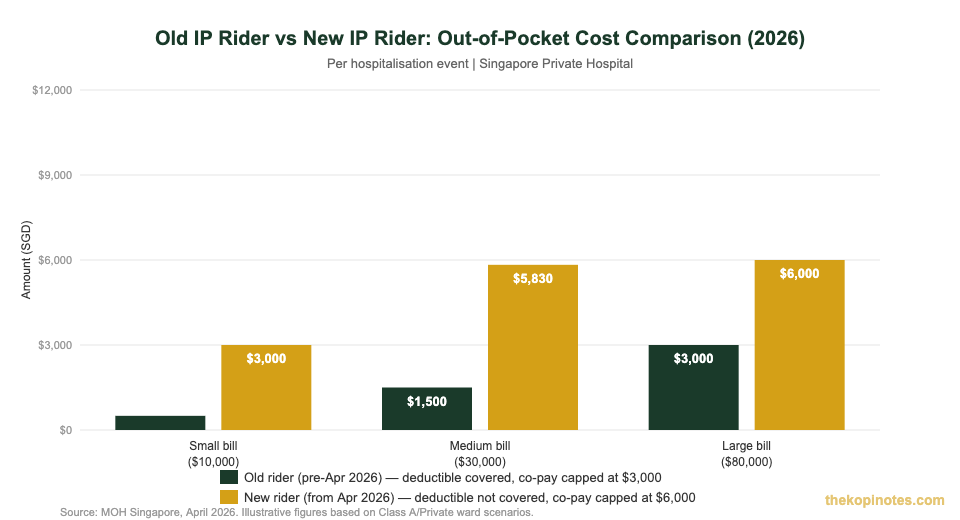
The premium savings from new riders vary widely by insurer and by the ward class your base plan covers. Here is what we know as at April 2026:
| Insurer | Plan / Rider | Change vs Old Rider | Notes |
|---|---|---|---|
| Income | Enhanced Preferred / Advantage rider | ~47–48% lower | Largest savings in market |
| Income | Enhanced Basic rider | ~30% lower | Good entry-level saving |
| Income | Base plan (Preferred / Advantage) | +13–14% higher | Base plan premium rises despite rider savings |
| Income | Base plan (Basic) | +7% higher | Modest increase for basic tier |
| Singlife | Plan 1 Private Prime rider | ~78% lower | Significant saving for private hospital cover |
| Singlife | Plan 2 Public Prime / Lite rider | ~14–19% lower | |
| Great Eastern | SupremeHealth base plan | Frozen for 2026 | GE committed to no base plan increase in 2026 |
| All insurers | New riders (market average) | ~30% lower | MOH projection; actual varies by age |
Source: FSMOne, insurer announcements, MOH. Data as at April 2026. Figures are averages — individual premiums vary by age band and plan type.
One thing to watch: even though the rider itself is cheaper, some insurers have raised their base plan premiums. For Income policyholders, the combined effect (base + rider) may not feel as significant as the headline rider saving suggests. Always check your total annual premium before deciding to switch.
Should You Switch? A Decision Framework
There is no single right answer. The decision depends on your age, health, financial cushion, and how likely you are to be hospitalised. Here is a practical framework.
Strong reasons to keep your old rider:
- You are 50 or older and more likely to face hospitalisation
- You have a chronic condition (diabetes, heart disease, cancer history) that increases medical costs
- Your MediSave balance is low and you cannot easily absorb a $2,500–$3,500 deductible
- You use private hospitals regularly and expect bills above $30,000
- You value peace of mind over premium savings
Strong reasons to consider switching to a new rider:
- You are young (under 40), generally healthy, and rarely hospitalised
- You have substantial MediSave savings that can comfortably cover the deductible
- The premium saving of 30–47% materially improves your monthly cash flow
- You can self-insure the additional $3,000 co-pay gap using your emergency fund
- You do not mind the switch deadline in 2028 and prefer to plan ahead now rather than scramble later
One important nuance: riders bought between 27 November 2025 and 31 March 2026 — the last vintage of old-style riders — must transition to new riders at their first renewal after 1 April 2028. If you bought in that window, you are living on borrowed time with the old structure. It is worth modelling the long-term cost now, rather than facing a forced switch later.
Worked Example: Real Cost Scenarios in SGD
Numbers make this concrete. Consider a 45-year-old Singapore resident with an ISP covering private hospital (Class A/private ward). She is on an Enhanced IncomeShield Preferred plan with a rider.
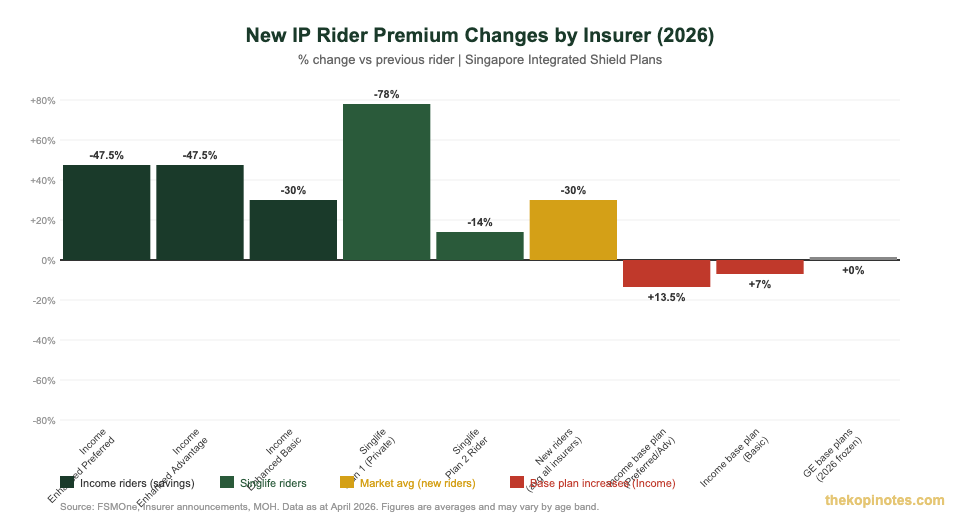
Scenario 1: Small bill — $10,000 surgery
- Old rider: Deductible covered. Co-pay = 5% × $10,000 = $500. Total out-of-pocket: $500.
- New rider: Deductible = $2,500 (not covered). Co-pay = 5% × $7,500 = $375. Total out-of-pocket: $2,875.
- Difference: $2,375 more with the new rider.
Scenario 2: Medium bill — $30,000 hospitalisation
- Old rider: Deductible covered. Co-pay = 5% × $30,000 = $1,500. Total out-of-pocket: $1,500.
- New rider: Deductible = $2,500. Co-pay = 5% × $27,500 = $1,375. Total out-of-pocket: $3,875. (Still under $6,000 cap.)
- Difference: $2,375 more with the new rider.
Scenario 3: Large bill — $80,000 ICU stay
- Old rider: Deductible covered. Co-pay capped at $3,000. Total out-of-pocket: $3,000.
- New rider: Deductible = $2,500. Co-pay = 5% × $77,500 = $3,875, but capped at $6,000. Total out-of-pocket: $6,000.
- Difference: $3,000 more with the new rider.
But here is the counter-argument: if the new rider saves her $1,600/year in premiums, she accumulates $4,800 in cash savings over three years. That more than covers the extra $2,375–$3,000 she would pay if hospitalised once. The break-even depends on hospitalisation frequency and bill size.
You can use the Singapore retirement calculator to model how these healthcare costs interact with your long-term financial plan.
What’s Changing at Each Insurer
Each of Singapore’s five ISP providers — AIA, Great Eastern, Income, Prudential, and Singlife — is rolling out new riders differently. Here is the overview.
AIA (HealthShield Gold Max): AIA has not publicly announced specific rider premium percentages. Their new riders comply with MOH requirements from 1 April 2026. AIA policyholders should contact their FA or check the AIA website for their specific new rider premium schedule. AIA HealthShield Gold Max is known for high overall annual claim limits and strong pre- and post-hospitalisation benefits. For details on AIA’s premium table, see our dedicated AIA HealthShield Gold Max premium guide.
Great Eastern (SupremeHealth): GE froze its base plan premiums for all of 2026 — a policyholder-friendly move. New GE riders comply with the April 2026 deductible and co-payment requirements. Their GREAT TotalCare rider remains competitive. See our Great Eastern SupremeHealth review for full details.
Income (IncomeShield): Income has the most published data. New riders on Enhanced Preferred and Advantage plans are 47–48% cheaper. However, base plan premiums are rising 13–14%. If you’re on Income, do the combined maths before celebrating the rider saving.
Prudential (PRUShield): Prudential’s new PRUExtra Care series adds $100,000 to your annual policy limit if you’re hospitalised with a covered critical illness. Their PRUPanel Connect network is one of the larger private GP and specialist panels in Singapore. Read our full Prudential PRUShield Singapore review for the premium breakdown.
Singlife (Singlife Shield): Singlife’s new private hospital rider (Private Prime) is 78% cheaper — the largest saving in the market. However, their Plan 1 base plan premium is rising 10%. Singlife also introduced a Care Collab Recovery Support Benefit: $20,000 for home nursing care and rehabilitation after hospitalisation, which is a meaningful addition for older policyholders.
Using MediSave to Pay the New Costs
Good news: both the deductible and the 5% co-payment under new riders can be paid using your MediSave, subject to prevailing withdrawal limits set by MOH.
This means that for most Singaporeans, the new deductible does not necessarily come from your cash wallet. It can come from your MediSave account — where your employer and you contribute monthly as part of the CPF system.
The current MediSave withdrawal limit for hospitalisation is set annually by MOH. For day surgeries and inpatient stays, the limit is generally sufficient to cover a deductible of $1,500–$3,500 — but it varies by procedure and ward class. Check the CPF Board’s MediSave page for the latest limits.
For a deeper guide on CPF and how it interacts with your investment and insurance planning, see our CPF investment strategy guide.
One caveat: if you’re frequently hospitalised (e.g. managing a chronic condition with multiple stays per year), the annual MediSave withdrawal limit may not cover every deductible. It is worth modelling your expected healthcare usage against your MediSave balance.
This article is for general information only. It is not financial advice. For personalised insurance recommendations, consult a licensed financial adviser or check the MOH’s official ISP comparison table. Data as at June 2026.
Frequently Asked Questions
What is the integrated shield plan rider change from April 2026?
From 1 April 2026, new Integrated Shield Plan (IP) riders sold in Singapore are no longer allowed to cover the minimum IP deductible set by MOH. The deductible ranges from $1,500 (Class C ward) to $3,500 (private ward) per year, and policyholders must now pay it themselves — via MediSave or cash. The annual co-payment cap is also raised from $3,000 to at least $6,000. In exchange, new rider premiums are approximately 30% lower on average.
Do I have to switch to the new IP rider immediately?
No. If you hold a rider purchased before 27 November 2025, you are not immediately affected. You can keep your old rider until your first renewal date after 1 April 2028, at which point you will need to transition to a new compliant rider. Riders purchased between 27 November 2025 and 31 March 2026 follow the same 2028 deadline. Riders purchased from 1 April 2026 onwards must already comply with the new rules.
Is it worth switching to the new rider now to save on premiums?
It depends on your health and hospitalisation history. If you are young, healthy, and rarely hospitalised, the 30–47% premium saving can more than offset the higher out-of-pocket exposure over several years. But if you have a chronic condition, are over 50, or anticipate frequent hospitalisation, the additional deductible ($2,500–$3,500) plus the higher co-pay cap ($6,000) can exceed the premium savings quickly. A licensed financial adviser can help you model the break-even for your specific situation.
Can I pay the new deductible using MediSave?
Yes. Both the minimum IP deductible and the 5% co-payment under new IP riders can be paid using your MediSave balance, subject to MOH’s prevailing MediSave withdrawal limits. This means the deductible does not necessarily come from your monthly cash — it comes from your CPF MediSave account. However, if you are hospitalised multiple times a year, the annual MediSave withdrawal limit may cap how much you can use.
What happens if I switch insurers to get a new rider?
Switching to a different ISP provider typically requires going through underwriting again. This means the new insurer may impose exclusions for pre-existing conditions, or decline to cover you if your health has changed since you first bought your plan. MOH strongly recommends staying with the same insurer if you want to adjust your rider. You retain continuity of coverage within the same insurer even when upgrading or downgrading your rider.
Which ISP insurer has the best new rider in 2026?
Singlife’s new Private Prime rider shows the largest premium reduction (up to 78% lower) compared to the old rider. Income’s new riders on Enhanced Preferred and Advantage plans are 47–48% cheaper. Great Eastern froze its base plan premiums for 2026. The “best” insurer depends on your ward preference, panel network, and annual claim limit needs. The MOH ISP comparison table at moh.gov.sg is the most reliable starting point for a side-by-side look at all five providers.
Does the ISP rider change affect my MediShield Life coverage?
No. MediShield Life is the base government health insurance scheme that all Singapore Citizens and PRs are automatically covered under. The April 2026 changes only affect the optional riders that sit on top of your Integrated Shield Plan (the privately-insured layer). Your MediShield Life coverage and premiums are not changed by these reforms. For a full explanation of how MediShield Life works and how it interacts with your ISP, see our integrated shield plan Singapore guide.
Review Your Insurance Coverage Today
The April 2026 changes make it more important than ever to understand what you are covered for. Compare ISPs, check your MediSave balance, and plan your healthcare costs alongside your investments.
Get Free Insurance Advice
Speak with a licensed insurance advisor. No obligation, no cost.
By submitting this form, you agree to our Privacy Policy.
This article was researched with the help of AI. While we strive to keep all information accurate and up to date, there may be errors. If you notice any discrepancies, please contact us.