Great Eastern GREAT SupremeHealth Review 2026: B Plus, A Plus & P Plus Compared
A complete Singapore guide to Great Eastern’s Integrated Shield Plan — coverage tiers, premium tables, GREAT TotalCare riders, and how it stacks up against AIA and Prudential in 2026.
GREAT SupremeHealth is Great Eastern’s MediSave-approved Integrated Shield Plan (ISP) that supplements MediShield Life. It comes in four tiers — Standard, B Plus, A Plus, and P Plus — with annual claim limits from S$200,000 up to S$1,500,000, covering ward classes from Class B1 in restructured hospitals all the way to any standard ward in private hospitals. The B Plus and A Plus tiers are widely regarded as among the best value ISPs in Singapore for their respective ward classes, while the P Plus plan offers private hospital access at a mid-range premium of S$322 per year for ages 31–35.
Not financial advice. All figures are for educational reference only. Data as at April 2026 unless noted.
Table of Contents
Contents — Click to expand
What Is GREAT SupremeHealth?
GREAT SupremeHealth is Great Eastern Life’s MediSave-approved Integrated Shield Plan (ISP), officially launched in its current form and most recently updated in April 2026. Like all ISPs in Singapore, it sits on top of MediShield Life — the mandatory baseline hospitalisation insurance administered by the CPF Board — and extends your coverage to higher ward classes and additional benefits that MediShield Life does not cover.
MediShield Life is sized for Class B2 and C ward bills at restructured hospitals. If you stay in a Class A ward, a Class B1 ward, or choose a private hospital, MediShield Life will only pay a portion of your bill, and you’ll need to fund the rest from your MediSave account or cash. GREAT SupremeHealth fills that gap.
Your GREAT SupremeHealth premium includes two components: the MediShield Life component (managed by CPF Board) and the additional private insurance component (underwritten by The Great Eastern Life Assurance Company Limited). Both portions can be paid using MediSave up to the applicable Additional Withdrawal Limits set by the Ministry of Health. Any excess premium must be paid in cash.
As at April 2026, Great Eastern is one of seven insurers offering ISPs in Singapore. The others are AIA, Prudential, NTUC Income, Singlife, Raffles Health Insurance, and HSBC Life (formerly AXA). Each insurer offers slightly different coverage, premium pricing, and rider options — which is why doing a structured comparison matters before you commit.
Plan Tiers at a Glance
GREAT SupremeHealth comes in four tiers. The table below summarises the key metrics for each tier as at April 2026:
| Plan Tier | Ward Entitlement | Annual Claim Limit | Annual Premium (Age 31–35) |
|---|---|---|---|
| Standard | Class B1 & lower (RH) | S$200,000 | ~S$53 |
| B Plus | Class B1 & lower (RH) | S$500,000 | S$77–$80 |
| A Plus | Class A & lower (RH) | S$1,000,000 | S$106–$123 |
| P Plus | Private & Restructured Hospital (any standard ward) | S$1,500,000 | ~S$322 |
Source: Great Eastern GREAT SupremeHealth Benefit Schedule and Premium Rates, April 2026. RH = Restructured Hospital. Premiums for standard lives, age next birthday 31–35, inclusive of GST.
Note that all four tiers include 120 days of pre-hospitalisation coverage and 365 days of post-hospitalisation coverage — a consistent feature across the entire range. Great Eastern also introduced a new private hospital tier, P Prime, which pairs with a new GREAT TotalCare 2 Prime rider as part of the April 2026 MOH ISP reforms.
B Plus Plan Review
The GREAT SupremeHealth B Plus is designed for Singapore residents who want enhanced coverage within the restructured hospital system — specifically Class B1 wards and below. At S$77–S$80 per year for ages 31–35 (standard life, inclusive of GST), it is one of the more competitively priced B1-tier ISPs available, and it leads the field in terms of cost-benefit ratio.
For a Singapore resident in their early 30s holding the B Plus plan, the annual premium of roughly S$79 translates to a cost-benefit ratio of approximately S$6,493.51 for every S$1 of premium paid — the highest among all seven ISP providers at this tier. For context, the next best at this tier is Singlife Shield Plan 3 at S$5,000 per dollar, and Raffles Shield B at S$4,545.
Pre-hospitalisation coverage stands at 120 days and post-hospitalisation at 365 days. The 120-day pre-hospitalisation figure is slightly behind plans like Singlife (180 days) but better than the 90-day coverage offered by Raffles Shield B at this tier. Post-hospitalisation at 365 days is among the best in class for a B1-tier plan. Other competitive plans like NTUC Income Enhanced IncomeShield Basic cap both at 100 days — making the B Plus a significantly better option for policyholders who may require extended specialist follow-up care after discharge.
One important note: Great Eastern uses claims-based pricing on its ISPs. This means if you make a hospitalisation claim, your premium may increase at the next renewal. Healthy policyholders who rarely claim benefit from lower premiums under this model, but those who claim frequently may see premiums rise over time. This is the key trade-off to be aware of before committing to any Great Eastern ISP.
A Plus Plan Review
The GREAT SupremeHealth A Plus is widely considered the standout plan in Great Eastern’s ISP range — and one of the best Class A ward shield plans in Singapore for 2026. At S$106–S$123 per year for ages 31–35, it is among the cheapest options for this ward class, second only to NTUC Income’s Enhanced IncomeShield Advantage (at S$74) and comparable to AIA HealthShield Gold Max B (S$157) and Prudential PRUShield Plus (S$119).
The annual claim limit for the A Plus plan is S$1,000,000 — the joint-highest available at this tier, matching AIA HealthShield Gold Max B and Singlife MyShield Plan 2. This is significantly higher than Raffles Shield A (S$600,000) or AXA Shield Plan B (S$550,000). For a Singapore investor building a long-term retirement plan, the combination of high claim limit and low annual premium makes the A Plus a compelling base for healthcare protection.
The cost-benefit ratio for the A Plus plan is S$9,433.96 for every S$1 of premium — the best in its tier by a wide margin. As an illustration: a Singaporean aged 32 holding a GREAT SupremeHealth A Plus pays roughly S$115 per year. If they were admitted to a Class A ward at SGH for a complex procedure costing S$30,000, the plan would cover the bulk of that bill (subject to deductibles and co-insurance), effectively offering protection worth hundreds of times the annual premium outlay.
Pre- and post-hospitalisation coverage mirrors the B Plus at 120 and 365 days respectively. The 120-day pre-hospitalisation window applies to specialist consultations and investigations leading up to a hospitalisation event — and while 120 days is not the longest available (AIA covers up to 13 months via its AQHP specialist network), it is adequate for most planned admissions.
You can link the A Plus plan with the GREAT TotalCare 2 (Elite A or Classic A) rider to further reduce co-insurance to 5% of your eligible bill and cap annual co-payment at S$6,000 — making your out-of-pocket expenses more predictable for major hospitalisation events.
P Plus Plan Review
The GREAT SupremeHealth P Plus provides access to any standard ward at private hospitals in Singapore, including Mount Alvernia Hospital, Farrer Park Hospital, Raffles Hospital, and Thomson Medical Centre — all part of Great Eastern’s Partnering Medical Institutions (PMIs) network — as well as all restructured hospitals.
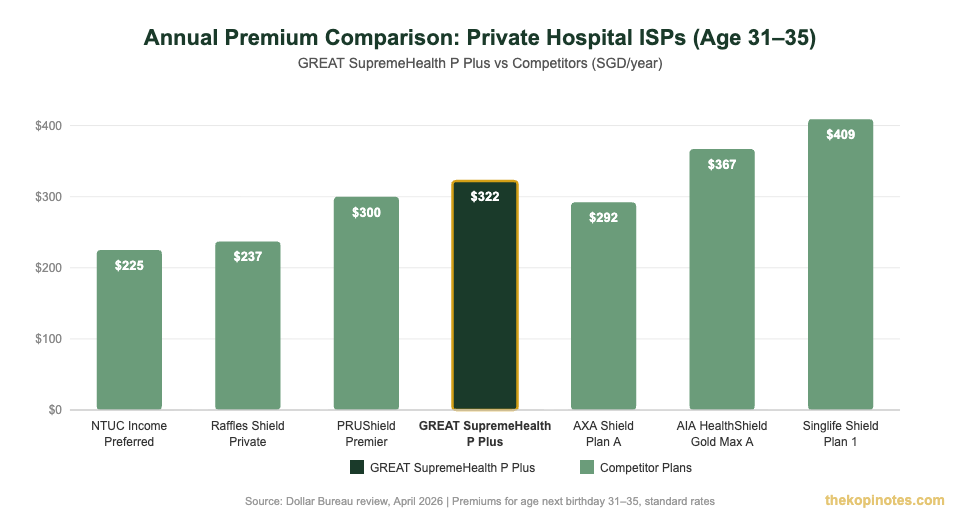
The annual claim limit is S$1,500,000, and the annual premium for a standard 31–35-year-old is approximately S$322 inclusive of GST. Compared to the private hospital tier of other ISPs, this positions Great Eastern in the mid-range — cheaper than AIA HealthShield Gold Max A (S$367) and Singlife Shield Plan 1 (S$409), but more expensive than NTUC Income Enhanced IncomeShield Preferred (S$225) and Raffles Shield Private (S$237).
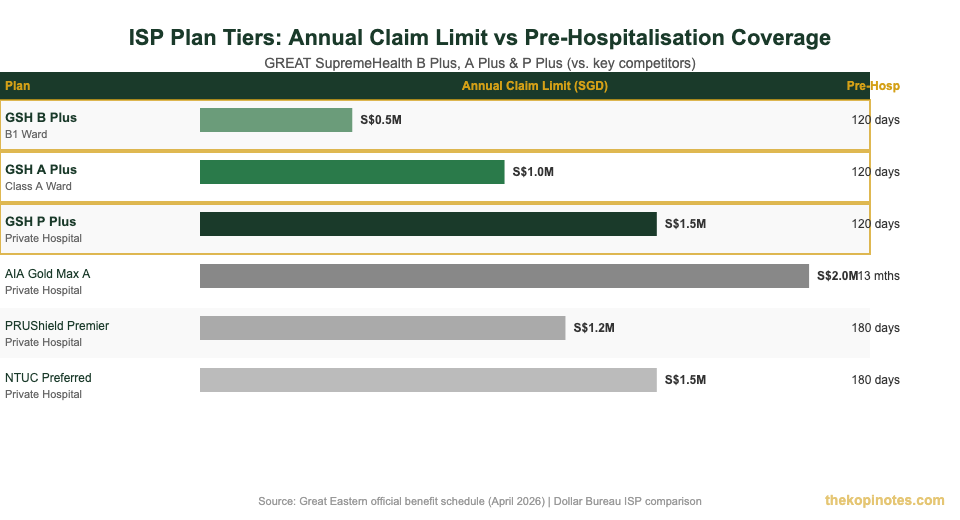
On annual claim limit, the P Plus at S$1,500,000 is competitive but not the highest: AIA HealthShield Gold Max A and Singlife Shield Plan 1 both offer S$2,000,000, while HSBC Life’s Shield Plan A reaches S$2,500,000. If maximum claim headroom matters to you — for example, if you’re at higher health risk or plan to use private hospitals frequently — those alternatives are worth evaluating.
Pre-hospitalisation coverage at 120 days remains the same across all GREAT SupremeHealth tiers and is the lowest among private hospital ISPs, where the norm is 180 days. This is the P Plus plan’s most notable limitation. Post-hospitalisation coverage of 365 days is best-in-class at this tier. The cost-benefit ratio for the P Plus comes in at S$4,658.39 per dollar of premium — placing it in the lower half of the competitive set, behind NTUC (S$6,666.67), AXA (S$8,561.64), and Raffles (S$6,329.11).
From April 2026, Great Eastern introduced a new P Prime tier paired with the GREAT TotalCare 2 Prime rider, which limits co-insurance to treatment at Great Eastern’s Partnering Medical Institutions by Panel Providers only. The co-payment cap remains at S$6,000 per policy year.
GREAT TotalCare 2 Riders
The GREAT TotalCare 2 (GTC2) supplementary plan is the rider you add to your GREAT SupremeHealth base plan to reduce out-of-pocket expenses. It is not a MediSave-approved plan, so its premiums must be paid in cash — you cannot use MediSave to fund GTC2 premiums.
As of 1 April 2026, Great Eastern restructured its rider offerings to comply with new MOH requirements for ISP supplementary plans. The updated GTC2 plans introduce mandatory deductibles that policyholders must pay before the rider kicks in:
| Ward Class Used | Minimum Deductible (Payable by Policyholder) |
|---|---|
| Private Hospital / Restructured Hospital (Class A) | S$3,500 |
| Ward Classes B1 / B2 / B2+ | S$2,500 |
| Ward Class C | S$2,000 |
| Day Surgeries / Short-Stay (non-subsidised) | S$2,500 |
Source: Great Eastern GREAT SupremeHealth FAQ, April 2026. Higher deductibles may apply depending on plan type and age.
After the deductible is paid, a Co-payment Cap of S$6,000 per policy year applies — meaning once you’ve paid S$6,000 in co-payments (excluding the deductible) in any given year, GTC2 covers 100% of remaining eligible expenses. This cap provides meaningful financial certainty for policyholders facing a major illness or lengthy hospitalisation.
The corresponding GTC2 plan type for each base plan is: P Plus → GTC2 P; A Plus → GTC2 A; B Plus and Standard → GTC2 B. The additional GREAT TotalCare Plus 2 rider can be layered on top of GTC2 to extend coverage worldwide (including overseas hospitalisation) with an additional annual claim limit of up to S$50,000.
Special benefits included under GTC2 that go beyond standard ISP coverage include: Other Outpatient Cancer Drug Treatment not on the Cancer Drug List, Emergency Accidental Outpatient Treatment, 180 days of Home Health Care benefit, 180 days of Post-Hospital Traditional Chinese Medicine, Ambulance Services, Medical Aids, and 10 days of Companion Accommodation benefit. These additional benefits make GTC2 one of the more comprehensive rider options in the Singapore market.
Pros and Cons of GREAT SupremeHealth
No integrated shield plan is perfect for everyone. Here is an honest assessment based on the April 2026 benefit schedule and independent reviews:
| Pros | Cons |
|---|---|
| ✅ Best cost-benefit ratio at B Plus tier (S$6,493 per dollar) | ❌ Claims-based pricing: premiums rise after claims |
| ✅ Excellent A Plus value: S$1M limit from ~S$115/year | ❌ Pre-hospitalisation only 120 days (competitors offer 180 days) |
| ✅ 365-day post-hospitalisation across all tiers | ❌ P Plus annual claim limit (S$1.5M) lower than AIA and AXA |
| ✅ Great Medical Care Concierge: 24/7 support, 800+ panel specialists | ❌ GTC2 rider premiums not payable via MediSave |
| ✅ Available to non-Singaporeans (valid work pass holders) | ❌ Max entry age is 75 ANB for P Plus, A Plus, B Plus |
Source: Great Eastern official FAQ and benefit schedule, April 2026; Dollar Bureau ISP comparison, April 2026.
How GREAT SupremeHealth Compares to AIA and Prudential
For a Singapore resident choosing between the three most established ISP providers — Great Eastern, AIA, and Prudential — the decision typically comes down to three factors: pricing, claim limit, and pre-hospitalisation coverage. Here is a side-by-side comparison for the private hospital tier (the highest-stakes decision):
| Feature | GREAT SupremeHealth P Plus | AIA HealthShield Gold Max A | PRUShield Premier |
|---|---|---|---|
| Annual Premium (Age 31–35) | ~S$322 | ~S$367 | ~S$300 |
| Annual Claim Limit | S$1,500,000 | S$2,000,000 | S$1,200,000 |
| Pre-Hospitalisation | 120 days | 13 months (AQHP) | 180 days |
| Post-Hospitalisation | 365 days | 13 months (AQHP) | 365 days |
| Pricing Model | Claims-based | As-charged | Claims-based |
| Cost-Benefit Ratio | S$4,658 per dollar | S$5,450 per dollar | S$4,000 per dollar |
| Best For | Mid-range private coverage; healthy individuals | Max claim headroom; longer pre-hosp window | Budget private coverage; lower base premium |
Source: Dollar Bureau ISP comparison, April 2026. Premiums are for standard lives, age next birthday 31–35, inclusive of GST.
The key takeaway: if you value the highest annual claim limit and the longest pre-hospitalisation window, AIA HealthShield Gold Max A is the strongest option — but it comes at the highest premium in this group. If you prioritise cost-benefit ratio, GREAT SupremeHealth A Plus (at the restructured hospital tier) is unmatched. For private hospital coverage specifically, NTUC Income Enhanced IncomeShield Preferred and Raffles Shield Private offer better value per premium dollar than any of the three above — though they operate under different panel and network structures.
Planning for retirement and wondering how your healthcare costs interact with your CPF and SRS savings? You can use our Singapore retirement calculator to model healthcare costs as part of your overall retirement planning.
Paying GREAT SupremeHealth Premiums with MediSave
GREAT SupremeHealth is a MediSave-approved Integrated Shield Plan, which means you can use your MediSave account to pay premiums up to the Additional Withdrawal Limits (AWL) set by MOH. These limits vary by age — younger policyholders have lower AWLs, while older policyholders (who face higher premiums) have higher AWLs to match.
Any premium above the AWL must be paid in cash. This is particularly relevant for older policyholders on the P Plus tier, where premiums can rise substantially from age 60 onwards. The GTC2 rider premium, as noted above, must always be paid in cash regardless of age — it is not a MediSave-eligible expense.
The Great Medical Care Concierge is an exclusive benefit for GREAT SupremeHealth policyholders that provides 24/7 dedicated support, on-site service desks at Partnering Medical Institutions, referrals to over 800 Private Panel Specialists, and priority appointment bookings at both private and restructured hospitals. This concierge layer is a meaningful differentiator for policyholders who want active support navigating the Singapore healthcare system — not just passive claims coverage.
If you are also exploring investment options for your retirement, our passive income Singapore guide covers dividend strategies that complement your ISP planning by building the financial buffer to cover healthcare out-of-pocket costs in retirement. You may also want to review your overall CPF investment strategy to ensure your MediSave balance stays healthy enough to sustain premium payments as you age.
Who Should Buy GREAT SupremeHealth?
GREAT SupremeHealth is ideal if: you are in good health and unlikely to make frequent claims (making claims-based pricing work in your favour); you want the best cost-benefit ratio at the Class B1 or Class A tier; you prefer a single insurer relationship that covers you from your 20s through to retirement; you want access to private hospitals through an established insurer with a broad panel network; or you are a foreigner with a valid work pass who needs ISP coverage.
Consider alternatives if: you value the longest possible pre-hospitalisation window (AIA’s 13-month AQHP specialist window is unmatched); you want the highest annual claim limit for private hospital coverage (AIA at S$2M or HSBC Life at S$2.5M); you expect to make frequent claims and want as-charged pricing that doesn’t penalise claims (AIA uses as-charged pricing); or you are on a very tight budget and the NTUC Income Enhanced IncomeShield Preferred at S$225/year fits better.
Note that ISPs bought on the LSE or other overseas exchanges are not CPF-investable. However, ISPs purchased through Syfe referral code and similar robo-advisory platforms can sometimes be bundled with investment portfolios as part of holistic financial planning. For guidance on complementary investments, our Singapore REIT ETF guide walks through the key options for Singaporeans building a diversified portfolio alongside their ISP coverage.
If you are actively comparing ISP riders and want to understand how shield plan costs interact with your broader financial plan, the MediShield Life premium guide on TKN covers the base layer in detail. For a broader view of the integrated shield plan landscape across all seven providers, our integrated shield plan comparison guide is the definitive starting point.
Not financial advice. ISP premiums are not guaranteed and may be revised. Speak to a licensed financial adviser before purchasing. Data as at April 2026.
Frequently Asked Questions
What is GREAT SupremeHealth and how does it differ from MediShield Life?
GREAT SupremeHealth is Great Eastern’s MediSave-approved Integrated Shield Plan that builds on top of MediShield Life, the mandatory baseline insurance that every Singapore Citizen and Permanent Resident carries. MediShield Life is sized for subsidised Class B2 and C ward bills — it will only partially cover bills if you stay in Class A, B1, or a private hospital. GREAT SupremeHealth fills that gap, extending your coverage to higher ward classes, higher annual claim limits, and additional benefits like pre- and post-hospitalisation coverage. Your GREAT SupremeHealth premium includes both the MediShield Life component and the additional Great Eastern private insurance component, and both portions can be paid using MediSave up to the applicable Additional Withdrawal Limits.
Is GREAT SupremeHealth the best integrated shield plan for Class A wards in Singapore?
For Class A ward coverage at restructured hospitals, the GREAT SupremeHealth A Plus is widely considered the strongest value option in Singapore as at April 2026. At S$106–S$123 per year for ages 31–35, it offers an annual claim limit of S$1,000,000 — the highest at this tier alongside AIA HealthShield Gold Max B and Singlife MyShield Plan 2 — and a cost-benefit ratio of S$9,433.96 per dollar, the best in its category. The 120-day pre-hospitalisation window is slightly shorter than the 180-day coverage offered by some competitors, but the combination of claim limit, pricing, and post-hospitalisation coverage (365 days) makes it a very strong overall package for the A ward tier.
What is claims-based pricing and how does it affect my GREAT SupremeHealth premium?
Claims-based pricing means your ISP premium can increase at renewal if you submit hospitalisation claims. Great Eastern uses this pricing model across its GREAT SupremeHealth range. If you are healthy and rarely claim, you benefit from lower premiums — healthy policyholders effectively subsidise their own coverage at a lower cost. However, once you start making claims, your premium band can rise noticeably. This contrasts with as-charged pricing (used by AIA, for example), where premiums are set based on your age group and do not rise specifically because you claimed. If you have chronic conditions or expect to hospitalise regularly, you should factor claims-based pricing into your decision before committing to Great Eastern.
Can I pay GREAT SupremeHealth premiums using MediSave?
Yes, GREAT SupremeHealth base plan premiums (covering both the MediShield Life portion and the additional Great Eastern private insurance portion) are MediSave-approved and can be paid from your MediSave account up to the Additional Withdrawal Limits set by MOH. These limits increase with age to help offset the higher premiums that come with advancing age groups. Any premium above the AWL must be paid in cash. The GREAT TotalCare 2 rider is not MediSave-approved, so its premiums must always be paid in cash — this is worth budgeting for as an additional recurring expense.
What does the GREAT TotalCare 2 rider cover and is it worth getting?
GREAT TotalCare 2 (GTC2) is the supplementary plan you attach to your GREAT SupremeHealth base plan to reduce out-of-pocket expenses. It covers a portion of your deductible and co-insurance, capping your total co-payment (excluding the deductible) at S$6,000 per policy year. As of April 2026, mandatory deductibles of S$2,000–S$3,500 apply depending on ward class before the rider coverage activates. GTC2 also includes additional benefits not found in the base plan: outpatient cancer drugs not on the Cancer Drug List, emergency accidental outpatient treatment, 180 days of home health care, 180 days of post-hospital TCM treatment, ambulance services, and a companion accommodation benefit. Whether it’s worth the additional cash premium depends on your risk appetite and your realistic probability of hospitalisation. For most working-age Singaporeans, getting GTC2 alongside the A Plus or P Plus base plan provides a comprehensive safety net.
Is GREAT SupremeHealth available for foreigners in Singapore?
Yes. GREAT SupremeHealth is one of the few Integrated Shield Plans available to non-Singaporeans holding valid work passes in Singapore. Great Eastern offers specific information for foreign residents on its website. Unlike Singapore Citizens and PRs, foreigners do not have MediShield Life coverage and cannot use MediSave to pay premiums — they would pay the full GREAT SupremeHealth premium in cash. The maximum entry age is 75 years next birthday for the P Plus, A Plus, and B Plus tiers. If you are a foreigner on a long-term work pass or Employment Pass in Singapore, getting an ISP like GREAT SupremeHealth is strongly recommended for access to restructured and private hospital care without catastrophic out-of-pocket expenses.
Plan Your Healthcare and Finances Together
Your ISP is just one piece of the puzzle. Pair it with smart investing and retirement planning for full financial security.
Get Free Insurance Advice
Speak with a licensed insurance advisor. No obligation, no cost.
By submitting this form, you agree to our Privacy Policy.
This article was researched with the help of AI. While we strive to keep all information accurate and up to date, there may be errors. If you notice any discrepancies, please contact us.