Best Integrated Shield Plan for Class A Ward Coverage in Singapore (2026)
We compared premiums, claim limits and the new April 2026 rider rules across all 7 Class A ward shield plans on the market.
The best Class A ward integrated shield plan for most Singaporeans in 2026 is Prudential PRUShield Plus. It combines a full S$1,000,000 annual claim limit with some of the lowest premiums across every age band and one of the flattest three-year premium trends in the market. AIA, Great Eastern and Singlife match its S$1,000,000 limit but cost more.
Not financial advice. All figures are for educational reference only. Data verified as at 22 July 2026 against MOH’s official Integrated Shield Plan comparison tables and MOH’s November 2025 rider policy announcement.
- Prudential PRUShield Plus offers the best all-round mix of price and S$1,000,000 coverage for most buyers.
- AIA, Great Eastern and Singlife also hit the S$1,000,000 ceiling — Singlife’s limit refreshes once if you’re hospitalised again for an unrelated condition in the same year.
- From 1 April 2026, new riders no longer cover your S$3,500 deductible. Budget for that plus a 5% co-payment (capped at S$6,000 a year) even with a rider.
Table of Contents
Contents — Click to expand
- Quick Answer: Our Picks at a Glance
- Class A Ward Shield Plans Compared: Premiums, Limits & Deductibles
- How the April 2026 Rider Reform Changes What “Best” Means
- Best Class A Shield Plan by Category
- Real Cost Example: A S$40,000 Class A Ward Bill
- How to Choose Before You Switch
- Frequently Asked Questions
Quick Answer: Our Picks at a Glance
Seven insurers currently sell a Class A ward integrated shield plan (ISP) in Singapore: NTUC Income, AIA, Great Eastern, Prudential, Singlife, HSBC Life and Raffles Health Insurance. You can read the full breakdown of how all 7 insurers’ shield plans compare across every ward class — this guide narrows in on Class A specifically, where premiums and claim limits vary more than most buyers expect.
There is no single “best” plan for everyone. Your ideal pick depends on your age, budget and how much you value a higher claim ceiling. Here’s our shortlist, based on MOH’s official premium and benefit data.
| Category | Winner | Why |
|---|---|---|
| Best overall value | Prudential PRUShield Plus | Lowest or near-lowest premium in most age bands, S$1,000,000 limit, flat 0.6% 3-year premium trend |
| Cheapest for young adults | NTUC Income Enhanced IncomeShield Advantage | Lowest premium at ages 21–30 (S$313/year), though rising faster than peers |
| Highest claim ceiling | AIA, Great Eastern, Singlife, Prudential (4-way tie) | All cap at S$1,000,000 per policy year |
| Best for repeat hospitalisation | Singlife Shield Plan 2 | Unique once-a-year limit “refresh” if you’re readmitted for an unrelated condition |
Class A Ward Shield Plans Compared: Premiums, Limits & Deductibles
All figures below are sourced from MOH’s official Comparison of Integrated Shield Plans for Ward Class A table (updated 1 January 2025, the latest published version as at July 2026). Two older plans — Income’s original IncomeShield Plan A and Prudential’s original PRUShield A — are closed to new members, so we’ve excluded them and kept the 7 plans still open for sale.
| Insurer & Plan | Deductible (Class A) | Co-insurance | Policy Year Limit |
|---|---|---|---|
| NTUC Income — Enhanced IncomeShield Advantage | S$3,500 | 10% | S$500,000 |
| AIA — HealthShield Gold Max B | S$3,500 | 10% | S$1,000,000 |
| Great Eastern — GREAT SupremeHealth A Plus | S$3,500 | 10% | S$1,000,000 |
| Prudential — PRUShield Plus | S$3,500 | 10% | S$1,000,000 |
| Singlife — Shield Plan 2 | S$3,500 | 10% (capped at S$25,500/yr) | S$1,000,000 (refreshes once/yr) |
| HSBC Life — Shield Plan B | S$3,500 | 10% | S$550,000 |
| Raffles Health Insurance — Raffles Shield A | S$3,500 | 10% | S$600,000 |
Source: MOH, Comparison of Integrated Shield Plans for Ward Class A in Public Hospitals, updated 1 January 2025.
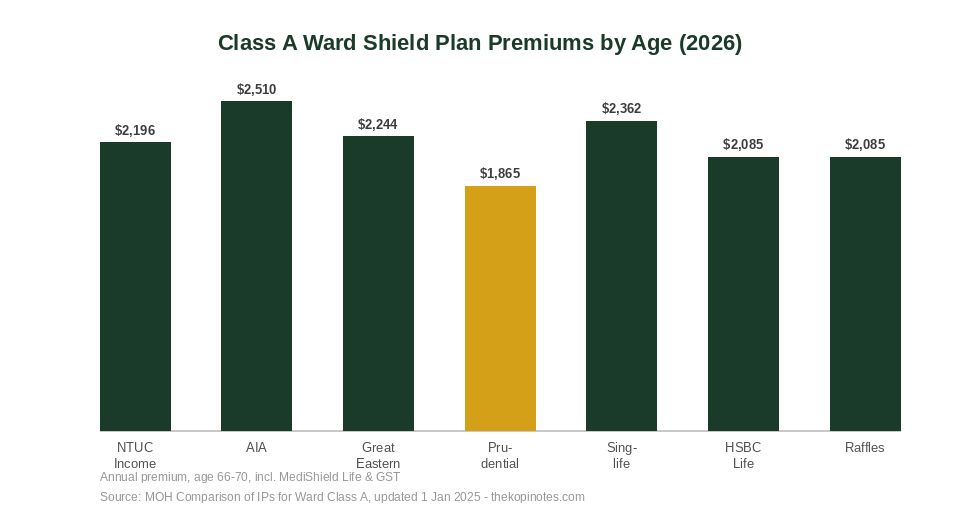
Notice that MOH sets the same S$3,500 minimum deductible for every Class A plan — insurers can’t compete on that number. What actually separates these plans is the premium you pay and the claim ceiling you get. Here’s how premiums stack up by age, inclusive of the MediShield Life component and GST:
| Insurer | Age 21–30 | Age 31–40 | Age 51–60 | Age 66–70 |
|---|---|---|---|---|
| NTUC Income | S$313 | S$497–522 | S$1,209–1,251 | S$2,196 |
| AIA | S$366 | S$568 | S$1,284–1,325 | S$2,510 |
| Great Eastern | S$340–359 | S$505–535 | S$1,107–1,343 | S$2,029–2,459 |
| Prudential (PRUShield Plus) | S$314 | S$485–511 | S$1,044–1,076 | S$1,822–1,909 |
| Singlife | S$356 | S$568 | S$1,292–1,318 | S$2,362 |
| HSBC Life | S$346 | S$556 | S$1,234–1,292 | S$2,085 |
| Raffles Health Insurance | S$346 | S$511–525 | S$1,171–1,197 | S$2,085 |
Source: MOH, Comparison of Integrated Shield Plans for Ward Class A in Public Hospitals, updated 1 January 2025. Premiums are for Singapore Citizens/PRs, inclusive of MediShield Life and GST, and will have shifted slightly since publication — check the insurer’s current rate card before buying.
How the April 2026 Rider Reform Changes What “Best” Means
Until recently, “best” often meant whichever rider covered the most of your bill. That calculus has changed. On 26 November 2025, MOH announced new rules for integrated shield plan riders, and insurers rolled out compliant riders from 1 April 2026 — a change we covered in detail in our explainer on the new MOH rider rules.
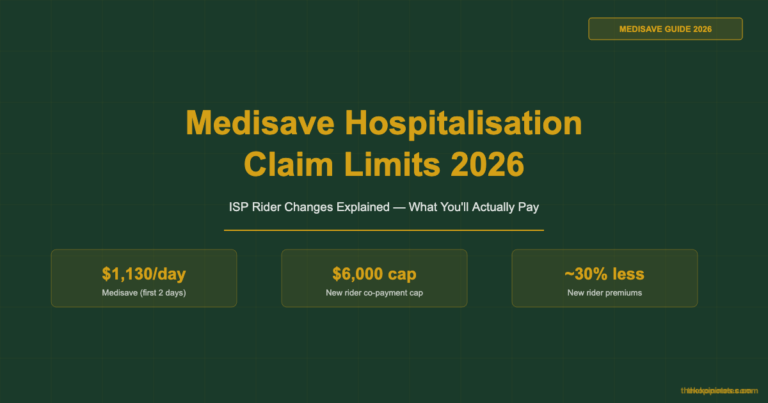
Two changes matter most for Class A ward buyers. First, new riders sold from 1 April 2026 can no longer cover your S$3,500 minimum deductible — you now pay that yourself, or via MediSave. Second, the minimum co-payment stays at 5%, but MOH raised the annual co-payment cap from S$3,000 to S$6,000 (this cap excludes the deductible). In exchange, MOH expects the new riders to cost about 30% less on average than the old near-zero co-pay riders.
That’s a real trade-off, not a free lunch. A rider still meaningfully caps your worst-case bill — but you should now budget for the deductible plus a genuine 5% share of every claim, up to S$6,000 a year. If you bought your rider before 27 November 2025, MOH has confirmed you can keep it until your insurer transitions you at a later renewal; new buyers only get the new-style rider.
Best Class A Shield Plan by Category
Best Overall: Prudential PRUShield Plus
Prudential’s PRUShield Plus is the standout for most buyers. It ties the market-leading S$1,000,000 policy year limit, but consistently undercuts AIA, Singlife and HSBC Life on premium — by as much as S$688 a year at ages 66–70. Its three-year premium growth rate has also been flat at roughly 0.6% a year, meaning your future cost is more predictable than some rivals.
Cheapest for Young Adults: NTUC Income Enhanced IncomeShield Advantage
If you’re under 30, NTUC Income’s Enhanced IncomeShield Advantage is the cheapest Class A entry point at S$313 a year. The caveat: MOH’s data shows Income’s Class A premiums have grown 5.6%–13.3% a year (excluding MediShield Life) over the past three years — noticeably faster than every other insurer on this list, which sat near a flat 0.6%. Cheap today doesn’t necessarily mean cheap in a decade.
Highest Claim Ceiling: AIA, Great Eastern, Singlife and Prudential
Four insurers — AIA HealthShield Gold Max B, Great Eastern SupremeHealth A Plus, Singlife Shield Plan 2 and Prudential PRUShield Plus — all cap Class A coverage at S$1,000,000 a policy year. NTUC Income (S$500,000), HSBC Life (S$550,000) and Raffles Shield A (S$600,000) sit meaningfully lower, which matters most if you’re weighing coverage for cancer treatment, organ transplants or an extended ICU stay.
Best for Repeat Hospitalisation: Singlife Shield Plan 2
Singlife has a feature none of its rivals match: if you exceed your S$1,000,000 limit and are hospitalised again for a different medical condition within the same policy year, your limit refreshes once. Singlife also caps your annual co-insurance at S$25,500, giving you an extra layer of predictability. We go deeper on this in our Singlife Shield Plan 2 review.
Real Cost Example: A S$40,000 Class A Ward Bill
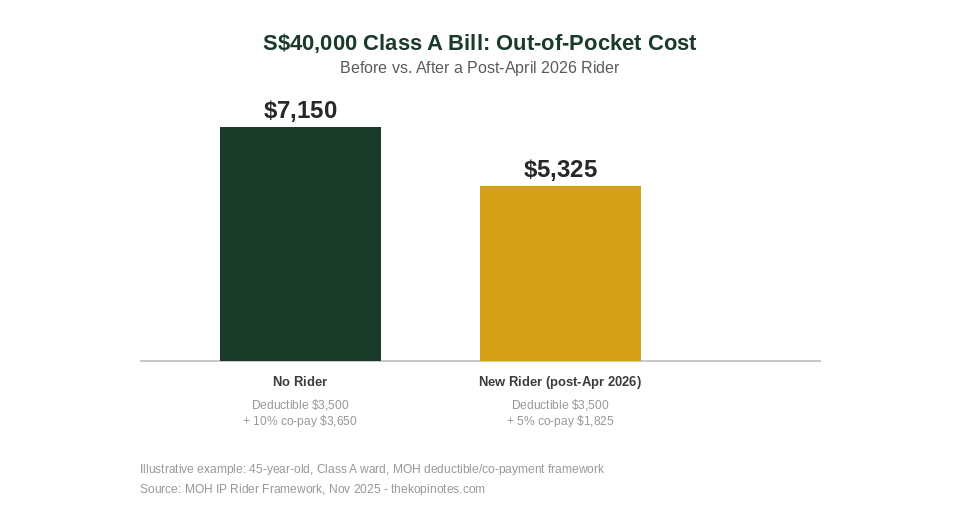
Here’s a simplified worked example for a 45-year-old Singaporean admitted to a Class A ward with a S$40,000 bill, using MOH’s own deductible and co-payment framework.
Without a rider: You pay the S$3,500 deductible, then 10% co-insurance on the remaining S$36,500 — that’s S$3,650. Total out-of-pocket: S$7,150.
With a new (post-April 2026) rider: You still pay the S$3,500 deductible, since new riders no longer cover it. But your co-payment drops to 5% of the remaining S$36,500 — S$1,825, comfortably under the new S$6,000 annual cap. Total out-of-pocket: S$5,325.
That’s a S$1,825 saving over going without a rider — while the rider itself costs roughly 30% less than the old-style riders that covered almost everything. For most people who aren’t hospitalised often, that’s a better trade-off than paying a premium for near-zero co-payment. The deductible and co-payment portions can be paid using MediSave, subject to the prevailing withdrawal limits.
How to Choose Before You Switch
Before switching insurers or adding a rider, work through these questions:
How much can you comfortably absorb out of pocket? If a S$5,000–S$7,000 bill in a bad year would strain your finances, prioritise a rider over chasing the cheapest base premium.
How healthy is your family history? If cancer or major surgery runs in your family, the S$1,000,000 tier (AIA, Great Eastern, Singlife, Prudential) is worth the marginally higher premium over Income, HSBC Life or Raffles.
Are you comparing like-for-like ward class? If you’re unsure whether Class A is worth the jump from B1, read our breakdown of what a Class A ward actually costs in Singapore first.
Can your MediSave cover the premium? The annual MediSave withdrawal limit for ISP premiums is S$300 if you’re 40 or younger, S$600 for ages 41–70, and S$900 for ages 71 and above — anything above that comes out of cash.
Switching insurers also means underwriting on any pre-existing conditions, so don’t cancel an existing policy until your new one is confirmed. A licensed financial adviser can help you compare the full policy wording, not just the headline numbers in this guide.
Frequently Asked Questions
What is the best Class A ward integrated shield plan in Singapore right now?
There’s no single plan that’s best for everyone, but Prudential PRUShield Plus offers the strongest overall balance as at July 2026 — it matches the market-leading S$1,000,000 claim limit while consistently pricing below AIA, Singlife and HSBC Life. If you want the absolute lowest entry premium and are under 30, NTUC Income’s Enhanced IncomeShield Advantage is cheaper, but its premiums have historically risen faster.
Which Class A ward shield plan has the highest annual claim limit?
AIA HealthShield Gold Max B, Great Eastern SupremeHealth A Plus, Singlife Shield Plan 2 and Prudential PRUShield Plus all cap Class A coverage at S$1,000,000 per policy year. NTUC Income, HSBC Life and Raffles Shield A offer lower ceilings of S$500,000, S$550,000 and S$600,000 respectively.
How did the April 2026 MOH rider changes affect Class A ward plans?
From 1 April 2026, new integrated shield plan riders can no longer cover your S$3,500 Class A deductible, and the minimum co-payment stays at 5% of each bill. MOH raised the annual co-payment cap from S$3,000 to S$6,000 to compensate, and expects the new riders to cost roughly 30% less on average than the older, more comprehensive riders.
Can I use MediSave to pay for my Class A ward shield plan premium?
Yes. CPF Board sets annual MediSave withdrawal limits for integrated shield plan premiums: S$300 if you’re 40 or younger at your next birthday, S$600 for ages 41 to 70, and S$900 for ages 71 and above. Amounts above these limits must be paid in cash.
Is NTUC Income's Enhanced IncomeShield Advantage still a good choice given rising premiums?
It’s still the cheapest entry point for young adults, at S$313 a year for ages 21–30. But MOH’s own three-year premium data shows Income’s Class A premiums climbing 5.6% to 13.3% a year, versus a near-flat 0.6% for AIA, Great Eastern, Prudential, Singlife, HSBC Life and Raffles. If long-term cost predictability matters to you, weigh that trend against the lower starting price.
Should I upgrade from a Class B1 plan to a Class A plan?
It depends on how much you value private-doctor choice and shorter waits over cost. Class A wards typically cost significantly more than B1 out of pocket without a shield plan. Read our full breakdown of what a Class A ward costs in Singapore before deciding, and compare the premium gap against your own risk tolerance and family medical history.
Planning Your Healthcare and Retirement Budget?
Model how shield plan premiums fit into your long-term retirement numbers.
Get Free Insurance Advice
Speak with a licensed insurance advisor. No obligation, no cost.
By submitting this form, you agree to our Privacy Policy.
This article was researched with the help of AI. While we strive to keep all information accurate and up to date, there may be errors. If you notice any discrepancies, please contact us.