Shield Plan Comparison Singapore 2026: How All 7 Insurers’ New Riders Stack Up
Every Integrated Shield Plan insurer relaunched its riders on 1 April 2026. Here’s how their new premiums, deductibles and coverage actually compare.
For a shield plan comparison in Singapore that actually matters in 2026, look past base premiums straight to the riders. From 1 April 2026, MOH banned new riders from covering your deductible and raised the minimum co-payment cap to $6,000. All seven insurers — AIA, Great Eastern, HSBC Life, Income, Prudential, Raffles Health and Singlife — have since launched new, cheaper riders built around this rule.
Not financial advice. All figures are for educational reference only. Data verified as at 19 July 2026 against MOH and insurer sources unless otherwise noted.
- Your rider no longer covers the deductible, and the co-payment cap rose from $3,000 to $6,000 a year — but new rider premiums are 35–40% cheaper on average.
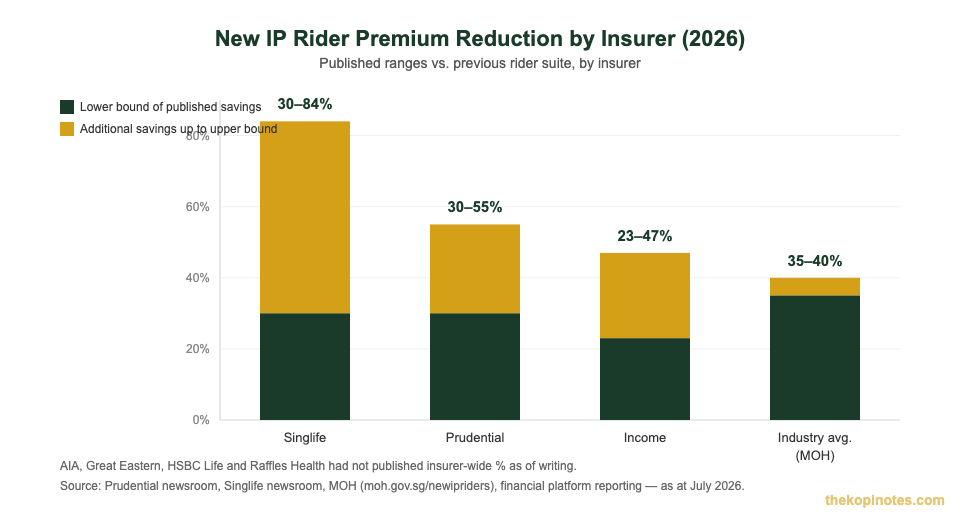
- Prudential, Income and Singlife have published exact savings (23% to 84%, depending on plan and age). AIA, Great Eastern, HSBC Life and Raffles Health have new riders too, but haven’t released insurer-wide percentages.
- There’s no single “cheapest” insurer — the right pick depends on your ward class, age, and how much cash buffer you’re comfortable holding for a hospital bill.
Quick Answer
Every shield plan comparison in Singapore now has to account for one thing first: the rider, not the base plan. Your Integrated Shield Plan (IP) still covers hospital bills the same way it always did. What changed is the optional rider you stack on top of it.
From 1 April 2026, that rider can no longer pay your deductible for you. Instead, it caps your co-payment at a minimum of $6,000 a year. In exchange, the new riders cost noticeably less — Prudential says at least 30% less, Income around 23% to 47% less, and Singlife up to 84% less on some plans. That’s the trade-off: lower premiums today, higher cash outlay if you’re actually hospitalised.
What Changed on 1 April 2026
MOH announced the new rider rules on 26 November 2025. The goal: slow down runaway rider premiums. Its data showed private hospital IP policyholders with riders were 1.4 times more likely to claim, with claims 1.4 times larger on average, than those without riders. Generous riders were quietly driving up everyone’s costs.
Your main Integrated Shield Plan didn’t change at all. It still covers your hospital bill up to your ward class limit, the same way it did in 2025. Only the optional rider on top of it changed. If you don’t hold a rider, none of this affects your existing coverage — it only matters when you’re deciding whether to add or switch one.
Two things changed for every new rider sold from 1 April 2026:
1. Riders no longer cover the deductible. You pay this yourself — in cash or MediSave, subject to withdrawal limits. The deductible is a fixed amount you pay once a year before your IP starts paying out.
2. The co-payment cap rose from $3,000 to $6,000 a year. This is the most you’ll pay in co-insurance (excluding the deductible) if you use a panel or pre-authorised provider. The minimum 5% co-payment rate itself didn’t change.
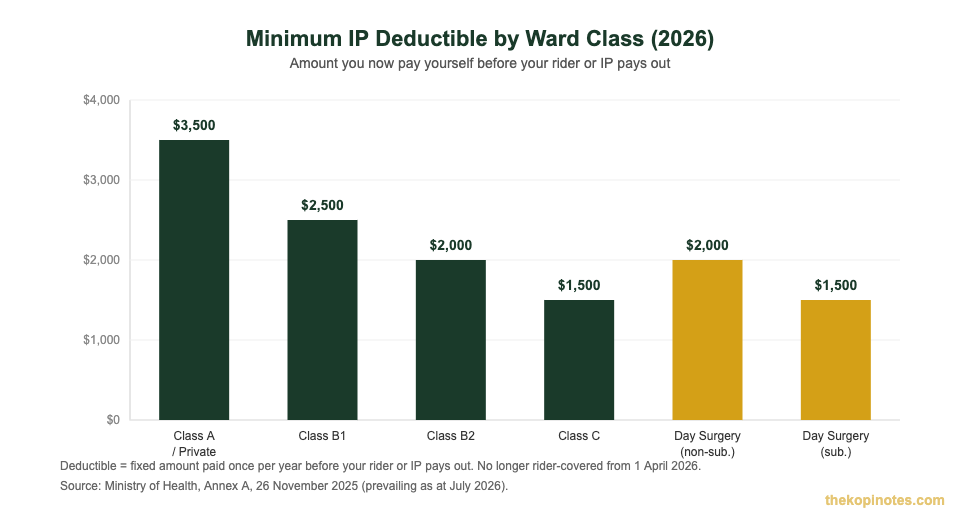
Here’s what the minimum deductible looks like by ward class, based on MOH’s official table:
| Ward Class / Coverage | Minimum Deductible |
|---|---|
| Class A / Private | $3,500 |
| Class B1 | $2,500 |
| Class B2 | $2,000 |
| Class C | $1,500 |
| Day Surgery (non-subsidised) | $2,000 |
| Day Surgery (subsidised) | $1,500 |
Source: Ministry of Health, Annex A, 26 November 2025 (prevailing as at July 2026).
If you switched to a new rider before 1 April 2026, don’t panic. Existing rider policyholders who bought before 27 November 2025 keep their current terms — each insurer is deciding its own transition approach. If you bought a non-compliant rider between 27 November 2025 and 31 March 2026, MOH requires your insurer to move you to a compliant rider no later than your next renewal after 1 April 2028.
How the 7 Insurers’ New Riders Compare
All seven IP insurers had launched MOH-compliant riders by mid-2026. However, and this matters for your shield plan comparison: not every insurer has published exactly how much cheaper its riders are. Here’s what’s confirmed, insurer by insurer. For exact numbers on your own ward class, check insurer-specific breakdowns like the AIA HealthShield Gold Max premium table or the Great Eastern SupremeHealth P Plus premium table — headline averages rarely match what you’d pay at your age.
| Insurer | New Rider(s) | Reported Premium Change | Notable Feature |
|---|---|---|---|
| AIA | Max VitalHealth Pro A / Pro B / Pro B Lite | Not individually published | No underwriting to switch from the old VitalHealth rider |
| Great Eastern | GREAT TotalCare 2 (+ TotalCare 2 Prime) | Not individually published | New “P Prime” private hospital plan tier launched alongside it |
| HSBC Life | Enhanced Care II | Not individually published | Adds outpatient dementia cover, up to $500/year |
| Income (NTUC) | Optima Care (Preferred) / Essential Care (Advantage & Basic) | ~23%–47% lower, reported | Tiered co-payment by panel, extended panel or other provider |
| Prudential | PRUExtra Premier / Preferred / Plus Care | At least 30% lower; Preferred Care at least 45% (up to 55%) | Up to $100,000 extra cover for critical illness; 12-month premium waiver if retrenched |
| Raffles Health | Raffles Choice Rider | Not individually published | Replaces co-insurance with a flat 5% co-payment after deductible |
| Singlife | Health Plus Private / Health Plus Public | 30%–84% lower, reported | Free Care Collab benefit — $20,000 over 2 years for recovery support, if paired with CareShield/ElderShield |
Source: MOH (moh.gov.sg/newipriders, industry average 35–40% lower as at July 2026), Prudential newsroom (1 April 2026), Singlife newsroom (2026), and financial comparison platform reporting for Income figures. AIA, Great Eastern, HSBC Life and Raffles Health had not published insurer-wide premium change percentages as at the time of writing.
Notice the gap. Prudential, Income and Singlife have put hard numbers behind their new riders in press releases. AIA, Great Eastern, HSBC Life and Raffles Health have launched compliant products but kept the marketing quieter — you’ll need to request an illustration to see your actual number. That’s not a red flag; it just means you can’t shop by headline percentage alone. If you’re weighing Prudential specifically, the PRUShield premium guide breaks down Standard, Plus and Premier by age band, and the Singlife Shield Plan 2026 guide does the same for Singlife’s Health Plus tiers.
How Much You Actually Save (Real Examples)
MOH published two worked examples when it announced the changes. They’re useful because they show both sides of the trade-off: lower premiums now, more out-of-pocket cash if you’re hospitalised.
Mr A, 60, private hospital rider. He switches to the new rider in April 2026 and saves 30% in premiums immediately — $1,600 in cash that year. Three years later, he needs knee replacement surgery costing $56,900. With the new rider, he pays $6,170 out of pocket (deductible plus 5% co-payment), all covered by MediSave. That’s $3,330 more than his old rider would have cost him for that one bill. But he’d already banked $4,800 in premium savings over those three years — so he still comes out ahead.
Mrs B, 40, no rider previously. Premiums were too high for her budget before. With the cheaper new riders, she adds one in April 2026, paying $500 less per year than peers who bought riders under the old system. In December 2026, she tears her ACL playing sport and needs a $38,700 surgery. Her rider cuts her out-of-pocket cost from $3,120 (no rider) to $1,360 (with rider) after MediSave.
Across the market, MOH estimates private hospital rider policyholders save around $600 a year on average, and public hospital rider policyholders save around $200 a year — with older policyholders saving more, since premiums rise steeply with age.
Ward Class and Deductible Comparison
Your ward class decides your deductible — and that’s now money you’ll actually pay, not money the rider absorbs. If you’re targeting Class A or a private hospital, budget for a $3,500 deductible plus up to $6,000 in co-payment in a bad year. That’s a possible $9,500 cash exposure, even with a rider.
Public hospital plans (Class B1 and below) have lower deductibles — $2,500 for B1, down to $1,500 for Class C. Your maximum cash exposure with a rider is correspondingly lower, which is one reason several insurers, including Great Eastern with its new P Prime tier, are pushing tiered products that let you dial coverage up or down by ward class rather than an all-or-nothing choice.
This is also where this year’s MediSave withdrawal limits matter. Both the deductible and the co-payment can be paid from MediSave, subject to prevailing limits — so check your available balance before assuming you’ll need cash savings on hand.
Who Should Pick Which Plan?
The new riders make sense if: you want private or Class A ward access but couldn’t previously afford a rider, like Mrs B above. You’re trading a small ongoing premium for a capped worst-case bill, instead of paying nothing and hoping you never need private care.
Consider going without a rider if: you’re young, healthy, and already hold at least $6,000 to $9,500 in accessible savings or MediSave. An average 40-year-old is hospitalised only once or twice in the next 20 years, per MOH’s claims data — for many people, self-insuring the co-payment is cheaper over a decade than paying rider premiums every year.
Keep your legacy rider if: you bought before 27 November 2025 and your insurer lets you retain it. Near-zero co-payment is genuinely valuable if you have a chronic condition or a family history that makes hospitalisation more likely — just expect to pay more for that certainty.
If you’re a foreigner or new PR: you don’t have MediShield Life, so your IP is your only hospital coverage — riders matter more, not less, since you can’t fall back on the national scheme. Budget for the higher deductible in cash rather than assuming MediSave will cover it, since MediSave access depends on your CPF contribution history.
Before deciding, run your numbers through MOH’s Health Insurance Planner and talk to a financial adviser — this article gives you the market picture, not a personal recommendation. For a deeper walkthrough of the reform itself, see our full ISP rider changes explainer or the earlier shield plan comparison, which this article updates with post-reform data. It’s also worth checking a retirement planning calculator to see how a smaller annual premium compounds over the years if invested instead.
Frequently Asked Questions
What's the best way to do a shield plan comparison in Singapore in 2026?
Compare the rider, not just the base Integrated Shield Plan. Since 1 April 2026, every insurer’s rider works the same basic way — no deductible coverage, $6,000 minimum co-payment cap — so the real differences are in premium, panel network and extra benefits like Prudential’s critical illness top-up or Singlife’s Care Collab benefit.
What changed for Integrated Shield Plan riders on 1 April 2026?
New riders can no longer cover your minimum deductible, and the minimum co-payment cap rose from $3,000 to $6,000 a year. In exchange, MOH says new riders are about 35–40% cheaper on average than the riders they replaced.
Which insurer has the cheapest new IP rider in 2026?
There’s no single cheapest insurer — it depends on your age, ward class and provider panel. Prudential, Income and Singlife have published rider-specific savings ranges (23% to 84%, depending on the plan). Get an actual quote from at least two or three insurers before deciding, since your specific age band changes the numbers significantly.
Do I have to switch to the new rider immediately?
No. If you bought your rider before 27 November 2025, you keep your existing terms for now — each insurer sets its own transition timeline. If you bought a rider on or after 27 November 2025 that doesn’t meet the new rules, your insurer must move you to a compliant rider no later than your next renewal after 1 April 2028.
Can I use MediSave to pay for the new higher deductible and co-payment?
Yes. Both the deductible and the co-payment can be paid from MediSave, subject to the prevailing withdrawal limits for your procedure type. Check your MediSave balance and this year’s withdrawal limits before assuming you’ll need cash savings on hand.
Is it worth downgrading my rider to save money?
It depends on your risk tolerance and savings buffer. MOH’s data shows an average 60-year-old is hospitalised about twice in the next 10 years, and an average 40-year-old once or twice in 20 years — infrequent enough that self-insuring the co-payment can be cheaper long-term for some people. Run the numbers through MOH’s Health Insurance Planner and speak to a financial adviser before deciding.
Put Your Rider Savings to Work
If switching riders freed up $500–$1,600 a year, don’t let it sit idle. Channel it into a diversified portfolio instead.
Not financial advice. All figures are for educational reference only. Data verified as at 19 July 2026.
Get Free Insurance Advice
Speak with a licensed insurance advisor. No obligation, no cost.
By submitting this form, you agree to our Privacy Policy.
This article was researched with the help of AI. While we strive to keep all information accurate and up to date, there may be errors. If you notice any discrepancies, please contact us.