PRUShield Review Singapore: 2026 Complete Guide (Premiums, Tiers & Rider Changes)
Your complete guide to Prudential’s Integrated Shield Plan — coverage tiers, updated 2026 premiums, and the new MOH rider rules explained.
PRUShield is Prudential Singapore’s Integrated Shield Plan (ISP), offered in three tiers — Plus, Premier, and Premier Plus — covering ward classes from Class B1 in public hospitals up to private hospital rooms. For a 30-year-old non-smoker, annual base premiums range from approximately SGD 330 (Plus) to SGD 1,020 (Premier), payable entirely from MediSave. From 1 April 2026, all new PRUShield riders no longer cover the mandatory deductible, and the co-payment cap has doubled to SGD 6,000 per year — but premiums on new riders are about 30% lower as a result.
Not financial advice. All figures are for educational reference only. Data as at June 2026 unless noted.
Table of Contents
Contents — Click to expand
- What Is PRUShield?
- PRUShield Plan Tiers at a Glance
- PRUShield Premiums 2026 (By Age Band)
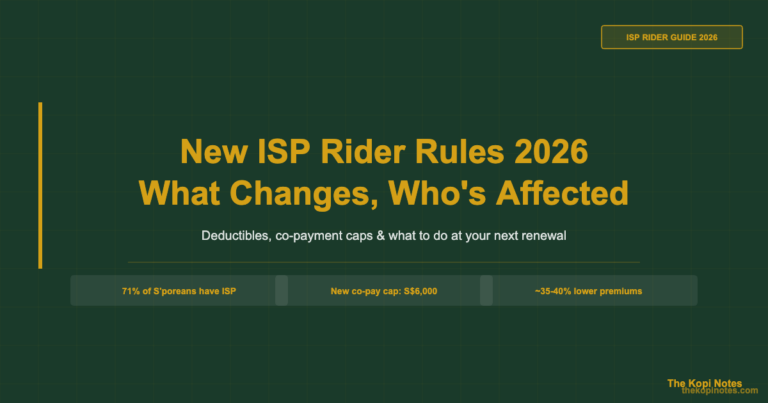
- The 2026 Rider Changes: What Changed and What Did Not
- PRUShield Riders: What Are Your Options?
- Out-of-Pocket Costs Under the New Rules
- PRUShield vs AIA, Great Eastern and NTUC Income
- Who Should Choose PRUShield?
- How to Apply for PRUShield
- Frequently Asked Questions
What Is PRUShield?
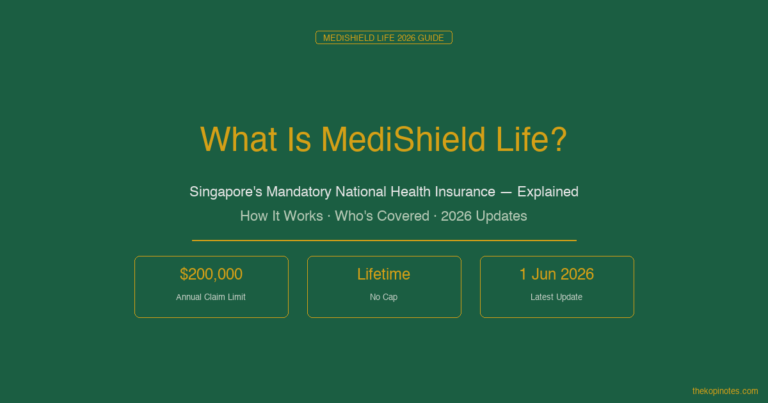
PRUShield is an Integrated Shield Plan (ISP) offered by Prudential Assurance Company Singapore. Like all ISPs, it is built on top of the national MediShield Life layer and provides coverage beyond what MediShield Life covers by default — namely, the ability to stay in Class A wards in public hospitals or in private hospitals, where bills can run significantly higher than the subsidised Class B2 and C wards that MediShield Life is sized for.
Every Singapore Permanent Resident and Citizen is automatically covered by MediShield Life from birth or upon obtaining PR status. PRUShield is an optional top-up that you purchase separately from Prudential, with premiums payable from your MediSave account (subject to the Additional Withdrawal Limits, or AWL, set by MOH).
PRUShield covers inpatient hospitalisation, day surgery, and certain pre- and post-hospitalisation outpatient treatment. It pays the difference between what MediShield Life covers and the actual hospital bill — up to the policy’s annual claim limit. Optional riders (sold separately) can then reduce your remaining out-of-pocket costs.
As at June 2026, Prudential holds a significant share of Singapore’s ISP market, with PRUShield known for its broad PRUPanel Connect network of specialists and straightforward claims process through the MyPrudential app.
PRUShield Plan Tiers at a Glance
PRUShield is available in three core tiers. Each tier determines which ward class and hospital type your coverage applies to:
| Plan | Ward Coverage | Hospital Type | Annual Claim Limit |
|---|---|---|---|
| PRUShield Plus | Class B1 | Public hospitals (restructured) | Up to SGD 800,000 |
| PRUShield Premier | Class A | Public + private hospitals | As charged |
| PRUShield Premier Plus | Private ward | Private hospitals (incl. overseas) | As charged (higher sub-limits) |
Source: Prudential Singapore PRUShield product summary, June 2026. Annual limits subject to sub-limits per condition.
Most Singapore residents choose either PRUShield Plus (if content with restructured hospital care) or PRUShield Premier (for flexibility to use private hospitals without bill shock). Premier Plus is the premium tier for those who want full private hospital coverage, including Mount Elizabeth, Gleneagles, and Parkway East.
PRUShield Premiums 2026 (By Age Band)
All PRUShield base plan premiums are payable entirely from MediSave, subject to the Additional Withdrawal Limits (AWL). Premiums are structured on an age-banded basis — they increase as you get older, and the step-ups become significant from age 50 onwards. Locking in cover early is advantageous because your premiums start lower and you avoid the risk of being declined or loaded due to pre-existing conditions.
Below are indicative annual base plan premiums for the three PRUShield tiers, for non-smoking policyholders:
| Age Band | PRUShield Plus | PRUShield Premier | PRUShield Premier Plus |
|---|---|---|---|
| 1-20 | ~SGD 170 | ~SGD 405 | ~SGD 520 |
| 21-30 | ~SGD 200 | ~SGD 500 | ~SGD 660 |
| 31-40 | ~SGD 275 | ~SGD 720 | ~SGD 940 |
| 41-50 | ~SGD 420 | ~SGD 1,090 | ~SGD 1,420 |
| 51-60 | ~SGD 700 | ~SGD 1,870 | ~SGD 2,450 |
| 61-70 | ~SGD 1,500 | ~SGD 4,200 | ~SGD 5,500 |
Source: Prudential Singapore PRUShield premium tables, June 2026. Figures are indicative — exact premiums vary by gender, smoking status, and health loading. Confirm at time of application. Payable from MediSave up to AWL limits.
An important note: if your annual premium exceeds the MediSave AWL for your plan tier, the excess must be paid in cash. For younger policyholders (under 40) on PRUShield Premier, premiums typically fall well within the AWL. For those over 60, cash top-ups may be required — always verify with your financial adviser or directly with Prudential.
The 2026 Rider Changes: What Changed and What Did Not
The Ministry of Health (MOH) implemented new requirements for all IP riders sold from 1 April 2026 onwards. These are the most significant changes to ISP riders since the 5% co-payment rule was introduced in 2018. Here is what changed:
| Feature | Before April 2026 (Old Riders) | From April 2026 (New Riders) |
|---|---|---|
| Deductible coverage | Rider could cover the deductible | Rider cannot cover deductible |
| Deductible amount (private hospital) | SGD 3,500/year | SGD 3,500/year (unchanged) |
| Co-payment requirement | Minimum 5% | Minimum 5% (unchanged) |
| Co-payment annual cap | SGD 3,000/year | SGD 6,000/year |
| Rider premium (new private hospital rider) | Higher (max coverage) | ~30% lower on average |
Source: MOH circular on new ISP rider requirements, effective 1 April 2026.
Grandfather protection: If you purchased your PRUShield rider before 27 November 2025, your existing rider terms are preserved — the deductible remains covered and the co-payment cap stays at SGD 3,000. Older riders are the most comprehensive in the market. There is no benefit to switching an existing grandfathered rider to a new one.
For anyone buying a PRUShield rider for the first time from April 2026 onwards, the practical effect is that you will pay the deductible out-of-pocket first, then 5% of the remaining eligible bill, up to a total annual co-payment (excluding deductible) of SGD 6,000. Both amounts can be funded from MediSave, subject to prevailing withdrawal limits.
PRUShield Riders: What Are Your Options?
Prudential offers two main rider categories to complement the PRUShield base plan:
PRUExtra Premier CoPay (for PRUShield Premier): This rider covers a portion of your co-payments and helps reduce your net out-of-pocket exposure above the deductible. From April 2026, it cannot cover the SGD 3,500 deductible but does reduce co-payments above that threshold. This is the main rider option for PRUShield Premier holders.
PRUExtra Plus CoPay (for PRUShield Plus): The equivalent rider for the Plus (Class B1) tier, with correspondingly lower premiums and co-payment coverage aligned to lower restructured hospital bill sizes.
A key differentiator of PRUShield riders is the PRUPanel Connect network. When you see a PRUPanel specialist, your effective co-payments may be reduced compared to seeing a non-panel doctor. Prudential publishes an online panel directory searchable by specialty and location — this is worth checking before booking an elective consultation, as using a panel specialist can meaningfully reduce your out-of-pocket bill. Rider premiums must be paid in cash and cannot be deducted from MediSave.
Out-of-Pocket Costs Under the New Rules
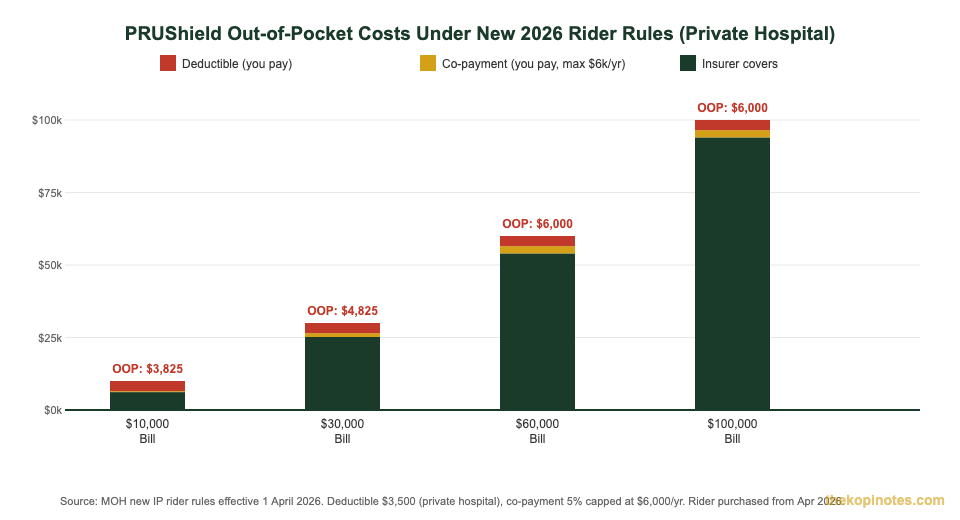
For Singapore residents who purchased a new PRUShield rider from April 2026, here is how the maths works for a private hospital admission. The deductible for private hospital stays is SGD 3,500 per year. After that, you pay 5% of the remaining eligible bill, up to a total annual co-payment cap (excluding deductible) of SGD 6,000.
Worked example: a Singapore policyholder hospitalised at Mount Elizabeth with an eligible bill of SGD 30,000 would pay: SGD 3,500 deductible + 5% x (SGD 30,000 minus SGD 3,500) = SGD 3,500 + SGD 1,325 = SGD 4,825 total out-of-pocket for the year. PRUShield Premier covers the remaining SGD 25,175. Once your annual co-payments (excluding deductible) reach the SGD 6,000 cap, PRUShield covers 100% of further eligible claims for the rest of that policy year — strong protection against catastrophically large hospital bills.
Both the deductible and co-payments can be paid using MediSave, subject to prevailing MediSave withdrawal limits — check with CPF Board for the current figures applicable to your age group.
PRUShield vs AIA, Great Eastern and NTUC Income
Choosing between ISPs is rarely just about premiums — the specialist panel network, claims process, and pre/post-hospitalisation coverage periods all matter significantly. Here is how PRUShield Premier compares to the other major ISPs on the private hospital tier:
| Feature | PRUShield Premier | AIA HealthShield Gold Max A | GE Supreme Health P Plus | NTUC Income Enhanced |
|---|---|---|---|---|
| Annual Claim Limit | As charged | As charged | As charged | As charged |
| Pre-hospitalisation | 180 days (panel) | 180 days | 180 days | 180 days |
| Post-hospitalisation | 365 days (panel) | 365 days | 365 days | 365 days |
| Panel network | PRUPanel Connect | AIA Preferred Providers | GREAT Panel | Income Panel |
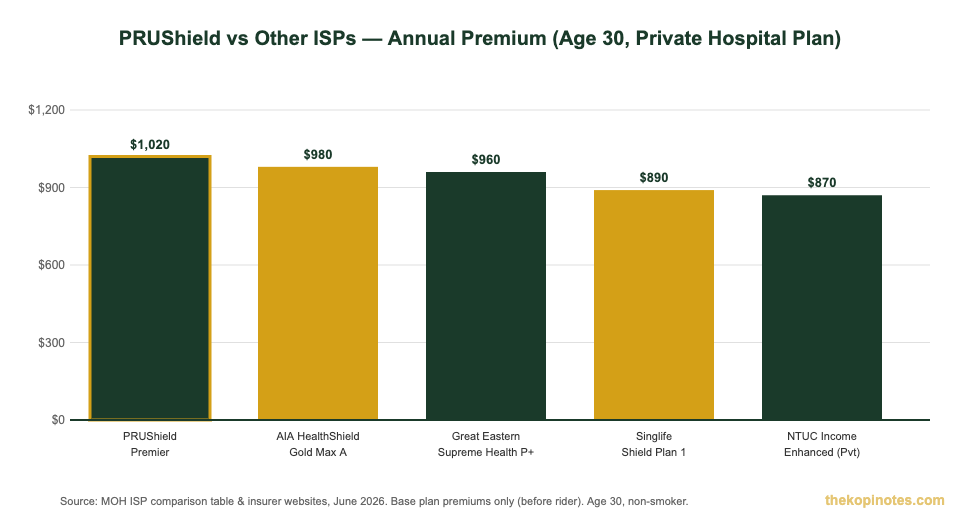
| Annual premium (age 30) | ~SGD 500-720 | ~SGD 450-680 | ~SGD 430-660 | ~SGD 380-620 |
| Key differentiator | Broad panel; MyPrudential app | Strong cancer sub-limits | Value-for-money premiums | Lowest premiums; co-op model |
Source: MOH ISP comparison table and insurer websites, June 2026. Premiums are indicative and vary by age, gender, and smoking status.
PRUShield sits in the mid-to-upper premium range. Its edge over competitors lies in the depth of the PRUPanel Connect specialist network — one of the largest among Singapore ISPs — and the seamless claims process via the Prudential app. If you prioritise panel breadth and ease of specialist access, PRUShield Premier is a strong contender. If price is your primary concern and you are comfortable researching specialist availability yourself, Great Eastern or NTUC Income may offer similar “as charged” benefits at a lower premium.
Who Should Choose PRUShield?
PRUShield is a strong fit for Singapore residents who want a private hospital ISP from an established insurer with a large panel network. Specifically, it suits working professionals in their 30s and 40s who want Class A or private hospital access and value a smooth digital claims experience. It is also a natural choice if you already hold other Prudential policies and prefer to consolidate with one insurer.
If you are primarily price-sensitive and comfortable navigating a smaller specialist panel, NTUC Income Enhanced may offer comparable coverage at a lower premium. If you have specific concerns about cancer treatment costs, AIA HealthShield Gold Max has a reputation for strong cancer sub-limits that is worth comparing.
ISPs are not eligible for the CPF Investment Scheme, but a well-structured CPF investment strategy can help ensure your Ordinary Account funds grow steadily alongside your MediSave health coverage. To see how your healthcare costs fit into your overall retirement picture, the Singapore retirement calculator is a useful planning tool.
How to Apply for PRUShield
You can apply for PRUShield through three main channels. The most common is through a Prudential financial adviser, who will walk you through the tiers and optional riders and advise on MediSave funding — there is no fee as advisers earn commission from Prudential. You can also apply directly via the Prudential Singapore website or the MyPrudential app using SingPass login and your MediSave details.
Before finalising any ISP, always check the MOH official ISP comparison table, which presents all five insurers (AIA, Great Eastern, Singlife, NTUC Income, and Prudential) on a standardised basis — this is the most trustworthy reference for benefit-by-benefit comparison.
To build passive income that can comfortably cover your annual deductible and co-payments over time, explore the passive income strategies popular among Singapore investors — S-REITs and dividend-focused ETFs can generate steady cash flows. The Syfe referral code offers a bonus for new investors opening a managed portfolio.
For a broader view of how insurance spending fits alongside your investment choices, the comparison of leading platforms in our Syfe vs Endowus 2026 review is a useful starting point for Singapore investors managing both protection and wealth-building goals.
Not financial advice. All figures are for educational reference only. Always verify premium tables directly with Prudential or your financial adviser before making any decision.
Frequently Asked Questions
What is PRUShield and is it worth buying in Singapore?
PRUShield is Prudential Singapore’s Integrated Shield Plan, which provides hospital coverage on top of MediShield Life. It is worth buying if you want the option of staying in Class A wards at restructured hospitals or in private hospitals — MediShield Life alone is sized only for Class B2 and C wards. For most working adults in Singapore, having at least PRUShield Plus or Premier provides meaningful protection against large hospital bills.
Can I pay for PRUShield using MediSave?
Yes — PRUShield base plan premiums can be paid entirely from your MediSave account, up to the Additional Withdrawal Limits (AWL) set by MOH. For younger policyholders under 40, premiums typically fall within the AWL. For policyholders over 60 on higher-tier plans, the premiums may exceed the AWL and the excess must be paid in cash. Rider premiums must always be paid in cash and cannot be deducted from MediSave.
What changed for PRUShield riders from April 2026?
From 1 April 2026, new PRUShield riders can no longer cover the mandatory deductible (SGD 3,500 for private hospital stays). The annual co-payment cap has been raised from SGD 3,000 to SGD 6,000 per year. In exchange, premiums on new riders are approximately 30% lower than the old maximum-coverage riders. If you bought your rider before 27 November 2025, your existing terms are grandfathered — no change to your benefits.
Is PRUShield better than AIA HealthShield Gold Max?
Both PRUShield Premier and AIA HealthShield Gold Max A cover private hospitals with as-charged benefits and 365 days post-hospitalisation. AIA is known for strong cancer treatment sub-limits, while PRUShield stands out for the breadth of its PRUPanel Connect specialist network and the MyPrudential app claims experience. Premium-wise, they are comparable. The best choice depends on which specialists and hospitals you prefer — check both panel directories before deciding.
How much will I pay out-of-pocket with PRUShield Premier and a new 2026 rider?
Under the new April 2026 rules, you first pay the annual deductible of SGD 3,500 out-of-pocket (payable from MediSave). After that, you pay 5% of the remaining eligible bill, up to a maximum co-payment of SGD 6,000 per year (excluding deductible). For example, on a private hospital bill of SGD 30,000, you would pay SGD 3,500 (deductible) + SGD 1,325 (5% of SGD 26,500) = SGD 4,825 in total. PRUShield covers the remaining SGD 25,175.
Can I switch from PRUShield to another ISP?
Yes, you can switch ISPs at any time, but doing so carries risks. Pre-existing conditions on your current policy may be excluded or subject to premium loadings by the new insurer. You also lose any grandfathered rider benefits from before November 2025 if you cancel and reapply. Most financial advisers recommend staying with your current ISP unless there is a compelling reason to switch, such as meaningfully better premiums or panel access for your specific health needs.
Is PRUShield available for foreigners working in Singapore?
PRUShield is designed for Singapore Citizens and Permanent Residents, as it integrates with MediShield Life. Foreigners on Employment Pass or S-Pass are not covered by MediShield Life and therefore cannot purchase an ISP. Foreigners working in Singapore are typically advised to take out a private health insurance plan instead, which is fully cash-paid with no MediSave component. Check with an independent financial adviser for options tailored to your situation.
Build Your Financial Safety Net
Your ISP covers hospitalisation — grow your wealth alongside it. Use these tools and referral links to get started.
Get Free Insurance Advice
Speak with a licensed insurance advisor. No obligation, no cost.
By submitting this form, you agree to our Privacy Policy.
This article was researched with the help of AI. While we strive to keep all information accurate and up to date, there may be errors. If you notice any discrepancies, please contact us.