Integrated Shield Plan Singapore 2026: Complete Guide (With New Rider Rules Explained)
Updated June 2026 • Covers MOH rider changes effective 1 April 2026
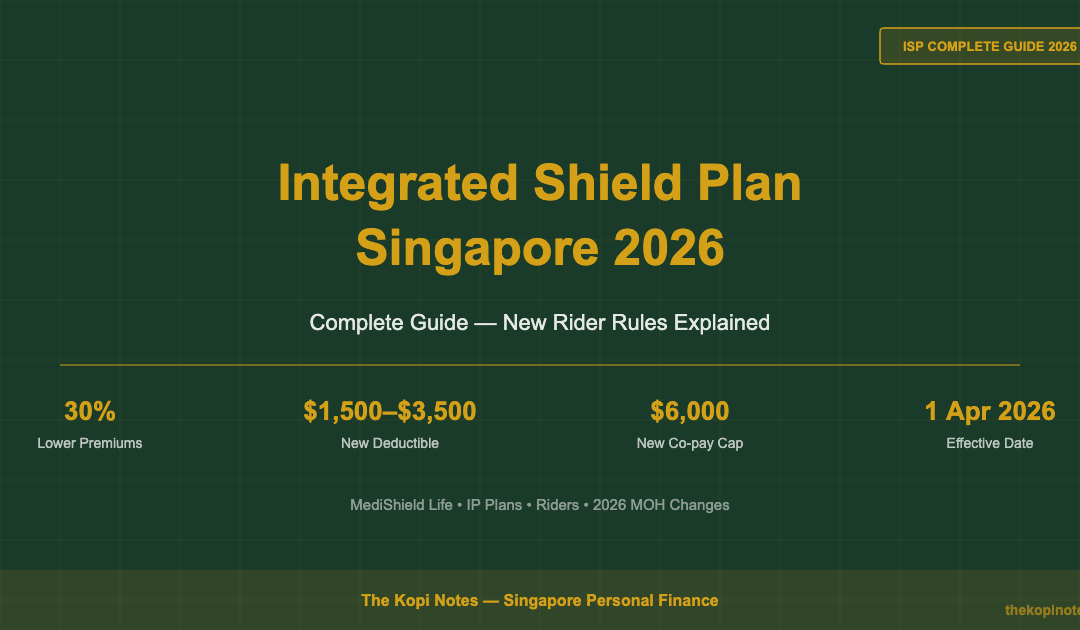
An Integrated Shield Plan (ISP) is a private health insurance policy in Singapore that sits on top of MediShield Life, the national health insurance scheme. ISPs let you upgrade your hospital coverage to Class A wards or private hospitals. As of 1 April 2026, MOH introduced major changes: new riders can no longer cover your deductible ($1,500–$3,500), the co-payment cap doubled from $3,000 to $6,000, and in return rider premiums dropped by about 30%. If you have an ISP, this guide explains exactly what changed and what you need to do.
Not financial advice. All figures are for educational reference only. Data as at June 2026 unless noted.
- ISPs upgrade your MediShield Life coverage to Class A, B1, or private hospital wards.
- From 1 April 2026, new riders no longer cover your deductible — you pay $1,500–$3,500 upfront per hospitalisation. But rider premiums are ~30% cheaper.
- If you bought your rider before 26 Nov 2025, your existing benefits stay as-is for now.
Table of Contents
- What Is an Integrated Shield Plan?
- How an ISP Works With MediShield Life
- The 2026 MOH Rider Changes Explained
- What You Will Actually Pay Under the New Rules
- ISP Plan Comparison: Which Insurers Offer What
- Should You Get a Rider in 2026?
- Using MediSave to Reduce Out-of-Pocket Costs
- Can Foreigners Get an ISP in Singapore?
- Frequently Asked Questions
What Is an Integrated Shield Plan?
MediShield Life covers you for Class B2 and C wards in public hospitals. That is the baseline every Singaporean gets automatically. But if you want to stay in a Class A ward, or go to a private hospital like Mount Elizabeth or Gleneagles, MediShield Life alone will not be enough.
That is where an Integrated Shield Plan (ISP) comes in. An ISP is a private health insurance policy that integrates with — and sits on top of — MediShield Life. You buy it from one of six private insurers approved by MOH, and it extends your coverage to higher ward classes or private hospitals.
There are currently six ISP insurers in Singapore: AIA (AIA HealthShield Gold Max), Great Eastern (Supreme Health), Income (IncomeShield), Prudential (PRUShield), Raffles Health Insurance (Raffles Shield), and Singlife (Singlife Shield).
Each insurer offers multiple plan tiers covering different ward classes. The higher the ward class, the higher the premium — but also the more flexibility you get when choosing your hospital and doctor.
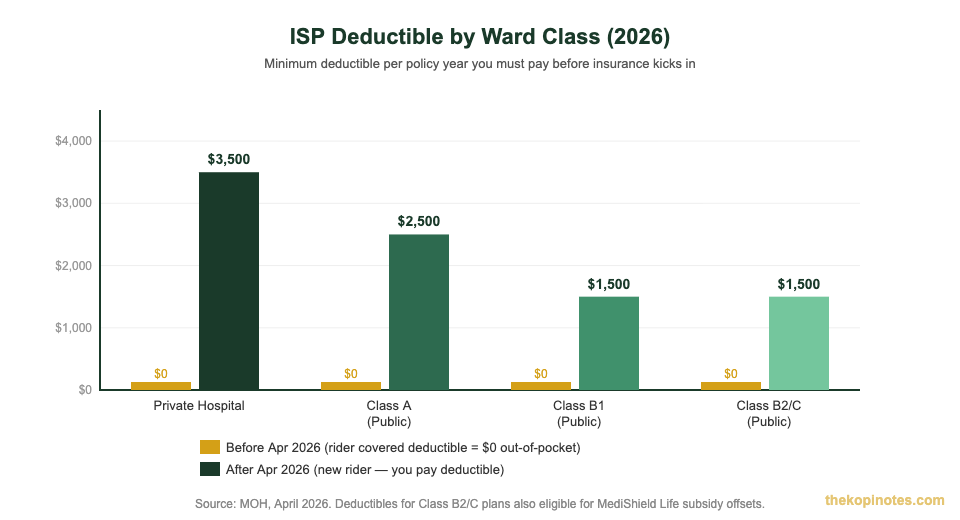
| Ward Class | Hospital Type | ISP Tier Needed | Annual Deductible |
|---|---|---|---|
| Class C | Public hospital, 6+ beds | MediShield Life only | $1,500 |
| Class B2 | Public hospital, 5–6 beds | Basic ISP | $1,500 |
| Class B1 | Public hospital, 4-bed ward | Mid-tier ISP | $2,500 |
| Class A | Public hospital, single/2-bed | Mid-to-high ISP | $3,500 |
| Private | Private hospital | Premium ISP | $3,500 |
Source: MOH, June 2026. Deductibles apply per policy year.
How an ISP Works With MediShield Life
Think of your health insurance as two layers. MediShield Life is the foundation — it pays for the bulk of a Class B2/C public hospital stay. Your ISP sits on top. When you are hospitalised, the bill flows through both layers together.
Here is the payment flow for a $30,000 private hospital bill:
- You pay the deductible first — typically $3,500 for private ward. This can be paid from MediSave.
- Co-insurance kicks in — you pay 5–10% of the remaining bill.
- ISP covers the rest — including the portion above MediShield Life claim limits.
- If you have a rider, it reduces your co-insurance to 5% and caps your annual co-payment (but no longer covers the deductible for new riders).
The ISP premium you pay each month is split: a portion goes to MediShield Life (via CPF MediSave), and the rest goes to your private insurer. This integration is why it is called an Integrated Shield Plan.
You can pay your ISP base premium using MediSave up to MAS-approved withdrawal limits. Rider premiums must always be paid in cash — they are not MediSave-eligible.
For a deeper breakdown of how CPF MediSave fits your overall financial plan, see our CPF investment strategy guide.
The 2026 MOH Rider Changes Explained
In November 2025, MOH announced significant changes to ISP rider design. These took effect on 1 April 2026 for all new riders sold from that date onwards.
The reason was rising premiums. Policyholders with full riders — where the rider covered both the deductible and most co-payments — were generating larger claims and higher utilisation. Over time, this drove premiums upward for everyone. MOH stepped in to reset the structure.
Change 1: Riders can no longer cover the deductible
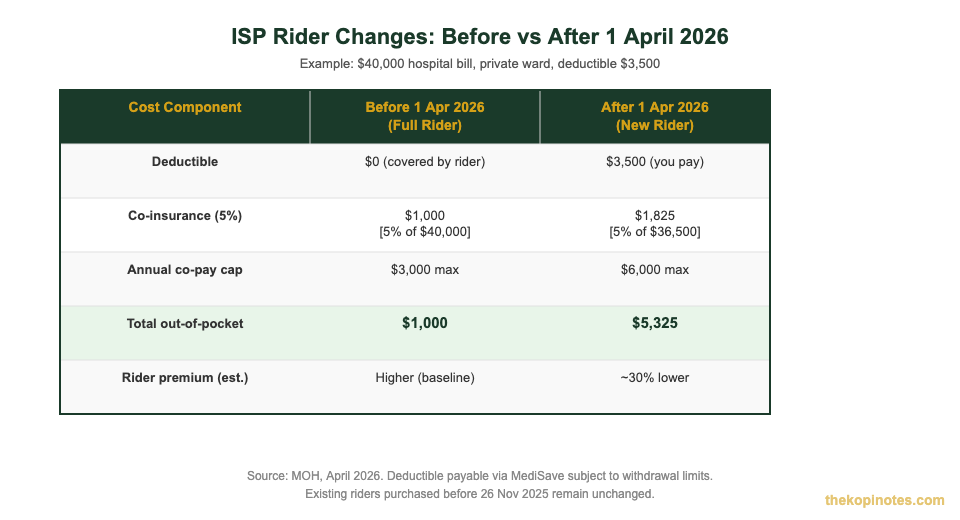
Previously, a full rider could cover your entire deductible ($1,500–$3,500), meaning you paid $0 upfront at admission. Under the new rules, any rider sold from 1 April 2026 cannot cover this deductible. You must pay it yourself — though you can use MediSave to do so.
Change 2: The annual co-payment cap doubled
The minimum 5% co-payment remains unchanged. But the annual cap on total co-payments has increased from $3,000 to $6,000. If you use a panel doctor and get pre-authorisation, you benefit from the capped rate.
Change 3: Rider premiums drop about 30%
Because riders are now less comprehensive, insurers are pricing them lower. MOH estimates new private hospital riders will be about 30% cheaper on average. For public hospital riders, savings are around $200/year. For private hospital riders, around $600/year.
What Happens to Existing Riders?
If you bought your ISP rider before 26 November 2025, your existing rider remains unchanged for now. Your insurer cannot automatically change your benefits on 1 April 2026. You keep the old structure — deductible covered, $3,000 co-pay cap — until your insurer reviews it.
If you bought a rider between 27 November 2025 and 31 March 2026, you are in a transition period. Your rider will be automatically converted to the new structure at your next policy renewal after 1 April 2028. That gives you time to decide whether to switch voluntarily earlier.
If you switch to a new rider after April 2026, no new underwriting is required. Your existing medical conditions remain covered.
26 Nov 2025 — MOH announced the changes
1 Apr 2026 — New rider rules took effect for all new riders
1 Apr 2028 — Transition riders automatically convert at renewal
What You Will Actually Pay Under the New Rules
Here is a concrete example. You are admitted to a private hospital. Total bill: $40,000. Deductible: $3,500.
| Cost Component | No Rider | Old Rider (pre-Apr 2026) | New Rider (Apr 2026+) |
|---|---|---|---|
| Deductible | $3,500 | $0 (rider covered) | $3,500 (you pay) |
| Co-insurance (5%) | $1,825 | $1,000 (capped $3k) | $1,825 (capped $6k) |
| Total out-of-pocket | $5,325 | $1,000 | $5,325 |
| Insurance pays out | $34,675 | $39,000 | $34,675 |
Source: MOH April 2026. Calculations illustrative. MediSave can offset deductible and co-insurance subject to withdrawal limits.
However, MediSave can help. If your withdrawal limit allows $3,000 for that admission, your actual cash outlay under the new rider drops to $2,325. The real benefit of the new rider is the 30% premium saving every year.
To model how healthcare costs affect your long-term finances, use our Singapore retirement calculator.
ISP Plan Comparison: Which Insurers Offer What
All six ISP insurers in Singapore have launched new rider products aligned with the April 2026 MOH requirements. Here is an overview of the key providers and their top-tier private hospital plans:
| Insurer | Plan Name | Max Coverage | 2026 Rider Available |
|---|---|---|---|
| AIA | HealthShield Gold Max | Private hospital | Yes |
| Great Eastern | Supreme Health | Private hospital | Yes |
| Income | IncomeShield | Private hospital | Yes |
| Prudential | PRUShield | Private hospital | Yes |
| Raffles Health | Raffles Shield | Private hospital | Yes |
| Singlife | Singlife Shield (Health Plus) | Private hospital | Yes (30–84% cheaper) |
Source: Individual insurer websites, June 2026. Confirm current products directly with your insurer before purchasing.
Do not switch ISP insurers just to chase a lower premium. Switching requires new underwriting. Any conditions developed while with your old insurer could be excluded or attract higher premiums with the new insurer. If you want to adjust coverage, do it within the same insurer at renewal.
For investment and savings platform options that complement your ISP, see our Endowus referral code guide for CPF-OA and SRS investing, or the Syfe referral code and sign-up bonus page for managed portfolios.
Should You Get a Rider in 2026?
This is the question most Singaporeans are asking after the April 2026 changes. The honest answer: it depends on your health profile, your financial comfort with surprises, and which ward class you prefer.
Consider getting a rider if:
- You have a private hospital ISP and want protection against large unexpected bills
- You or a family member have ongoing health conditions that could lead to hospitalisation
- You cannot easily access $3,500–$5,000 from cash or MediSave without financial stress
- You value predictability — knowing your maximum out-of-pocket for the year
Consider skipping the rider if:
- You are young and healthy with a strong MediSave balance
- You prefer lower premiums and are comfortable paying the deductible if hospitalised
- You have Class B1 or B2 coverage where deductibles are lower ($1,500–$2,500)
- Your employer group insurance already covers hospitalisation gaps
One key insight: older policyholders see greater premium savings under new riders. If you are in your 50s or 60s, the 30% premium reduction could translate to significant annual savings — even if you occasionally pay the deductible from MediSave.
Thinking about passive income to fund healthcare costs in retirement? Our passive income Singapore guide has practical strategies for building steady income streams.
Using MediSave to Reduce Out-of-Pocket Costs
MediSave is your CPF healthcare savings account. Under the new rider rules, it becomes more important — because you now need to pay the deductible yourself at every hospitalisation.
The good news: both the deductible and co-insurance are MediSave-eligible, up to prevailing withdrawal limits.
Example: Private hospital, $40,000 bill, new rider in place
- Deductible: $3,500 — pay from MediSave (subject to withdrawal limits)
- Co-insurance (5%): $1,825 — pay from MediSave or cash
- If MediSave limit covers $3,000 for that admission — your cash outlay drops to $2,325
MediSave withdrawal limits vary by treatment type. For most general admissions, the limit is around $450–$550 per day plus a procedure cap. Check the CPF Board MediSave page for current figures.
Your ISP base plan premium can also be partially paid from MediSave up to the Additional Withdrawal Limit — typically $300–$600/year depending on age. Rider premiums must be paid in cash.
For a full picture of how CPF works for healthcare and investment, see our CPF investment strategy guide and the Singapore Savings Bonds guide for safe capital-preservation options.
Can Foreigners Get an ISP in Singapore?
Integrated Shield Plans are only available to Singapore Citizens and Permanent Residents (PRs). This is because ISPs integrate with MediShield Life, which is only available to citizens and PRs.
If you are a foreigner living and working in Singapore, you need a standalone private health insurance policy instead. Options include expat health insurance from international insurers or non-integrated plans from local insurers.
If you are a PR considering an ISP, apply as early as possible — preferably when you are young and healthy — to lock in coverage before any health conditions develop. Premiums are much lower at younger ages, and you avoid exclusions for pre-existing conditions.
PRs who want to invest their MediSave alongside their ISP planning can find useful strategies in our CPF investment strategy guide. For broader savings options, the Singapore T-bills 2026 guide is a good starting point.
Frequently Asked Questions
What is an Integrated Shield Plan (ISP) in Singapore?
What changed for ISP riders from 1 April 2026?
Will my existing ISP rider be affected by the 2026 changes?
Can I use MediSave to pay my ISP deductible?
Is it worth getting a rider in 2026?
Can foreigners and expats get an ISP in Singapore?
Should I switch ISP insurers to get a better deal?
Build Your Full Financial Safety Net
Your ISP is one piece of a larger financial plan. Explore these related guides:
- Singapore Savings Bonds guide — safe savings alongside your insurance
- Singapore T-bills 2026 guide — short-term capital preservation
- Singapore retirement calculator — model healthcare costs in retirement
- FSMOne referral code — fee-efficient investment access
Disclaimer: This article is for general information and educational purposes only. It does not constitute financial, insurance, or medical advice. Always consult a licensed financial adviser or your insurer before making changes to your coverage. Data accurate as at June 2026.
Get Free Insurance Advice
Speak with a licensed insurance advisor. No obligation, no cost.
By submitting this form, you agree to our Privacy Policy.
This article was researched with the help of AI. While we strive to keep all information accurate and up to date, there may be errors. If you notice any discrepancies, please contact us.