Trust Bank + IBKR: The Cash-Plus-Investing Two-Platform Strategy for Singapore Investors (2026)
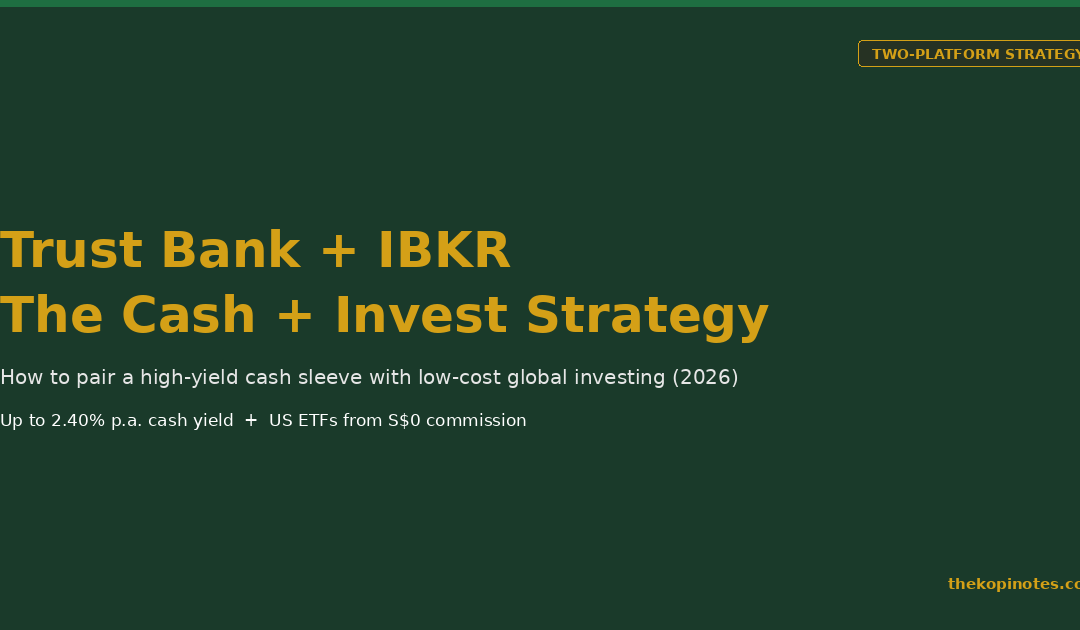
Earn up to 2.40% p.a. on your cash buffer with Trust Bank, then invest the surplus through IBKR at close to zero cost — without touching CPF or SRS at all.
Trust Bank pays up to 2.40% p.a. on cash you might need soon, while IBKR lets you invest surplus cash in global stocks and ETFs from S$0 commission. Pairing them splits your money into a liquidity sleeve and a growth sleeve — a strategy that works even without CPF or SRS funds, since neither platform touches those accounts.
Not financial advice. All figures are for educational reference only. Data as at July 2026 unless noted.
- Trust Bank’s Flex Plan pays up to 2.40% p.a. on balances up to S$1.2 million (cut from 2.50% in March 2026) — good for your emergency fund and near-term cash.
- IBKR charges S$0 commission on US-listed stocks/ETFs (IBKR Lite) and just 0.08% (min S$2.50) on SGX trades — good for money you won’t need for years.
- Neither platform supports CPF or SRS. This pairing is a pure cash-and-invest split, not a tax-account strategy.
Table of Contents
Contents — Click to expand
- Why Pair a Digital Bank With a Global Broker?
- Trust Bank in 60 Seconds: Plans, Rates & What Changed in 2026
- IBKR in 60 Seconds: Fees, Markets & the CPF/SRS Gap
- The Cash Sleeve Sizing Calculation (Worked Example)
- How Much Extra Interest Are You Actually Earning?
- What Happens to Surplus Cash Over 5, 10, 20 Years?
- How to Set Up the Two-Platform Strategy
- Risks, Limits & What Could Go Wrong
- FAQ
Why Pair a Digital Bank With a Global Broker?
Most “two-platform” strategies on this site pair a CPF/SRS-eligible robo-advisor with IBKR for cash-only investing. Trust Bank + IBKR is different. Trust Bank is a savings account, not an investing platform. IBKR is a brokerage, not a place to park emergency cash.
That makes this pairing simpler than the others. You’re not choosing between CPF eligibility and DIY control. You’re splitting your money by purpose: cash you might need soon goes into Trust Bank. Cash you won’t touch for years goes into IBKR.
This works for anyone — self-employed people without CPF contributions, young professionals still building their CPF balance, or simply investors who want a clean liquidity-plus-growth split outside their CPF/SRS accounts.
Trust Bank in 60 Seconds: Plans, Rates & What Changed in 2026
Trust Bank is a full bank, not a “light” digital wallet. It holds a full banking licence from the Monetary Authority of Singapore (MAS), operated by Standard Chartered Bank in partnership with FairPrice Group (NTUC Enterprise). That’s a step up from GXS and MariBank, which hold restricted digital full bank licences.
Your Singapore dollar deposits are insured by the Singapore Deposit Insurance Corporation (SDIC) up to S$100,000 per depositor — the same protection you get at DBS, OCBC, or UOB.
| Plan | Interest Rate | Conditions |
|---|---|---|
| Flex Plan | Up to 2.40% p.a. (on balances up to S$1.2 million) | Meet monthly spend/save/insure conditions on the Trust app |
| Signature Plan | Tiered, lower than Flex at full conditions | Default plan if none is selected |
| Zen Plan | 0.50% p.a. flat | Zero conditions — “park and forget” |
Source: Trust Bank rate card, as at July 2026. You can switch plans once a month via the Trust app.
Here’s the part worth flagging: Trust Bank cut its top rate from 2.50% p.a. to 2.40% p.a. in March 2026. That’s the second rate trim since launch. Bonus interest rates on every Singapore digital bank move with market conditions — don’t assume today’s 2.40% is locked in forever.
IBKR in 60 Seconds: Fees, Markets & the CPF/SRS Gap
Interactive Brokers (IBKR) gives you access to 150+ markets across 33 countries from one account. For Singapore investors, the two numbers that matter most are these: IBKR Lite charges S$0 commission on US-listed stocks and ETFs, and IBKR’s SGX Fixed tier charges 0.08% per trade (minimum S$2.50).
Here’s the trade-off. IBKR does not support CPF Investment Scheme (CPFIS) or SRS accounts. You can only fund it with cash. That’s exactly why it pairs naturally with Trust Bank — a cash-only savings account — instead of with a CPF/SRS-eligible robo-advisor.
Want the full breakdown of account tiers, funding, and withdrawal steps? Read our IBKR Singapore Review 2026 before you open an account.
The Cash Sleeve Sizing Calculation (Worked Example)
Before you invest a single dollar through IBKR, decide how big your Trust Bank cash sleeve needs to be. The standard rule of thumb is 3 to 6 months of expenses.
Let’s work through a real example. Say you spend S$4,000 a month. A 6-month buffer means you keep S$24,000 in Trust Bank. Round up to S$25,000 for a clean number.
Compare that to a typical bank base rate of 0.05% p.a. — the same S$24,000 buffer would earn just S$12 a year. That’s a 48x difference for doing nothing except opening a Trust Bank account and meeting the Flex Plan conditions.
Anything above your emergency buffer is surplus cash. That’s the portion you move into IBKR to invest in global stocks and ETFs, since it isn’t money you need for day-to-day survival.
How Much Extra Interest Are You Actually Earning?
The bigger your buffer, the bigger the gap between Trust Bank’s Flex Plan and a typical bank’s base rate. Here’s the maths at four common balance sizes.
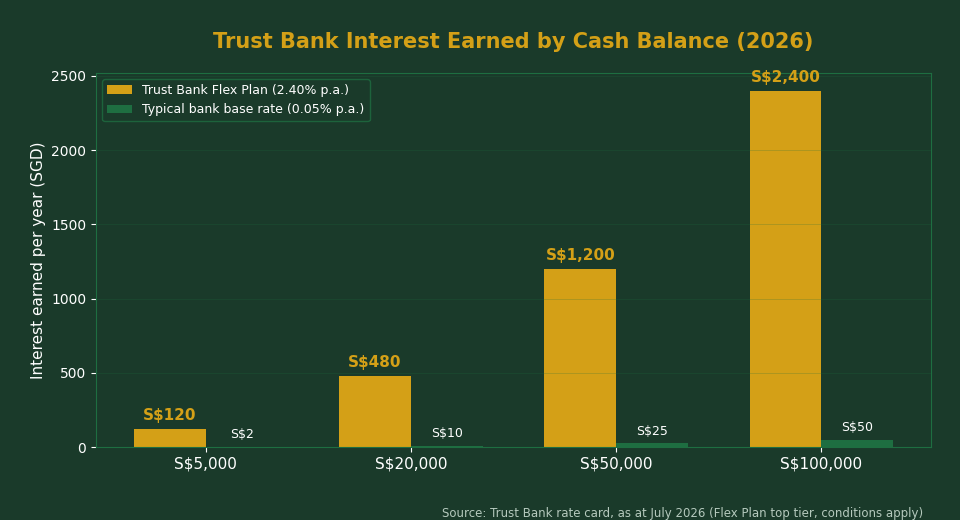
| Cash Balance | Trust Bank Flex (2.40% p.a.) | Typical Bank Base (0.05% p.a.) | Extra Per Year |
|---|---|---|---|
| S$5,000 | S$120.00 | S$2.50 | S$117.50 |
| S$20,000 | S$480.00 | S$10.00 | S$470.00 |
| S$50,000 | S$1,200.00 | S$25.00 | S$1,175.00 |
| S$100,000 | S$2,400.00 | S$50.00 | S$2,350.00 |
Source: The Kopi Notes calculation, based on Trust Bank’s July 2026 rate card. Flex Plan top rate requires meeting monthly conditions.
One cap to note: Trust Bank’s 2.40% top tier only applies up to S$1.2 million. Beyond that, extra cash earns just 0.05% p.a. — another reason to move surplus above your buffer into IBKR instead of stockpiling it in Trust Bank.
What Happens to Surplus Cash Over 5, 10, 20 Years?
Here’s the honest trade-off. Cash parked in Trust Bank is safe and liquid, but it grows slowly. Cash invested via IBKR can grow faster, but it isn’t guaranteed and it isn’t liquid in the same way.
Say you have S$50,000 in surplus cash — money beyond your emergency buffer. If you leave it in Trust Bank at 2.40% p.a., here’s what it becomes. If you invest it via IBKR in a globally diversified ETF like VWRA, assuming an illustrative 6% p.a. long-run return, here’s the difference.
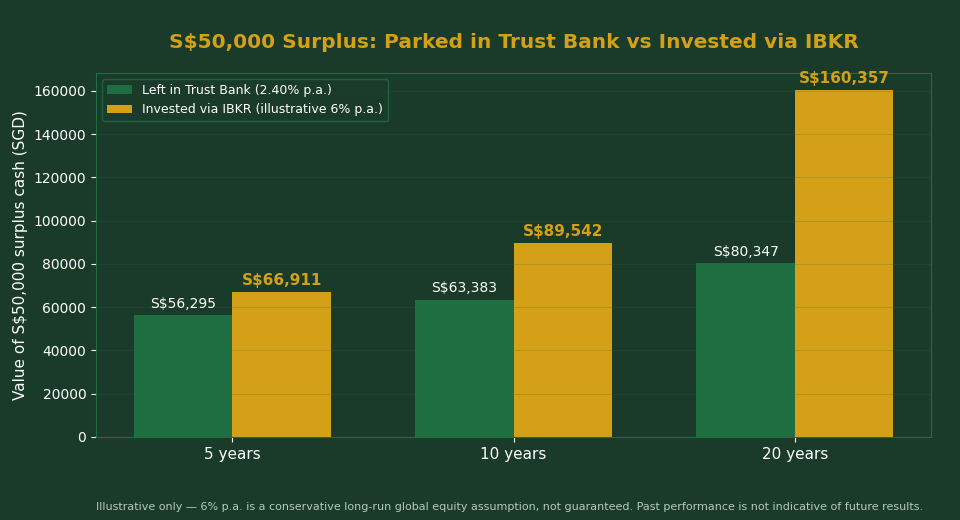
| Time Horizon | Left in Trust Bank (2.40% p.a.) | Invested via IBKR (illustrative 6% p.a.) | Growth Gap |
|---|---|---|---|
| 5 years | S$56,295 | S$66,911 | S$10,616 |
| 10 years | S$63,383 | S$89,542 | S$26,160 |
| 20 years | S$80,347 | S$160,357 | S$80,010 |
Source: The Kopi Notes calculation. 6% p.a. is an illustrative, conservative long-run global equity assumption — not a guarantee. Past performance does not predict future returns.
However, this isn’t a reason to empty your Trust Bank account. The whole point of the cash sleeve is that it doesn’t drop in value when markets fall. IBKR’s growth potential comes with volatility Trust Bank simply doesn’t have.
How to Set Up the Two-Platform Strategy
Here’s the step-by-step, in the order that actually makes sense.
Step 1: Open a Trust Bank account. Sign up via the Trust app with your Singpass. Select the Flex Plan and check which conditions (spend, save, insure) apply to you this month.
Step 2: Calculate your buffer. Multiply your monthly expenses by 3 to 6, depending on how stable your income is. Freelancers and business owners should lean toward 6 months or more.
Step 3: Fund Trust Bank up to your buffer amount. Anything beyond this is your surplus — the amount you’ll eventually move to IBKR.
Step 4: Open an IBKR account. You’ll need to fund it via bank transfer from a Singapore bank account (Trust Bank works fine for this). We cover the full account-opening steps and document checklist in our IBKR Singapore Review 2026 (linked above).
Step 5: Transfer your surplus and invest. Move only the amount above your buffer. Keep the emergency fund untouched in Trust Bank — that’s the entire point of the split.
Step 6: Review annually. As your expenses or income change, recalculate your buffer. As Trust Bank’s rate moves — and it has moved twice already — check whether your buffer still earns what you expect. For a full breakdown of current rates and conditions, see our Trust Bank Interest Rate 2026 guide.
Risks, Limits & What Could Go Wrong
No strategy is free of trade-offs. Here’s what to watch for.
SDIC cover stops at S$100,000. Trust Bank’s SGD deposits are insured by the Singapore Deposit Insurance Corporation up to S$100,000 per depositor. If your buffer is larger than that, the excess isn’t covered by deposit insurance — even though it still earns the Flex Plan rate up to S$1.2 million. Some investors split large cash buffers across two or three banks to stay under the S$100,000 SDIC limit at each.
Interest rates aren’t fixed. Trust Bank has already cut its top rate twice since launch. Your effective return could be lower next year. Check the MAS Financial Institutions Directory if you want to verify Trust Bank’s licensing status directly.
Conditions can be fiddly. The Flex Plan’s top rate depends on meeting monthly spend, save, and insure conditions through the Trust app. Miss a condition and you drop to a lower tier for that month.
IBKR has no CPF/SRS bridge. If you’re trying to optimise CPF or SRS funds specifically, this pairing won’t help — look at our CPF investment strategy guide instead.
Market risk is real. The 6% p.a. growth assumption used earlier in this article is illustrative only. Markets can and do fall. IBKR-invested money should genuinely be money you can leave alone for years, not cash you might need next month.
If you’d rather compare cash-yield options before committing to Trust Bank specifically, our Singapore T-Bills 2026 guide covers a lower-risk, government-backed alternative for part of your buffer.
Ready to Set Up Your Two-Platform Strategy?
Sign up for both platforms below to get started.
Frequently Asked Questions
Can I use Trust Bank for CPF or SRS investing?
Is Trust Bank's 2.40% p.a. rate guaranteed?
How much should I keep in Trust Bank before investing via IBKR?
Is my money safe in Trust Bank?
Does IBKR charge a fee to fund the account from Trust Bank?
What happens if my Trust Bank balance exceeds S$1.2 million?
Can I switch between Trust Bank plans if my needs change?
This article was researched with the help of AI. While we strive to keep all information accurate and up to date, there may be errors. If you notice any discrepancies, please contact us.