Great Eastern Supreme Health Singapore: Complete Guide 2026
Plans, premiums, riders, and what the 2026 MOH changes mean for you.
Great Eastern Supreme Health is Singapore’s largest Integrated Shield Plan (ISP), offering four tiers — B Plus, A, P, and P Plus — that upgrade your MediShield Life base coverage to private or Class A ward care. It is sold by Great Eastern Life and works alongside your CPF MediSave account. In 2026, MOH reformed ISP riders, meaning your out-of-pocket costs at claim are higher than before — this guide explains exactly what changed and which plan suits you.
Not financial advice. All figures are for educational reference only. Data as at June 2026 unless noted.
- Great Eastern Supreme Health has 4 plans: B Plus (restructured B ward), A (private A ward), P (private hospital) and P Plus (private hospital, enhanced limits).
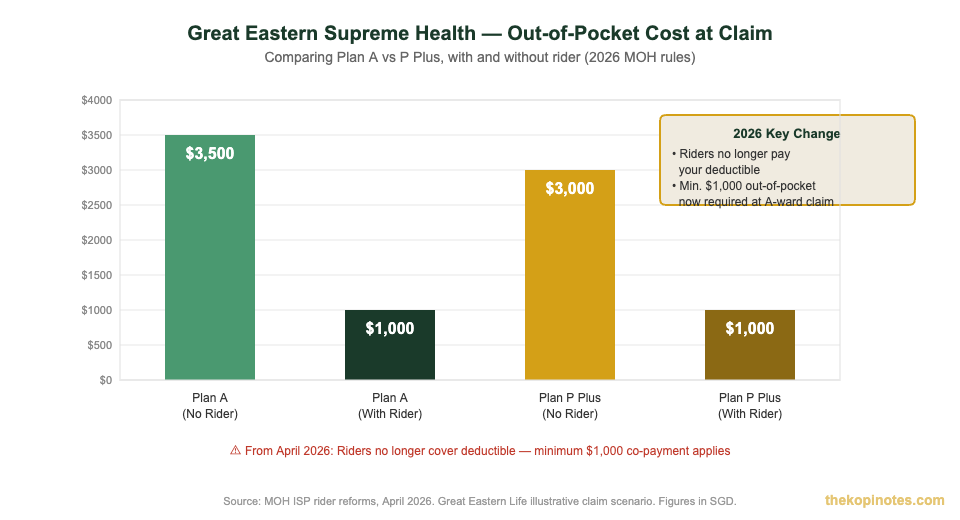
- From April 2026, ISP riders no longer cover your deductible — you must pay at least $1,000 out-of-pocket at every private ward claim.
- Plan A is the most popular choice for cost-conscious Singaporeans who want private A-ward access with manageable premiums.
Table of Contents
What Is Great Eastern Supreme Health?
Great Eastern Supreme Health is an Integrated Shield Plan (ISP) — a private health insurance product that sits on top of MediShield Life, Singapore’s compulsory national health insurance. Where MediShield Life covers subsidised B2/C ward stays, Supreme Health extends that coverage to Class B1, Class A, or private hospital wards depending on which tier you choose.
It is underwritten by Great Eastern Life Assurance, one of Singapore’s oldest and largest insurance companies with roots going back to 1908. Great Eastern is majority-owned by OCBC Bank, and its ISP is one of five approved by the Ministry of Health (MOH).
You pay for Supreme Health using a combination of MediSave (up to the Additional Withdrawal Limit, or AWL) and cash. The plan works year-round — you are covered from the first day of policy inception, with no waiting period for accidents, and typically a 30-day waiting period for illnesses (subject to underwriting).
As at June 2026, Great Eastern Supreme Health covers over 1.2 million lives in Singapore, making it one of the largest ISP providers in the market. You can find official plan details on the Great Eastern Life website or the MOH ISP information page.
The Four Supreme Health Plans Explained
Great Eastern offers four tiers of Supreme Health. Each tier covers a different ward class, which determines the hospital and room type you can claim for without significant shortfall.
| Plan | Ward Coverage | Hospital Type | Best For |
|---|---|---|---|
| B Plus | Class B1 ward | Restructured hospitals | Budget-conscious; upgrade from B2/C |
| A | Class A ward | Restructured hospitals | Most popular — single-bedder, restructured |
| P | Private hospital ward | Private hospitals (e.g. Mount E, Gleneagles) | Those who want private hospital choice |
| P Plus | Private hospital ward, higher limits | Private hospitals, enhanced benefit caps | Comprehensive private coverage, higher incl. limits |
Source: Great Eastern Life Supreme Health product brochure, June 2026.
Plan A is by far the most popular. It gives you access to a single-bedder Class A ward at restructured hospitals like Singapore General Hospital, Tan Tock Seng, or National University Hospital — without the premium spike that comes with private hospital plans. For most middle-income Singaporeans, Plan A strikes the best balance between cost and coverage.
Plan P and P Plus cover private hospitals. You can choose Mount Elizabeth, Gleneagles, Parkway East, or Raffles Hospital, among others. Premiums are significantly higher, especially after age 50 when hospitalisation risk rises. These plans suit you if you have a strong preference for private hospitals and your chosen specialist practises exclusively there.
B Plus is the entry-level upgrade — useful if you currently have MediShield Life only and want a modest improvement in ward class without a large premium increase.
2026 Premium Tables
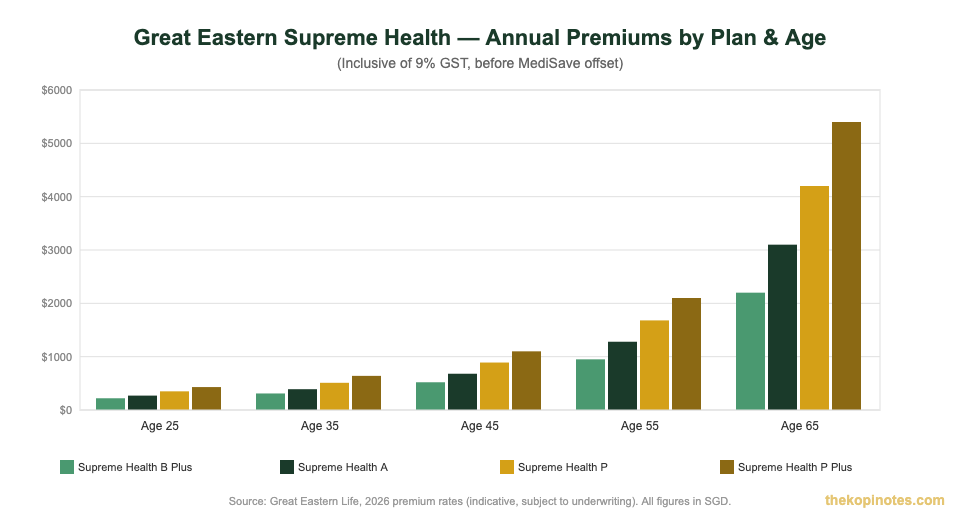
Below are indicative annual premiums for Great Eastern Supreme Health in 2026, inclusive of 9% GST. Note that actual premiums depend on your age at next birthday, gender, and smoking status. Premiums increase with age — this is especially pronounced after age 60.
| Age | B Plus (SGD/yr) | Plan A (SGD/yr) | Plan P (SGD/yr) | Plan P Plus (SGD/yr) |
|---|---|---|---|---|
| 25 | ~$220 | ~$270 | ~$350 | ~$430 |
| 35 | ~$310 | ~$390 | ~$510 | ~$640 |
| 45 | ~$520 | ~$680 | ~$890 | ~$1,100 |
| 55 | ~$950 | ~$1,280 | ~$1,680 | ~$2,100 |
| 65 | ~$2,200 | ~$3,100 | ~$4,200 | ~$5,400 |
Source: Great Eastern Life, 2026 indicative premium rates (inclusive of 9% GST). Actual premiums subject to underwriting and individual health declaration.
The MediSave Additional Withdrawal Limit (AWL) for ISPs ranges from $600 per year (below age 40) to $1,800 per year (age 80 and above). For a 35-year-old on Plan A paying $390 per year, MediSave likely covers the full premium with no cash top-up needed. At age 65 on Plan P Plus ($5,400/yr), you would need to pay roughly $3,600 in cash annually, with only $1,800 coming from MediSave.
You can check your exact MediSave balance and AWL via your CPF online account. A smart approach to CPF investment strategy means growing your MediSave alongside your OA and SA for long-term health security.
Riders: What Changed in 2026?
This is the most important section if you already have or are thinking about buying a rider for your Supreme Health plan. MOH introduced major reforms to ISP riders in April 2026, and the changes affect how much you pay out-of-pocket when you make a claim.
What Is an ISP Rider?
An ISP rider is an add-on to your Integrated Shield Plan. Before April 2026, riders could cover your deductible and co-insurance — meaning you could make a claim at a private hospital and walk out paying almost nothing out of pocket. Riders made ISPs very popular but also drove up healthcare utilisation and hospital bills.
The 2026 MOH Change: Deductible No Longer Covered
From April 2026, MOH mandated that all ISP riders must require policyholders to bear a minimum amount at every claim. Specifically:
- Your rider cannot cover the deductible anymore
- You must pay a minimum of $1,000 out-of-pocket at private hospital claims (A-ward equivalent and above)
- The rider still covers co-insurance above the deductible
- For restructured hospital claims (B1/A ward), the co-payment structure is slightly different — check with Great Eastern directly for your specific plan
In practical terms: if you are hospitalised at a private hospital and your bill is $10,000, you pay $1,000 and your Supreme Health plan (plus rider) covers the rest. Previously, a rider could reduce your share to near zero. Now, $1,000 is the floor regardless of rider.
Should You Still Buy a Rider?
Yes — for most people on Plan P or P Plus, a rider still makes financial sense. Private hospital bills for surgeries can run $20,000–$80,000. Your rider covering everything above $1,000 is still enormous protection for a relatively modest additional annual premium ($500–$2,000 depending on plan and age).
For Plan A (restructured hospital A ward), the maths is less clear-cut. Restructured hospital bills are lower, and your plan’s co-insurance without a rider may still be manageable. Run the numbers for your specific situation or speak with a licensed adviser.
You can compare Great Eastern’s rider options against other providers by reading our full shield plan comparison guide.
Great Eastern Supreme Health vs Other ISP Providers
There are five MOH-approved ISP providers in Singapore: AIA, Great Eastern, Income (now Etiqa), Prudential, and Singlife. Here is how Supreme Health stacks up against the key alternatives on the most important metrics.
| Provider | Plan Name | Plan A Premium (Age 35) | Panel Hospitals | Notable Strength |
|---|---|---|---|---|
| Great Eastern | Supreme Health A | ~$390/yr | All restructured + most private | Strong panel, established brand |
| AIA | HealthShield Gold Max A | ~$370/yr | All restructured + all private | Widest private hospital panel |
| Prudential | PRUShield Premier | ~$420/yr | All restructured + selected private | Higher benefit limits |
| Singlife | Shield Plan 2 | ~$340/yr | All restructured + selected private | Competitive pricing |
| Income (Etiqa) | Enhanced IncomeShield Advantage | ~$360/yr | All restructured + selected private | Cooperative model, value pricing |
Source: MOH ISP comparison page, individual insurer brochures, June 2026. Premiums are indicative and non-smoker rates.
Great Eastern sits in the mid-range on price at the Plan A level. Its key advantage is its panel breadth — Supreme Health covers most private hospitals and restructured hospitals across Singapore without needing prior approval for panel specialists. If you want a deep dive into all five providers side-by-side, see our integrated shield plan comparison 2026 guide.
Using MediSave to Pay Your Supreme Health Premiums
One of the biggest advantages of ISPs over standalone private health insurance is that you can use your CPF MediSave account to pay premiums — up to the Additional Withdrawal Limit (AWL) for each policy year.
The AWL tiers as at 2026 are:
- Below age 40: $600/year
- Age 40–49: $900/year
- Age 50–59: $1,200/year
- Age 60–69: $1,500/year
- Age 70–79: $1,800/year
- Age 80 and above: $1,800/year
For younger policyholders on lower-tier plans, the AWL often covers the entire premium. For example, a 30-year-old on Plan B Plus paying roughly $240/year would likely be fully covered by the $600 AWL with no cash top-up. A 55-year-old on Plan A paying ~$1,280/year would use $1,200 from MediSave and pay ~$80 in cash.
If your MediSave balance runs low, you can top it up with cash through voluntary contributions — these are also tax-deductible up to the applicable CPF Annual Limit. Managing your CPF investment strategy holistically helps ensure your MediSave stays healthy for healthcare needs.
Note: The AWL covers your ISP base plan premium only. Rider premiums must be paid entirely in cash — MediSave cannot be used for rider costs.
Which Supreme Health Plan Should You Pick?
Here is a plain-English guide based on your situation:
Choose Plan B Plus if…
- You are on a tight budget and currently have MediShield Life only
- You are comfortable with Class B1 ward (4-bedder) at a restructured hospital
- You want to minimise premiums in your 20s and 30s while building other savings
Choose Plan A if…
- You want a single-bedder Class A ward at a restructured hospital
- You want a balance between coverage quality and premium cost
- You are between age 25–50 and premiums are still manageable
- You are not wedded to any specific private hospital
Choose Plan P or P Plus if…
- You have strong preferences for private hospitals (Mount Elizabeth, Gleneagles, Raffles)
- Your specialist practises exclusively at private hospitals
- You or your family have a history of conditions that may require specialised private care
- You can comfortably afford premiums of $1,500–$5,000+ per year at older ages
Important: ISPs are not eligible for CPF OA investment and cannot be funded via SRS. They are a direct MediSave-and-cash product. If you are planning for long-term retirement wealth, combining an ISP with a Singapore retirement calculator can help you model total healthcare costs over time.
If you are also looking at passive income strategies to fund your premiums in retirement, our guide on passive income in Singapore 2026 covers the options available to Singapore residents.
For those exploring fee-based robo-advisors that also offer insurance product referrals, the Endowus referral code (referral: 2V343) and Syfe referral code (referral: SRPRFFFCD) pages have current sign-up bonuses.
Disclaimer: This article is for general information only and does not constitute financial or insurance advice. ISP premiums, benefits, and terms are subject to change. Always read the product summary and policy documents before purchasing. If in doubt, consult a licensed financial adviser.
Frequently Asked Questions
What is Great Eastern Supreme Health and how does it work?
Great Eastern Supreme Health is an Integrated Shield Plan (ISP) sold by Great Eastern Life. It upgrades your mandatory MediShield Life coverage to a higher ward class — B1, A, or private hospital — depending on which of the four plan tiers you choose. You pay premiums annually using MediSave (up to your Additional Withdrawal Limit) and cash. When you are hospitalised, the plan pays most of your bill after a deductible and co-insurance, with riders available to reduce your out-of-pocket share further (subject to 2026 MOH rules).
Which Supreme Health plan is the most popular in Singapore?
Plan A (Class A ward at restructured hospitals) is the most widely held tier. It gives you a single-bedder room at hospitals like SGH, NUH, and Tan Tock Seng — comfortable, well-staffed, and served by senior specialists — without the sharp premium increase of private hospital plans. For most working Singaporeans aged 25–50, Plan A hits the sweet spot of coverage and cost.
What did MOH change about ISP riders in 2026?
From April 2026, MOH required that all ISP riders must no longer cover the policyholder’s deductible. This means you must pay a minimum of $1,000 out of pocket at every private ward claim, even if you have a rider. Previously, a rider could reduce your share to near zero. Co-insurance above the deductible can still be covered by the rider. The reform was introduced to curb over-utilisation and rising private hospital bills in Singapore.
Can I use MediSave to pay for Great Eastern Supreme Health?
Yes. You can use your CPF MediSave to pay your ISP base plan premium up to the Additional Withdrawal Limit (AWL), which ranges from $600/year (below age 40) to $1,800/year (age 80+). However, MediSave cannot be used to pay rider premiums — those must be paid in cash. If your base plan premium exceeds the AWL, the excess must also be paid in cash.
Is Great Eastern Supreme Health better than AIA HealthShield Gold Max?
Both are strong ISPs, and the best choice depends on your priorities. AIA HealthShield Gold Max has a slightly wider private hospital panel and competitive Plan A premiums (~$370/yr vs GE’s ~$390/yr at age 35). Great Eastern Supreme Health is well-regarded for its established brand, claims service, and solid panel breadth. If private hospital access is critical, compare both panels to check that your preferred specialist or hospital is covered before deciding.
What is the Supreme Health P Plus plan?
Supreme Health P Plus is Great Eastern’s highest-tier ISP. It covers private hospital stays and offers enhanced benefit limits compared to the standard Plan P — including higher annual claim caps and broader coverage for outpatient cancer treatment, kidney dialysis, and organ transplantation. Premiums are the highest among the four tiers, ranging from around $430/year at age 25 to over $5,400/year at age 65. It suits individuals who want comprehensive private hospital coverage without any coverage gaps.
Can I switch from another ISP provider to Great Eastern Supreme Health?
Yes, you can switch ISP providers in Singapore. However, switching resets your policy and the new insurer may apply a waiting period or exclusions for pre-existing conditions declared at underwriting. If you are in good health with no pre-existing conditions, switching is relatively straightforward. If you have existing health issues, compare whether the new plan will cover them before switching — losing coverage for a known condition is a significant risk. Always get the new policy in force before cancelling your existing one.
Plan Your Healthcare Coverage Today
Compare ISPs, check your MediSave balance, and plan for retirement healthcare costs — all in one place.
Get Free Insurance Advice
Speak with a licensed insurance advisor. No obligation, no cost.
By submitting this form, you agree to our Privacy Policy.
This article was researched with the help of AI. While we strive to keep all information accurate and up to date, there may be errors. If you notice any discrepancies, please contact us.