Investing in REITs Singapore: Complete Guide (2026)
How S-REITs work, the best sectors, how to buy on SGX, and what every Singapore investor needs to know before they start.
Investing in REITs in Singapore gives you access to income-generating commercial properties — from shopping malls to data centres — without buying physical real estate. Singapore REITs (S-REITs) are listed on the SGX, pay quarterly or semi-annual distributions, and must return at least 90% of taxable income to unitholders. For many Singaporeans, S-REITs are the easiest way to earn passive income from property starting from as little as a few hundred dollars.
Not financial advice. All figures are for educational reference only. Data as at June 2026 unless noted.
- S-REITs are SGX-listed trusts that own income properties — they pay you regular distributions like dividends.
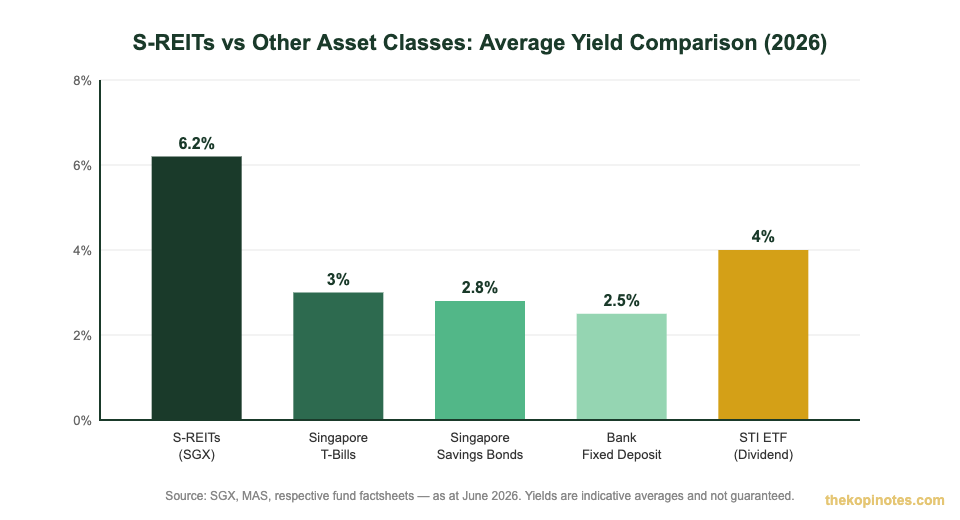
- Average yield is around 5–7% per year, well above Singapore T-bills and fixed deposits as at June 2026.
- You can buy S-REITs through any Singapore brokerage — IBKR, Syfe, FSMOne, or MooMoo — with no minimum beyond one lot (100 units).
Table of Contents
What Is a REIT?
A Real Estate Investment Trust (REIT) is a company that owns, operates, or finances income-producing real estate. Think of it like a mutual fund — but instead of holding stocks or bonds, it holds physical properties such as shopping malls, office buildings, warehouses, data centres, or hospitals.
In Singapore, REITs are governed by the Monetary Authority of Singapore (MAS) under the Code on Collective Investment Schemes. S-REITs must distribute at least 90% of their taxable income each year to qualify for tax transparency — meaning the REIT itself pays no income tax on the distributed portion. Instead, you as the unitholder receive the income directly.
This structure is why S-REITs tend to offer yields well above bonds or fixed deposits. The property income flows through directly to investors, rather than being retained on the company’s balance sheet.
Singapore’s REIT market is the largest in Asia ex-Japan. As at June 2026, there are over 40 S-REITs and property trusts listed on SGX, with a combined market capitalisation exceeding SGD 100 billion. Major sponsors include CapitaLand, Mapletree, Keppel, and Frasers — some of Singapore’s largest and most reputable property groups.
Why Singapore Investors Love REITs
Singapore has a unique advantage for REIT investing. There is no capital gains tax and no dividend tax for individual investors. This means the full distribution per unit (DPU) you receive from an S-REIT lands in your pocket — no further tax deduction applies for Singapore tax residents.
Compare this to owning physical property in Singapore: you face Buyer’s Stamp Duty (BSD), Additional Buyer’s Stamp Duty (ABSD), property maintenance, agent fees, and ongoing property tax. An S-REIT removes all of that. You simply buy units on SGX and collect income every quarter.
| Factor | Physical Property | S-REIT |
|---|---|---|
| Minimum Investment | SGD 300,000+ | SGD 200–500 (1 lot) |
| Stamp Duty | BSD + ABSD (up to 60%) | None |
| Liquidity | Months to sell | Sell instantly on SGX |
| Diversification | 1 property | 10–100+ properties |
| Dividend / Income Tax (SG Resident) | Rental income taxable | No withholding tax for SG residents |
Source: IRAS, MAS, SGX — as at June 2026
S-REITs are also one of the few investment vehicles eligible for the Supplementary Retirement Scheme (SRS). You can buy SGX-listed REITs using your SRS account, which means your investment is made with pre-tax dollars — an immediate tax saving depending on your marginal tax rate.
For a deeper look at how S-REITs generate passive income in Singapore, see our dedicated guide covering DPU growth trends and income strategies.
Types of S-REITs by Sector
Not all REITs are the same. The sector determines what kind of properties the REIT owns, how stable the income is, and how sensitive it is to interest rate changes. Here is a breakdown of the main S-REIT sectors you will encounter on SGX:
| Sector | Examples | Indicative Yield | Key Characteristic |
|---|---|---|---|
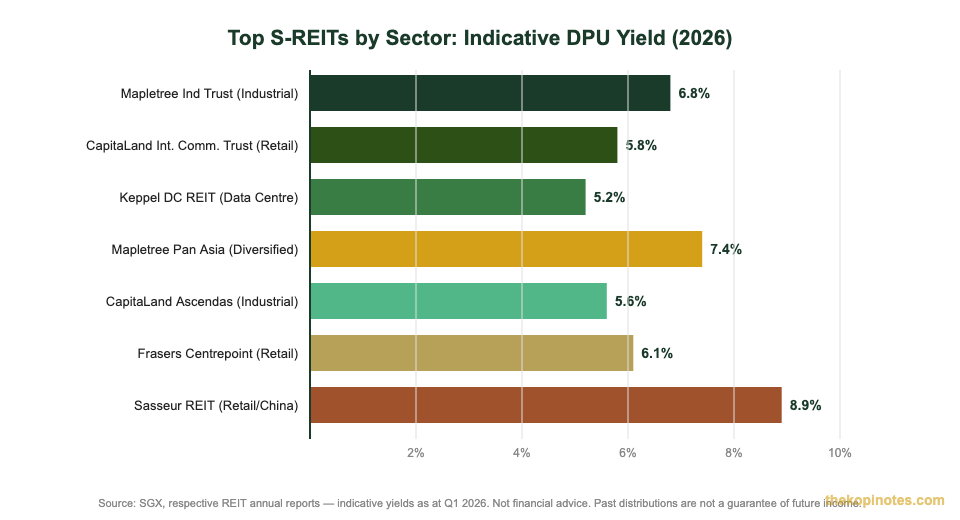
| Industrial | Mapletree Industrial Trust, CapitaLand Ascendas REIT | 5–7% | Warehouses, business parks, data centres — long leases, stable income |
| Retail | CapitaLand Integrated Commercial Trust, Frasers Centrepoint Trust | 5–6% | Singapore malls — resilient foot traffic, suburban focus post-COVID |
| Office | Keppel REIT, OUE Commercial REIT | 5–6% | CBD office buildings — sensitive to work-from-home trends |
| Hospitality | CDL Hospitality Trusts, Far East Hospitality Trust | 5–8% | Hotels and serviced apartments — more volatile, tied to tourism |
| Healthcare | Parkway Life REIT, First REIT | 4–5% | Hospitals and nursing homes — very defensive, lower but consistent yield |
| Data Centre | Keppel DC REIT, Digital Core REIT | 5–7% | High AI/cloud demand driving occupancy — growth-oriented |
| Diversified / Overseas | Mapletree Pan Asia Commercial Trust, Sasseur REIT | 6–9% | Multi-geography exposure — higher yield but also higher FX and geopolitical risk |
Source: SGX REIT Monitor, respective annual reports — indicative yields as at Q1 2026. Yields change daily with market prices.
For Singapore investors who want sector diversification without picking individual REITs, a Singapore REIT ETF — such as the Lion-Phillip S-REIT ETF (CLR) or NikkoAM-Straits Trading Asia Ex Japan REIT ETF — holds a basket of S-REITs in a single SGX-listed fund.
Key Metrics: How to Evaluate an S-REIT
Before you buy any S-REIT, check these five numbers. They tell you whether the REIT is financially healthy and whether the yield is sustainable.
1. Distribution Per Unit (DPU) — This is the cash payout per unit, usually quoted as Singapore cents per unit per year. A rising DPU trend indicates a healthy REIT. A falling DPU is a red flag — it could mean rent reversions going negative, rising costs, or a rights issue diluting unitholders.
2. Distribution Yield — DPU divided by the current unit price, expressed as a percentage. This is how most people compare REITs. However, a very high yield (above 9–10%) often signals that the market expects a DPU cut — not a bargain.
3. Gearing (Leverage Ratio) — This is the total debt divided by total assets. MAS caps S-REIT gearing at 50% (or 55% if the REIT has a minimum interest coverage ratio of 2.5x). A gearing ratio above 40% means the REIT has limited room to borrow for acquisitions without doing a rights issue.
4. Net Asset Value (NAV) per Unit — The book value of the underlying properties divided by the number of units. If an S-REIT trades at a significant discount to NAV (say 0.7x), the market may be pricing in asset write-downs or DPU cuts. If it trades at a premium (1.3x+), the market is pricing in strong growth expectations.
5. Weighted Average Lease Expiry (WALE) — How long the average lease has left, in years. A WALE of 4+ years means income is locked in and not up for renegotiation anytime soon. A short WALE of 1–2 years means significant lease renewal risk in the near term.
A worked example: Suppose Mapletree Industrial Trust (MIT) is trading at SGD 2.20 per unit and pays a DPU of SGD 0.136 per year. Its yield is 6.2%. Its gearing is 37% and NAV per unit is SGD 2.45, so it trades at 0.90x NAV — a modest discount. This combination of reasonable gearing, a discount to NAV, and a healthy yield is what many long-term investors look for.
How to Buy REITs in Singapore (Step-by-Step)
S-REITs are listed on SGX and can be bought through any SGX-connected brokerage. Here is how to get started:
Step 1: Open a Brokerage Account
You need a Central Depository (CDP) account or a custodian brokerage account to buy S-REITs. The CDP account is held directly with SGX and gives you direct ownership. Custodian accounts (used by IBKR, MooMoo, Tiger Brokers) hold units on your behalf — slightly cheaper in some cases but slightly more admin when transferring.
Popular brokerages for buying S-REITs in Singapore:
| Broker | Commission (SGX stocks) | CDP-Linked? | Best For |
|---|---|---|---|
| Interactive Brokers (IBKR) | USD 1.50 min / 0.08% | No (custodian) | Cost-conscious, large portfolios |
| Syfe Brokerage | SGD 1.49 flat (first trade free) | Yes (CDP) | Beginners wanting CDP ownership |
| FSMOne | SGD 10 min / 0.08% | Yes (CDP) | Regular savings plan (RSP) investors |
| MooMoo Singapore | SGD 0.99 / 0.03% | No (custodian) | Active traders, low commissions |
| Endowus (Cash/SRS) | 0.3–0.6% platform fee | No (custodian) | SRS investing, managed portfolios |
Source: Respective broker websites — as at June 2026. Fee structures may change; always verify before trading.
If you are investing for retirement using your SRS account, platforms like Endowus referral code and FSMOne referral code both support SRS-linked investing in SGX-listed REITs.
Step 2: Fund Your Account
Transfer SGD from your bank account via PayNow or FAST. Most brokerages settle in SGD for SGX-listed securities. S-REITs trade in SGD lots of 100 units. If a REIT is priced at SGD 2.50 per unit, one lot costs SGD 250 — well within reach of most Singapore investors.
Step 3: Search and Buy
Search for the REIT by name or ticker on your broker’s platform. For example, Mapletree Industrial Trust trades under the ticker “ME8U” on SGX. Select the SGX exchange, choose the number of lots, and place a limit order at or near the current market price. Your units will settle T+2 (two trading days after your purchase).
Step 4: Collect Your DPU
Most S-REITs pay distributions quarterly or semi-annually. The DPU is credited directly to your bank account (for CDP-linked accounts) or to your brokerage cash balance (for custodian accounts). You do not need to do anything — the income arrives automatically.
You can track all your S-REIT holdings and income using the Singapore retirement calculator to see how your passive income stacks up against your retirement goals.
S-REIT vs S-REIT ETF: Which Is Right for You?
Once you decide you want S-REIT exposure, you face a second choice: buy individual REITs, or buy a REIT ETF that holds a basket of them? Both approaches work — the right one depends on your portfolio size and how much time you want to spend managing it.
| Factor | Individual S-REITs | S-REIT ETF (e.g. CLR) |
|---|---|---|
| Diversification | Low (unless you buy 5–10 REITs) | High (30+ REITs in one fund) |
| Cost | Low (no management fee, just brokerage) | Management fee ~0.5% p.a. on top |
| Control | You pick which sectors and REITs | Index decides the weighting |
| Effort | High — monitor each REIT’s results | Low — passive, set and forget |
| Suitable For | Investors with SGD 20k+ who enjoy research | Beginners and busy investors |
Source: TKN analysis, SGX — as at June 2026
A practical approach many Singapore investors take: buy the Singapore REIT ETF first for broad exposure, then later add selected individual REITs in sectors you have conviction in — such as industrial REITs if you believe in data centre demand, or healthcare REITs if you want maximum defensiveness.
For the best S-REITs in Singapore for 2026, our comprehensive ranking covers the top picks by sector, yield, and balance sheet strength.
Risks of Investing in REITs
S-REITs are not a risk-free substitute for a fixed deposit. Before you invest, understand these four key risks:
Interest rate risk is the biggest one. When interest rates rise, REIT borrowing costs go up — that squeezes the income available for distributions. At the same time, higher rates make bonds and fixed deposits more attractive relative to REIT yields, which pushes REIT unit prices down. This is exactly what happened to S-REITs in 2022–2023 when global rates surged. With SORA easing in 2025–2026, REITs have partially recovered, but rate uncertainty remains.
Currency risk applies to REITs with overseas properties. Mapletree Pan Asia Commercial Trust owns properties in Japan, Hong Kong, China, and Singapore. If the Japanese yen weakens significantly against the SGD, the DPU in SGD terms falls — even if the properties are performing well in local currency terms.
Concentration risk applies if you only hold one or two REITs. A single tenant default, a regulatory change affecting one sector, or a specific property market downturn can hit your DPU hard. Diversify across at least 3–4 sectors if you are building a personal REIT portfolio.
Leverage and refinancing risk — S-REITs borrow heavily to acquire properties. When debt comes up for refinancing at higher rates, borrowing costs rise and DPU falls. Always check when the REIT’s major debt tranches mature and what percentage of debt is on fixed vs floating rates. The best REITs hedge 60–80% of their debt at fixed rates, reducing this risk.
Not financial advice. S-REIT distributions are not guaranteed. Past yields do not indicate future performance. Consider your own financial situation and consult a licensed financial adviser before investing.
For investors also considering CPF investment strategy, note that S-REITs are not eligible for the CPF Investment Scheme (CPFIS) ordinary account. You would need to use SRS or cash to invest in REITs. Some SGX-listed REIT ETFs may be eligible — always confirm with your broker and check the CPF Board’s approved investment list.
Looking at the broader investment landscape, it also helps to compare S-REITs against other Singapore T-bills 2026 and Singapore Savings Bonds to decide how much of your portfolio to allocate to each asset class.
Frequently Asked Questions
What is a REIT and how does it work in Singapore?
A REIT (Real Estate Investment Trust) is a listed fund that owns income-producing properties. In Singapore, S-REITs are regulated by MAS and listed on SGX. They must distribute at least 90% of their taxable income to unitholders each year, which is why they offer higher yields than most stocks. You buy units on SGX just like any stock, and receive quarterly or semi-annual cash distributions (called DPU — Distribution Per Unit) credited directly to your bank or brokerage account.
How much money do I need to start investing in REITs in Singapore?
S-REITs trade in board lots of 100 units on SGX. Most S-REITs are priced between SGD 0.50 and SGD 4.00 per unit, so a single lot typically costs SGD 50 to SGD 400. You can start with as little as SGD 100–200 for some lower-priced REITs. Alternatively, some brokerages and robo-advisors like Syfe allow fractional or regular savings plan (RSP) investing in REIT ETFs, which means you can invest a fixed dollar amount monthly without worrying about lot sizes.
Are S-REIT distributions taxed in Singapore?
For individual Singapore tax residents, S-REIT distributions are not subject to withholding tax — they are received tax-free at the unitholder level. This is because S-REITs enjoy tax transparency under MAS rules: the trust pays no income tax on the distributed portion, and individual investors receive the full distribution without further tax deduction. There is also no capital gains tax in Singapore, so any profit when you sell your REIT units is yours to keep entirely. Non-resident individual investors may be subject to a 10% withholding tax — check with your tax adviser if this applies to you.
Can I buy S-REITs with my SRS account?
Yes. SGX-listed S-REITs are eligible for investment using your Supplementary Retirement Scheme (SRS) account. You simply open an SRS account at DBS, OCBC, or UOB, link it to an SRS-eligible brokerage (such as FSMOne or Syfe), and buy S-REIT units as normal. Investing via SRS uses pre-tax dollars — every dollar contributed to SRS reduces your chargeable income for that year. However, SRS withdrawals at retirement are taxable (at 50% of the withdrawn amount), so factor this into your long-term tax planning.
What is a good REIT yield in Singapore?
The average S-REIT yield on SGX is around 5–7% as at June 2026. A yield in the 5–7% range for an S-REIT with healthy gearing (under 40%), a stable WALE (above 3 years), and a track record of consistent DPU is generally considered attractive. Be cautious of REITs yielding above 9–10% — an exceptionally high yield often signals the market expects a DPU cut, elevated gearing risk, or significant asset concentration in a volatile market. Always look at DPU trends over 3–5 years, not just the current yield.
What is the difference between investing in S-REITs and buying a REIT ETF?
Buying individual S-REITs gives you more control and lower costs (no management fee), but requires you to research and monitor each REIT yourself. A REIT ETF (such as the Lion-Phillip S-REIT ETF, ticker CLR on SGX) holds a diversified basket of 30+ S-REITs in one fund — you get instant diversification with minimal effort, at the cost of a small annual management fee (around 0.5% p.a.). For beginners or busy investors, the REIT ETF is often the smarter starting point. Once you are comfortable, you can layer in individual REITs on top.
How do I pick the best S-REITs in Singapore?
Look at five key metrics: (1) Distribution Yield — aim for 5–7% with stable or growing DPU; (2) Gearing ratio — below 40% is comfortable, above 45% is risky; (3) WALE (Weighted Average Lease Expiry) — above 3 years provides income visibility; (4) NAV per unit — a discount to NAV may indicate undervaluation; (5) Sponsor quality — REITs backed by strong sponsors like CapitaLand, Mapletree, or Keppel have better access to deal pipelines and equity markets. Always read the REIT’s latest quarterly results and annual report before investing.
Ready to Start Investing in S-REITs?
Open a brokerage account today and start earning passive income from Singapore’s best REITs. Use our referral links for exclusive sign-up bonuses.
This article was researched with the help of AI. While we strive to keep all information accurate and up to date, there may be errors. If you notice any discrepancies, please contact us.