Michael Burry’s AI Warning: What “Token Maxing” and the Bezzle Mean for Your Portfolio
The Big Short investor’s May 2026 thesis on why AI capex is a bubble — and what Singapore investors should do about it.
Michael Burry — the investor who predicted the 2008 housing crash — now says the AI spending boom is a bubble. In his May 2026 essay “Tracepalooza & the Bezzle,” Burry argues that companies are forcing AI usage through quotas, harvesting data to replace vendors, and locking in massive debt for demand that may not last. If you hold VWRA, CSPX, or SMH, his warning applies directly to your portfolio.
Not financial advice. All figures are for educational reference only. Data as at June 2026 unless noted.
- The thesis: Hyperscalers are spending $725 billion on AI capex in 2026, but much of the demand is artificially inflated by forced usage quotas (“token maxing”) and data harvesting — not genuine productivity gains.
- The risk: Markets are pricing AI’s most expensive adoption phase as the permanent state. When companies cut back, Nvidia and semiconductor stocks face a demand cliff.
- What to do: Don’t panic-sell. Stress-test your portfolio, know your actual Nvidia exposure, and consider rebalancing toward less correlated assets.
Watch: Michael Burry’s AI Bubble Thesis Explained
Table of Contents
Contents — Click to expand
- Who Is Michael Burry — and Why Should You Listen?
- Token Maxing and the Bezzle: The Core Thesis
- The Microsoft Case Study
- Nvidia and the Concentration Problem
- The Capex Numbers: How Big Is the Bet?
- The Counter-Case: Why the Bulls Might Be Right
- What This Means for Singapore Investors
- Practical Takeaways: What to Do Now
- Frequently Asked Questions
Who Is Michael Burry — and Why Should You Listen?
You probably know Michael Burry from The Big Short. He’s the hedge fund manager who bet against the US housing market in 2007 and made hundreds of millions when it collapsed. What made that trade legendary wasn’t just the profit — it was the timing. Burry saw the structural rot in mortgage-backed securities years before anyone else took it seriously.
Since then, Burry has published contrarian calls through his fund Scion Asset Management and, more recently, through his Substack newsletter Cassandra Unchained. His track record is far from perfect — he called a market crash in 2019 that didn’t materialise as predicted. But when Burry publishes a detailed, multi-part thesis with specific mechanisms (not just vibes), it’s worth reading carefully.
His AI series — “The Heretic’s Guide to AI’s Stars” — is now three parts long. Part III, published in May 2026, is the most actionable yet. It introduces two key concepts: “token maxing” and “the Bezzle.” Together, they form a coherent argument for why AI spending could contract sharply — and why that matters for your portfolio.
Token Maxing and the Bezzle: Burry’s Core AI Thesis
Burry’s argument is not that AI is useless. He’s careful to distinguish between the technology and the market’s pricing of the technology. His claim: the market is capitalising the most expensive, temporary phase of AI adoption as if it were the permanent steady state.
Here’s how the two concepts work together.
What Is “Token Maxing”?
Burry coined the term “token maxing” (his broader label is “Tracepalooza”) to describe how large companies are forcing employees to use AI tools through quotas, leaderboards, and usage mandates. Think of it as management saying: “You must run at least X AI queries per week.”
Why would companies do this? Not necessarily because every query adds value. Burry argues that many of these queries are performative — employees hitting targets to satisfy internal metrics rather than solving real problems. The result is inflated usage data that makes AI adoption look stronger than it actually is.
What Is “The Bezzle”?
Burry borrows the term “Bezzle” from economist John Kenneth Galbraith. It describes a period where both sides of a transaction believe they’re wealthier than they actually are — a temporary illusion of value.
In the AI context, the Bezzle works like this. Hyperscalers (Google, Amazon, Microsoft, Meta) commit hundreds of billions in capex to build data centres, believing enterprise demand will persist. Nvidia and chip suppliers book record revenue and project it forward. Enterprise customers sign multi-year cloud contracts, believing AI will transform their businesses. Investors bid up the entire AI supply chain based on these revenue figures.
Everyone feels richer. But the capex is locked in via long-term debt and infrastructure commitments, while the demand side (enterprise spending on AI) can shift in a single budget cycle. That duration mismatch — long-term commitments funded by short-term demand — is the core of the Bezzle.
Data Harvesting: The Hidden Exit Strategy
Burry adds a third layer: data harvesting. He argues that some companies are deliberately pushing employees to use third-party AI tools — not for productivity, but to collect the prompts, workflows, and outputs. The data generated by these queries becomes training material for proprietary in-house models.
Once the in-house model is good enough, the company cancels its third-party AI subscription. So the very act of using AI tools plants the seeds of reduced AI spending later. This is a self-limiting cycle that the market hasn’t priced in.
The Microsoft Case Study: Proof the Cycle Has Already Started
You don’t have to take Burry’s word for it. In June 2026, Microsoft provided a real-world example that validates his thesis almost perfectly.
Rajesh Jha, Microsoft’s EVP of Experiences + Devices, instructed the division to cancel all Claude Code licenses by June 30, 2026. Engineers were pushed to use GitHub Copilot CLI instead — Microsoft’s own in-house tool.
This is textbook data harvesting in action. Phase 1 — Adopt: Microsoft engineers used Anthropic’s Claude Code extensively, generating thousands of prompts, code patterns, and debugging workflows. Phase 2 — Harvest: The data from those interactions informed Microsoft’s understanding of what developers actually need from AI coding tools. Phase 3 — Replace: Once GitHub Copilot CLI reached a competitive level, Microsoft cut the external vendor and brought everything in-house.
To be fair, Microsoft isn’t cutting AI spending overall. It’s redirecting it internally. But from the perspective of third-party AI vendors and the semiconductor supply chain that serves them, the net effect is the same: less external demand.
Nvidia and the Concentration Problem
This brings us to the stock that matters most: Nvidia. And more importantly, how much of Nvidia you already own — even if you didn’t choose to buy it.
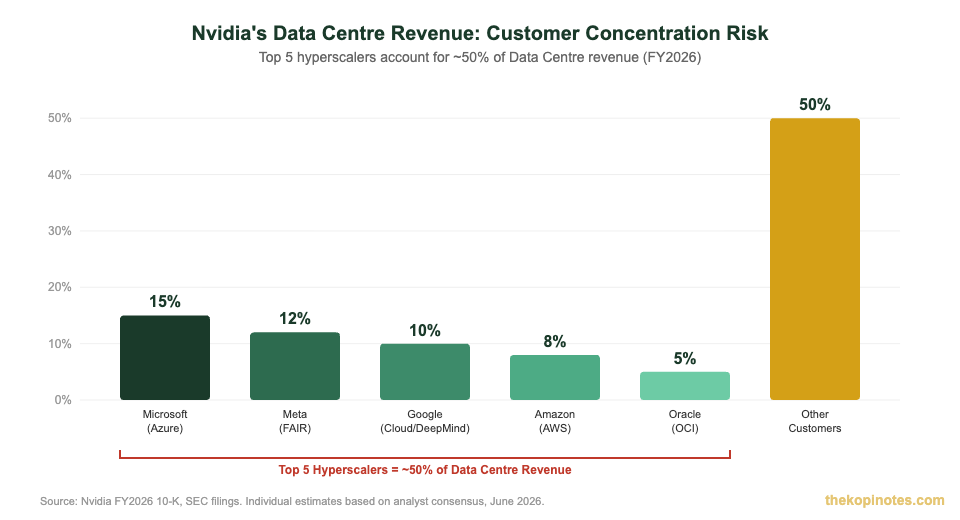
Hyperscalers represent roughly 50% of Nvidia’s Data Centre revenue as at FY2026. That means half of Nvidia’s growth engine depends on spending decisions made by just four or five companies. When Burry warns about customer concentration risk, this is what he means.
Now look at SMH, the VanEck Semiconductor ETF. It returned an eye-watering +68.78% in the first half of 2026, with a beta of 1.54. But that performance is heavily concentrated:
| Stock | Weight in SMH | Primary AI Revenue Risk |
|---|---|---|
| Nvidia | 17.00% | ~50% Data Centre revenue from hyperscalers |
| TSMC | 10.50% | Manufactures Nvidia + AMD AI chips |
| Broadcom | 7.95% | Custom AI chips for Google (TPU), Meta |
| Intel | 7.02% | Foundry + data centre exposure |
| AMD | 6.17% | MI300X GPU competing for AI workloads |
| Top 5 Total | 48.65% | Nearly half the ETF in AI-exposed chips |
Source: VanEck SMH factsheet, June 2026
Almost half of SMH is concentrated in five stocks, all of which depend — directly or indirectly — on hyperscaler AI spending continuing to grow. If Burry is right that this spending cycle peaks sooner than expected, SMH has significant downside risk.
But here’s what many Singapore investors miss: even if you don’t own SMH, you’re still exposed. CSPX (the S&P 500 ETF many of you hold through Syfe referral code and sign-up bonus or IBKR) has roughly 30% in the Magnificent 7 tech stocks, with Nvidia alone sitting near 7% of the index. VWRA dilutes this somewhat through global diversification, but the US still makes up about 60% of the fund.
The Capex Numbers: How Big Is the Bet?
To understand the scale of what Burry is warning about, you need to see the numbers. The Big 4 hyperscalers — Google (Alphabet), Amazon, Microsoft, and Meta — have committed to a level of capital spending that is historically unprecedented for the tech sector.
| Metric | 2024 (Actual) | 2026 (Planned) | 2027 (Forecast) |
|---|---|---|---|
| Big 4 Combined Capex | ~$410B | $725B | >$1 trillion |
| Year-over-Year Growth | — | +77% YoY | +38% YoY (est.) |
| Goldman Sachs Cumulative Forecast | $5.3 trillion combined capex from 2025 to 2030 | ||
Source: Company filings, CNBC, Goldman Sachs estimates, June 2026
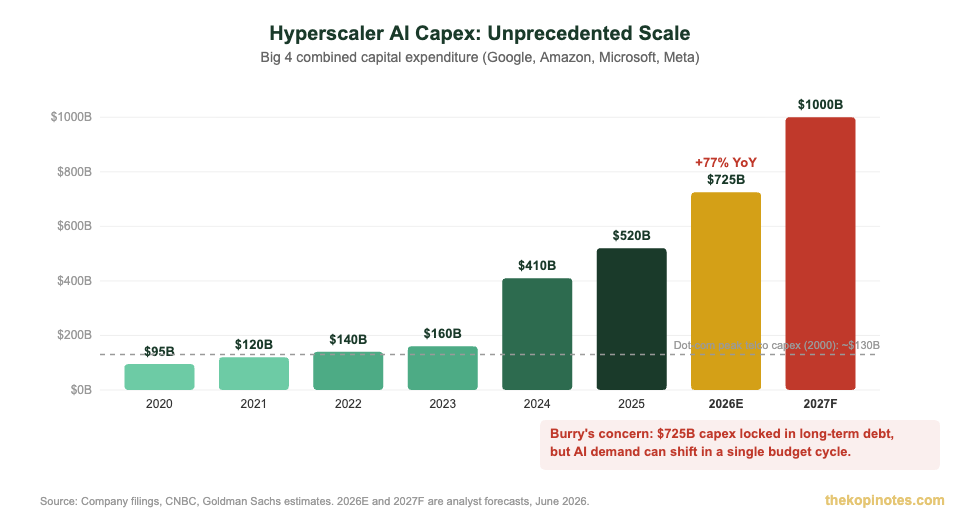
Burry’s concern isn’t the spending itself. It’s the duration mismatch. Data centres take 18–24 months to build and carry 20–30 year useful lives. The debt financing them runs 10–15 years. But the enterprise customers paying for AI cloud services can cancel or reduce their contracts in 12 months or less.
This creates what Burry calls the Bezzle: a period where everyone believes the AI infrastructure is worth what was spent on it, because current utilisation rates look healthy. But if demand drops — because companies internalise AI, because the ROI disappoints, or because the next efficiency breakthrough makes current hardware obsolete — you’re left with hundreds of billions in stranded assets.
There are also emerging risks in how this capex is financed. Some data centres are being packaged into asset-backed securities (ABS), similar in structure to the mortgage-backed securities that Burry shorted in 2007. While the comparison isn’t exact, the pattern of taking illiquid, long-duration assets and turning them into tradeable securities should sound familiar.
The Counter-Case: Why the Bulls Might Be Right
Burry has been early — or outright wrong — before. It’s important to understand why many smart investors disagree with his AI thesis.
The Jevons Paradox argument: As AI gets cheaper and more efficient, total usage could grow exponentially — just as cheaper electricity didn’t reduce power consumption, it massively increased it. Bulls argue that even if individual query costs drop, the number of queries will overwhelm any per-unit savings. Burry is sceptical this will happen fast enough to justify current capex levels, but historically, the Jevons Paradox has played out in most technology cycles.
Revenue is real, not speculative: Unlike the dot-com bubble where companies had no earnings, Nvidia posted record revenue and margins in 2025 and 2026. Microsoft Azure’s AI services are generating measurable revenue growth. This isn’t pets.com — the underlying businesses are profitable.
Sovereign AI is a new demand source: Governments in India, the Middle East, Southeast Asia, and Europe are building national AI infrastructure. This diversifies demand beyond the Big 4 hyperscalers. Even if enterprise spending dips, sovereign spending could pick up the slack.
AI agents and inference demand: As AI moves from chatbots to autonomous agents (booking flights, managing workflows, writing code), inference demand could grow 10–50×. This isn’t priced into most bear scenarios.
The bottom line: Burry could be right about the mechanism (token maxing, data harvesting) but wrong about the timing. If the demand cliff arrives in 2029 instead of 2027, the trade works against you for three years first.
What This Means for Singapore Investors
Here’s where it gets personal. If you’re a Singaporean investor using IBKR, Endowus referral code, or Syfe, chances are you hold at least one of these funds:
| ETF | Nvidia Weight (approx.) | Total Mag 7 Weight | Burry-Risk Level |
|---|---|---|---|
| SMH (Semiconductor ETF) | ~17% | N/A (sector fund) | High |
| CSPX (S&P 500) | ~7% | ~30% | Medium |
| VWRA (All-World) | ~4% | ~18% | Lower |
| S-REIT ETFs | 0% | 0% | Minimal |
Source: iShares, Vanguard, VanEck factsheets, June 2026. Weights are approximate and change daily.
If you only hold VWRA: Your Nvidia and AI exposure is diluted but still material at roughly 4% direct and 18% via the Magnificent 7. A 30% drawdown in AI-related stocks would drag VWRA down by about 5–6%. Uncomfortable, but not catastrophic. VWRA’s global diversification is doing its job.
If you hold CSPX: You’re more concentrated. The S&P 500 has never been this top-heavy in modern history. A correction in the Magnificent 7 would hit CSPX harder than VWRA. Consider whether you want to complement it with non-US or non-tech exposure.
If you hold SMH or individual semiconductor stocks: You’re making a direct bet that AI capex continues growing. That bet has paid off spectacularly (+68.78% YTD in H1 2026), but it carries a beta of 1.54. If Burry’s thesis plays out, SMH could give back a significant portion of those gains faster than the broad market.
The Singapore-Specific Angle
Singapore investors have a unique advantage here: access to asset classes with low correlation to US tech. If you’re worried about AI concentration risk, consider diversifying into:
S-REITs: Zero exposure to AI capex risk, and they benefit from a different set of drivers (interest rates, occupancy, rental reversion). Check out our Singapore REIT ETF guide for options.
Singapore Savings Bonds / T-bills: Risk-free yield in SGD. Not exciting, but they don’t correlate with Nvidia’s earnings.
Dividend-focused strategies: Our guide on passive income Singapore covers ways to build income streams that aren’t tied to AI capex cycles.
Still deciding between robo-advisors? Our syfe vs endowus 2026 comparison can help you figure out which platform suits your risk tolerance.
Practical Takeaways: What to Do Now
Burry’s thesis is a warning, not a sell signal. Here’s how to think about it practically.
1. Know Your Actual AI Exposure
Log in to your broker and check the top holdings of every ETF you own. Add up your total Nvidia, Microsoft, Alphabet, Amazon, and Meta exposure. If it’s above 25% of your portfolio, you’re making a meaningful bet on AI spending continuing to grow. That might be fine — but make it a conscious decision, not an accident.
2. Stress-Test Your Portfolio
Ask yourself: “If Nvidia dropped 40% over six months, what would happen to my portfolio?” Use a Singapore retirement calculator to model different scenarios. If a semiconductor correction would meaningfully delay your financial goals, you’re too concentrated.
3. Don’t Try to Time It
Burry was two years early on the housing trade. He could be early on AI too. Selling your entire position because of one bearish thesis — however well-argued — is usually a mistake. Instead, consider trimming at the margins or redirecting new contributions to less correlated assets.
4. Watch the Leading Indicators
If Burry is right, you’ll see early signs before the market reacts. Watch for more companies cancelling third-party AI tool licenses (like Microsoft did with Claude Code), hyperscaler capex guidance revisions downward, rising vacancy rates in data centre markets, and Nvidia’s customer concentration disclosures in quarterly filings.
5. Rebalance, Don’t Panic
If your CSPX or VWRA position has grown disproportionately large due to AI-driven gains, rebalancing back to your target allocation is a disciplined move — not a market-timing call. Take profits systematically and redeploy into areas with lower correlation to AI capex.
Not financial advice. All figures are for educational reference only. Consult a licensed financial adviser before making investment decisions.
Frequently Asked Questions
Is Michael Burry shorting AI stocks in 2026?
Burry has not publicly disclosed a short position in AI stocks as of his latest 13F filing. His Substack essay is an analytical thesis, not a trade alert. However, his detailed, multi-part coverage suggests he has strong conviction. Past Scion filings have shown positions that align with his published views, but there’s typically a lag between his writing and any disclosed trades.
What is token maxing in simple terms?
Token maxing is when companies force employees to use AI tools by setting usage quotas or tracking consumption on leaderboards. The goal isn’t always productivity — it’s often about hitting internal metrics or harvesting data. Burry argues this inflates AI usage statistics, making the market believe demand is stronger and more sustainable than it actually is.
Should I sell my VWRA or CSPX because of Burry's warning?
No. Selling a broad-market ETF based on a single bearish thesis — no matter how credible — is rarely the right move. VWRA holds over 3,400 stocks across 49 countries, so AI is only one of many growth drivers. CSPX is more concentrated in US tech, so you might consider complementing it with non-US or non-tech funds. The key is to know your exposure and rebalance thoughtfully, not to panic-sell.
How does the AI capex bubble compare to the dot-com bubble?
There are similarities and important differences. Like the dot-com era, there’s massive infrastructure spending based on optimistic demand projections. But unlike 1999, the companies doing the spending (Google, Amazon, Microsoft, Meta) are enormously profitable and have real AI revenue. The risk isn’t that these companies will go bankrupt — it’s that their AI spending may prove excessive relative to returns, leading to capex cuts that ripple through to Nvidia and the supply chain.
What is the Jevons Paradox and does it disprove Burry's thesis?
The Jevons Paradox says that as a technology becomes more efficient, total consumption often increases rather than decreases — because lower costs unlock new use cases. AI bulls argue this means cheaper inference will drive explosive demand growth. Burry doesn’t deny the Jevons Paradox exists. He argues it won’t kick in fast enough to absorb $725 billion in annual capex. Historically, the paradox plays out over decades, not quarters.
How much Nvidia exposure do Singapore investors typically have?
It depends on your ETF. VWRA holders have roughly 4% direct Nvidia exposure. CSPX holders have about 7%. If you own SMH or individual semiconductor stocks, it could be 17% or more. Add indirect exposure through Microsoft, Google, and Amazon (which are both Nvidia customers and major ETF holdings), and the real figure is higher than most investors realise. Check your broker’s portfolio analytics for your actual concentration.
What should Singapore investors buy as an AI hedge?
Assets with low correlation to US tech include Singapore REITs, Singapore Savings Bonds, T-bills, gold ETFs, and international value funds. The goal isn’t to bet against AI — it’s to ensure your portfolio isn’t dominated by a single theme. If AI capex continues growing, your VWRA and CSPX will capture the upside. If Burry is right, your diversified holdings limit the downside. That’s the whole point of asset allocation.
Worried About Your AI Exposure?
Use our tools to stress-test your portfolio and explore diversified alternatives.
This article was researched with the help of AI. While we strive to keep all information accurate and up to date, there may be errors. If you notice any discrepancies, please contact us.