Endowus Core (Flagship) vs Factor Portfolio: Which Is Better for Singapore Investors? (2026)
Performance data, fund composition, and a clear framework for choosing between Endowus’s two flagship Dimensional portfolios.
Endowus offers two core equity portfolios built on Dimensional Fund Advisors: the Core (Flagship) portfolio, which tracks broad global markets with a mild factor tilt, and the Factor portfolio, which tilts harder toward value, small-cap, and profitability factors across 10,000+ stocks in 43 markets. For Singapore investors, the choice comes down to factor conviction and tolerance for tracking error — not fees, since both charge the same Endowus access fee.
Not financial advice. All figures are for educational reference only. Data as at Q1 2026 unless noted.
Table of Contents
Quick Answer: Core (Flagship) or Factor?
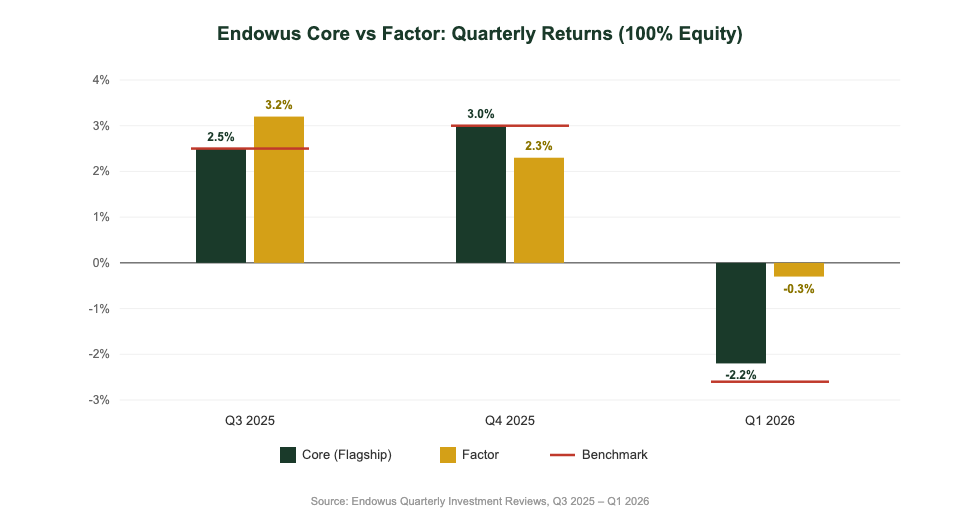
If you want broad global equity exposure that closely tracks a market-cap-weighted benchmark with lower tracking error, Core (Flagship) is the straightforward choice. It uses Dimensional funds with a mild tilt toward value and profitability, but stays close enough to the benchmark that quarterly performance rarely surprises you. In Q4 2025, Core 100% Equity returned 3.0%, matching its benchmark exactly.
If you believe that systematically overweighting value stocks, smaller companies, and profitable firms across developed and emerging markets will deliver higher long-term returns — and you can tolerate quarters where you underperform the broad market — Factor is worth considering. Factor 100% Equity returned 2.3% in Q4 2025 (behind the benchmark’s 3.0%), but turned around in Q1 2026, falling just 0.3% when the benchmark dropped 2.6%.
Both portfolios are available through Endowus using cash, CPF, or SRS funds, and charge the same access fee. The real difference is how much factor risk you are willing to take on.
Key Differences at a Glance
| Feature | Core (Flagship) | Factor |
|---|---|---|
| Investment Philosophy | Broad market tracking with mild factor tilt | Systematic factor overweight (value, size, profitability) |
| Fund Provider | Dimensional Fund Advisors | Dimensional Fund Advisors |
| Number of Stocks | ~8,000+ across global markets | ~10,000+ across 43 markets |
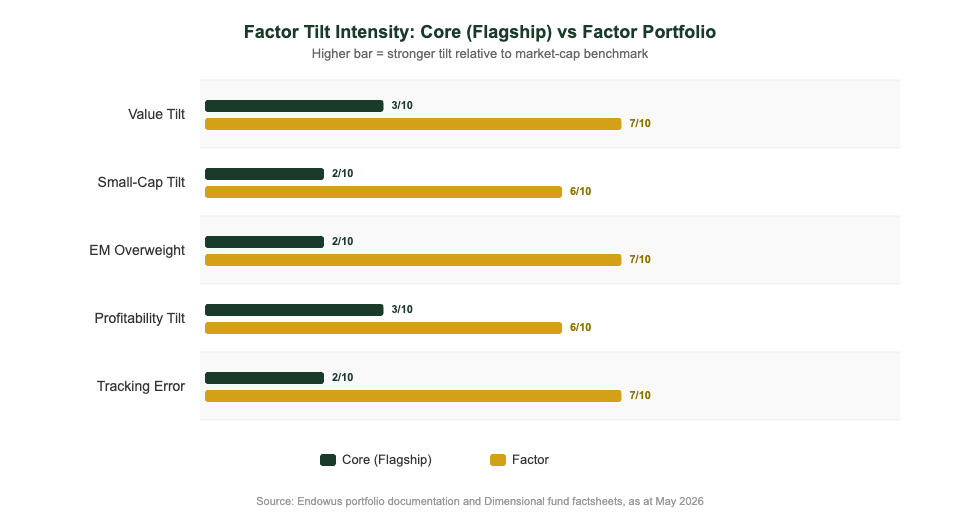
| Factor Intensity | Mild — closer to benchmark | Stronger — higher value/small-cap/EM tilt |
| Benchmark Tracking | Tight — low tracking error | Looser — higher tracking error |
| EM Overweight | Slight | Significant — includes EM sustainability tilt |
| Endowus Access Fee | 0.25%–0.60% p.a. (tiered) | 0.25%–0.60% p.a. (tiered) |
| Underlying Fund TER | ~0.28%–0.42% p.a. | ~0.25%–0.45% p.a. |
| Q4 2025 Return (100% Eq) | 3.0% | 2.3% |
| Q1 2026 Return (100% Eq) | Tracked closer to benchmark | −0.3% (beat benchmark −2.6%) |
Source: Endowus Quarterly Investment Reviews, Q3 2025 – Q1 2026
Fund Composition Breakdown
Both Core and Factor portfolios are built on Dimensional Fund Advisors funds — the same fund house, but different fund combinations and weightings. Understanding the building blocks helps explain why performance diverges in certain market conditions.
Core (Flagship) — Building Blocks
The Core portfolio uses Dimensional funds that provide broad global equity exposure with a mild tilt. The equity sleeve typically includes a global equity core fund, a US equity fund, and smaller allocations to emerging markets and international developed markets. The tilt toward value and profitability factors is present but dialled down — think of it as “market plus a nudge.”
For Singapore investors who already hold individual ETFs like CSPX or VWRA, Core (Flagship) is the closest Endowus equivalent — broad global equities, mostly cap-weighted, low tracking error.
Factor — Building Blocks
The Factor portfolio tilts harder. Its key equity funds include:
- Dimensional Global Core Equity Fund (~60% weight) — the largest allocation, covering developed and emerging markets with systematic value, size, and profitability tilts
- Dimensional US Core Equity Fund — adds US-specific value and small-cap exposure
- Dimensional Emerging Markets Sustainability Core Equity Fund — overweights EM stocks with ESG screening and factor tilts
- Dimensional Pacific Basin Small Companies Fund — targets small-cap stocks in Japan, Australia, and Asia-Pacific ex-China
The result: Factor holds over 10,000 stocks across 43 markets with a meaningfully higher allocation to value, small-cap, and emerging market equities compared to Core. This is not a different asset class — it is the same global equity universe, but with the dial turned up on factors that academic research (Fama-French, dimensional fund studies) says should deliver a premium over long time horizons.
Performance Comparison (2025–2026)
The difference between Core and Factor becomes clearest when you look at quarterly returns side by side. Here is the data from Endowus’s own quarterly investment reviews:
| Quarter | Core 100% Equity | Factor 100% Equity | Benchmark | Key Driver |
|---|---|---|---|---|
| Q3 2025 | In line | Outperformed | — | EM strength (China, Taiwan rally) |
| Q4 2025 | 3.0% | 2.3% | 3.0% | US large-cap growth led; Factor’s value tilt lagged |
| Q1 2026 | Tracked closer to −2.6% | −0.3% | −2.6% | Value/EM overweight cushioned drawdown |
Source: Endowus Quarterly Investment Reviews, Q3 2025 – Q1 2026
The pattern is consistent with factor investing theory. When US large-cap growth stocks (think Magnificent Seven) dominate, Factor lags Core because its value and small-cap tilt means less exposure to the winners. When markets rotate toward value, emerging markets, or smaller companies — as happened in Q3 2025 and Q1 2026 — Factor outperforms.
Over a full market cycle (typically 7–10 years), factor premiums have historically been positive, meaning Factor investors are compensated for the higher tracking error. But “historically” does not guarantee “going forward,” and there have been extended periods — notably 2018–2020 — where growth dominated and factor tilts detracted from returns.
When Factor Beats Core (and Vice Versa)
Understanding the conditions that favour each portfolio helps set expectations. This is not about timing — it is about knowing what you signed up for.
Factor tends to outperform when:
- Value stocks outperform growth: Factor’s overweight to value companies (lower price-to-book, higher dividend yield) pays off when the market rotates from growth to value — as seen in 2021–2022 and parts of 2025.
- Emerging markets rally: Factor has a significant EM overweight, particularly through the Dimensional Emerging Markets Sustainability Core Equity Fund. When EM markets (China, Taiwan, India, Brazil) outperform developed markets, Factor benefits disproportionately. This drove Factor’s Q3 2025 outperformance.
- Small-cap stocks catch up: The Pacific Basin Small Companies allocation gives Factor exposure to smaller companies in Asia-Pacific — a segment that tends to outperform during economic recoveries.
- Market drawdowns are value-led: In Q1 2026, the broad market fell 2.6%, but Factor fell only 0.3%. Value stocks — which tend to be cheaper relative to fundamentals — held up better than expensive growth stocks.
Core tends to outperform when:
- US large-cap growth dominates: When companies like Apple, Nvidia, and Microsoft drive the bulk of global returns, Core’s closer benchmark alignment captures more of that rally. In Q4 2025, Core matched the benchmark at 3.0% while Factor lagged at 2.3%.
- Emerging markets underperform: When EM sentiment is weak (China regulatory crackdowns, currency weakness), Factor’s EM overweight drags on returns.
- Markets are narrowly led: Concentrated rallies in a few large companies favour market-cap-weighted portfolios over factor-tilted ones.
Does the Fed Rate Path Matter?
With the US Federal Reserve holding rates at 3.50%–3.75% for the third consecutive meeting as at April 2026, and a new Fed Chair expected following Jerome Powell’s term expiry on 15 May 2026, Singapore investors are naturally asking whether rates should influence their Core vs Factor decision.
The short answer: not really. Here is why:
The Fed’s rate path mainly affects the fixed income side of each portfolio. Core Fixed Income rose 1.7% in Q3 2025, driven by falling yields and tighter credit spreads. If the new Fed Chair cuts rates 1–2 times in late 2026 (as the May 2026 guidance suggested), bond prices rise and fixed income returns improve in both portfolios equally.
On the equity side, rate cuts and a weaker USD are historically a mild tailwind for emerging markets and value stocks — which gives Factor a slight edge. But this effect is modest and unreliable. Plenty of rate-cutting cycles have seen growth stocks outperform regardless. The April 2026 meeting produced an unusual 8–4 vote split, signalling that even the Fed committee is divided on the direction from here.
Our view: pick Core vs Factor based on your factor conviction and tracking error tolerance, not on the Fed. Trying to time your portfolio tilt to interest rate expectations adds a layer of speculation that most passive investors are better off avoiding. If you’re using Endowus for long-term CPF or SRS investing — and most Singapore users are — a 25-basis-point rate move matters far less than staying invested through a full cycle.
For investors looking to optimise their overall allocation, consider running the numbers on the Singapore retirement calculator to see how different return assumptions compound over your investment horizon.
Fee Comparison
One of the simplest parts of this comparison: fees are essentially identical.
| Fee Component | Core (Flagship) | Factor |
|---|---|---|
| Endowus Access Fee | 0.25%–0.60% p.a. | 0.25%–0.60% p.a. |
| Fund-Level TER (est.) | ~0.28%–0.42% p.a. | ~0.25%–0.45% p.a. |
| Est. All-In Cost | ~0.53%–1.02% p.a. | ~0.50%–1.05% p.a. |
| Trailer Fee Rebate | 100% rebated | 100% rebated |
| Sales Charge / Platform Fee | None | None |
Source: Endowus fee schedule, as at May 2026. Access fee is tiered by AUM: 0.60% for first SGD 200k, scaling down to 0.25% above SGD 5m.
Endowus rebates 100% of trailer fees (also called distribution fees or retrocessions) from the fund managers back to the investor. This is a key differentiator versus platforms like Syfe or banks that keep these fees. The trailer fee rebate effectively reduces the all-in cost and makes Endowus competitively priced for access to institutional-grade Dimensional funds that are normally not available to retail investors in Singapore.
For context, buying VWRA directly through moomoo or IBKR costs just the ETF’s TER (0.22% for VWRA) plus brokerage — which is cheaper. But that comparison misses the point: VWRA is a passive market-cap-weighted ETF. Endowus Core and Factor offer systematic factor tilts via Dimensional, which you cannot replicate with a single ETF purchase.
Who Should Pick Which?
Choose Core (Flagship) if you:
- Want broad global equity exposure with minimal tracking error
- Prefer a portfolio that moves in line with the global market — no surprises
- Are new to factor investing and want to start with the simpler option
- Use Endowus for CPF or SRS and want predictable, benchmark-like returns
- Already hold individual ETFs (CSPX, VWRA) and want the Endowus equivalent for a different account (e.g., SRS)
Choose Factor if you:
- Believe in factor premiums (value, size, profitability) over a 10+ year horizon
- Can tolerate quarters — or even years — of underperformance relative to the broad market
- Want higher emerging market and small-cap exposure in your portfolio
- Have a long investment horizon (10+ years) and are comfortable with higher volatility
- Understand that Factor’s edge is structural, not tactical — it is not about timing markets
A practical middle ground
Some Singapore investors split their allocation: for example, 70% Core and 30% Factor. This gives you the majority of your portfolio tracking the benchmark (reducing regret risk) while still capturing some factor premium. Endowus allows you to hold multiple portfolios within one account, so this is operationally simple.
If you are deciding between Endowus and other robo-advisors, the detailed comparison in our Syfe vs Endowus 2026 analysis covers the broader platform differences including fee tiers, fund selection, and CPF/SRS compatibility.
For income-focused investors exploring other options alongside Endowus, Singapore REITs remain a popular dividend play. Our best S-REITs in Singapore 2026 guide covers the top picks and yields.
Not financial advice. Past performance does not guarantee future results. Factor premiums may not materialise over your specific investment horizon. Always consider your own risk tolerance and financial situation before investing.
Frequently Asked Questions
What is the main difference between Endowus Core (Flagship) and Factor portfolios?
Both portfolios use Dimensional Fund Advisors funds, but Core tracks broad global markets with a mild factor tilt, while Factor tilts more aggressively toward value, small-cap, and profitability factors across 10,000+ stocks. Core has lower tracking error and stays closer to benchmark returns, while Factor can deviate significantly in either direction.
Are Endowus Core and Factor available for CPF and SRS investment?
Yes, both portfolios are available for investing through CPF-OA, CPF-SA, SRS, and cash accounts on the Endowus platform. The fund selection and access fee structure are the same across all account types. CPF and SRS investors can access Dimensional funds through Endowus that would not otherwise be available to retail investors in Singapore.
Which Endowus portfolio performed better in 2025 and 2026?
Performance alternated depending on market conditions. Core 100% Equity matched its benchmark at 3.0% in Q4 2025, while Factor returned 2.3%. But in Q1 2026, Factor fell only 0.3% compared to the benchmark’s 2.6% decline. Factor tends to outperform when value stocks and emerging markets do well, while Core wins when US large-cap growth dominates.
Is the Endowus Factor portfolio riskier than Core?
Factor has higher tracking error — meaning its returns deviate more from the benchmark in any given quarter. This is not necessarily “riskier” in the traditional sense (both hold thousands of diversified stocks), but it does mean more variability relative to what a standard global index returns. Investors with shorter time horizons or lower tolerance for underperformance may find Core more comfortable.
Do Endowus Core and Factor charge different fees?
No. Both charge the same Endowus access fee (0.25%–0.60% p.a., tiered by AUM) and both receive 100% trailer fee rebates. The underlying Dimensional fund TERs are similar (roughly 0.25%–0.45% p.a.). Fee differences between the two portfolios are negligible — the choice should be driven by factor conviction and risk tolerance, not cost.
Should I switch from Core to Factor based on the Fed’s rate decisions?
We would not recommend it. The Fed rate path mainly affects fixed income, not the equity factor tilt decision. While rate cuts and a weaker USD can be mildly positive for emerging markets and value stocks (where Factor is overweight), this effect is too small and unreliable to base portfolio changes on. Choose based on your long-term factor conviction and tracking error comfort, not short-term macro views.
Can I hold both Core and Factor portfolios on Endowus?
Yes, Endowus allows you to create multiple portfolios within a single account. A common approach among Singapore investors is to allocate 70% to Core and 30% to Factor, capturing some factor premium while keeping most of the portfolio aligned with the benchmark. You can adjust the split at any time without additional charges.
Ready to Start Investing with Endowus?
Open an Endowus account using our referral code to get started with Core or Factor portfolios.
This article was researched with the help of AI. While we strive to keep all information accurate and up to date, there may be errors. If you notice any discrepancies, please contact us.