LionGlobal Singapore Physical Gold ETF (GLD SGD): Complete Guide (2026)
Singapore’s only SGD-hedged physical gold ETF — listed on SGX, accessible via CPF-OA and SRS.
The LionGlobal Singapore Physical Gold ETF (SGX ticker: GLD SGD) is Singapore’s first SGD-denominated physically-backed gold ETF, listed on the Singapore Exchange (SGX). Managed by Lion Global Investors, it holds physical gold bullion in a London vault and hedges currency exposure back to SGD, making it a clean, low-cost way for Singapore investors to gain gold exposure without foreign exchange risk. Its TER of 0.25% p.a. is the lowest among SGX-listed gold ETFs as at June 2026.
Not financial advice. All figures are for educational reference only. Data as at June 2026 unless noted.
Table of Contents
Contents — Click to expand
- What Is the LionGlobal Singapore Physical Gold ETF?
- Key Facts at a Glance
- Why Singapore Investors Buy Gold ETFs in 2026
- SGX Gold ETF Comparison: GLD SGD vs Alternatives
- Cost Analysis and Annual Fee Impact
- How to Buy the LionGlobal Gold ETF in Singapore
- CPF and SRS Eligibility
- Risks to Consider
- Frequently Asked Questions
What Is the LionGlobal Singapore Physical Gold ETF?
The LionGlobal Singapore Physical Gold ETF is an exchange-traded fund managed by Lion Global Investors, one of Southeast Asia’s largest asset managers. Unlike gold mining ETFs or synthetic gold products that use futures contracts, this ETF holds allocated physical gold bullion stored in a vault in London — each unit of the ETF is backed by actual gold. As at June 2026, each unit represents approximately 0.1 troy ounce of gold.
The standout feature that differentiates GLD SGD from other SGX-listed gold ETFs is its SGD currency hedge. Most gold ETFs trade in USD, meaning a Singapore investor’s returns fluctuate with the SGD/USD exchange rate in addition to the gold price itself. GLD SGD uses a rolling FX hedge to convert the USD gold price exposure into SGD, so what you see in your brokerage account is a cleaner reflection of the gold price movement in local currency terms.
The fund was established under a prospectus registered with the Monetary Authority of Singapore (MAS) and is subject to MAS oversight as a Recognised Market Operator product, giving Singapore retail investors regulatory protection under the Securities and Futures Act.
Key Facts at a Glance
| Metric | Detail |
|---|---|
| Full Name | LionGlobal Singapore Physical Gold ETF |
| SGX Ticker | GLD SGD (SGD-denominated counter) |
| Manager | Lion Global Investors Ltd |
| Underlying Asset | Physical gold bullion (London vault) |
| TER (Expense Ratio) | 0.25% p.a. |
| Currency | SGD (USD gold price, SGD-hedged) |
| Exchange | Singapore Exchange (SGX) |
| Structure | Open-ended ETF (not distributing — no dividends) |
| CPF-OA Eligible | Yes (subject to CPF Investment Scheme limits) |
| SRS Eligible | Yes |
Source: Lion Global Investors fund factsheet, SGX, June 2026
Why Singapore Investors Buy Gold ETFs in 2026
Gold has long served as a portfolio diversifier and inflation hedge, and 2026 has seen renewed interest from Singapore retail investors for three key reasons.
Global macro uncertainty: Ongoing geopolitical tensions — including continued conflict in Eastern Europe, Middle East instability, and US-China trade friction — have driven safe-haven demand for gold. The gold price in USD rose from approximately USD 2,000/oz in early 2024 to trade above USD 3,000/oz by mid-2026, a gain of over 50% over two years.
SGD strength concern: Many Singapore investors hold significant USD-denominated assets (IBKR accounts, US-listed ETFs, property). Adding a SGD-hedged gold ETF provides portfolio balance — your gold exposure is not double-exposed to USD movements.
CPF and SRS diversification: With CPF-OA interest rates pegged at 2.5%–4%, some investors choose to deploy a portion into CPF-approved gold ETFs as part of a diversified strategy. GLD SGD is one of the few gold products on the CPFIS-approved list. For a full overview of CPF investment strategy, see our dedicated guide.
Convenience over physical gold: Buying physical gold bars or coins involves storage costs, insurance, and illiquidity. A gold ETF trades on SGX like any share — you can buy and sell in real time during market hours with no storage hassle.
SGX Gold ETF Comparison: GLD SGD vs Alternatives
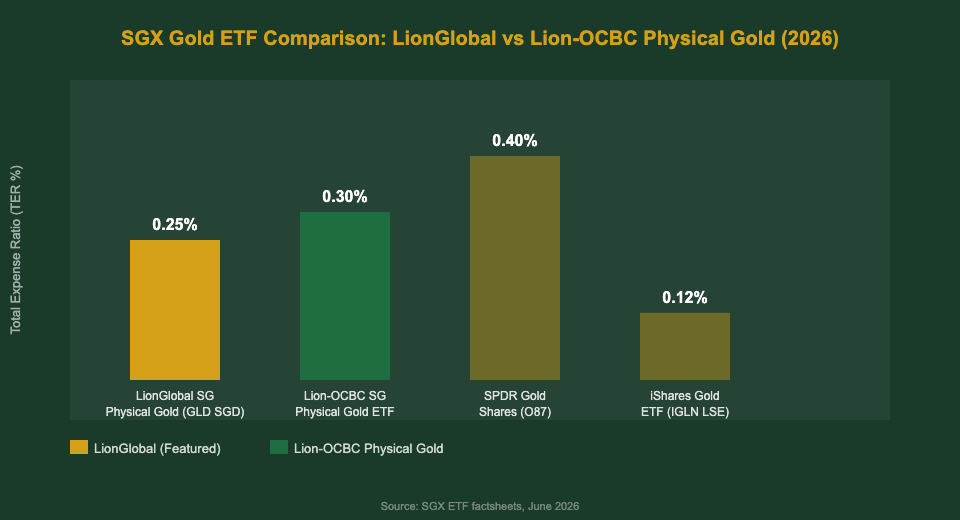
Singapore investors have several SGX-listed gold options. Here is how the LionGlobal product stacks up against the main alternatives as at June 2026.
| ETF | Ticker | TER | Currency | Physical? | CPF-OA? |
|---|---|---|---|---|---|
| LionGlobal SG Physical Gold ETF | GLD SGD | 0.25% | SGD-hedged | Yes | Yes |
| Lion-OCBC SG Physical Gold ETF | GLD USD / GLD SGD | 0.30% | USD / SGD | Yes | Yes |
| SPDR Gold Shares | O87 | 0.40% | USD | Yes | Yes |
| iShares Physical Gold ETF | IGLN (LSE) | 0.12% | USD | Yes | No |
| Sprott Physical Gold Trust | PHYS (NYSE) | 0.35% | USD | Yes | No (US-listed) |
Source: SGX, fund factsheets, June 2026. TER figures are as published by fund managers.
Key takeaway: For a Singapore investor who wants CPF-OA or SRS eligibility and SGD currency convenience, GLD SGD is the most cost-efficient choice on SGX. The iShares IGLN on the London Stock Exchange is cheaper (0.12% TER) but is not accessible via CPF and requires an international brokerage account like IBKR.
Cost Analysis and Annual Fee Impact
The TER is the single largest recurring cost for a buy-and-hold gold ETF investor. Here is how the annual cost drag looks at different portfolio sizes for GLD SGD versus its main SGX competitor.
For a Singapore investor holding SGD 50,000 in GLD SGD, the annual cost is approximately SGD 125 (0.25% × SGD 50,000). By comparison, the same position in SPDR Gold Shares (O87) would cost SGD 200 per year — a SGD 75 difference annually. Over 10 years, compounded, that difference in fee drag adds up to meaningful savings in favour of GLD SGD.
| Portfolio Size | GLD SGD (0.25%) | Lion-OCBC (0.30%) | SPDR O87 (0.40%) | Savings vs O87 |
|---|---|---|---|---|
| SGD 10,000 | SGD 25/yr | SGD 30/yr | SGD 40/yr | SGD 15/yr |
| SGD 50,000 | SGD 125/yr | SGD 150/yr | SGD 200/yr | SGD 75/yr |
| SGD 100,000 | SGD 250/yr | SGD 300/yr | SGD 400/yr | SGD 150/yr |
| SGD 250,000 | SGD 625/yr | SGD 750/yr | SGD 1,000/yr | SGD 375/yr |
Source: TKN calculations. Annual cost = portfolio value × TER. Transaction costs (brokerage commissions, bid-ask spreads) excluded. June 2026.
Note: The TER does not include brokerage commissions or the FX hedging cost embedded in GLD SGD. The currency hedge does carry a small additional cost (the “hedge ratio roll cost”), which in a low-interest-rate environment is minimal but widens when Singapore interest rates diverge significantly from US rates.
How to Buy the LionGlobal Gold ETF in Singapore
GLD SGD trades on SGX like any local share. You can buy it through any broker that provides SGX access. Here are the main options for Singapore investors as at June 2026.
DBS Vickers / POSB Invest-Saver
As a SGX-listed product, GLD SGD is available through all major local bank brokers — DBS Vickers, OCBC Securities, and UOB Kay Hian. The advantage: it can be held in a CDP-linked account, making it straightforward for CPF-OA and SRS investing. Commissions are typically SGD 25 minimum or 0.28% of trade value, whichever is higher.
Syfe Brokerage
For a simpler experience, Syfe referral code gives new users a sign-up bonus. Syfe Brokerage offers commission-free SGX trades for the first 30 days, after which there is a flat fee per trade. GLD SGD is accessible and can be used within Syfe’s CPFIS-eligible account for qualifying investors.
FSMOne
FSMOne charges a flat SGD 10 minimum commission for SGX shares and ETFs. For smaller purchases of GLD SGD, this makes FSMOne cost-competitive. You can use our FSMOne referral code for a fee credit on sign-up.
Interactive Brokers (IBKR)
IBKR Singapore charges approximately SGD 2.50 minimum per SGX trade, making it the lowest-cost option for frequent or large trades. IBKR does not support CPFIS directly, so if CPF investment is your priority, use a CDP-linked broker instead.
Step-by-Step: Buying GLD SGD on SGX
- Open and fund your brokerage account (CDP-linked or custodian, depending on broker)
- Search for ticker GLD SGD on the SGX market
- Check the current price and the bid-ask spread (typically very tight for this ETF)
- Place a limit order at or near the last traded price — avoid market orders during low-liquidity periods
- Confirm the order; settlement is T+2 on SGX
For CPF-OA investment: contact your broker’s CPFIS desk or use an online CPFIS portal. You will need to have an existing CPF Investment Account with one of the approved agents (DBS, OCBC, UOB). GLD SGD must be on the CPF Board’s approved investment list at time of purchase — confirm this before proceeding as the list is periodically reviewed.
CPF and SRS Eligibility
This is one of GLD SGD’s key advantages over international gold ETFs. As an SGX-listed ETF, GLD SGD is eligible for both the CPF Investment Scheme (CPFIS) — using CPF-OA funds — and the Supplementary Retirement Scheme (SRS).
CPF-OA: You can invest up to 35% of your investible savings (CPF-OA balance above SGD 20,000) in gold ETFs under CPFIS. Since gold ETFs are classified as a “higher risk” product under CPFIS, this falls within the 35% allowance for “higher-risk” instruments.
SRS: SRS contributions can be invested in any SGX-listed ETF, including GLD SGD. There is no percentage cap on SRS allocation to gold ETFs — the SRS balance itself is the limit. For context on how gold fits within a broader Singapore retirement calculator approach, consider what proportion of your retirement portfolio warrants gold exposure (many planners suggest 5–10%).
Caveat: The iShares IGLN on the London Stock Exchange has a lower TER (0.12%) but is NOT eligible for CPF or SRS. For investors who do not need CPF/SRS compatibility and are comfortable using an international broker like IBKR, IGLN may be worth comparing. See our Singapore REIT ETF guide for context on how ETF selection works across different account types.
Risks to Consider
Gold ETFs carry specific risks that every Singapore investor should understand before committing capital.
Gold price volatility: Gold can fall sharply — it dropped over 30% from its 2011 peak to its 2015 trough. A buy-and-hold Singapore investor must be prepared for multi-year drawdowns. Gold is a portfolio diversifier, not a guaranteed store of value in the short term.
SGD hedge cost and basis risk: The SGD-hedging mechanism in GLD SGD means the ETF’s price does not perfectly track the USD gold price. In periods of high USD/SGD interest rate differentials, the hedge can introduce tracking error relative to the underlying gold price.
Counterparty risk: Physical gold in a vault is subject to custodian risk. Lion Global uses a reputable London custodian, and the gold is allocated (i.e., specifically identified bars assigned to the ETF), reducing but not eliminating custodian risk.
Liquidity: GLD SGD has lower daily trading volume than global gold ETFs like GLD (NYSE) or IGLN (LSE). For large orders, you may need to use limit orders and accept some price impact. Check the SGX daily volume data before placing large trades.
No dividends: Gold produces no income. Unlike passive income Singapore strategies built around REITs or dividend ETFs, a gold ETF contributes nothing to cash flow — all return is capital appreciation only.
Not suitable as a core holding: Most Singapore financial planners recommend gold as a 5–15% satellite allocation within a broader portfolio that includes equities (e.g., CSPX or VWRA) and income assets (e.g., best S-REITs in Singapore 2026). Overweighting gold at the expense of growth assets has historically resulted in lower long-term returns.
Not financial advice. All data is for educational reference only. Past performance is not indicative of future results. Always consult a licensed financial adviser before making investment decisions. Data as at June 2026.

Frequently Asked Questions
What is the LionGlobal Singapore Physical Gold ETF and why do Singapore investors buy it?
The LionGlobal Singapore Physical Gold ETF (SGX ticker: GLD SGD) is an SGX-listed ETF that holds physical gold bullion in a London vault. Singapore investors buy it because it offers the lowest TER (0.25%) among SGX gold ETFs, is SGD-hedged to remove currency risk, and is eligible for CPF-OA and SRS investment — making it a convenient, regulated, and cost-efficient way to add gold to a Singapore-based portfolio without the hassle of storing physical gold.
Can I buy the LionGlobal Gold ETF using my CPF-OA funds?
Yes. GLD SGD is eligible under the CPF Investment Scheme (CPFIS) using CPF Ordinary Account (OA) funds. You can invest up to 35% of your investible CPF-OA savings in gold ETFs under the CPFIS “higher risk” allocation. To invest via CPF, you need a CPF Investment Account with DBS, OCBC, or UOB, and the ETF must remain on the CPF Board’s approved list at time of purchase.
Is the LionGlobal Gold ETF better than SPDR Gold Shares (O87) for Singapore investors?
For most Singapore investors, GLD SGD is a better choice than SPDR O87 because it has a lower TER (0.25% vs 0.40%) and offers SGD currency hedging, eliminating FX risk. Both are physically-backed and CPF-eligible. The main reason to choose O87 instead is if you want USD-denominated gold exposure — for example, if you are using gold as a USD hedge within a USD-heavy portfolio.
What is the minimum investment amount for GLD SGD?
The minimum purchase on SGX is 1 lot (100 units). As at June 2026, each unit of GLD SGD is priced at approximately SGD 3–4, making the minimum investment roughly SGD 300–400 per lot. This low entry point makes it accessible for investors just beginning to add gold to their portfolio. Check your broker’s platform for the current price and lot size before trading.
Does the LionGlobal Physical Gold ETF pay dividends?
No. GLD SGD does not pay dividends or distributions. Gold itself generates no income — its return is entirely from price appreciation. All gains are reflected in the ETF unit price. This is an important consideration if you are building a passive income strategy; for income-focused investing, you may want to combine gold with dividend-generating assets such as S-REITs or dividend ETFs alongside your gold allocation.
How does the SGD hedge in GLD SGD work?
GLD SGD holds gold in USD but uses rolling currency forward contracts to convert that USD exposure into SGD. This means the unit price moves primarily with the gold price in SGD terms, rather than being affected by daily SGD/USD exchange rate fluctuations. The hedge is not perfect — there is a small hedging cost and residual tracking error — but for most Singapore investors the SGD-hedged structure provides a cleaner, more predictable gold price exposure in local currency terms.
Ready to Add Gold to Your Portfolio?
Open a brokerage account and buy GLD SGD on SGX today. Use our referral links for exclusive sign-up bonuses.
This article was researched with the help of AI. While we strive to keep all information accurate and up to date, there may be errors. If you notice any discrepancies, please contact us.