Mapletree Logistics Trust Q1 FY2026/27 Preview: What to Watch Before the 28 July Results (SGX: M44U)
DPU trend, gearing, occupancy and analyst targets — the baseline numbers to know before MLT reports.
Mapletree Logistics Trust (SGX: M44U) releases its Q1 FY2026/27 business update after trading hours on 28 July 2026, covering the quarter ended 30 June 2026. Going in, MLT’s DPU has risen for four straight quarters to 1.819 cents, occupancy sits at 96.9%, and gearing is at 40.6%. The swing factors to watch: China warehouse vacancy, Fed rate moves, and MLT’s redevelopment pipeline.
Not financial advice. All figures are for educational reference only. Data as at July 2026 unless noted.
- MLT’s last 4 quarters of DPU all rose slightly, hitting 1.819 cents in Q4 FY2025/26 — a fifth straight gain would be a good sign in the 28 July update.
- Gearing at 40.6% and China vacancy at 21.5% are the two numbers most likely to move the share price after results.
- The share price (~S$1.21) already sits below most analyst price targets, but the “Hold” ratings tell you why nobody’s rushing in.
Table of Contents
Contents — Click to expand
- What’s Being Released on 28 July
- MLT at a Glance: The Q4 FY2025/26 Baseline
- DPU Trend: Four Quarters of Slow, Steady Growth
- Three Things to Watch in the Q1 Update
- Gearing and Interest Rate Sensitivity
- Where Analysts Have Set Their Price Targets
- Buy, Hold, or Wait for the Results?
- Frequently Asked Questions
What’s Being Released on 28 July
Mapletree Logistics Trust Management Ltd. confirmed on 14 July 2026 that Q1 FY2026/27 financial results — covering the quarter ended 30 June 2026 — will be released after trading hours on 28 July 2026. That’s a business update, not a full financial statement: expect distributable income, DPU, portfolio occupancy, gearing, and a short management commentary, but not the full notes-to-accounts detail you get at half-year and full-year results.
You (as a unitholder or prospective buyer) don’t get any actual numbers before then. The announcement itself carried zero financial figures — no revenue, no DPU guidance, nothing. So the only useful thing to do right now is understand the baseline MLT is coming from, and know which numbers actually move the share price when they land.
MLT at a Glance: The Q4 FY2025/26 Baseline
MLT’s financial year runs 1 April to 31 March. So “Q4 FY2025/26” is the quarter ended 31 March 2026 — reported on 30 April 2026 — and it’s the most recent full data set we have. Here’s where things stood.
| Metric | Q4 FY2025/26 (31 Mar 2026) |
|---|---|
| DPU (quarter) | 1.819 cents |
| Portfolio Occupancy | 96.9% (up from 96.4%) |
| Gearing Ratio | 40.6% |
| Interest Coverage | 2.9x |
| Debt Maturity Profile | 3.6 years (17% due by end FY2028) |
| NAV per Unit | S$1.26 |
| Price to Book | 0.97x (share price S$1.22 on 12 Jun 2026) |
| Market Capitalisation | ~S$6.25 billion (12 Jun 2026) |
Source: MLT FY2025/26 Full Year Results, released 30 April 2026; share price and market cap as at 12 June 2026.
You’re holding a unit that trades at a small discount to its book value (0.97x P/B), backed by a portfolio spread across Singapore, Hong Kong, Japan, China, Australia, South Korea, Malaysia, Vietnam, and India. That geographic spread cuts both ways — it smooths out any single market’s downturn, but it also means you’re exposed to China’s property slowdown and multiple currencies at once.
If you’re comparing MLT against other options, our best S-REITs in Singapore 2026 roundup ranks it alongside peers on yield, gearing and growth.
DPU Trend: Four Quarters of Slow, Steady Growth
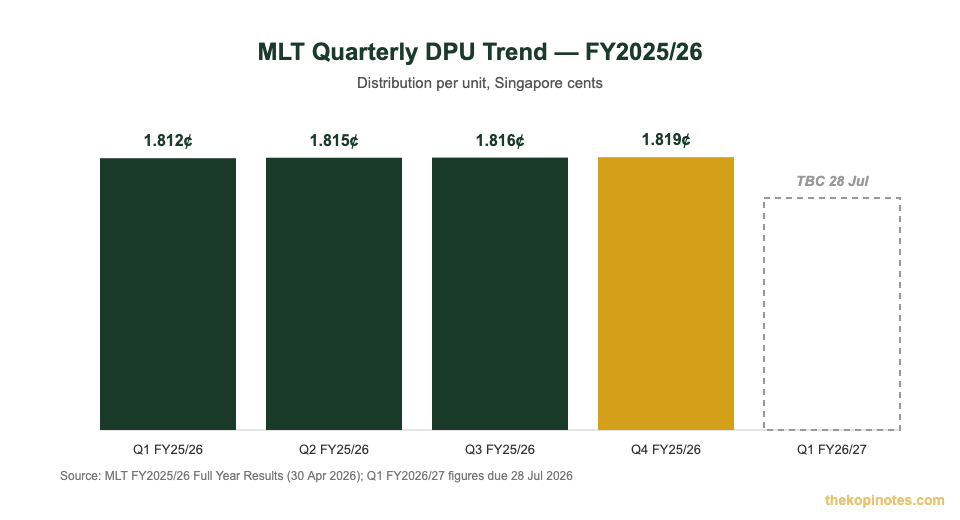
Distribution Per Unit (DPU) — basically how much cash each MLT unit pays you per quarter — has crept up every quarter through FY2025/26. It’s not exciting growth. But “boring and rising” beats “exciting and falling” for a REIT you’re holding for income.
| Quarter | DPU (cents) | QoQ Change |
|---|---|---|
| Q1 FY2025/26 | 1.812 | — |
| Q2 FY2025/26 | 1.815 | +0.2% |
| Q3 FY2025/26 | 1.816 | +0.1% |
| Q4 FY2025/26 | 1.819 | +0.2% |
| Q1 FY2026/27 | Due 28 Jul 2026 | — |
Source: MLT quarterly business updates, FY2025/26.
Add up the four FY2025/26 quarters and you get a full-year DPU of roughly 7.262 cents. Against a ~S$1.21 share price, that works out to a trailing yield of about 6.0%. If the 28 July print continues the trend and lands around 1.820-1.825 cents, the yield story stays intact. A DPU that drops below 1.80 cents, on the other hand, would be the first quarter-on-quarter decline in over a year — worth watching for.
Three Things to Watch in the Q1 Update
Beyond the headline DPU number, three things in the 28 July release will tell you more about where MLT is heading than the distribution figure alone.
1. China Warehouse Vacancy
MLT’s China portfolio has been the weak link. Vacancy there has climbed to around 21.5%, a historical high for the portfolio, according to sell-side coverage. That’s dragging on rents in a market that used to be a growth engine for the trust. If China vacancy improves even slightly in the Q1 update, that would ease one of the biggest overhangs on the stock. If it worsens, expect analysts to trim numbers further.
2. Interest Rates and Refinancing
The Fed held its benchmark rate at 3.50%-3.75% at its 29 April 2026 meeting — an unusually split 8-4 vote, with several officials pushing back against further cuts. MLT discloses that every 25 basis point move in rates on its variable-rate borrowings shifts DPU by about 0.10 cents a year (roughly 0.5%). With 17% of MLT’s debt maturing by the end of FY2028, where the Fed goes next matters more to unitholders than it might seem.
3. Redevelopment and Acquisition Pace
MLT redeployed capital into a Grade A warehouse in Mumbai in March 2026, part of its ongoing “rejuvenation” strategy — recycling older, lower-yielding assets into newer logistics properties with better rental growth potential. Watch the Q1 update for any signal on further acquisitions or divestments, especially in India and Australia, where MLT has been most active in upgrading its portfolio.
Gearing and Interest Rate Sensitivity
At 40.6%, MLT’s gearing ratio — how much of its assets are funded by debt — sits comfortably under MAS’s 50% regulatory ceiling for S-REITs, but it’s still on the higher side among large-cap S-REITs. That’s why analysts rated this metric “Unfavourable” even though it barely moved quarter-on-quarter (40.6% vs 40.7% prior). It’s not a red flag by itself, but it does mean MLT has less headroom than lower-geared peers to take on debt for new acquisitions without diluting unitholders through a rights issue or placement.
| Rate Change | Impact on DPU (cents/year) | Impact on DPU (%) |
|---|---|---|
| +25 bps | -0.010 | -0.5% |
| +50 bps | -0.020 | -1.1% |
Source: MLT FY2025/26 Full Year Results, 30 April 2026 — management’s own disclosed sensitivity on variable-rate borrowings.
In practice, this means MLT is more of a “rates hold steady, REIT holds steady” story than a “rate cuts will supercharge the yield” story right now. If you’re holding MLT for income, the 3.6-year average debt maturity profile is the more reassuring number here — it means MLT isn’t forced to refinance a big chunk of debt at once into a potentially higher-rate environment.
Where Analysts Have Set Their Price Targets
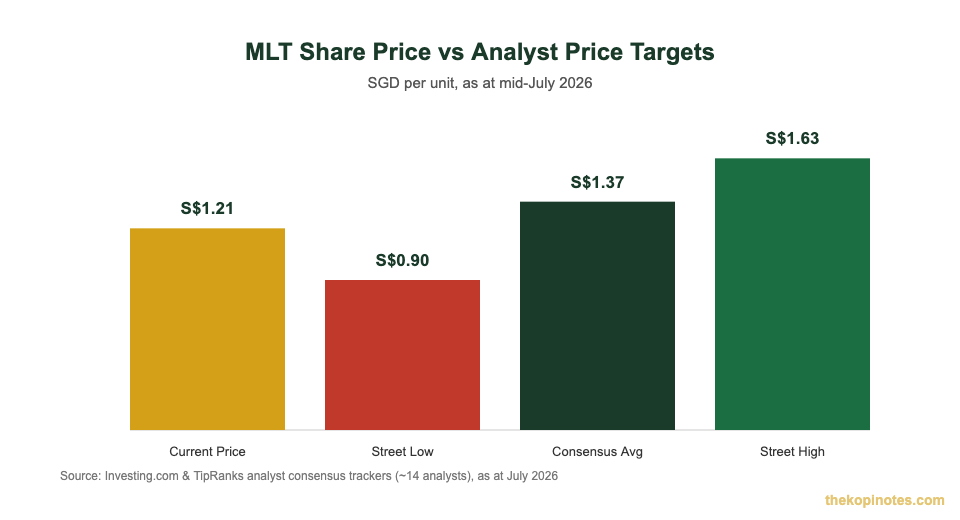
Sell-side price targets on MLT cluster in a wide S$0.90-S$1.63 range across roughly a dozen analysts tracked by Investing.com and TipRanks, with a consensus average sitting around S$1.35-S$1.40 as at July 2026. Against a ~S$1.21 share price, that implies meaningful upside on paper — but the “Hold” ratings attached to many of those targets are the more honest signal.
| Benchmark | Price (SGD) | vs Current Price |
|---|---|---|
| Current Share Price | 1.21 | — |
| Street Low Target | 0.90 | -25.6% |
| Consensus Average | ~1.37 | +13.2% |
| Street High Target | 1.63 | +34.7% |
Source: Investing.com & TipRanks analyst consensus trackers, as at July 2026. Individual targets vary significantly by house and update date.
Analysts flagging caution point to the same China vacancy issue discussed above, plus lingering concerns about a US-China trade conflict resurfacing and pressuring demand for MLT’s China warehouses further. The offsetting positive: rental reversions in Singapore and Australia have stayed positive, which is partly why the DPU has kept inching up despite the China drag.
For a deeper dive into MLT’s full valuation case, see our Mapletree Logistics Trust price target analysis and the complete MLT investor guide for portfolio background and historical context.
Buy, Hold, or Wait for the Results?
Here’s how to think about it, not what to do with your own money (that decision is yours).
The case for holding through results: DPU has risen for four straight quarters, occupancy is at a multi-quarter high of 96.9%, gearing is stable, and the ~6.0% trailing yield is fully covered by distributable income. Nothing in the baseline data suggests a distribution cut is imminent.
The case for caution: Gearing at 40.6% limits room for yield-accretive acquisitions without new equity. China vacancy at 21.5% is a real drag that hasn’t been resolved. And the market already seems to be pricing in most of the “safe REIT” premium — the 0.97x price-to-book isn’t a screaming bargain.
If you already hold MLT for income, there’s little in this preview that should change your position ahead of 28 July. If you’re considering a new position, waiting for the actual Q1 print — specifically the China occupancy trend and any gearing change — gives you more information for the same decision.
Frequently Asked Questions
When will Mapletree Logistics Trust release its Q1 FY2026/27 results?
Mapletree Logistics Trust Management confirmed on 14 July 2026 that Q1 FY2026/27 results, covering the quarter ended 30 June 2026, will be released after trading hours on 28 July 2026. No financial figures have been disclosed ahead of that date.
What was MLT's DPU in the most recent quarter?
MLT’s most recent reported DPU was 1.819 Singapore cents for Q4 FY2025/26 (quarter ended 31 March 2026), up slightly from 1.816 cents the prior quarter. Full-year FY2025/26 DPU totalled roughly 7.262 cents.
Is Mapletree Logistics Trust's gearing ratio too high?
At 40.6%, MLT’s gearing is below MAS’s 50% regulatory ceiling for S-REITs, so it’s not a breach risk. But it’s on the higher side versus some large-cap S-REIT peers, which limits how much new debt MLT can take on for acquisitions without issuing new units.
Why are analysts cautious on MLT despite the dividend yield?
The main concern is China, where warehouse vacancy has climbed to around 21.5% — a historical high for MLT’s portfolio — pressuring rents in that market. Some analysts also flag the risk of renewed US-China trade tensions weighing further on demand. This is why several houses keep “Hold” ratings even when their price targets sit above the current share price.
What is MLT's dividend yield right now?
Based on trailing FY2025/26 DPU of about 7.262 cents and a share price of roughly S$1.21, MLT’s trailing dividend yield works out to around 6.0%. This will move once the Q1 FY2026/27 DPU is confirmed on 28 July 2026.
Should I buy Mapletree Logistics Trust before the Q1 results?
There’s no way to know in advance whether the results will beat or miss expectations. If you’re considering MLT for its income profile, the baseline going into 28 July is stable — rising DPU, high occupancy, manageable gearing — but China vacancy and gearing headroom are worth watching in the actual release before making a decision. This isn’t financial advice; do your own research or speak to a licensed advisor.
Building a Passive Income Portfolio Around S-REITs?
Track MLT alongside other S-REITs through a low-cost brokerage or robo-advisor — open an account and set up your CPF/SRS-compatible strategy.
This article was researched with the help of AI. While we strive to keep all information accurate and up to date, there may be errors. If you notice any discrepancies, please contact us.