Mapletree Logistics Trust (MLT): Complete Guide for Singapore Investors 2026
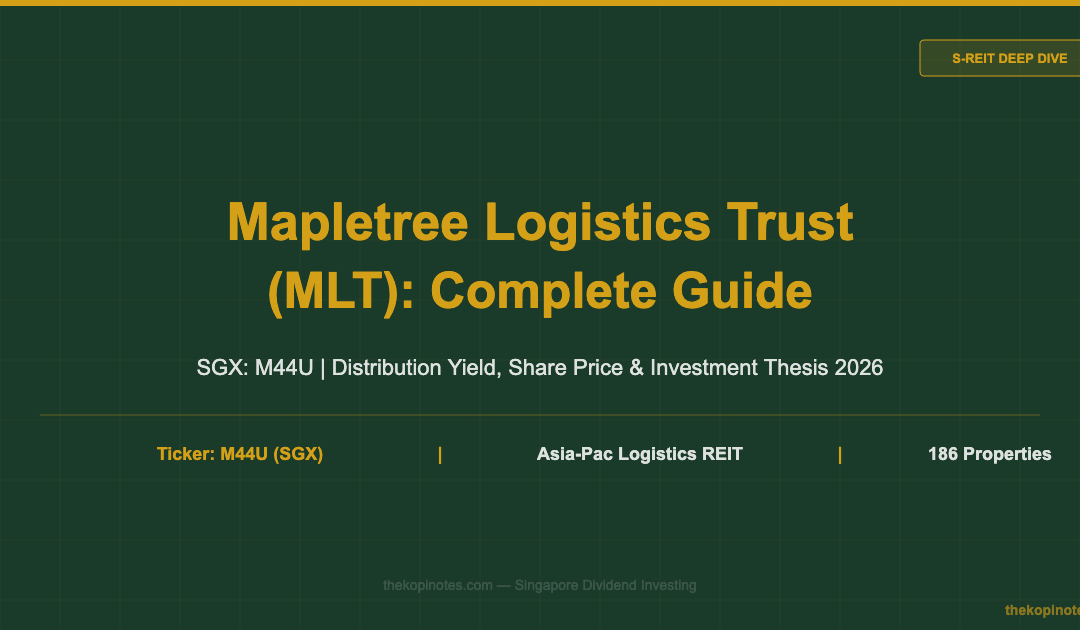
SGX: M44U | Asia-Pacific Logistics REIT | Updated July 2026
Mapletree Logistics Trust (MLT) is Singapore’s first and largest Asia-Pacific logistics REIT, listed on SGX under ticker M44U. Sponsored by Mapletree Investments, it holds 186 properties across 9 markets — including Singapore, Japan, China, Australia, South Korea, Malaysia, Vietnam, Hong Kong, and India. MLT pays quarterly distributions, with an annual DPU of 7.612 Singapore cents in FY2025, translating to a yield of approximately 6–7% at current prices.
Not financial advice. All figures are for educational reference only. Data as at July 2026 unless noted.
- MLT (SGX: M44U) is Asia-Pac’s largest logistics REIT with 186 properties across 9 countries
- FY2025 DPU was 7.612 cents — yield of ~6.5% at S$1.17 price — quarterly distributions
- Key risks: China exposure (~26% of AUM), rising interest rates, and ongoing DPU compression since FY2023 peak
What Is Mapletree Logistics Trust?
Mapletree Logistics Trust, or MLT, was listed on the Singapore Exchange (SGX) in July 2005. It was Asia’s first logistics-focused REIT and remains the largest in the region by assets under management (AUM).
MLT is managed by Mapletree Logistics Trust Management Ltd., a wholly-owned subsidiary of Mapletree Investments Pte Ltd — a major real estate company headquartered in Singapore and owned by Temasek Holdings. That Temasek-linked sponsorship gives MLT strong institutional backing and a healthy pipeline of potential asset acquisitions.
As a REIT, MLT must distribute at least 90% of its taxable income to unitholders. This makes it a popular choice for Singapore investors seeking passive income — especially those who want exposure to Asia-Pacific logistics real estate without directly buying warehouses.
The trust’s assets are predominantly logistics warehouses, distribution centres, and cold storage facilities. These are essential infrastructure for e-commerce, third-party logistics (3PL) companies, and consumer goods firms — all growing sectors across Asia.
MLT’s Portfolio: 9 Markets, 186 Properties
MLT’s geographic diversification is one of its biggest selling points. Unlike some S-REITs that are concentrated in Singapore, MLT spreads its risk across nine Asia-Pacific countries.
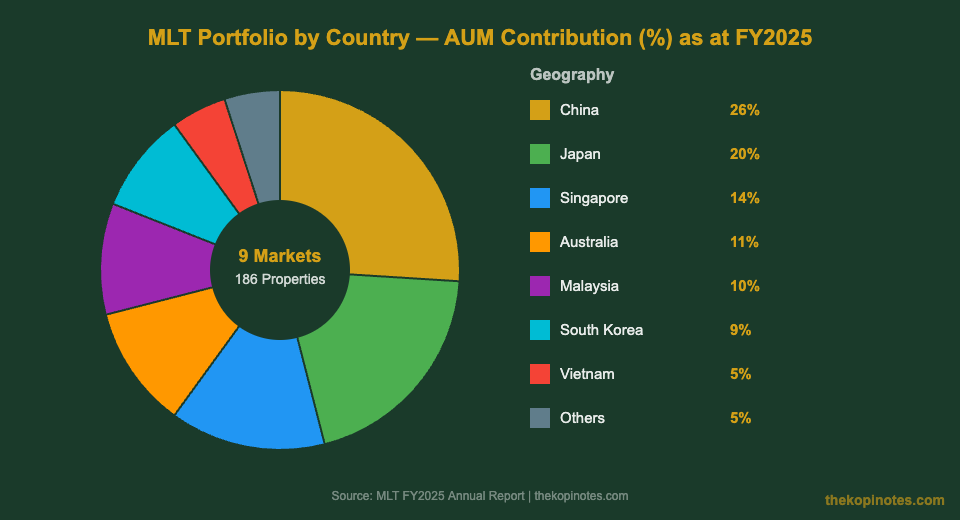
Source: MLT FY2025 Annual Report. Percentages are approximate AUM contribution.
| Country | No. of Properties | AUM Share (~%) | Key Assets |
|---|---|---|---|
| China | ~50 | 26% | Distribution centres, cold storage |
| Japan | ~45 | 20% | Modern logistics facilities |
| Singapore | ~18 | 14% | Mapletree Logistics Hub, Toh Tuck Link |
| Australia | ~25 | 11% | Interstate logistics parks |
| Malaysia | ~18 | 10% | Klang Valley warehouses |
| South Korea | ~12 | 9% | Seoul metro logistics |
| Vietnam + Others | ~18 | 10% | Emerging market growth plays |
Source: MLT FY2025 Annual Report. Figures are approximate.
The portfolio occupancy rate sits consistently above 95%, reflecting strong demand for logistics space across Asia. Weighted average lease expiry (WALE) is approximately 3.1 years, giving MLT a stable near-term income profile with regular renewal opportunities to reset rents upward.
MLT Distribution Per Unit (DPU) History
DPU — Distribution Per Unit — is the key number for income investors. It tells you how much cash MLT pays per unit you hold, typically every quarter. Here’s how MLT’s annual DPU has trended:
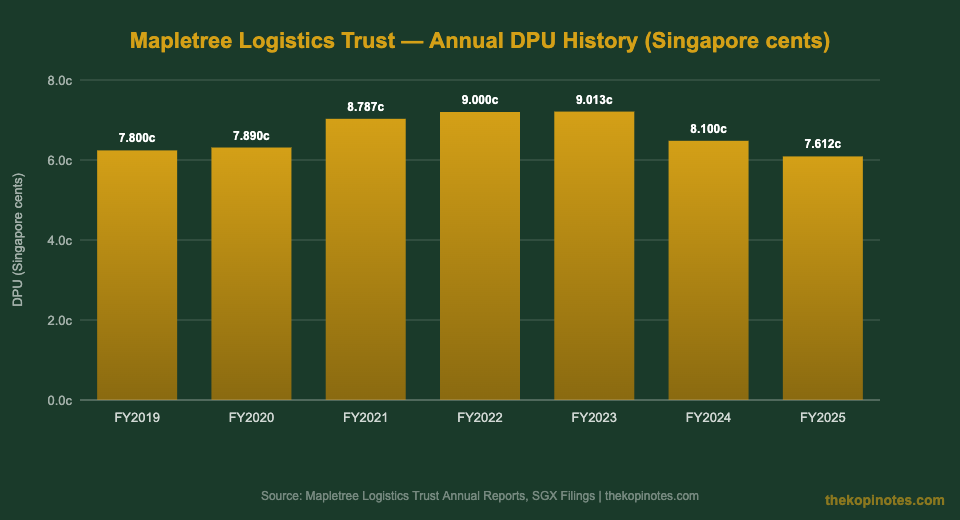
Source: Mapletree Logistics Trust Annual Reports, SGX Filings. FY ends 31 March.
| Financial Year | Annual DPU (cents) | YoY Change | Yield at S$1.17* |
|---|---|---|---|
| FY2019 | 7.800c | — | 6.7% |
| FY2020 | 7.890c | +1.2% | 6.7% |
| FY2021 | 8.787c | +11.4% | 7.5% |
| FY2022 | 9.000c | +2.4% | 7.7% |
| FY2023 | 9.013c ← Peak | +0.1% | 7.7% |
| FY2024 | 8.100c | -10.1% | 6.9% |
| FY2025 | 7.612c | -6.0% | 6.5% |
*Illustrative yield based on S$1.17 per unit price as reference point. Actual yield depends on your entry price. Source: MLT Annual Reports.
DPU grew steadily from FY2019 through FY2023, driven by acquisitions and strong logistics demand during the e-commerce boom. Since FY2024, DPU has compressed — primarily due to higher interest costs, China property market headwinds affecting tenant demand, and dilution from a rights issue completed in FY2023.
That said, MLT still pays distributions quarterly — in February, May, August, and November each year. For income investors, this gives you a regular cash flow rather than waiting for an annual payout.
Key Financial Metrics
Before investing in any REIT, you want to look beyond just the yield. Here are the numbers that matter most for MLT:
| Financial Metric | FY2025 Value | Why It Matters |
|---|---|---|
| Gross Revenue | ~S$750 million | Total rental income collected |
| Net Property Income (NPI) | ~S$600 million | Revenue after property expenses — the “profit” from running assets |
| Distributable Income | ~S$340 million | Cash available to pay unitholders after finance costs |
| Aggregate Leverage | ~39% | Debt as % of total assets — MAS cap is 50% |
| Interest Coverage Ratio | ~3.0x | NPI covers interest expense 3 times — moderate safety buffer |
| Portfolio Occupancy | 95.7% | High occupancy = stable rental income |
| WALE | ~3.1 years | Weighted Average Lease Expiry — longer = more income stability |
| % Fixed-Rate Debt | ~73% | Shields DPU from immediate rate rises on most of the debt book |
Source: MLT FY2025 Annual Report and SGX announcements. Figures are approximate.
The interest coverage ratio of ~3.0x is something to watch. It’s above MAS’s minimum threshold, but lower than the 4x–5x seen in peak years. If interest rates stay elevated or revenue dips, this buffer could thin further.
On the positive side, 73% fixed-rate debt means most of MLT’s borrowing costs are locked in for now. Rate risk is real but partially hedged.
Investment Case: Why Consider MLT?
1. Structural Tailwinds in Asia-Pacific Logistics
E-commerce penetration in Asia is still rising. Countries like Vietnam, India, and Indonesia are building out their logistics infrastructure from scratch. MLT is positioned to benefit as the demand for modern, efficient warehouses grows across the region.
Japan, which is MLT’s second-largest market, has seen rental reversions turn positive as modern logistics facilities remain undersupplied relative to demand from 3PL operators and e-commerce players.
2. Temasek-Linked Sponsor with a Deep Asset Pipeline
Mapletree Investments has a massive global portfolio. MLT has a right of first refusal (ROFR) over Mapletree’s logistics assets — meaning when the sponsor wants to sell a logistics property, MLT gets first dibs. This gives the REIT a built-in acquisition pipeline without needing to compete in open auctions.
This sponsor structure is common among top S-REITs and is one reason why CapitaLand-sponsored and Mapletree-sponsored REITs tend to have more consistent DPU growth compared to smaller, independently managed REITs.
3. Quarterly Distributions for Steady Income
MLT pays distributions every quarter. If you hold 50,000 MLT units at S$1.17 (a S$58,500 investment), you’d receive approximately S$950 in distributions every quarter — or about S$3,800 per year — based on FY2025 DPU. Not life-changing, but a meaningful passive income stream on top of your CPF and SSB holdings.
You can also reinvest your distributions using a passive income Singapore strategy to compound your unit count over time.
4. Diversification Within a Single Ticker
Buying MLT gives you exposure to 186 properties across 9 countries — China, Japan, Singapore, Australia, Malaysia, South Korea, Vietnam, Hong Kong, and India. That’s remarkable diversification for a single SGX-listed unit at S$1.17.
Compare this with buying direct property in Singapore — you’d need millions of dollars, significant leverage, and zero diversification across countries.
Risks to Watch
China Exposure (~26% of AUM)
China is MLT’s largest single market. While this provided strong growth during 2020–2022, the Chinese property market downturn and weaker consumer demand have weighed on leasing activity. Rental reversions in some China properties turned negative in FY2024 and FY2025.
China will eventually recover — the structural logistics demand story remains intact — but the timing is uncertain. This exposure is the single biggest risk factor to monitor.
Interest Rate Sensitivity
REITs are sensitive to interest rates because they carry significant debt. When rates rise, finance costs go up, and distributable income falls — which is exactly what happened to MLT from FY2023 to FY2025.
The good news: the US Fed began its rate-cutting cycle in late 2024. If rates continue to fall through 2026, MLT’s refinancing costs should ease, potentially supporting a DPU recovery. However, these cuts are gradual and not guaranteed.
Currency Risk
MLT collects rents in Chinese RMB, Japanese Yen, Australian Dollars, South Korean Won, and other currencies. When these currencies weaken against the Singapore Dollar, MLT’s translated income falls even if the local operations are doing fine.
MLT hedges a portion of its foreign income using derivatives, but not all of it. The Yen in particular has been weak, which has partially offset the strong operational performance in Japan.
Gearing and Refinancing Risk
At ~39% gearing, MLT has headroom before hitting MAS’s 50% cap. However, if property values fall (reducing the denominator), gearing could rise even without new debt. If gearing approaches 45%, MLT would have limited capacity to make debt-funded acquisitions without a rights issue.
Check out the best REITs Singapore 2026 guide for a comparison of gearing levels across major S-REITs.
How to Buy MLT in Singapore
Buying MLT is straightforward if you have a brokerage account that gives you access to SGX. Here’s the step-by-step:
- Open a brokerage account — You need an SGX-connected broker. Popular choices among Singapore investors include Syfe Trade, moomoo, IBKR (Interactive Brokers), FSMOne, or CDP-linked platforms like DBS Vickers or Phillip Securities.
- Fund your account — Transfer SGD from your bank to your brokerage account.
- Search for M44U — MLT’s SGX ticker is M44U. Enter this in your broker’s search bar.
- Place a buy order — Standard lot size on SGX is 100 units. At S$1.17 per unit, the minimum purchase is S$117 plus brokerage fees.
- Receive distributions — Once a holder of record on the ex-dividend date, distributions are credited to your CDP account or brokerage cash balance.
Can You Buy MLT with CPF or SRS?
Yes. MLT is CPF Investment Scheme (CPFIS) approved and SRS (Supplementary Retirement Scheme) eligible. You can purchase it using funds from your CPF Ordinary Account (OA) or SRS account through most major brokers.
Using SRS to invest in MLT is a popular tax-efficiency strategy — your SRS contributions reduce taxable income, and distributions within SRS are not immediately taxed. For more on this, see our CPF investment strategy guide.
Broker Comparison: Fees for Buying MLT
| Broker | Min. Commission | Commission Rate | Best For |
|---|---|---|---|
| IBKR (Interactive Brokers) | S$2.50 | 0.05% of trade value | Active traders, low costs |
| moomoo | S$0.99 | 0.03% of trade value | Low-cost, beginner-friendly |
| FSMOne | S$10 | 0.08% of trade value | SRS investing, wide product range |
| Syfe Trade | S$1.98 | 0.06% of trade value | Simple interface, fractional shares |
Source: Broker websites as at July 2026. Fees subject to change. Add exchange fees and GST to all trades.
If you’re just starting out, get your Syfe referral code and sign-up bonus or use our FSMOne referral code — both platforms are SRS-eligible and have zero platform fees for equity trading.
For the most competitive trading commissions on SGX stocks, IBKR remains the benchmark. Use our Endowus referral code if you prefer a managed approach to REIT exposure via their fund platform.
Frequently Asked Questions About Mapletree Logistics Trust
Is Mapletree Logistics Trust a good investment in 2026?
What is Mapletree Logistics Trust's DPU for FY2025?
How often does MLT pay distributions?
Can I buy Mapletree Logistics Trust with CPF?
What is the minimum lot size to buy MLT on SGX?
What is MLT's gearing ratio and is it safe?
How does MLT compare to CapitaLand Ascendas REIT?
The Bottom Line on Mapletree Logistics Trust
MLT is Asia-Pacific’s premier logistics REIT — well-managed, Temasek-backed, and diversified across nine markets. At a ~6.5% distribution yield and 0.85x NAV, there is a valuation case to be made for patient income investors.
The main watchpoints are: China leasing recovery, interest rate trajectory, and whether DPU can stabilise above 7.5 cents in FY2026 and beyond. If you believe Asia-Pacific logistics demand is a decade-long structural story — which the data suggests it is — then MLT deserves a place in your consideration set.
Want to track MLT alongside other quality S-REITs? Check our best S-REITs in Singapore 2026 comparison and use our Singapore retirement calculator to model how a S$50,000 MLT position fits into your long-term income plan.
Disclaimer: This article is for educational purposes only and does not constitute financial advice. Past distributions are not indicative of future performance. Always conduct your own research or consult a licensed financial adviser before making investment decisions.
This article was researched with the help of AI. While we strive to keep all information accurate and up to date, there may be errors. If you notice any discrepancies, please contact us.