Interactive Brokers (IBKR) and Tiger Brokers are both MAS-regulated brokerages popular with Singapore investors, but they serve very different audiences. IBKR offers the lowest trading costs in Singapore — from US$0.35 per US trade with industry-best FX spreads of 0.002% — making it the clear winner for cost-conscious investors. Tiger Brokers counters with a simpler interface, lower SGX minimums, and stronger Asian market access for newer investors.
This is an editorial comparison. Not financial advice. All figures are for educational reference only. Data as at July 2026 unless noted.
- Choose IBKR if you want the absolute lowest trading costs, access to 150+ global markets, and the tightest FX conversion rates in Singapore
- Choose Tiger Brokers if you’re a newer investor who wants a simpler app, lower SGX trade minimums (S$1.99 vs S$2.50), and don’t mind paying slightly more overall
- For a S$50,000 portfolio with typical trading activity, IBKR saves approximately S$57/year — mostly from its superior FX spread
Quick Verdict
This is probably the most common brokerage question on r/singaporefi, and the answer depends on how much you trade and how much you care about saving a few dollars per trade.
IBKR is objectively cheaper for almost every trade type. Its tiered pricing starts at US$0.35 per US stock trade versus Tiger’s minimum of US$1.99. Its FX spread is 0.002% versus Tiger’s estimated 0.05–0.10%. Over a year of regular trading, these differences add up to meaningful savings.
Tiger Brokers is easier to use. The app is cleaner, the onboarding is faster, and the interface doesn’t overwhelm you with professional-grade complexity. If you’re making your first few stock purchases and want something that feels like a modern fintech app rather than a Bloomberg terminal, Tiger is more approachable.
Trading Fees Compared
Here’s the full fee breakdown. IBKR offers two pricing plans — Fixed and Tiered. Most Singapore retail investors benefit from the Tiered plan, which we use for this comparison.
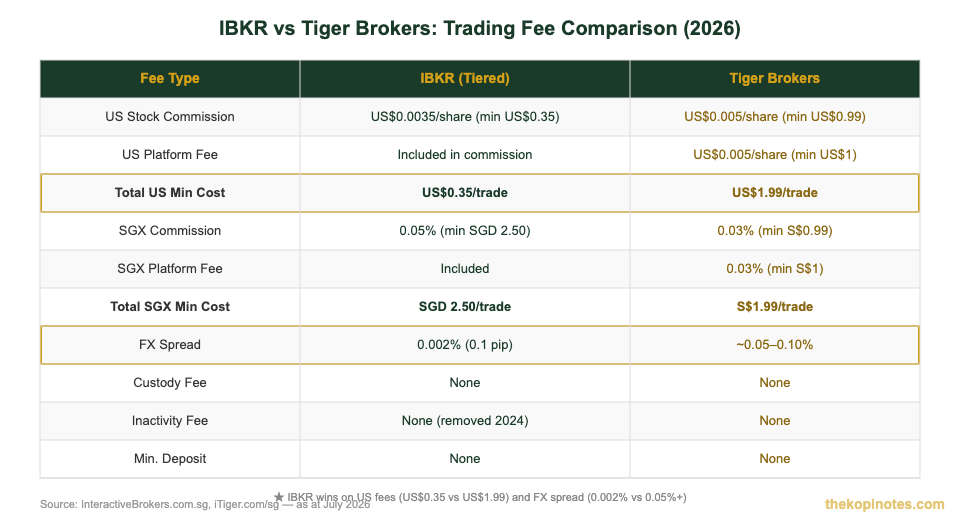
US stocks: IBKR’s tiered pricing charges US$0.0035 per share with a minimum of US$0.35 per trade. Tiger charges US$0.005/share commission plus US$0.005/share platform fee, with a combined minimum of US$1.99. For a typical 50-share order, IBKR costs US$0.35 while Tiger costs US$1.99 — IBKR is 82% cheaper.
SGX stocks: IBKR charges 0.05% with a minimum of SGD 2.50 per trade. Tiger charges 0.03% commission plus 0.03% platform fee (0.06% total) with a minimum of S$1.99. For small SGX trades under S$5,000, Tiger is actually cheaper. For larger trades above S$8,300, IBKR becomes cheaper thanks to its lower percentage rate.
Both charge zero custody fees, zero inactivity fees (IBKR removed theirs in 2024), and no minimum deposit. Neither charges for dividend collection.
The FX Spread Difference (This Is Where IBKR Wins)
Most comparison articles focus on commission rates. But for Singapore investors converting SGD to USD to buy US stocks, the FX spread is often a bigger cost than the commission itself.
IBKR offers institutional-grade FX conversion at 0.002% (0.1 pip). This is essentially the interbank rate. Converting SGD 10,000 to USD costs you roughly SGD 0.20 in spread.
Tiger Brokers charges approximately 0.05% to 0.10% on FX conversion. Converting the same SGD 10,000 costs you SGD 5.00 to SGD 10.00 in spread — 25x to 50x more than IBKR.
This is the single biggest cost difference between the two brokers, and it’s rarely discussed. If you’re converting SGD 35,000 to USD per year (roughly what a S$50,000 portfolio needs for US stock purchases), you save approximately S$24 per year on FX alone by using IBKR.
| Amount Converted | IBKR FX Cost (0.002%) | Tiger FX Cost (~0.07%) | You Save with IBKR |
|---|---|---|---|
| SGD 5,000 | SGD 0.10 | SGD 3.50 | SGD 3.40 |
| SGD 10,000 | SGD 0.20 | SGD 7.00 | SGD 6.80 |
| SGD 35,000 | SGD 0.70 | SGD 24.50 | SGD 23.80 |
| SGD 100,000 | SGD 2.00 | SGD 70.00 | SGD 68.00 |
Source: IBKR published FX spread (0.1 pip = ~0.002%), Tiger estimated from user reports, July 2026
For investors buying LSE-listed ETFs like CSPX or VWRA (which trade in USD on the London Stock Exchange), IBKR’s FX advantage is even more impactful because you’re converting currency on every purchase.
Platform & Usability
IBKR: Powerful but Complex
IBKR’s Trader Workstation (TWS) is a professional-grade platform with advanced charting, options chains, and algorithmic order types. It’s powerful but has a steep learning curve. The mobile app (IBKR Mobile) is more user-friendly but still more complex than Tiger’s app. IBKR also offers a web-based Client Portal that’s simpler for basic tasks.
For new investors, IBKR can feel overwhelming. The number of order types, account settings, and market data subscriptions can be confusing. However, once you learn the platform, it’s difficult to go back to anything simpler.
Tiger Brokers: Clean and Intuitive
Tiger’s mobile app is designed for retail investors who want a clean, modern experience. It has social features, educational content, and a straightforward buy/sell interface. You can place a trade in 3 taps. The desktop platform is also well-designed.
Tiger also supports fractional shares with a capped platform fee of 1% (max US$1), making it accessible for investors who want to buy expensive US stocks like Apple or Nvidia in small amounts.
Verdict on Platform
If you’re a beginner, Tiger’s simplicity is genuinely valuable — fewer mistakes, less confusion. If you’re intermediate or advanced, IBKR’s depth is worth the learning curve. Most investors who start with Tiger eventually graduate to IBKR as their portfolio grows.
Markets & Instruments
| Market / Product | IBKR | Tiger Brokers |
|---|---|---|
| Number of Markets | 150+ exchanges in 34 countries | ~10 markets |
| US (NYSE/NASDAQ) | ✅ | ✅ |
| Singapore (SGX) | ✅ | ✅ |
| Hong Kong (HKEX) | ✅ | ✅ |
| London (LSE) | ✅ | ❌ |
| Australia (ASX) | ✅ | ✅ |
| Japan, Europe, etc. | ✅ (34 countries) | Limited |
| US Options | ✅ (advanced) | ✅ |
| Futures | ✅ (global) | ✅ (limited) |
| Bonds | ✅ | ❌ |
| Forex (spot) | ✅ | ❌ |
| Fractional Shares | ✅ | ✅ |
| Margin Trading | ✅ (lowest rates) | ✅ |
Source: InteractiveBrokers.com.sg, iTiger.com/sg — as at July 2026
IBKR’s market access is unmatched. If you want to buy LSE-listed ETFs (like CSPX or VWRA), European stocks, or trade forex, IBKR is your only option between the two. Tiger covers the major Asian and US markets, which is sufficient for most Singapore retail investors.
For investors following a passive income strategy focused on Singapore REITs and US ETFs, both platforms have what you need. IBKR becomes essential only when you want global diversification beyond Asia and the US.
Regulation & Safety
Both brokers are regulated by MAS with active CMS licences. However, there are significant differences in their regulatory profiles.
IBKR (Interactive Brokers Singapore Pte. Ltd.) is a subsidiary of Interactive Brokers Group, listed on NASDAQ (ticker: IBKR). The group has been operating since 1978 and is one of the largest electronic brokerages globally. Client assets are protected by segregated accounts, and the US parent entity offers SIPC protection on US-based accounts (up to US$500,000).
Tiger Brokers (Up Fintech Holding Ltd.) is listed on NASDAQ (ticker: TIGR). The Singapore entity, Tiger Brokers (Singapore) Pte Ltd, holds a CMS licence. Tiger has been MAS-regulated since 2020. Assets are held in segregated custodian accounts.
Both are publicly listed, which means their financials are auditable. IBKR’s longer operating history (46 years vs Tiger’s ~7 years) gives it a stronger track record. For context, IBKR survived the 2008 financial crisis — a meaningful stress test that Tiger hasn’t faced. You can read more in our IBKR Singapore review.
Real Cost Scenario: S$50,000 Portfolio
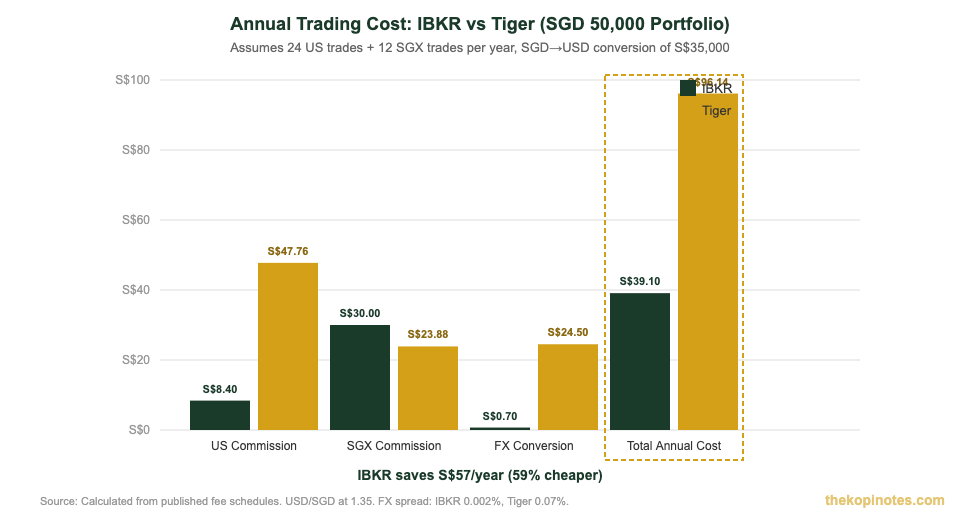
Let’s model a realistic year of investing with a S$50,000 portfolio. You DCA monthly into 2 US ETFs and buy SGX REITs quarterly.
| Cost Component | IBKR (Tiered) | Tiger Brokers |
|---|---|---|
| US trades (24 trades/year) | US$8.40 (S$11.34) | US$47.76 (S$64.48) |
| SGX trades (12 trades/year) | S$30.00 | S$23.88 |
| FX conversion (S$35,000) | S$0.70 | S$24.50 |
| Total annual cost | S$42.04 | S$112.86 |
| Annual savings with IBKR | S$70.82 (63% less) | |
Source: Calculated from published fee schedules, July 2026. USD/SGD at 1.35. IBKR FX: 0.002%, Tiger FX: 0.07%. US trades: ~50 shares avg.
The FX spread alone accounts for S$23.80 of that difference. For investors who convert larger amounts — say S$100,000 per year — IBKR saves S$68 on FX conversion alone.
However, Tiger wins on SGX trades under S$5,000 due to its lower minimum (S$1.99 vs S$2.50). If you primarily buy small lots of Singapore REITs, Tiger’s SGX pricing is competitive.
Who Should Use Which?
Use IBKR if you: invest more than S$20,000 in US stocks annually, want access to LSE-listed ETFs, care about FX conversion costs, need margin trading at the lowest rates, or plan to build a globally diversified portfolio. IBKR is the default recommendation on r/singaporefi for a reason — it’s simply the cheapest option for serious investors. Use our IBKR referral code for sign-up rewards.
Use Tiger Brokers if you: are just starting out and want a simpler app, primarily trade SGX stocks in small amounts, want social features and educational content, or find IBKR’s platform intimidating. Tiger is a solid starter broker, and there’s no shame in using a platform that doesn’t overwhelm you.
Many investors start with Tiger and migrate to IBKR once they’re comfortable with investing concepts. Both accounts are free to open, so there’s no harm in trying both.
TKN’s Take
For most Singapore investors with portfolios above S$10,000, IBKR is the better broker. The combination of rock-bottom US commissions (US$0.35 vs US$1.99), institutional FX rates (0.002% vs ~0.07%), and access to 150+ markets makes it hard to justify paying more elsewhere. IBKR’s learning curve is real, but most people master the basics within a week.
Tiger Brokers fills a genuine niche for newer investors, small SGX trades, and anyone who values app simplicity over cost optimisation. It’s not a bad broker — it’s just not the cheapest one.
If you’re buying UCITS ETFs on the London Stock Exchange (like VWRA or IWDA), IBKR is your only realistic option between the two, since Tiger doesn’t offer LSE access. For US stocks only, consider pairing IBKR with a retirement calculator to plan your long-term strategy.
Frequently Asked Questions
Is IBKR really cheaper than Tiger Brokers?
Does IBKR still charge inactivity fees?
Can I buy LSE ETFs like CSPX on Tiger Brokers?
Is Tiger Brokers safe to use in Singapore?
Which broker is better for buying Singapore REITs?
Should I use IBKR Tiered or Fixed pricing?
Can I transfer shares from Tiger to IBKR?
Does IBKR or Tiger support CPF/SRS investing?
This article was researched with the help of AI. While we strive to keep all information accurate and up to date, there may be errors. If you notice any discrepancies, please contact us.