
How to Invest in Singapore After a Divorce: Splitting CPF, SRS and Rebuilding Your Portfolio (2026)
A divorce splits more than the family home. Here’s how CPF, CPF investments and SRS actually get divided under Singapore law — and how to rebuild your retirement plan afterward.
In a Singapore divorce, the Family Court can order your CPF savings, CPF investments and CPF LIFE payouts to be split with your ex-spouse under the Women’s Charter — either through a transfer order (moved straight into their own CPF account) or a charging order (paid to them in cash once you’re eligible to withdraw). SRS accounts and brokerage holdings are divided separately, since CPF Board only handles CPF-related assets.
Not financial advice, and not legal advice. All figures are for educational reference only. Data verified as at 12 August 2026.
- CPF savings, CPF investments (CPFIS) and CPF LIFE payouts can be split by court order through a transfer order (into your ex-spouse’s own CPF account) or a charging order (a later cash payout).
- SRS accounts and joint brokerage holdings aren’t handled by CPF Board — they’re covered by the same court order, but settled directly between you, your bank or broker, and IRAS.
- Rebuilding afterward usually means restarting voluntary CPF/SRS top-ups and rebuilding a fresh, right-sized investment plan — not panic-selling what’s left.
Table of Contents
Contents — Click to expand
- Is CPF a Matrimonial Asset in a Singapore Divorce?
- Transfer Order vs Charging Order: How CPF Savings Get Divided
- Dividing CPF Investments (CPFIS) and CPF LIFE Payouts
- The Special Account Wrinkle If You’re Near 55
- What Happens to SRS Accounts and Joint Brokerage Holdings
- A Worked Example: Splitting $300,000 in CPF After 20 Years
- Rebuilding Your CPF, SRS and Investment Portfolio
- A Post-Divorce Financial Checklist
- Frequently Asked Questions
Is CPF a Matrimonial Asset in a Singapore Divorce?
Every other article in this series has been about growing your CPF, SRS and brokerage accounts. This one is about what happens when a marriage — and the joint financial plan that came with it — ends.
Under section 112 of the Women’s Charter, the Family Court has broad discretion to divide matrimonial assets between divorcing spouses in proportions it considers just and equitable. Matrimonial assets generally include anything acquired during the marriage, plus certain assets acquired before marriage if they were used by the family or substantially improved during it.
CPF Board’s own guidance confirms that CPF savings, property bought with CPF savings, CPF investments, and even CPF LIFE payouts can all be treated as matrimonial assets. It’s the Court — not CPF Board — that decides whether your ex-spouse is entitled to a share, based on factors like each person’s financial and non-financial contributions to the marriage (including homemaking and caregiving) and each person’s needs after the divorce.
Once the Court decides a share is due, CPF Board’s role is purely administrative: it executes whatever the court order specifies. That’s why getting the order’s wording right matters so much — CPF Board follows the order to the letter, and can’t improvise around gaps or ambiguity.
Transfer Order vs Charging Order: How CPF Savings Get Divided
If CPF savings are to be split, the court order has to specify exactly how. There are two mechanisms, and they behave very differently.
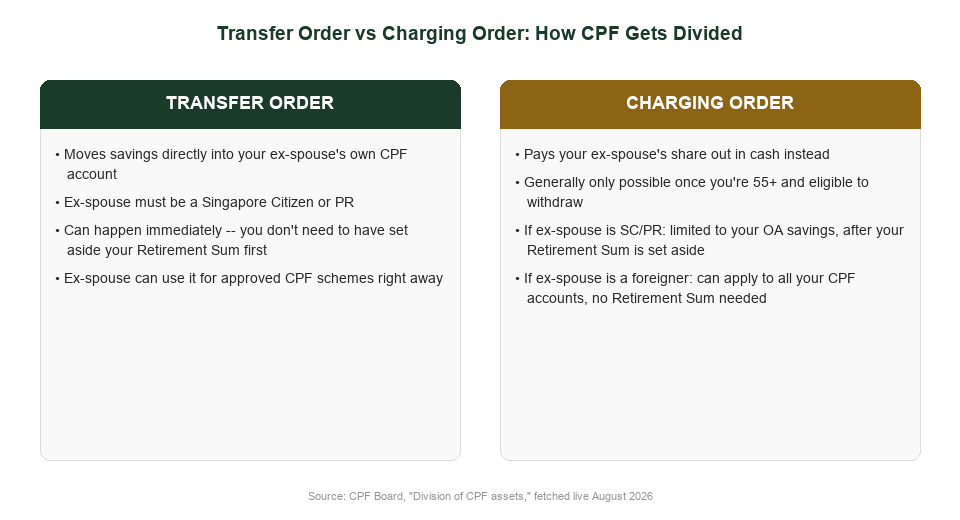
A transfer order moves your CPF savings directly into your ex-spouse’s own CPF account — Ordinary Account to Ordinary Account, MediSave to MediSave, and so on. This can happen immediately: you don’t need to have set aside your Full Retirement Sum first. Once transferred, your ex-spouse can use the money for approved CPF purposes like housing or CPFIS investing straight away, or withdraw it once they’re eligible.
A charging order works differently — it pays your ex-spouse’s share out in cash, but generally only once you turn 55 and become eligible to withdraw your own CPF savings. If your ex-spouse is a Singapore Citizen or PR, the charge can typically only be placed on your Ordinary Account, and only after your Full Retirement Sum has been set aside in your Retirement Account. If your ex-spouse is a foreigner, the charge can apply across all your CPF accounts, with no Retirement Sum requirement.
| Feature | Transfer Order | Charging Order |
|---|---|---|
| Form of payout | Into ex-spouse’s own CPF account | Cash, paid to ex-spouse |
| Ex-spouse’s citizenship | Must be SC or PR | Any (SC/PR or foreigner) |
| Timing | Can be immediate | Generally only once you’re 55+ and eligible to withdraw |
| Your Retirement Sum | Not required to be set aside first | Must be set aside first if ex-spouse is SC/PR |
Source: CPF Board, “Division of CPF assets,” fetched live August 2026
In practice, most couples who want a clean, immediate break prefer a transfer order where possible. A charging order tends to come up when the paying spouse is already 55 or older, or when a transfer order isn’t otherwise workable.
Dividing CPF Investments (CPFIS) and CPF LIFE Payouts
If you’ve invested part of your CPF Ordinary or Special Account savings through the CPF Investment Scheme (CPFIS), those holdings don’t sit outside the divorce settlement — they’re treated as CPF-related assets too.
The Court can order this split in one of two ways. It can order an outright ownership transfer of the investment from you to your ex-spouse. Or it can order you to sell the investment, with the proceeds first refunded to your CPFIS account, then to your Ordinary or Special Account, before CPF Board transfers the agreed amount to your ex-spouse’s CPF account (or pays it out in cash, depending on the order).
If you’ve already started drawing monthly payouts from your CPF LIFE plan, the Court has two more options here too: it can order a portion of your ongoing payouts redirected to your ex-spouse, or it can order CPF Board to refund your CPF LIFE premium back into your Retirement Account, which is then divided under the usual transfer or charging mechanics.
Here’s a detail that catches people off guard: divorce doesn’t automatically revoke your CPF nomination. If your ex-spouse is still listed as a beneficiary for your CPF savings after you pass away, they’ll remain entitled to that share until you actively submit a new nomination. The same applies to your Dependants’ Protection Scheme (DPS) term insurance nomination. Updating both is one of the first things worth doing once your divorce is finalised, not something to leave for later.
The Special Account Wrinkle If You’re Near 55
There’s a timing detail that specifically matters if either spouse is close to 55. Since 19 January 2025, CPF members’ Special Accounts are closed once they turn 55 — the savings are swept into the Retirement Account instead, as part of a broader CPF Board restructuring.
If a court order instructs CPF Board to transfer or pay out from your Special Account, but your Special Account has already closed because you’ve since turned 55, CPF Board won’t be able to carry out that specific instruction. In that scenario, CPF Board’s own guidance suggests either settling the matter privately between the parties, or applying back to the Court to vary the order so the transfer or payment comes from a different account instead.
The practical lesson: if you’re finalising a divorce court order anywhere close to your (or your spouse’s) 55th birthday, get the account-specific wording checked carefully, since a delay in execution could run straight into this account closure.
What Happens to SRS Accounts and Joint Brokerage Holdings
CPF Board’s division process only covers CPF-related assets. Your Supplementary Retirement Scheme (SRS) account and any brokerage or robo-advisor holdings sit outside that system entirely — but they aren’t excluded from the divorce settlement itself.
Like CPF, an SRS account can only ever be held by one individual — there’s no joint SRS account under IRAS rules, exactly the same way there’s no joint CPF account. That means an SRS balance built up during the marriage is still assessed as a matrimonial asset under the Women’s Charter’s broad definition, but there’s no CPF-Board-style mechanism to automatically transfer part of one person’s SRS account into the other’s. In practice, this typically gets handled either through a direct cash settlement between the parties, or by offsetting the SRS balance against other assets in the overall division — rather than a literal SRS-to-SRS transfer.
Brokerage and robo-advisor accounts follow more conventional rules. If you’re investing through a joint account — for example, the joint-alternate structures now offered by Interactive Brokers, Endowus or Syfe — the court order (or your own settlement) needs to specify how the holdings are split or which party takes over the account. Individual (non-joint) brokerage accounts funded during the marriage are still matrimonial assets in the eyes of the Court, even though the broker itself has no role in enforcing a divorce order the way CPF Board does.
If you and your ex-spouse held a joint investment account, our guide to investing as a couple covers how those joint-alternate structures work in the first place, which is useful context for understanding what you’re unwinding.
A Worked Example: Splitting $300,000 in CPF After 20 Years of Marriage
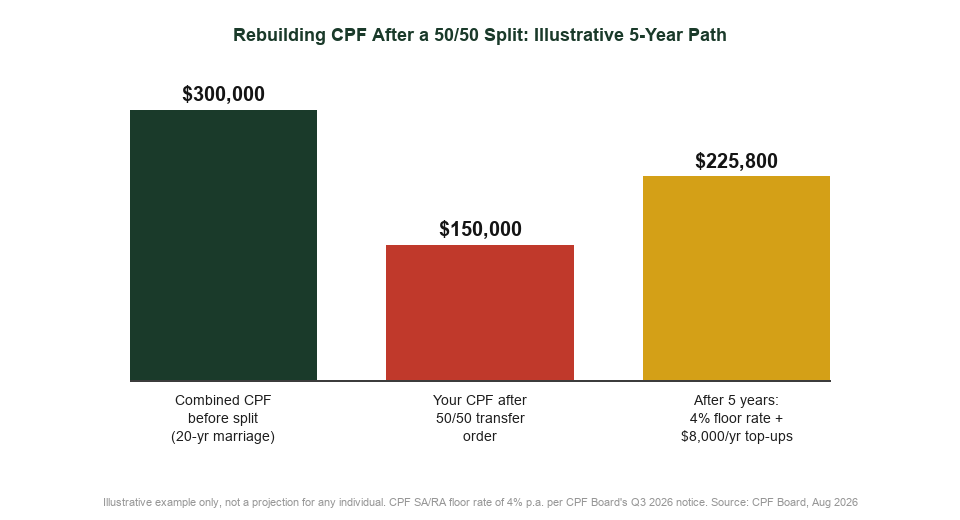
Take a couple who married 20 years ago and built up a combined $300,000 in CPF Ordinary and Special Account savings, largely from one spouse’s employment CPF contributions. The Court decides a 50/50 division is just and equitable, and the order specifies a transfer order.
CPF Board transfers $150,000 from the higher-balance spouse’s CPF accounts directly into the receiving spouse’s own OA and SA, in the corresponding proportions. Because it’s a transfer order, this can happen without the paying spouse needing to have set aside their Full Retirement Sum first — the receiving spouse now has $150,000 sitting in their own CPF accounts, immediately usable for approved schemes or continued growth.
From there, both spouses are essentially rebuilding independently. Assuming the receiving spouse’s $150,000 sits mostly in their Special Account earning the CPF SA/RA floor rate of 4% per year (per CPF Board’s official rate notice for 1 July-30 September 2026, unchanged and previously verified across multiple sessions), and they commit to an additional $8,000 per year in voluntary CPF top-ups — roughly $667 a month — the balance would illustratively grow to about $225,800 after five years, purely from compounding plus contributions.
| Stage | Illustrative Balance |
|---|---|
| Combined CPF before split (20-year marriage) | $300,000 |
| Your CPF after 50/50 transfer order | $150,000 |
| After 5 years: 4% floor rate + $8,000/yr top-ups | ~$225,800 |
Source: Author’s illustrative calculation applying CPF Board’s verified SA/RA interest rate floor, August 2026. Not a projection for any individual, and not a substitute for financial advice.
This is deliberately a simplified illustration — actual splits depend heavily on each couple’s specific court order, contribution history, and account composition. The broader point holds regardless of the exact numbers: a divorce resets your starting balance, but it doesn’t reset the interest rate or the power of continuing to contribute.
Rebuilding Your CPF, SRS and Investment Portfolio
Once the court order has been executed, the financial task shifts from division to rebuilding. A few moves make the biggest difference.
Restart voluntary CPF top-ups deliberately, not reflexively. If your Special Account or Retirement Account balance dropped significantly, the guaranteed 4% floor rate on SA/RA savings (unchanged for 1 July-30 September 2026, per CPF Board’s official notice) makes voluntary top-ups one of the most reliable ways to rebuild — but only top up what you can genuinely afford to lock away, since CPF withdrawal rules haven’t changed just because your balance did.
Rebuild your SRS contributions with the current caps in mind. The annual SRS caps remain $15,300 for Singapore Citizens and PRs, and $35,700 for foreigners (IRAS-confirmed, unchanged and previously verified across multiple sessions this year). If your SRS balance was affected by the settlement, resuming contributions — even partially — keeps the tax-relief benefit working for you going forward.
Reassess your risk profile before jumping back into markets. A divorce often means a materially different financial picture: possibly a smaller asset base, a different housing situation, and different monthly cash flow. Don’t simply resume your pre-divorce investment allocation on autopilot — our risk profile guide walks through how to reassess this properly.
Rebuild your account sequencing from scratch. With a new (likely smaller) pool of CPF, SRS and cash, it’s worth revisiting which account to fund first rather than assuming your old order-of-operations still applies.
If alimony, child maintenance or a lump-sum settlement is involved, treat it with the same care as any other windfall. Our windfall investing guide covers how to sequence a lump sum into CPF/SRS top-ups versus taxable brokerage investing, which applies just as well here.
Get a proper legal opinion for anything beyond a straightforward split. CPF-related divorce clauses are technical, and CPF Board strictly follows whatever the court order says — there’s little room to fix wording errors after the fact. Our broader CPF investment strategy guide is a useful next stop once the legal side is settled and you’re ready to plan forward again.
A Post-Divorce Financial Checklist
Beyond the CPF, SRS and investment mechanics above, a few administrative steps are easy to overlook in the middle of a divorce.
Update your CPF nomination. As covered above, this isn’t automatic — submit a new nomination if your ex-spouse was previously named.
Cancel recurring GIRO top-ups to your ex-spouse’s CPF account. Voluntary top-ups you’d set up during the marriage don’t stop automatically either; you’ll need to instruct your bank directly.
Update your Dependants’ Protection Scheme and other insurance nominations. The same “not automatically revoked” rule applies here as it does to CPF nominations.
Review your Home Protection Scheme cover if the matrimonial flat was sold or transferred, since your required coverage level likely changed.
Stop any standing MediSave authorisations you’d set up to help pay your ex-spouse’s insurance premiums or medical treatment costs — these need to be actively revoked.
Check each broker or robo-advisor’s process for splitting or closing a joint account before assuming the platform will handle it automatically once you tell them about the divorce.
Frequently Asked Questions
Is CPF automatically split 50/50 in a Singapore divorce?
No. There’s no automatic 50/50 rule. The Family Court decides whether — and how much — of each spouse’s CPF savings counts as a matrimonial asset, based on factors like financial and non-financial contributions to the marriage, under section 112 of the Women’s Charter.
What's the difference between a CPF transfer order and a charging order?
A transfer order moves savings directly into your ex-spouse’s own CPF account and can happen immediately, without you needing to set aside your Retirement Sum first. A charging order pays your ex-spouse’s share out in cash, but generally only once you turn 55 and become eligible to withdraw your own CPF savings.
Can my SRS account be divided in a divorce?
SRS accounts are individual, like CPF, so there’s no CPF-Board-style mechanism to directly transfer part of one person’s SRS into another’s. Instead, SRS balances built up during the marriage are typically factored into the overall matrimonial asset split — often through a cash settlement or by offsetting against other assets.
Does divorce automatically cancel my CPF nomination?
No. CPF nominations, and Dependants’ Protection Scheme insurance nominations, are not automatically revoked by divorce. If your ex-spouse is still listed as a beneficiary, you need to actively submit a new nomination to change this.
What happens if my Special Account is already closed when the court order is meant to be executed?
Since 19 January 2025, CPF members’ Special Accounts close once they turn 55, with savings moved into the Retirement Account. If a court order specifies a transfer or payment from a Special Account that has since closed, CPF Board can’t carry it out as worded — the parties may need to settle privately or apply to vary the order.
Can CPF investments (CPFIS) be divided in a divorce?
Yes. The Court can order an outright ownership transfer of CPFIS investments to your ex-spouse, or order you to sell the investments, with the proceeds refunded to your CPF accounts before being transferred or paid out under the court order.
Rebuild Your CPF, SRS and Investment Plan
Whether you’re navigating the split now or already past it, a fresh plan starts with knowing exactly where your accounts stand.
Not financial or legal advice. All figures are for educational reference only and were verified against official CPF Board sources as at 12 August 2026. The Kopi Notes may earn a referral fee if you sign up through the links below.
This article was researched with the help of AI. While we strive to keep all information accurate and up to date, there may be errors. If you notice any discrepancies, please contact us.