How to Invest a Windfall in Singapore: Bonus, Inheritance, or Property Sale Proceeds (2026)
A sudden lump sum needs a different plan than your monthly salary — here’s a framework for handling it well.
A windfall — a year-end bonus, an inheritance, or proceeds from selling a property — is different from your monthly salary because it arrives all at once and tempts you to make one big decision fast. In Singapore, the right approach is usually to top up your emergency fund first, refund any CPF used on property with accrued interest, then split the rest between CPF/SRS top-ups and a phased-in investment plan.
Not financial or tax advice. All figures are for educational reference only. Data verified as at 6 August 2026.
- Singapore doesn’t tax inheritances, gifts, or property sale gains — but a cash bonus from your employer is still taxable income.
- Selling a property means refunding the CPF you used, plus accrued interest, back into your OA before you see any cash proceeds.
- Lump sum investing beats spreading it out over months more often than not — but a hybrid approach reduces regret either way.
Table of Contents
Contents — Click to expand
- Why a Windfall Needs a Different Plan Than Your Salary
- Is Your Windfall Taxed? Bonus vs Inheritance vs Property Sale
- Step 1: Top Up Your Emergency Fund First
- Step 2: If It’s Property Money, Refund CPF First
- Step 3: Lump Sum or Drip It In? What the Data Shows
- Step 4: Consider a CPF or SRS Top-Up
- A Worked Example: Allocating a SGD 100,000 Windfall
- What to Do This Week
- Frequently Asked Questions
Why a Windfall Needs a Different Plan Than Your Salary
Your monthly pay gets budgeted, spent, and invested in small, repeatable amounts. A windfall doesn’t work that way. It shows up as one large number, and that size alone changes how your brain treats it.
Behavioural economists call this “mental accounting” — money that arrives unexpectedly feels less “real” than money you worked steadily for, so it gets spent more loosely. A $15,000 bonus can vanish into a renovation, a holiday, and a new laptop within weeks, even though the same person would never dream of blowing $15,000 of accumulated salary savings that fast.
That’s not a reason to avoid enjoying part of a windfall. It is a reason to make a deliberate plan before the money lands in your account, rather than deciding in the moment.
Is Your Windfall Taxed? Bonus vs Inheritance vs Property Sale
The tax treatment depends entirely on where the money came from. These are not the same thing, and mixing them up leads to bad planning.
Cash bonus from your employer. This is ordinary employment income. It is added to your salary for the year and taxed at Singapore’s progressive personal income tax rates, the same as your regular pay. Your employer typically reports it to IRAS as part of your annual income.
Inheritance. Singapore abolished estate duty for all deaths from 15 February 2008 onwards. There is no inheritance tax, no estate-duty return to file, and no clearance certificate needed from IRAS before assets can be distributed to you. What you inherit is yours, tax-free, at the point you receive it.
Cash gift (ang bao, family gift, etc). Singapore has no gift tax regime for individuals. A cash gift from a parent, relative, or friend is not taxable income to you.
Property sale proceeds. Singapore has no capital gains tax, so any profit you make selling a property is not taxed as income. That said, if you’re selling within a few years of purchase, Seller’s Stamp Duty (SSD) may apply depending on your holding period — check the current SSD holding-period rules before you sell, since this reduces your net proceeds directly.
Step 1: Top Up Your Emergency Fund First
Before any of the money goes toward investing, check your emergency fund. If it doesn’t cover 3-6 months of essential expenses, this is the cheapest insurance you can buy with a windfall — it costs you nothing beyond parking the cash in a high-yield savings account, T-bill, or Singapore Savings Bond.
This step matters more with windfalls than with regular salary because a windfall often removes the temptation to build a buffer gradually. If you invest the entire amount and then face a job loss or medical emergency, you may be forced to sell investments at a bad time just to cover a few months of expenses.
Step 2: If It’s Property Money, Refund CPF First
If your windfall is proceeds from selling a home, don’t assume the full sale price is available to invest. If you used CPF savings to buy the property, you are required to refund the CPF principal you withdrew, plus the accrued interest it would have earned at the OA rate (2.5% p.a., compounded monthly) had you never withdrawn it, back into your CPF Ordinary Account when you sell.
This refund isn’t a penalty — the money goes back into your own CPF OA, where it keeps earning interest and remains part of your retirement savings. But it does mean your actual “cash in hand” from a property sale is often meaningfully less than the headline sale price.
| Item | Illustrative Amount |
|---|---|
| Sale price | $650,000 |
| CPF principal used for purchase | − $150,000 |
| Accrued CPF interest owed on refund (illustrative, ~5 years) | − $19,800 |
| Estimated net cash proceeds (before agent fees, SSD if applicable) | ≈ $480,200 |
Illustrative example only. Source: CPF Board refund mechanics, cpf.gov.sg. August 2026.
Step 3: Lump Sum or Drip It In? What the Data Shows
Once your buffer and any CPF refund are sorted, the classic question is whether to invest the rest all at once (lump sum) or spread it over several months (dollar cost averaging, or DCA).
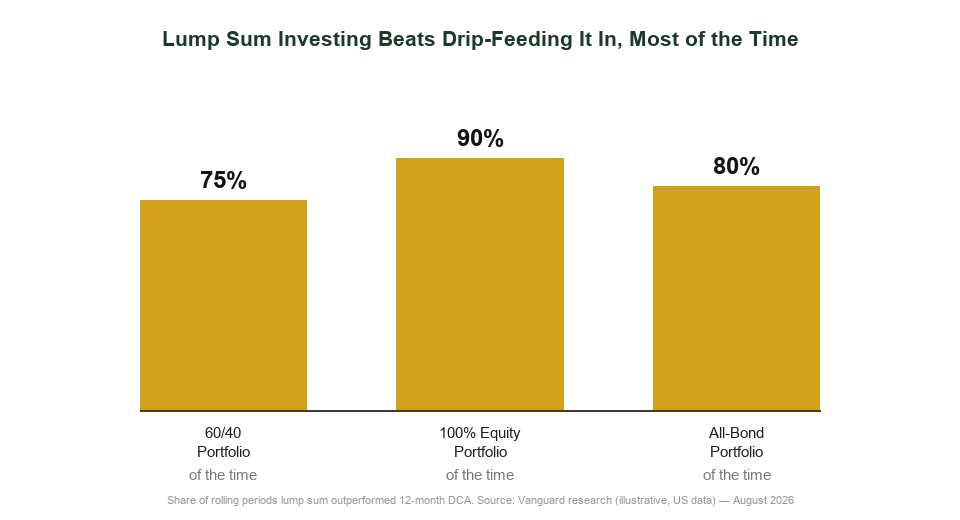
Research from Vanguard, based on historical US market data and cited widely by AAII and other financial researchers, found that investing a lump sum immediately outperformed a 12-month DCA schedule roughly 75-90% of the time across different portfolio mixes, because markets rise more often than they fall, and money sitting in cash while you drip-feed it in misses out on that upward drift.
That’s not a guarantee for any single year, and it’s US data used here as an illustrative reference point, not a Singapore-specific study. But so what does this mean for you? If your time horizon is long (7+ years) and the money isn’t needed soon, investing it in one go statistically gives you a better expected outcome than spreading it out.
That said, the psychological cost of lump-sum investing right before a downturn is real — our market crash survival guide covers what that feels like and how to plan for it. A common middle ground: invest half immediately, and phase the rest in over 6-12 months. You get most of the statistical benefit of lump-sum investing while reducing the regret of “what if it drops right after I invest everything.”
Step 4: Consider a CPF or SRS Top-Up
A windfall is one of the few times most people have enough spare cash to meaningfully use the Retirement Sum Topping-Up (RSTU) scheme or fund an SRS account in one shot, rather than scraping together small amounts each year.
CPF cash top-up (RSTU). You can top up your own Special Account (SA) if you’re below 55, or Retirement Account (RA) if you’re 55 or above, up to the current year’s Full Retirement Sum (FRS) of $220,400, or Enhanced Retirement Sum (ERS) of $440,800 for those 55 and above. Tax relief applies up to $8,000 for topping up your own account, plus another $8,000 if you top up a loved one’s account — up to $16,000 in relief in total, subject to the overall $80,000 personal income tax relief cap. The money then earns a guaranteed 4% p.a. floor rate (SA/RA), extended through 31 December 2026 per CPF Board’s official rate notices.
SRS contribution. Singapore Citizens and PRs can contribute up to $15,300 a year to an SRS account; foreigners can contribute up to $35,700. Every dollar contributed reduces your taxable income for the year dollar-for-dollar, up to the cap, and the funds can then be invested in stocks, ETFs, bonds, or robo-advisor portfolios inside the SRS wrapper.
These moves aren’t free money — CPF top-ups lock the funds up until retirement age, and SRS withdrawals before the statutory retirement age face a 5% penalty plus full taxation on the amount withdrawn. But for windfall money you weren’t already counting on for near-term spending, the guaranteed CPF interest rate and immediate tax relief are hard to beat. Our CPF investment strategy guide covers this trade-off in more depth.
A Worked Example: Allocating a SGD 100,000 Windfall
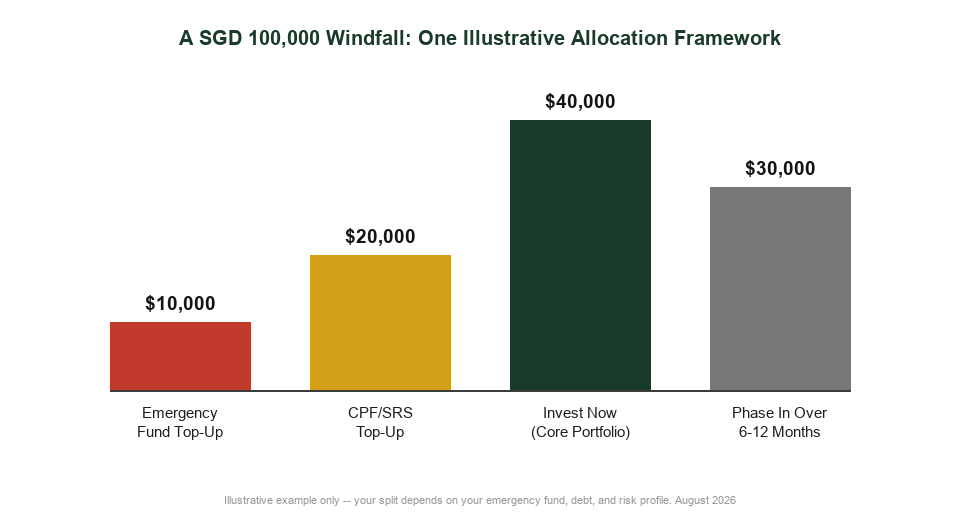
Say you inherit SGD 100,000 and your emergency fund is already at $10,000, half of what you’d like. Here’s one illustrative way to split it — your own numbers will differ based on your debt, buffer, and risk profile.
| Allocation | Amount | Why |
|---|---|---|
| Emergency fund top-up | $10,000 | Bring buffer to a full 6 months of expenses |
| CPF/SRS top-up | $20,000 | Guaranteed return plus immediate tax relief |
| Invest now (core portfolio) | $40,000 | Lump sum into a diversified ETF portfolio |
| Phase in over 6-12 months | $30,000 | Reduces regret risk of investing everything at once |
Illustrative example only, not a recommendation. Adjust the split based on your own emergency fund status, debt, and goals.
Notice what’s absent: spending the whole windfall on a single large purchase. That’s a valid personal choice for part of the money — many people reasonably set aside 5-10% for something they genuinely want — but building it into your plan deliberately, rather than letting it happen by default, is the whole point of this exercise.
What to Do This Week
Step 1: Confirm the tax treatment of your specific windfall — inheritance and gifts are untaxed, a bonus is taxable income already reflected in your payslip, and property sale proceeds need a CPF refund calculation first.
Step 2: Check your emergency fund against 3-6 months of expenses and top it up if it’s short.
Step 3: Decide how much, if any, goes toward a CPF or SRS top-up this calendar year, keeping the $220,400 FRS / $440,800 ERS ceiling and $80,000 overall relief cap in mind.
Step 4: Split the remainder between investing now and phasing in over the next 6-12 months, sized to your own comfort with volatility. Our risk profile guide can help you size the equity portion appropriately, and our goal-based investing guide is useful if part of the windfall is earmarked for a specific near-term goal.
Not financial or tax advice. Every windfall situation is different — consult a licensed financial adviser or tax professional for guidance specific to your circumstances. Data verified as at 6 August 2026.
Frequently Asked Questions
Is an inheritance taxed in Singapore?
No. Singapore abolished estate duty for all deaths from 15 February 2008 onwards. There is no inheritance tax to pay, and no clearance certificate is needed from IRAS before inherited assets can be distributed to beneficiaries.
Is a year-end bonus from my employer taxed the same as inheritance?
No, they’re very different. A cash bonus from your employer is ordinary employment income and is taxed at Singapore’s progressive personal income tax rates, same as your regular salary. An inheritance or cash gift, by contrast, is not taxed at all.
Do I get to keep all the money when I sell my HDB or condo?
Not automatically. If you used CPF savings to buy the property, you must refund the CPF principal plus accrued interest (at the OA rate, compounded monthly) back into your CPF Ordinary Account when you sell. This reduces your cash proceeds but the refunded amount stays in your own CPF, still earning interest for retirement.
Should I invest a windfall all at once or spread it out?
Historical research (Vanguard, using US market data) suggests investing a lump sum immediately outperforms spreading it out over 12 months roughly 75-90% of the time, since markets rise more often than they fall. A common compromise is investing half immediately and phasing the rest in over 6-12 months to reduce regret risk.
How much of a windfall should go into CPF or SRS?
There’s no fixed rule, but the ceilings to know are the Full Retirement Sum of $220,400 (or Enhanced Retirement Sum of $440,800 if you’re 55+) for CPF top-ups, and $15,300 a year for SRS if you’re a Citizen or PR ($35,700 for foreigners). Tax relief on CPF top-ups is capped at $8,000 for yourself and $8,000 for a loved one, within an overall $80,000 personal relief cap.
Should I pay off debt before investing a windfall?
Generally, yes for high-interest debt like credit cards, which often charge 26-28% p.a. — no investment reliably beats that. For lower-interest debt like a home loan pegged near SORA, it’s more of a personal choice. Our debt vs investing guide walks through the full decision framework.
Ready to Put Your Windfall to Work?
Open a brokerage or robo-advisor account through our referral links for sign-up bonuses.
This article was researched with the help of AI. While we strive to keep all information accurate and up to date, there may be errors. If you notice any discrepancies, please contact us.