How to Invest in Singapore: Index Funds vs Active Funds — Why Index Usually Wins (2026 Guide)
SPIVA data, CPFIS analysis, and a practical action plan for Singaporean investors.
Table of Contents
- What are index funds and active funds?
- The cost gap — why 1% matters more than you think
- The evidence: what SPIVA data shows
- CPFIS: index funds win here too
- When active funds might make sense
- How to start index investing in Singapore
- Broker comparison: where to buy index funds
- Frequently asked questions
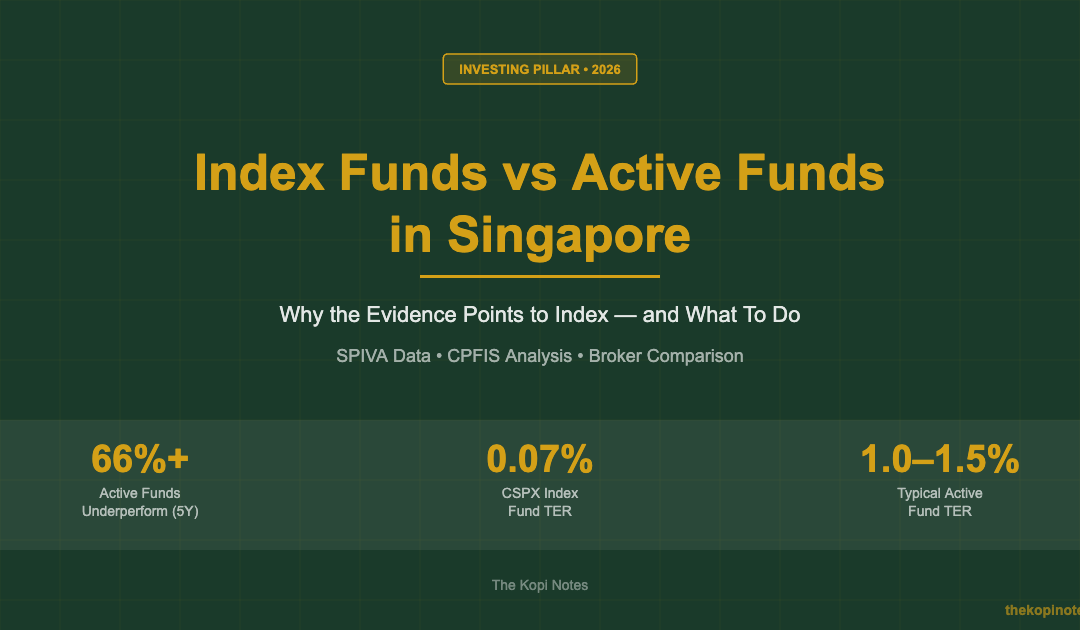
Index funds and active funds are the two main ways to invest in Singapore — and the data strongly favours index funds for most investors. Over five years, more than 66% of actively managed funds in Asia ex-Japan failed to beat their benchmark index, according to the SPIVA Asia ex-Japan Year-End 2025 report. Add in fees of 1.0%–1.5% per year versus 0.07%–0.30% for index ETFs, and the case for passive investing becomes hard to ignore.
Not financial advice. All figures are for educational reference only. Data as at September 2026 unless noted.
- Over 66% of active funds in Asia ex-Japan underperformed their index over 5 years (SPIVA 2025)
- Index ETFs like CSPX (0.07% TER) cost 10–20× less than typical active funds (1.0%–1.5%)
- On a $100,000 portfolio over 20 years, a 1.5% fee gap can cost you over $80,000 in lost returns
What Are Index Funds and Active Funds?
An index fund (or passive fund) simply tracks a market index — like the S&P 500, the global MSCI World, or the Straits Times Index (STI). It buys all (or most) of the securities in that index and holds them. No fund manager is trying to pick winners. The goal is to match the market return, minus a small fee.
An active fund employs a professional fund manager to select stocks, time the market, and try to deliver returns above the index. You pay more for this expertise — typically 0.8%–1.75% per year in fees for CPFIS-approved unit trusts in Singapore.
| Feature | Index Fund (Passive) | Active Fund |
|---|---|---|
| Goal | Match the index | Beat the index |
| Typical TER | 0.07%–0.30% p.a. | 0.80%–1.75% p.a. |
| Manager decisions | None (rules-based) | Daily stock picking |
| Predictability | High (tracks index closely) | Low (varies by manager) |
| Examples (Singapore) | CSPX, VWRA, ES3 STI ETF | Schroders Global, Fidelity, Lion-OCBC |
Source: iShares, Vanguard, SPDR factsheets; CPF Board CPFIS-OA fund list, September 2026
The Cost Gap — Why 1% Matters More Than You Think
Fees don’t sound like much. A 1% annual fee feels almost invisible. But fees are charged on your entire portfolio every year — not just on your gains. Over time, the compounding effect of fees is brutal.
Here’s what happens to $100,000 invested over 20 years at a 7% gross annual return:
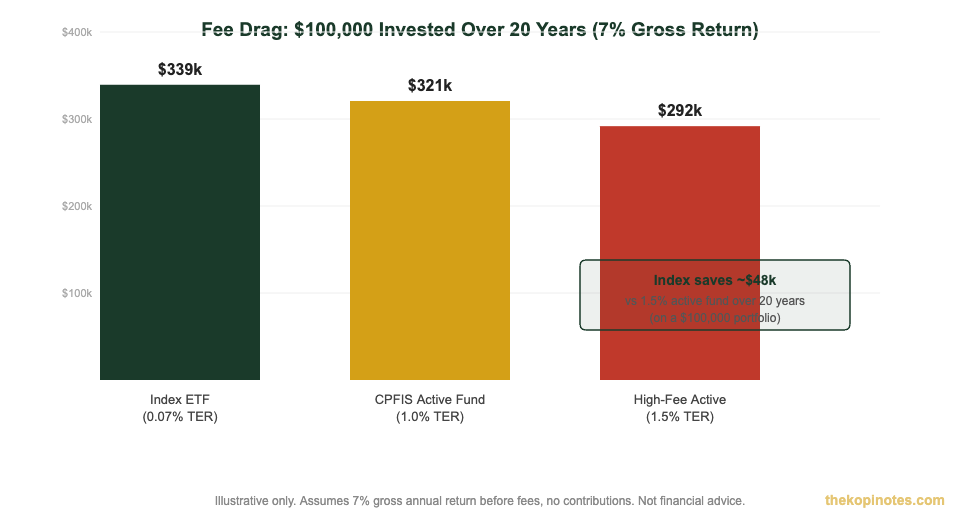
Illustrative only. Assumes 7% gross annual return, no contributions. Not financial advice. The Kopi Notes, September 2026.
That $80,000+ isn’t lost to the market. It’s lost to fees. And you still pay it whether your fund manager beats the index or not.
| Fund Type | TER | $100k → 20Y | You Lose vs Index |
|---|---|---|---|
| CSPX (iShares S&P 500) | 0.07% | ~$376,000 | — |
| CPFIS Active Fund (avg 1.0%) | 1.0% | ~$321,000 | ~$55,000 |
| High-fee active unit trust | 1.5% | ~$292,000 | ~$84,000 |
Illustrative calculation: $100,000 initial investment, 7% gross annual return, 20-year horizon. TER deducted annually from return. Not financial advice.
The Evidence: What SPIVA Data Shows
Every year, S&P Global publishes the SPIVA (S&P Indices Versus Active) Scorecard — the gold standard for comparing active fund performance against their benchmark indices. It covers Asia ex-Japan, which includes Singapore-based funds.
The verdict from the SPIVA Asia Ex-Japan Year-End 2025 report is damning for active managers:
- Over 1 year: 54% of domestic equity active funds underperformed their benchmark
- Over 3 years: 77% underperformed
- Over 5 years: 66% underperformed (international equity funds)
And for bond funds, the numbers are worse — 97% underperformed over 3 years. That’s nearly every bond fund manager failing to beat a simple bond index.
Here’s why active managers struggle over time:
- Fees compound against you. The fund manager needs to beat the index by at least their fee just to break even for you.
- Markets are fairly efficient. Professional traders already price in most information. “Edge” is rare and fleeting.
- Survivorship bias. Funds that consistently underperform are quietly closed. The average looks better than reality.
- Style drift. Managers change strategy, market conditions shift, and last year’s winner rarely stays on top.
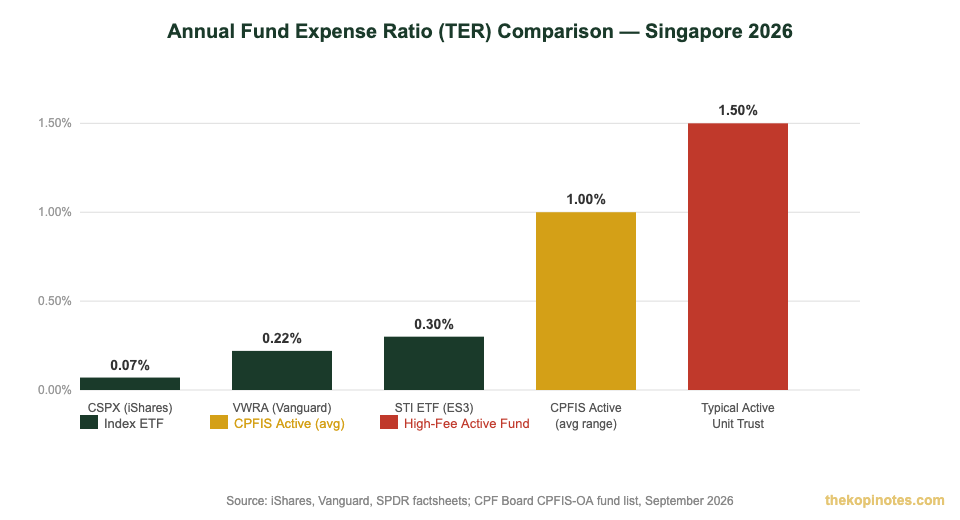
Source: iShares CSPX factsheet, Vanguard VWRA factsheet, SPDR ES3 factsheet, CPF Board CPFIS-OA fund list, September 2026
CPFIS: Index Funds Win Here Too
Many Singaporeans invest through the CPF Investment Scheme (CPFIS). You can use your CPF Ordinary Account (OA) savings to invest — but only in CPFIS-approved products.
Here’s the catch: most CPFIS-approved unit trusts are actively managed with fees of 0.80%–1.75% per year. Meanwhile, CPF-OA earns a guaranteed 2.5% per annum risk-free.
That means if you invest in a CPFIS active fund with a 1.5% fee, your fund needs to earn 4.0%+ per year just to match what you’d earn by leaving the money in CPF-OA. Year after year, that’s a high hurdle.
The good news: some index-tracking ETFs and funds are CPFIS-approved. The CPF investment strategy that typically makes sense is low-cost and globally diversified — which points squarely to index funds.
| Option | Annual Return / Fee | Verdict |
|---|---|---|
| CPF-OA (leave it) | 2.5% guaranteed | ✅ Risk-free baseline |
| CPFIS Index ETF (low-cost) | Market return − 0.07–0.30% | ✅ Good for long horizon (10Y+) |
| CPFIS Active Unit Trust | Market return − 1.0–1.75% | ⚠️ High hurdle; most fail to clear it |
Source: CPF Board, Morningstar, CPFIS-OA Approved Fund List, September 2026
When Active Funds Might Make Sense
Index investing isn’t the right answer 100% of the time. There are situations where active management can add value:
- Niche or illiquid markets. In less efficient markets — like small-cap emerging market stocks — skilled managers have more opportunity to find mispriced securities. Index options are also limited here.
- Absolute return / low-correlation strategies. Some investors want a portion of their portfolio that zigs when equity markets zag. Certain alternative active funds offer this.
- Tax-managed active strategies. In jurisdictions with capital gains tax (not Singapore, but relevant if you invest abroad), some active strategies can harvest losses to reduce your tax bill.
- Very short investment horizons. If you need the money in 1–3 years, capital preservation matters more than long-term growth — and some active bond or multi-asset funds are designed for this.
However, most Singaporean retail investors are investing for retirement or long-term wealth building. For horizons of 10+ years in liquid, mainstream markets (global equities, Singapore equities), the evidence strongly supports index funds.
How to Start Index Investing in Singapore
You don’t need a lot of money or expertise to get started. Here’s a simple framework:
Step 1: Decide your allocation — How much in equities vs bonds? A common starting point for long-term investors under 40 is 80–90% global equities, 10–20% bonds. As you approach retirement, shift gradually toward bonds and income assets.
Step 2: Pick your index ETFs — For global exposure, CSPX (S&P 500, LSE) and VWRA (global all-cap, LSE) are the two most popular choices for Singapore investors. For Singapore exposure, ES3 (STI ETF, SGX) provides local market coverage. All three are listed on major exchanges, UCITS-compliant, and avoid US estate tax issues.
Step 3: Choose a broker — See the comparison table below. For small amounts (under $20,000), robo-advisors like Syfe or Endowus may be more cost-efficient. For larger amounts, IBKR or FSMOne are typically cheaper per trade.
Step 4: Invest regularly — Monthly or quarterly contributions smooth out market volatility. You don’t need to time the market. In fact, trying to time the market is one of the biggest mistakes investors make. Our CPF / SRS / cash account order guide can help you decide which account to fund first.
Step 5: Rebalance annually — Once a year, check if your equity/bond split has drifted and top up the underweight asset class. That’s all the “active management” most investors need.
Broker Comparison: Where to Buy Index Funds in Singapore
| Platform | Best For | Commission | Notes |
|---|---|---|---|
| IBKR (Interactive Brokers) | DIY investors, larger portfolios | USD 1.70/trade (LSE ETFs) | Low FX spread; no min. funding. Use referral code: jianxiong368 |
| FSMOne | SRS + Cash, RSP plans | 0.08% or S$10 min | CPFIS, SRS support; good for RSP automation. Referral code: P0544985 |
| Syfe Trade | Beginners, small amounts | 0 commission on US trades; 0.35%/yr management | Robo portfolios available; CSPX/VWRA accessible. Referral: SRPRFFFCD |
Source: Official platform pricing pages, September 2026. Fees may change — always verify on the platform’s website before trading.
Our take on robo-advisors vs DIY investing:
If you’re investing less than $20,000, the per-trade commission on IBKR can eat into returns more than a robo-advisor’s 0.35%/yr fee. Once you cross $20,000–$30,000, DIY at IBKR or FSMOne typically becomes more cost-efficient.
Want to understand how to build a passive income stream from your index fund portfolio over time? Our passive income Singapore guide walks through the full picture — including how index funds fit alongside S-REITs and T-bills. For a complete long-term view, try our Singapore retirement calculator.
Frequently Asked Questions
Are index funds available in Singapore?
Can I use CPF to invest in index funds?
What's the difference between a TER and a sales charge?
Is now a good time to switch from active funds to index funds?
What are the risks of index funds?
How much should I invest in index funds each month?
This article is for educational purposes only and does not constitute financial advice. Past performance is not indicative of future results. Always do your own research or consult a licensed financial adviser before making investment decisions. Data verified as at 23 September 2026.
This article was researched with the help of AI. While we strive to keep all information accurate and up to date, there may be errors. If you notice any discrepancies, please contact us.