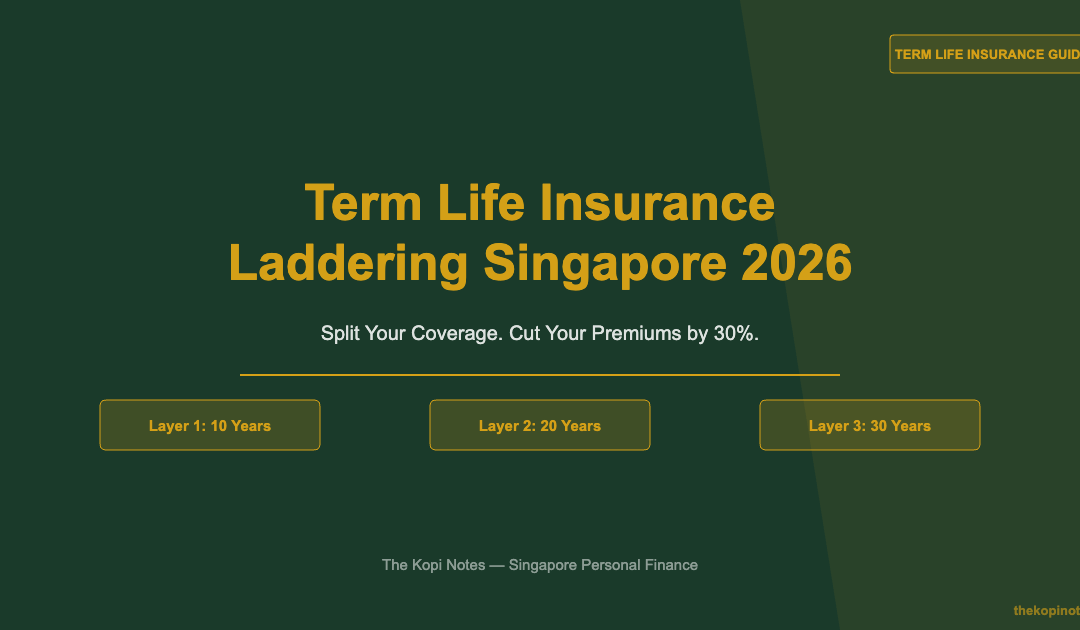
Term Life Insurance Laddering Singapore 2026: Split Your Coverage, Cut Your Premiums by 30%
The smart strategy that most Singaporeans have never heard of — and it can save you S$300+ every year.Term life insurance laddering is a strategy where you buy two or three smaller policies with different coverage periods — instead of one large single policy. Because shorter-term policies cost less per year, your total annual premium drops by roughly 25–35%. For a 35-year-old in Singapore needing S$1.5 million in coverage, laddering can save around S$300–400 every year while still keeping you fully protected when it matters most.
Not financial advice. All premium figures are estimates for educational reference. Data verified as at September 2026. Speak to a licensed financial adviser before purchasing any policy.
- Laddering splits your total coverage across 2–3 policies with different terms (e.g. 10yr + 20yr + 30yr)
- Shorter-term policies are cheaper — so your blended annual premium is significantly lower
- It works because your coverage needs naturally shrink over time (mortgage paid off, kids grown, savings built up)
What Is Term Life Insurance Laddering?
The traditional approach is simple: work out how much coverage you need, then buy one big policy that covers you until retirement. Done.
Laddering takes a different view. It asks a smarter question: do you actually need the same amount of coverage for the next 30 years?
Probably not. At age 35, you might have a S$500k mortgage with 20 years left, two young kids, and no real savings to speak of. If you died today, your family would need a lot of money. But at age 55? Your mortgage could be mostly paid. Your kids are working adults. You have CPF and savings. Your family’s financial need is much smaller.
Laddering matches your coverage to your actual need at each life stage. You buy three separate policies:
- A 30-year policy for long-term baseline protection
- A 20-year policy for when the kids are still schooling and the mortgage is half-paid
- A 10-year policy for the most vulnerable early years
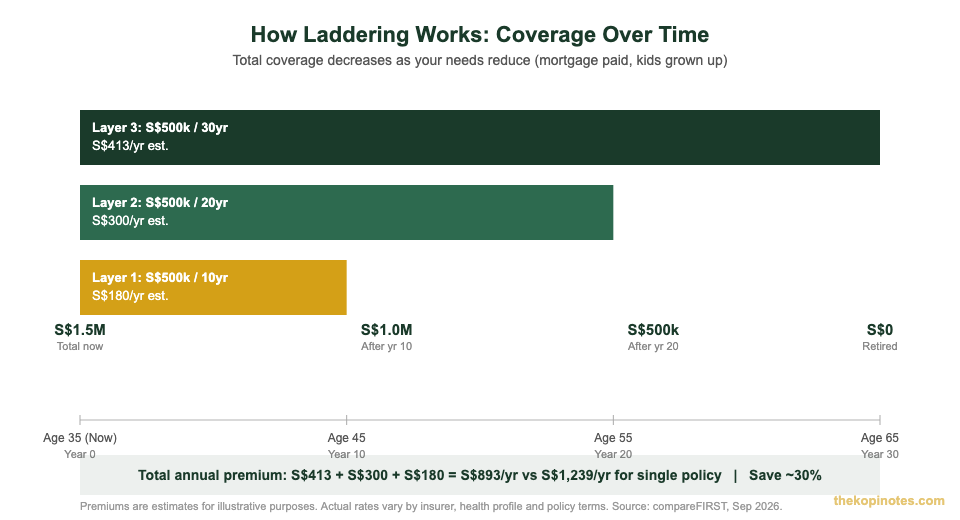
Together, these three policies give you full protection now — and naturally phase down as your obligations reduce. And because shorter terms cost less, your blended annual premium is lower than buying one giant 30-year policy.
Why Laddering Saves You Money
Term life premiums are higher the longer the coverage period. This makes actuarial sense — a longer policy means the insurer is on the hook for more years.
For a 35-year-old male non-smoker with Singlife Elite Term II:
| Policy Term | Sum Assured | Est. Annual Premium | Cost per S$1k of Cover |
|---|---|---|---|
| 10 years | S$500,000 | ~S$180/yr | S$0.36/S$1k |
| 20 years | S$500,000 | ~S$300/yr | S$0.60/S$1k |
| 30 years | S$500,000 | ~S$413/yr | S$0.83/S$1k |
| Ladder Total (S$1.5M combined) | ~S$893/yr | ||
Source: Estimates based on compareFIRST data, Singlife Elite Term II, September 2026. Age 35, male, non-smoker. Get actual quotes for your profile before purchasing.
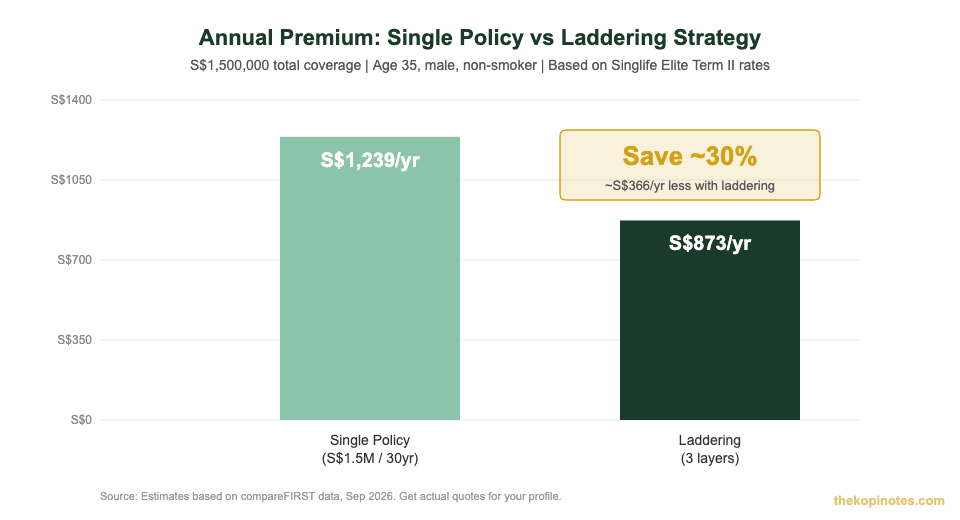
Compare that to a single S$1.5M policy for 30 years. At roughly S$1,239/yr, you would pay S$346 more every year — or S$10,380 more over 30 years — for the same coverage in the early years and far too much coverage in the later years.
The 3-Layer Ladder: A Worked Example
Let’s make this concrete. Meet Wei Ling, a 35-year-old marketing manager earning S$7,500 a month (S$90,000/yr).
Her financial situation:
- HDB mortgage: S$450,000 outstanding, 22 years left
- Two kids aged 5 and 8 — education costs ahead
- CPF balance: S$120,000
- Savings: S$40,000
Using the LIA’s 9x income guideline, Wei Ling needs roughly S$810,000 in basic death coverage. But she also has the mortgage and education costs. Her full picture looks like this:
| Need | Amount | Years Relevant |
|---|---|---|
| Income replacement (9× S$90k) | S$810,000 | 30 years (until 65) |
| Mortgage payoff | S$450,000 | 22 years (until 57) |
| Children’s education (×2) | S$200,000 | 15 years (youngest at 23) |
| Less: DPS, CPF, savings | − S$230,000 | — |
| Total coverage needed (now) | ~S$1,230,000 |
Source: DIME method adapted for Singapore context. LIA income multiplier guideline 2026.
Wei Ling needs about S$1.2M today. But in 20 years? Her mortgage is gone, her kids are working, and her savings have grown. She might only need S$400–500k then.
Here is how her ladder looks:
| Layer | Coverage | Term | Covers What | Est. Premium |
|---|---|---|---|---|
| Layer 1 | S$400,000 | 15 years | Education + early mortgage | ~S$140/yr |
| Layer 2 | S$400,000 | 22 years | Remaining mortgage | ~S$230/yr |
| Layer 3 | S$400,000 | 30 years | Income replacement | ~S$330/yr |
| Total ladder (S$1.2M now, reduces over time) | ~S$700/yr | |||
Premiums are estimates for a female, age 35, non-smoker, standard health. Actual rates depend on insurer, health status, and policy terms. Source: compareFIRST estimates, Sep 2026.
How to Set Up Your Own Ladder (Step by Step)
Setting up a ladder takes a little planning, but the process is straightforward. Here is how to do it.
Step 1: List Your Financial Obligations
Write down every financial obligation your family depends on:
- Outstanding mortgage or rental commitments
- Children’s education costs (estimate university fees per child)
- Any personal loans or outstanding debt
- Monthly living expenses your family needs to replace
Step 2: Assign a Time Horizon to Each Need
When does each obligation end? Your mortgage might have 20 years left. Your youngest child goes to university in 15 years. Your need for income replacement runs until you retire at 65. These time horizons become your policy terms.
Step 3: Calculate Coverage for Each Layer
Use the LIA’s 9x income multiplier as your base income replacement figure. Then add the other obligations. Subtract what your family already has: CPF Life payouts, DPS cover (typically S$46,000–S$70,000 for HDB owners), and existing savings.
Step 4: Get Quotes for Each Layer Separately
Use compareFIRST — MAS’s official insurance comparison portal — to get quotes for each layer individually. You can hold policies from different insurers, which lets you pick the cheapest provider for each term.
Step 5: Apply in Parallel, Stagger If Needed
You can apply for multiple policies at the same time from different insurers. Some financial advisers recommend staggering applications by 3–6 months to avoid any underwriting concerns about concurrent applications — but this is usually not an issue for standard health profiles.
For personalised guidance on how to structure your ladder, a fee-based financial adviser can run the numbers for your specific situation.
Which Insurers to Use for Each Layer
You are not locked into one insurer for your ladder. In fact, mixing insurers is often smarter — each insurer tends to be most competitive at different terms and ages.
| Layer | Recommended Insurers | Why |
|---|---|---|
| Short term (10–15yr) | FWD, Etiqa, Singlife | Most competitive on short-term premiums; flexible payout options |
| Medium term (20–22yr) | Singlife, Manulife, China Taiping | Strong mid-range pricing; good claims track records |
| Long term (25–30yr) | Singlife, AIA, Great Eastern | Financial strength matters for long-duration policies; Singlife cheapest on 30yr |
Source: compareFIRST data, September 2026. Always verify current rates as premiums change regularly.
For the shortest-term layer, FWD Term Life Plus and Etiqa Essential Term Life Cover are frequently among the cheapest options. For the longest-term anchor layer, Singlife Elite Term II has consistently ranked as the most affordable 30-year term plan for standard profiles.
If you invest through a robo-adviser, it is worth checking whether your platform offers group or packaged insurance. Endowus (referral code: 2V343) and Syfe (referral code: SRPRFFFCD) both offer investment platforms where you can grow your savings alongside your protection strategy.
When Laddering Might Not Be Right for You
Laddering is not a universal fix. There are situations where a single policy makes more sense.
You have health conditions. Every policy requires underwriting. If you have a pre-existing condition, each application involves separate health disclosures and potential exclusions. A single policy with one underwriting decision is simpler and reduces the risk of being declined on one layer.
You prefer simplicity. Managing two or three policies — each with its own premium schedule, renewal date, and contact point — adds administrative complexity. For some people, the premium savings are not worth the extra paperwork.
Your coverage needs are fixed. If you are single with no mortgage and no dependents, you may only need a small amount of coverage for a specific purpose (e.g. to repay a business loan). In that case, one targeted policy is cleaner.
You are nearing retirement. Laddering works best when you have 20–30 years ahead. If you are in your late 50s, the premium savings are much smaller and the complexity is not worth it.
The bottom line: laddering suits working-age Singaporeans (30–50) with mortgages, dependents, and at least 20 years until retirement. For everyone else, evaluate your situation carefully. You can also explore your options using our Singapore retirement planning calculator to understand your long-term financial picture.
Frequently Asked Questions
What is term life insurance laddering in Singapore?
How much can I save by laddering my term life insurance?
Can I hold term life insurance policies from different insurers?
Does laddering affect my CPF or DPS coverage?
Is laddering suitable for HDB flat owners with HPS?
What are the risks of a laddering strategy?
Where can I compare term life insurance quotes in Singapore?
Get Free Insurance Advice
Speak with a licensed insurance advisor. No obligation, no cost.
By submitting this form, you agree to our Privacy Policy.
This article was researched with the help of AI. While we strive to keep all information accurate and up to date, there may be errors. If you notice any discrepancies, please contact us.