Multi-Pay Critical Illness Insurance Singapore (2026): Is It Worth Paying More?
Multi-pay critical illness (CI) insurance pays a lump sum for each new critical illness you develop — not just the first one. Unlike standard CI plans that pay once and lapse, the top multi-pay plans in Singapore from Singlife and Tokio Marine pay up to 900% of your sum assured across multiple claims. The trade-off: premiums typically run 30–50% higher than a comparable single-payout plan.
Not financial advice. All figures are for educational reference only. Data verified as at 12 September 2026.
- Multi-pay CI covers you for a second or third critical illness — standard CI pays once then ends
- Top Singapore plans cover 100–187 conditions and pay up to 900% of your sum assured total
- Worth it if you have a family history of multiple CIs, or want lifelong coverage past age 70
What Is In This Guide
What Is Multi-Pay Critical Illness Insurance?
Standard critical illness insurance works like this: you get diagnosed with cancer, you claim S$300,000, and the policy ends. One payout, then nothing.
Multi-pay CI insurance works differently. After you claim for cancer, the policy continues. A year or two later, if you suffer a heart attack, you can claim again. The policy keeps paying for each new qualifying illness until you reach the plan maximum payout — often as high as 900% of your original sum assured.
Here is a worked example. You buy a multi-pay CI plan with S$200,000 sum assured and a 900% maximum payout:
- Age 45: Cancer diagnosis — claim S$200,000
- Age 54: Heart attack — claim another S$200,000
- Age 61: Kidney failure — claim S$200,000 again
Total received: S$600,000 from a policy with a S$200,000 base sum assured. That is the core advantage of multi-pay CI.
The catch: you typically wait 12–24 months between claims in the same illness category. And premiums are higher from day one.
For a deeper look at what a CI payout actually covers and what it does not, read our guide on critical illness insurance payouts and the recovery costs they do not cover.
Multi-Pay vs Standard CI Insurance: Key Differences
Here is a side-by-side comparison of the two types of CI insurance on the features that matter most.
| Feature | Standard CI (Single-Pay) | Multi-Pay CI |
|---|---|---|
| Payouts | 1 (policy ends after claim) | Multiple (policy continues) |
| Policy after first claim | Terminates | Continues with waiting period |
| Conditions covered | 37 LIA standard severe CIs | 37–187 (varies by plan) |
| Maximum total payout | 100% of sum assured | Up to 900% of sum assured |
| Waiting period between claims | Not applicable | Typically 12–24 months |
| Premium (relative) | Base | 30–50% higher than single-pay |
| Best for | Budget-conscious; working-years focus | Long-term coverage; family CI history |
Source: LIA Singapore framework; insurer product brochures, September 2026
Top Multi-Pay CI Plans in Singapore (2026)
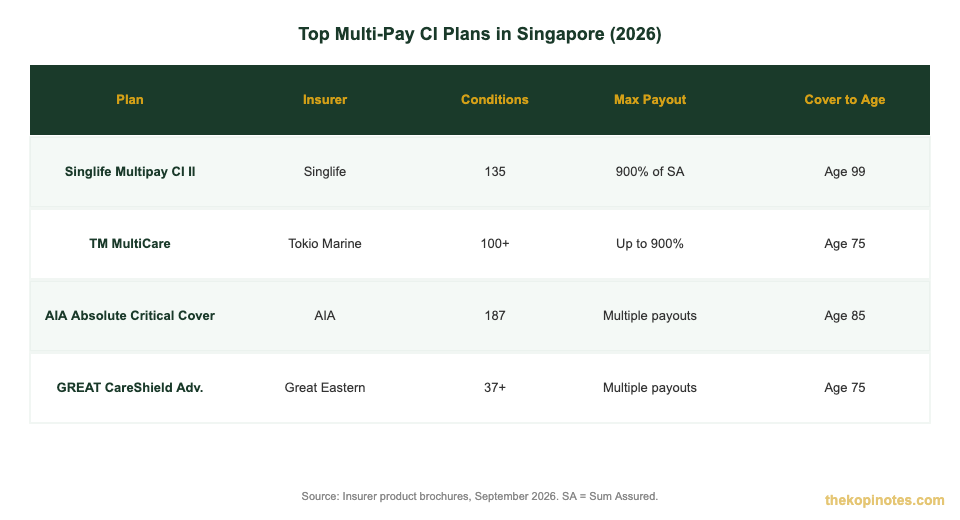
A small number of insurers offer dedicated multi-pay CI plans in Singapore. Here is an overview of the major options. For a full breakdown of Singlife specifically, see our Singlife Multipay Critical Illness II review.
Singlife Multipay Critical Illness II
Singlife Multipay Critical Illness II is widely regarded as Singapore’s most comprehensive multi-pay CI plan. It covers 135 conditions across early, intermediate, and severe stages, and allows you to claim up to 900% of your sum assured over a lifetime. Coverage extends to age 99.
A key feature: a cancer claim does not affect your ability to claim later for heart attack or stroke. Each illness category is treated independently. The waiting period within the same illness group is typically 12 months.
Tokio Marine TM MultiCare
Tokio Marine’s TM MultiCare is a multi-pay option built into Tokio Marine’s term insurance framework. It covers over 100 conditions and allows multiple payouts. Coverage typically extends to age 75. It suits those who prefer bundling life and CI protection under a single insurer.
AIA Absolute Critical Cover
AIA Absolute Critical Cover covers 187 conditions — the widest list of the three. It spans early, intermediate, and severe stages and allows multiple payouts across different severity levels. The structure differs from pure multi-pay plans, so read the policy wording carefully. Coverage extends to age 85.
For a full comparison across all CI plan types, see our best critical illness insurance Singapore 2026 comparison guide.
How Much More Do Multi-Pay CI Plans Cost?
Multi-pay CI premiums are not dramatically higher — but the gap compounds over a 20 to 30 year policy term. Expect to pay approximately 30–50% more for a multi-pay plan versus a standard single-pay CI policy at the same sum assured.
For reference: a non-smoking male aged 35, with S$300,000 CI coverage on a 25-year term, might pay roughly S$1,500–2,000 per year for a standard CI plan. The equivalent multi-pay plan typically runs S$2,200–3,000 per year — a difference of S$700–1,000 annually.
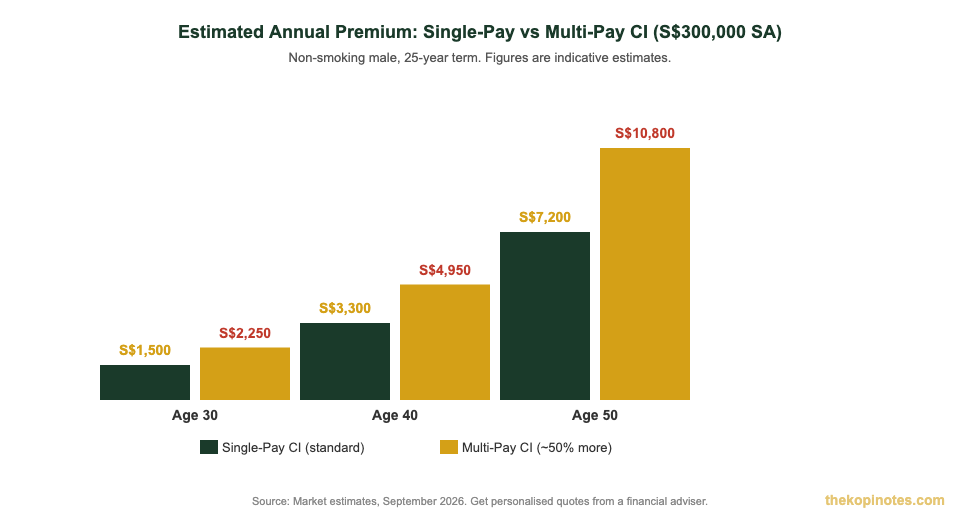
Over 25 years, that premium gap adds up to S$17,500–25,000 in extra premiums paid. Whether the additional payout potential — up to 900% versus 100% of sum assured — justifies this depends on your personal circumstances.
Premium rates also scale sharply with age. Starting CI cover at 30 rather than 40 can roughly halve your annual premium cost.
All premium figures above are illustrative estimates. Always obtain personalised quotes from a licensed financial adviser based on your age, health status, and sum assured.
Is Multi-Pay CI Insurance Worth the Extra Premium?
The honest answer depends on your health history and how long you plan to maintain coverage.
A standard CI plan covers the single most devastating health event. Cancer treatment alone can cost S$100,000 to S$234,000 for late-stage immunotherapy in Singapore. A S$300,000 payout covers that and gives you a meaningful recovery buffer. For many Singaporeans, that is enough.
But what if you survive cancer — and develop a heart attack ten years later? Your standard CI policy is gone. No cover, no payout. This is exactly the scenario multi-pay CI is designed to address.
Multi-pay CI is most likely worth it if you:
- Have a family history of multiple types of critical illness (for example, a parent who had both cancer and a stroke)
- Want coverage extending past age 65 into your 70s or 80s, when multiple CI risks compound
- Are in good health and qualify for standard premium rates, keeping the gap manageable
- Do not have a whole life policy with a CI benefit that covers a second diagnosis
Standard single-pay CI may be sufficient if you:
- Primarily need income replacement for one major illness during your working years
- Are budget-constrained and need to maximise sum assured per premium dollar
- Already have CI riders on a whole life or endowment policy
For context on how CI riders work alongside term life policies, see our term life insurance riders Singapore guide, which covers CI accelerator and early CI riders in detail.
Who Should Choose Multi-Pay vs Standard CI?
Use this quick-reference table to match your situation to the right choice.
| Your Situation | Recommended Choice | Reason |
|---|---|---|
| Age 25–35, building coverage from scratch | Standard CI first; review at 40 | Lock in low premiums now; reassess type later |
| Family history of 2 or more CI types | Multi-Pay CI | Second illness risk is statistically higher |
| Want coverage past age 70 | Multi-Pay CI | Singlife Multipay II covers to age 99 |
| Tight budget; need maximum sum assured | Standard CI | More coverage per premium dollar |
| Already have CI rider on whole life plan | Standard CI for top-up | Whole life CI handles one claim; add term CI top-up |
| Age 40+, no whole life CI, good health | Multi-Pay CI | At older ages, multiple CI risk justifies higher premium |
Source: The Kopi Notes analysis, September 2026
Use our Singapore retirement planning calculator to model how a critical illness event could impact your savings goals — and whether your current coverage is enough to absorb the financial shock.
Also worth reading: our breakdown of early versus late stage CI coverage differences — an equally important decision alongside single-pay versus multi-pay.
Frequently Asked Questions
What is the difference between multi-pay and single-pay CI insurance?
Is multi-pay CI insurance worth the higher premium?
How many times can I claim on a multi-pay CI policy?
Which multi-pay CI plan is the best in Singapore?
Can I add early-stage CI coverage to a multi-pay plan?
Compare the Best CI Plans in Singapore
Our full guide covers all major CI plan types — single-pay, multi-pay, and early CI — with premiums and coverage details for 2026.
Get Free Insurance Advice
Speak with a licensed insurance advisor. No obligation, no cost.
By submitting this form, you agree to our Privacy Policy.
This article was researched with the help of AI. While we strive to keep all information accurate and up to date, there may be errors. If you notice any discrepancies, please contact us.