Critical Illness Insurance Singapore 2026
Early Stage vs Late Stage: What the Coverage Gap Costs You
This article explains how Singapore’s CI insurance tiers work. It is for information only and does not constitute financial advice. Data verified as at 10 September 2026. Consult a licensed financial adviser before making any insurance decision.
A 38-year-old woman is diagnosed with Stage 1 breast cancer. Surgery removes the tumour. She recovers in six weeks. Her standard critical illness plan pays out nothing.
That is not a loophole. That is how most CI plans sold in Singapore work.
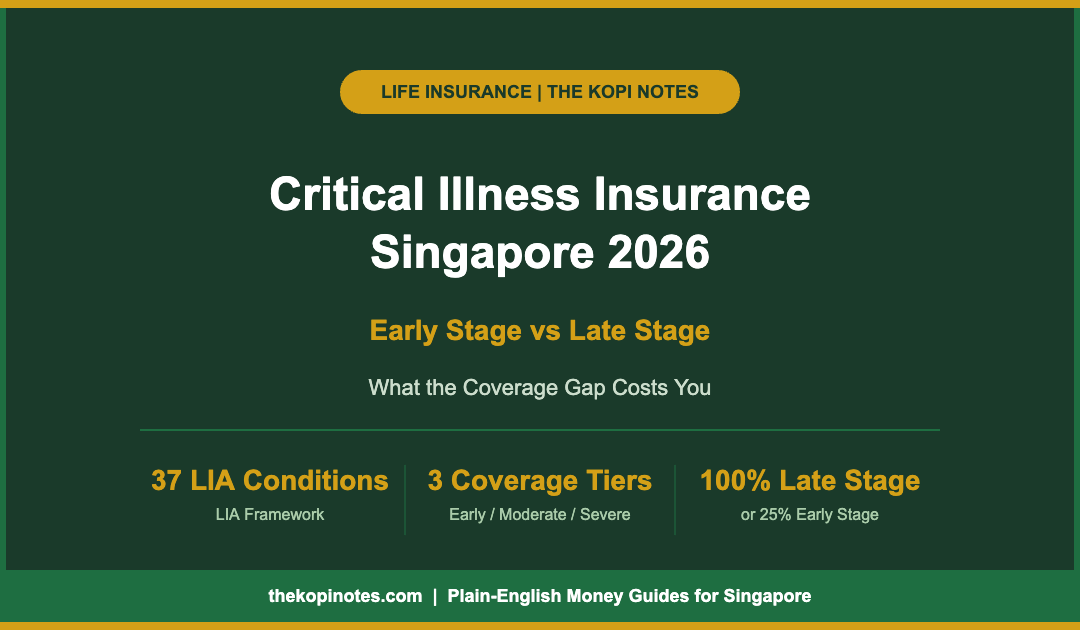
Standard critical illness insurance in Singapore follows the LIA framework covering 37 conditions. For cancer, it only triggers at late-stage — typically Stage 3 or 4. Early diagnoses, including carcinoma in situ and Stage 1 cancers, fall outside the payout threshold of a standard plan.
Early stage CI plans and multi-pay CI plans exist to close that gap. They cost more. Whether the extra premium is worth it depends on the conditions you are most likely to face — and what your savings can absorb if the payout does not come.
What the LIA 37-Condition Framework Covers
The Life Insurance Association of Singapore (LIA) published its standard CI framework in 2019. It defines 37 conditions with precise medical criteria. Every CI plan sold in Singapore that claims to follow this framework uses the same definitions for those 37 conditions.
The framework splits conditions into three severity stages:
- Severe (late stage): Full sum assured paid out. This is what a standard CI plan covers.
- Moderate: Partial payout, typically 25-50% of sum assured, capped at S$125,000.
- Early: Partial payout, same cap range.
A standard CI plan only covers the severe tier. Early stage CI plans cover all three tiers at different payout percentages for moderate and early diagnoses.
The 37 conditions include cancer, heart attack, stroke, kidney failure, end-stage lung disease, major burns, coma, Parkinson’s disease, and more. Cancer, heart attack, and stroke alone account for the majority of CI claims in Singapore.
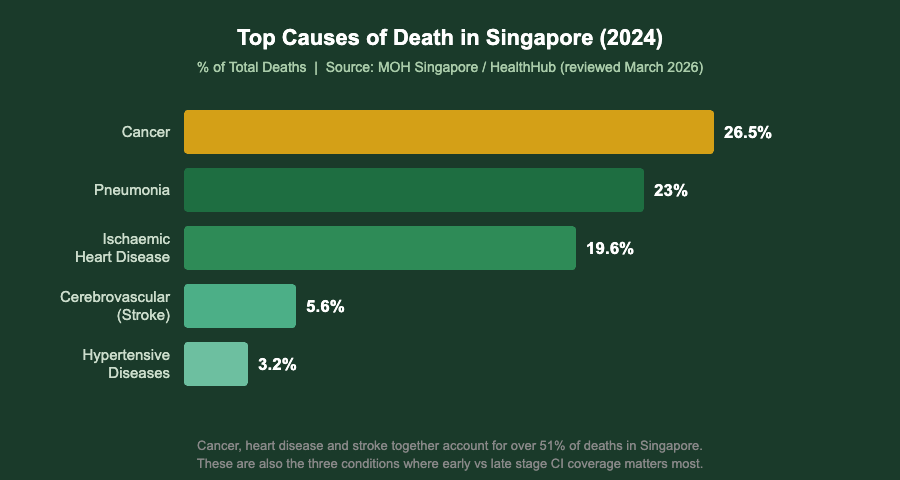
Per MOH data, cancer caused 26.5% of deaths in Singapore in 2024. Ischaemic heart diseases caused 19.6%. Stroke contributed another 5.6%. Those three categories alone make up over half of all mortality — and they are the three conditions where early vs late stage coverage matters most.
Early Stage vs Late Stage: The Key Differences
The practical difference comes down to one question: at what point does your policy pay?
A standard CI plan (late stage only) requires that your condition reaches the severe tier before your claim is approved. For cancer, that generally means Stage 3 or 4, or cancer that has spread beyond the primary site. For heart attack, it requires significant myocardial damage measured by specific enzyme markers. For stroke, it requires permanent neurological deficit lasting at least three months.
An early stage CI plan lowers the trigger. For cancer, it covers carcinoma in situ (pre-invasive cancer), Stage 1 cancer, and some Stage 2 diagnoses. For heart attack, it covers angioplasty and mild myocardial infarction without meeting the severe-tier enzyme thresholds. For stroke, it covers transient ischaemic attack (TIA) in some plans.
The trade-off is cost. Early stage CI premiums run roughly 20-40% higher than an equivalent standard CI plan with the same sum assured. A 35-year-old non-smoking male buying S$300,000 of standard CI might pay around S$80-120 per month. The same coverage with early stage benefits often runs S$110-170 per month depending on the insurer and plan structure.
Those numbers are illustrative. Actual premiums depend on your age, sex, occupation, health history, and the specific insurer. Always compare quotes from at least two insurers before buying.
The Cancer Gap: When Your Plan Pays (and When It Does Not)
Cancer is the single biggest CI claim category in Singapore. It is also where the early vs late stage gap is most visible.
Under the LIA severe-tier definition, cancer must be a malignant tumour characterised by the uncontrolled growth and spread of malignant cells, with invasion and destruction of normal tissue. This definition specifically excludes:
- Tumours classified as carcinoma in situ (pre-invasive)
- Stage 1 cancers of specific types (thyroid, prostate, chronic lymphocytic leukaemia at early stage)
- All skin cancers except malignant melanoma of specified severity
This means a standard CI plan does not pay for early-stage thyroid cancer or carcinoma in situ of the cervix, breast, or colon — which are among the most common early cancer diagnoses in Singapore women aged 30-50.
An early stage CI plan fills this gap. It pays a partial sum — typically 25% of sum assured up to a cap — when an early-stage diagnosis is confirmed. You still get the full sum if the condition progresses to late stage. But you get something immediately after diagnosis, when medical costs and income loss start accumulating.
The value of that early payout is not just the treatment cost. It is the income you lose during recovery and the lifestyle adjustments you make while waiting to return to work. For a Singapore household on S$8,000 per month combined income, six weeks of reduced work capacity costs roughly S$12,000 in income alone before counting hospital bills, follow-up scans, and medication.
Heart Attack and Stroke: The Same Story
The same logic applies to heart conditions. A standard CI plan requires a heart attack of specified severity — meaning significant myocardial damage confirmed by elevated cardiac enzymes (troponin), specific ECG changes, and regional wall motion abnormality.
Many patients who undergo angioplasty or balloon treatment for coronary artery disease do not meet this threshold. They had a procedure. They spent days in hospital. They took weeks off work. Their standard CI plan paid nothing.
Early stage CI plans cover angioplasty under the moderate-tier. The payout is partial — often 25% of sum assured — but it covers the most immediate financial gap: surgery cost top-ups beyond MediShield Life, and the income loss during recovery.
For stroke, the standard tier requires permanent neurological deficit lasting three months. Transient ischaemic attacks (mini-strokes) recover within 24 hours by definition. A person who suffers a TIA, takes six weeks off work, and undergoes rehabilitation does not qualify for a standard CI payout. Some early stage plans cover TIA — check the policy wording carefully, as coverage varies by insurer.
Multi-Pay CI: A Third Tier
Multi-pay CI plans allow multiple claims across different illness categories over the life of the policy, rather than paying out once and terminating.
Under a standard single-pay CI plan, one claim ends the cover. If you claim for a heart attack at 45, the policy closes. If you then develop cancer at 55, you have no coverage.
Under a multi-pay plan, the policy resets after a claim — typically after a separation period of one to two years. You can claim for a heart-related condition and later claim for cancer, subject to the plan’s category structure and reset rules.
Multi-pay plans are more expensive still. Premiums typically run 40-80% higher than a comparable standard CI plan, depending on the plan’s structure and the insurer. They suit people who want coverage that does not expire after the first serious diagnosis — particularly those with a family history of multiple conditions, or those who want the policy to remain active into their 60s and 70s.
The trade-off is complexity. Multi-pay plans have category exclusions after a claim, reset waiting periods, and reduced payouts on repeat claims within the same category. Read the policy document before buying, not after.
Coverage Comparison Table
| Condition / Scenario | Standard CI | Early Stage CI | Multi-Pay CI |
|---|---|---|---|
| Stage 3-4 cancer (late stage) | 100% payout | 100% payout | 100% payout |
| Stage 1 cancer / carcinoma in situ | No payout | ~25% (capped) | ~25% (capped) |
| Heart attack of specified severity | 100% payout | 100% payout | 100% payout |
| Angioplasty / mild heart event | No payout | ~25% (capped) | ~25% (capped) |
| Stroke with permanent deficit (3+ months) | 100% payout | 100% payout | 100% payout |
| Transient ischaemic attack (TIA) | No payout | Varies by plan | Varies by plan |
| Second unrelated CI claim | Policy ended | Policy ended | New claim eligible |
| Typical monthly premium (S$300k, male 35, non-smoker) | S$80-120 | S$110-170 | S$130-200+ |
Premium ranges are illustrative estimates only. Actual premiums vary by age, sex, health status, occupation, and insurer. Always obtain quotes from a licensed financial adviser.
Who Actually Needs Early Stage CI?
Early stage CI makes the most sense if at least one of these applies to you:
- Family history of early-onset cancer: If a parent or sibling was diagnosed with cancer before age 50, your own risk of early-stage diagnosis is statistically higher.
- No emergency fund to cover three to six months of lost income: If your savings would not last six weeks of medical leave without financial stress, the early payout provides the buffer a standard plan will not.
- Self-employed or freelance: No employer sick pay. No group insurance. Six weeks without income on a standard CI plan that paid nothing means six weeks of drawing down savings or going into debt.
- High monthly obligations: Mortgage, car loan, and school fees do not pause while you recover. The early payout from a CI plan can cover two to three months of fixed costs.
Standard CI still works well if your emergency fund is solid (six months of expenses), you have employer-paid group insurance covering hospitalisation, and your financial obligations allow for a gap in income without triggering debt.
The decision is not about whether early stage CI is better in absolute terms. It is about whether the extra premium buys you protection your savings cannot already provide.
Use our insurance gap calculator to estimate how much coverage you actually need before comparing plans. For context on how CI coverage interacts with your full life insurance strategy, see our life insurance comparison guide.
Frequently Asked Questions
Does a standard CI plan in Singapore cover Stage 1 cancer?
What is the payout percentage for early stage CI claims?
How many CI conditions does Singapore's LIA framework cover?
Can I add early CI coverage as a rider on my existing plan?
Is a multi-pay CI plan worth the higher premium?
Does CI insurance qualify for SRS or CPF tax relief?
How does the LIA 2024 CI framework update affect my existing plan?
The bottom line
Standard CI covers you when the diagnosis is severe. Early stage CI covers you when the diagnosis is manageable but your income still stops. Which gap you are more exposed to depends on your savings, your obligations, and your family history. Neither plan is universal. Both have a role.
Before buying, estimate your coverage gap first. Then compare premiums for the coverage level that closes it.
Get Free Insurance Advice
Speak with a licensed insurance advisor. No obligation, no cost.
By submitting this form, you agree to our Privacy Policy.
This article was researched with the help of AI. While we strive to keep all information accurate and up to date, there may be errors. If you notice any discrepancies, please contact us.