Life Insurance Comparison Singapore 2026: Term, Whole Life, CI & DI Explained
Your complete guide to all four types — and which combination you actually need.
In Singapore, four main types of life insurance protect different financial risks: term life (death and TPD coverage for a set period), whole life (lifelong cover with cash value), critical illness insurance (lump sum on diagnosis of 37+ serious conditions), and disability income insurance (monthly payout if illness or injury stops you working). Most Singaporeans need a combination — not just one type. Here is how to compare them and build the right insurance stack for your life stage.
Not financial advice. All figures are for educational reference only. Speak to a licensed financial adviser before purchasing any insurance. Data verified as at September 2026.
- Term life gives the most coverage per dollar — buy this first if you have dependents
- Critical illness (CI) insurance covers income loss from serious illness that your medical insurance will not pay
- Whole life costs 3–5× more than term for the same sum assured — best for legacy planning, not basic protection
- Most Singaporeans in their 30s–40s need: ISP + Term Life + CI (and DI if self-employed or sole breadwinner)
Table of Contents
- 5 Types of Life Insurance at a Glance
- Term Life Insurance: Best for Most Singaporeans
- Whole Life Insurance: When It Makes Sense
- Critical Illness Insurance: Your Income Backup
- Disability Income Insurance: The Most Overlooked Cover
- Which Life Insurance Combo Do You Need?
- How Much Coverage by Life Stage
- Where to Buy Life Insurance in Singapore
- Frequently Asked Questions
5 Types of Life Insurance in Singapore: At a Glance
Before we go deep into each type, here is the quick comparison. Every type covers a different risk — which is why most Singaporeans end up with more than one policy.
| Type | What It Pays | Duration | From (30M, Non-Smoker) | Best For |
|---|---|---|---|---|
| Term Life | Lump sum on death or TPD | 10–40 years | ~S$30–40/mth for S$500k | Most working adults with dependents |
| Whole Life | Lump sum + cash value | Lifelong (to age 99+) | ~S$180–220/mth for S$200k | Legacy planning, wealth transfer |
| Critical Illness | Lump sum on diagnosis of 37+ conditions | Term or whole-of-life | ~S$130–160/mth for S$300k | Income gap during illness recovery |
| Disability Income (DI) | Monthly income (up to 75% of salary) | Until age 65–67 | ~S$45–65/mth for S$4k/mth benefit | Self-employed, sole breadwinners |
| Integrated Shield Plan (ISP) | Hospital bills above MediShield Life | Annual, renewable | ~S$300–600/yr (Medisave-payable) | Everyone — the non-negotiable base |
Source: LIA Singapore, insurer websites (September 2026). Premiums are indicative and vary by insurer, health status, age, and coverage terms.
Term Life Insurance: Best for Most Singaporeans
Term life pays a lump sum to your beneficiaries if you die or become totally and permanently disabled (TPD) within the policy term. There is no cash value — it is pure protection. That is exactly why it is so affordable.
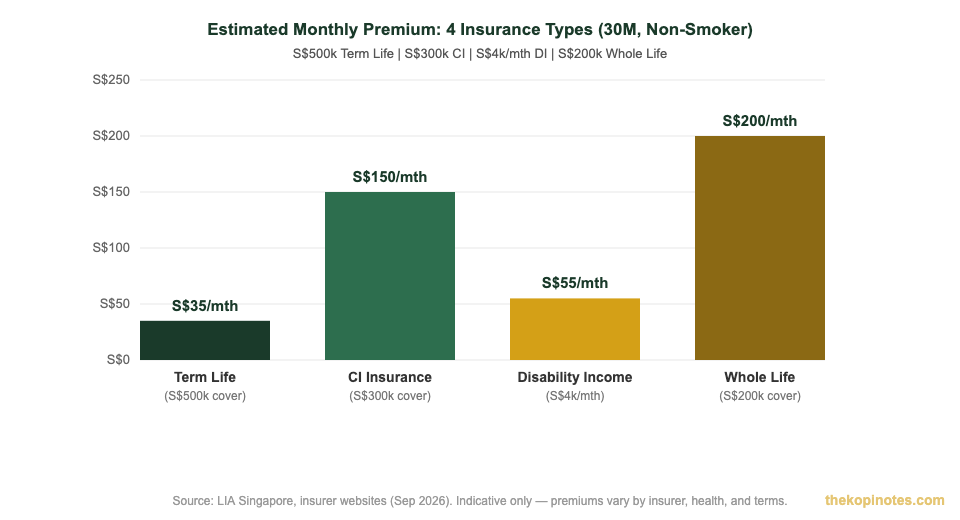
A 30-year-old non-smoker can get S$500,000 of coverage for around S$30–40 per month. Compare that to whole life, which costs S$180–220 per month for less than half the sum assured.
Who needs term life insurance?
Buy term life if any of these apply to you: you have dependents who rely on your income (spouse, children, elderly parents), you have a mortgage or outstanding loans, or you are your household’s primary breadwinner. The general rule is to aim for 10× your annual income in coverage — though your actual number depends on debts, dependents, and existing savings.
For a worked example: a 35-year-old earning S$6,000 per month with a S$400,000 mortgage and two young children should target at least S$1.2–1.5 million in term life coverage. Most Singaporeans fall well below this. For a detailed comparison of policy structures, see our guide to term vs whole life insurance Singapore.
Whole Life Insurance: When It Makes Sense
Whole life insurance covers you from the day you buy it until death, with no term limits or renewal risk. It also builds a cash value over time — you can borrow against it or surrender the policy for a payout.
The trade-off is cost. You pay 3–5× more per month than term life for the same sum assured. The cash value component typically grows at 3–4% per year (non-guaranteed portion), which is lower than most long-term investment alternatives for Singaporeans seeking passive income in Singapore.
When whole life insurance makes sense
Whole life suits you if you have already secured adequate term and CI coverage and want lifelong guaranteed coverage, are using it as an estate planning vehicle to pass a guaranteed sum to beneficiaries, or are a high-income earner who has maxed SRS and CPF investment headroom and wants a tax-efficient store of value.
When whole life is the wrong choice
Whole life is rarely the right starting point for families in their 30s and 40s. Dollar-for-dollar, term life plus CI insurance plus investing the premium difference in a low-cost index fund almost always outperforms whole life on both protection and investment return. Start with term and CI, then revisit whole life if your needs evolve.
Critical Illness Insurance: Your Income Backup
Critical illness (CI) insurance pays a lump sum when you are diagnosed with one of 37 serious conditions defined by the Life Insurance Association Singapore (LIA). These include major cancers, heart attack, stroke, end-stage kidney failure, and more.
Here is the key distinction most people miss: your Integrated Shield Plan covers your hospital bill. CI insurance covers everything your ISP cannot — the months of income lost while you recover, the mortgage that keeps running, childcare costs, and alternative treatments not covered by your plan.
For a Singaporean earning S$60,000 per year, that means S$300,000 in CI coverage. According to critical illness insurance claims data from LIA Singapore, cancer accounts for roughly 70% of all CI claims — and recovery can take 12–24 months, well beyond most people’s emergency fund runway.
Types of CI policy to know
Single-pay CI: One payout on diagnosis, then the policy ends. Simplest and most affordable option. Multi-pay CI: Multiple payouts across different conditions or claim stages — better for families with genetic risk factors, but more expensive. Early-stage CI: Pays out at Stage 1 or Stage 2 cancer (standard CI typically pays at Stage 3+). The additional premium is worth it for most people.
You can buy CI as a standalone policy or as a rider on a term or whole life plan. Standalone policies give more flexibility; riders are sometimes cheaper but terminate when the base plan does.
Disability Income Insurance: The Most Overlooked Cover
Disability income (DI) insurance replaces up to 75% of your monthly salary if you cannot work due to illness or injury — whether temporarily or permanently. MAS caps the benefit at 75% to preserve a financial incentive to return to work.
Consider a realistic scenario: you are diagnosed with cancer. Your ISP pays the hospital bills. Your CI insurance pays a lump sum. But who covers your S$3,000 mortgage, groceries, utilities, and children’s school fees for the 18 months you spend in treatment and recovery? That is what DI does — it provides a monthly income stream until you recover or reach the policy’s end date (typically age 60, 65, or 67).
Who needs DI insurance most urgently?
Self-employed and freelancers top this list — with no employer sick leave or HR backstop, inability to work means zero income. Sole breadwinners face the same existential risk. High earners with large fixed expenses (private school fees, large mortgage, car) also have a bigger gap to fill if they cannot work. For a detailed comparison with CPF’s built-in protection, see our guide to disability income insurance vs CPF DPS.
CPF’s Dependants’ Protection Scheme (DPS) does not cover disability — it only pays on death or total and permanent disability. DI insurance fills a completely different gap.
Which Life Insurance Combination Do You Actually Need?
The right answer depends on your life stage, dependents, income, and existing coverage. Here is a practical decision matrix based on common Singaporean situations.
| Your Situation | Recommended Insurance Stack | Rough Monthly Cost |
|---|---|---|
| Young single, no dependents | ISP + CI insurance (income backup) | S$150–300/mth |
| Married, no children yet | ISP + Term Life (S$500k+) + CI | S$250–450/mth |
| Married with children, mortgage | ISP + Term Life (S$1M+) + CI + DI | S$450–750/mth |
| Self-employed, sole breadwinner | ISP + Term Life (S$1M+) + CI + DI (priority) | S$500–850/mth |
| High income, children grown, 50+ | ISP + Whole Life (legacy) + CI multi-pay | S$700–1,500/mth |
Source: LIA Singapore Guidelines (2026). Figures are illustrative ranges. Actual premiums vary by age, health, insurer, and coverage amount.
The core stack for most working Singaporeans aged 30–50: ISP with a Class B1 or Class A rider, term life at 10× annual income, and CI at 5× annual income. Add DI if you are self-employed or the sole income earner in your household.
How Much Coverage Do You Need by Life Stage?
Insurance needs change as your life does. Your debts peak then shrink, dependents arrive then grow independent, and savings accumulate over time. Here is how your coverage needs shift across life stages in Singapore.
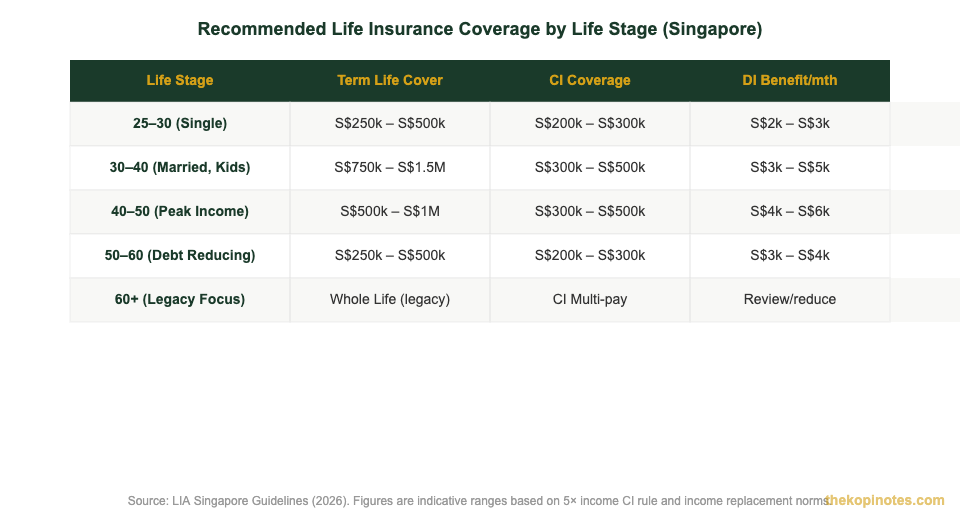
Source: LIA Singapore Guidelines (2026). Figures are indicative ranges.
As your savings and investments grow, your required insurance coverage decreases — a 55-year-old with S$800,000 in investments and grown-up children needs far less term life than a 35-year-old with young dependents and a new mortgage. Use our Singapore retirement calculator to model your specific coverage gap. Review your policies every five years or after any major life event such as marriage, new child, home purchase, or significant income change.
Where to Buy Life Insurance in Singapore
You have three main routes to buying life insurance in Singapore. The right one depends on how complex your needs are and how much guidance you want.
Option 1: Through a Licensed Financial Adviser
A tied agent represents one insurer; an Independent Financial Adviser (IFA) can compare policies across multiple insurers. For complex situations — multiple policies, estate planning, business insurance, or if you have health conditions — an IFA is worth the time. Find licensed advisers via the MAS Financial Adviser Directory at mas.gov.sg.
Option 2: Direct Purchase (No Adviser)
NTUC Income, FWD, and Singlife all offer direct online purchase for term life and CI. You skip advisory fees — direct term policies are typically 10–20% cheaper than adviser-sold equivalents. The trade-off is that you need to know exactly what you need before you start.
Option 3: Financial Platforms
Syfe (referral code: SRPRFFFCD) offers investment-linked policies alongside its investment products. Endowus (referral code: 2V343) helps you plan your CPF and SRS strategy holistically, which feeds directly into how much insurance you still need. FSMOne also has an insurance comparison tool worth checking before committing to any policy.
Whichever route you choose, compare at least three insurers before committing. Premiums for identical coverage can vary by 20–40% across providers for the same applicant profile.
Frequently Asked Questions
Do I need both term life and critical illness insurance in Singapore?
Is whole life insurance worth buying in Singapore 2026?
How underinsured are Singaporeans on life insurance?
Can I get life insurance in Singapore with a pre-existing condition?
When should I review my life insurance coverage?
Which life insurance company is best in Singapore?
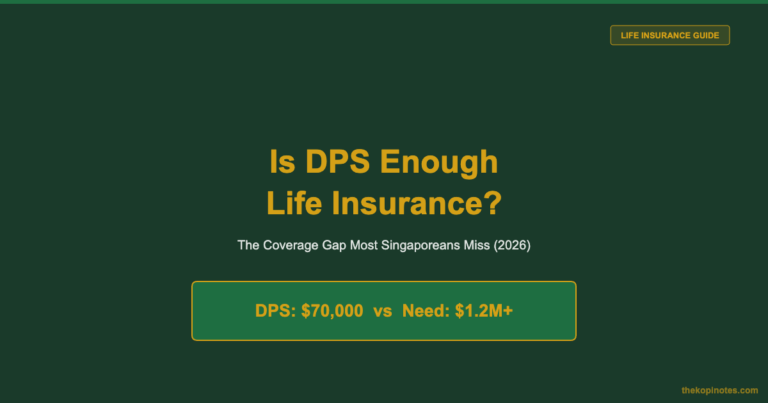
Is CPF DPS enough life insurance in Singapore?
Get Free Insurance Advice
Speak with a licensed insurance advisor. No obligation, no cost.
By submitting this form, you agree to our Privacy Policy.
This article was researched with the help of AI. While we strive to keep all information accurate and up to date, there may be errors. If you notice any discrepancies, please contact us.