Investment-Linked Policy vs Buy Term Invest the Rest: Which Wins in Singapore (2026)?
Updated September 2026 · 12 min read · Covers real numbers, fee drag, and a 20-year projection
TL;DR: For most Singapore investors under 45 with a 10–20 year horizon, Buy Term Invest the Rest (BTIR) outperforms an Investment-Linked Policy (ILP) once the fee drag compounds beyond Year 7–8. On a S$1,000/month budget, BTIR projects to S$474,500 at Year 20 vs S$388,300 for an ILP — a S$86,200 gap. ILPs can still make sense for specific scenarios: bundled coverage convenience, inability to self-invest, or short 5-year windows with high guaranteed cash-back riders.
Table of Contents
Jump to a section
2. What Is Buy Term Invest the Rest?
3. Cost Comparison: Fee Drag Side-by-Side
4. 20-Year Projection: S$1,000/month
5. When ILPs Make Sense
6. When BTIR Wins
7. How to Implement BTIR in Singapore
8. Verdict & Recommendations
9. FAQ
1. What Is an Investment-Linked Policy (ILP)?
An Investment-Linked Policy is a life insurance product that combines protection (death benefit, total permanent disability cover) with an investment component. You pay a single premium or regular premiums, and part of that money buys insurance units while the rest is invested in sub-funds chosen from your insurer’s menu.
Major ILP providers in Singapore include Great Eastern, Prudential, AIA, Manulife, and Tokio Marine. Sub-fund options typically include balanced funds, equity growth funds, and occasionally ESG or sector-specific funds.
ILP Cost Structure
ILPs carry multiple layers of charges that are not always obvious at point of sale:
- Fund Management Charge (FMC): 1.0–2.0% p.a., deducted from fund NAV daily
- Insurance Charge: Varies by age and sum assured — typically S$100–400/year for a 35-year-old with S$500k coverage
- Bid-offer spread / policy fee: Some older ILPs levy 3–5% on each premium paid
- Mortality charges: Rise steeply after age 50, eating into investment units
All-in effective drag: 1.5–3.5% p.a. depending on policy age, sum assured, and fund choice. MAS product highlights and benefit illustrations must disclose this — always request the effect of deductions table.
2. What Is Buy Term Invest the Rest (BTIR)?
BTIR is a strategy — not a product — where you:
- Buy a pure term life policy for your protection needs (death + TPD + optionally CI rider)
- Invest the premium savings into low-cost index ETFs, robo-advisors, or SRS-eligible funds
Term Insurance Cost (Singapore, 2026)
For a non-smoking male, 35 years old, 20-year term, S$500,000 sum assured:
- FWD Term Life: approximately S$600–700/year
- Singlife: approximately S$650–750/year
- Great Eastern Term Assure: approximately S$700–850/year
On a S$1,000/month (S$12,000/year) budget, your term premium is ~S$700–900/year, leaving S$11,100–11,300/year (S$925–942/month) to invest.
Investment Options for BTIR
- Low-cost ETFs via IBKR: CSPX (S&P 500, 0.07% OCF), VWRA (global, 0.14% OCF) — total cost including brokerage ~0.20% p.a.
- Robo-advisors: Endowus (0.25–0.60% platform fee + fund expense), Syfe (0.35–0.65% p.a.) — hands-off, CPF/SRS compatible
- SRS top-up + invest: Annual SRS cap S$15,300 (Singaporean) — eligible for FSMOne, Endowus, Syfe; reduces taxable income today
3. Cost Comparison: Fee Drag Side-by-Side
The core problem with ILPs is compounding fee drag. A 2.5% annual fee on a S$100,000 portfolio costs S$2,500 per year — that same S$2,500 compounded at 7% over 10 years becomes S$4,916 in lost opportunity cost.
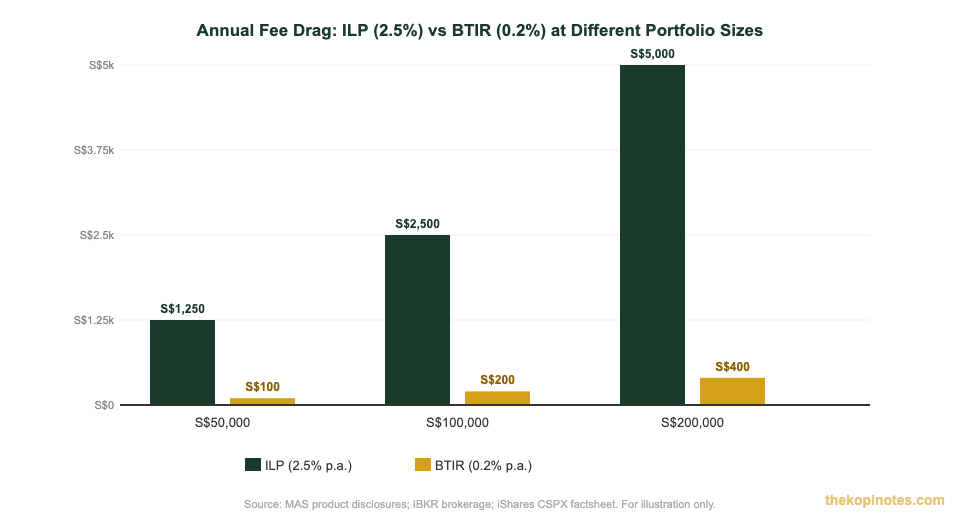
| Cost Component | ILP | BTIR (ETF) |
|---|---|---|
| Fund management charge | 1.0–2.0% p.a. | 0.07–0.20% p.a. |
| Insurance charge | Bundled (hidden) | S$600–900/yr (explicit) |
| Policy/admin fee | S$60–120/yr | Nil |
| Bid-offer spread | 0–5% (older plans) | Nil |
| All-in effective drag | 1.5–3.5% | ~0.2% |
Sources: MAS product highlights; insurer benefit illustrations; iShares, Vanguard factsheets. Figures are representative ranges.
4. 20-Year Projection: S$1,000/month Budget
Assumptions: 7% gross annual return; ILP all-in charge 2.5% p.a. net return 4.5%; BTIR term cost S$800/year invested amount S$933/month at 0.2% p.a. for net return ~6.8%; no surrender charges modelled for ILP after Year 3.
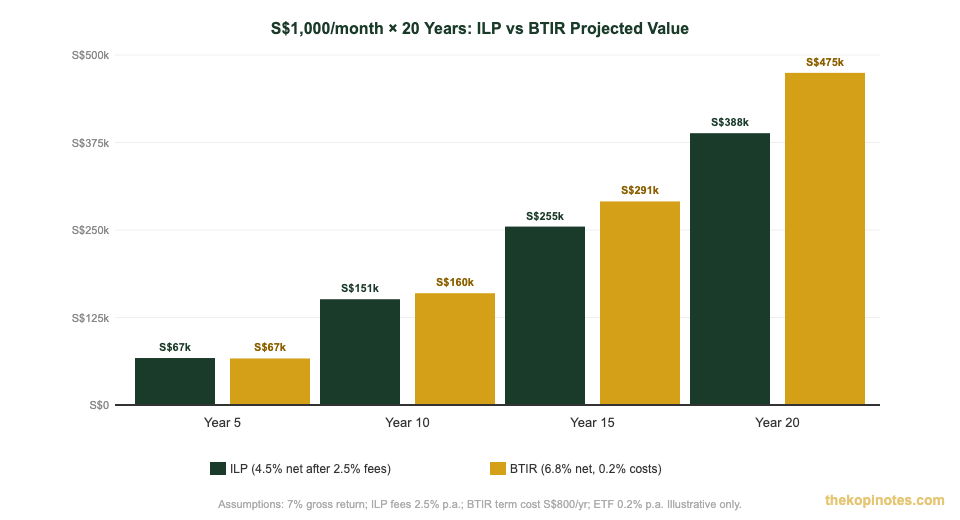
| Year | ILP Value | BTIR Value | BTIR Advantage |
|---|---|---|---|
| Year 5 | S$67,100 | S$66,500 | -S$600 (ILP ahead) |
| Year 7–8 | ~S$106,000 | ~S$108,500 | Crossover |
| Year 10 | S$151,100 | S$159,700 | +S$8,600 |
| Year 15 | S$254,900 | S$290,800 | +S$35,900 |
| Year 20 | S$388,300 | S$474,500 | +S$86,200 |
Illustrative projections only. Past performance is not indicative of future results. Actual returns depend on market conditions, insurer fund performance, and individual circumstances.
5. When ILPs Make Sense
Despite the fee drag, ILPs remain suitable for certain profiles:
Investors Who Cannot Self-Invest
If you consistently fail to invest your savings after buying term, an ILP forces discipline. The bundled structure — albeit costly — beats leaving money idle in a savings account at 2% interest.
Short Horizon (Under 7 Years) with Guaranteed Benefits
Some ILPs offer guaranteed cash-back riders or capital protection floors. If your horizon is 5 years and you value guaranteed minimum returns, ILP can outperform on a risk-adjusted basis.
High Earners Who Want Insurance + Wealth Planning Under One Policy
ILPs can serve estate planning purposes (death benefits bypass probate), suit executives who prefer advisor-managed fund switches, or pair with whole life riders for layered coverage. Bancassurance ILPs from DBS/POSB, OCBC, or UOB are also common in bundled wealth-management packages for high-net-worth clients.
Limited Medical Underwriting Scenarios
Some ILPs have simplified underwriting compared to term policies — useful if you have health conditions that make term insurance expensive or unavailable.
6. When BTIR Wins
BTIR decisively wins if you have a 10-year-plus horizon, financial discipline to invest monthly, and access to a low-cost brokerage or robo-advisor. The compounding advantage of a 6.8% vs 4.5% net return widens dramatically over time — the S$86,200 gap at Year 20 represents roughly 7 extra years of contributions.
BTIR also gives flexibility. You can surrender your term policy if your dependants are financially independent; you cannot easily exit an ILP mid-way without incurring surrender charges (typically 2–5% of fund value in Years 1–5).
Finally, BTIR is transparent. You see exactly what you pay for insurance and exactly what your investments earn. ILPs bundle these costs in ways that even sophisticated investors find hard to disentangle without a financial planner.
7. How to Implement BTIR in Singapore
Step 1: Get Your Term Coverage
Use aggregators like CompareFirst (MAS-licensed), GoBear, or PolicyPal to compare term premiums. Aim for 10–12x your annual income in sum assured, and consider adding a critical illness rider if your employer coverage is thin.
Step 2: Open an Investment Account
For DIY index investing: open an FSMOne or IBKR account — both support CSPX, VWRA, and STI ETF with low transaction costs. For hands-off: Endowus (referral: 2V343) supports CPF OA top-up investing; Syfe (referral: SRPRFFFCD) offers Core portfolios from 0.35% p.a.
Step 3: Automate Your Monthly Invest
Set up a GIRO or standing instruction on the 1st of each month. Most robo-advisors allow auto-invest from S$100/month. Treat it like an insurance premium — non-negotiable.
Step 4: Review Annual
Every year: check your term coverage is still adequate (income changed? dependants changed?), rebalance your ETF portfolio back to target allocation, and verify SRS contribution is maxed if you benefit from the tax relief.
Use our Retirement Calculator to track whether your BTIR portfolio is on track for your target retirement sum.
8. Verdict & Recommendations
For investors aged 25–45 with a 10–20 year horizon, BTIR is the mathematically superior choice in most scenarios. The 2.3% fee gap between a typical ILP and a low-cost ETF BTIR portfolio compounds to a six-figure difference over two decades.
However, the best financial plan is the one you actually execute. If you know you will not invest the savings from buying term — BTIR loses its advantage. Honest self-assessment matters here.
Our recommendation: buy adequate term coverage first (CompareFirst.sg), then automate investing via Endowus or IBKR. Review your ILP if you already have one — if you are past the surrender charge window, consider restructuring. Consult a MAS-licensed financial adviser before making major changes to your insurance portfolio.
9. Frequently Asked Questions
Is ILP better than term insurance?
Can I cancel my ILP and switch to BTIR?
What ILP funds should I choose if I keep my ILP?
Does BTIR work for CPF savings?
How much term insurance do I need in Singapore?
Get Free Insurance Advice
Speak with a licensed insurance advisor. No obligation, no cost.
By submitting this form, you agree to our Privacy Policy.
This article was researched with the help of AI. While we strive to keep all information accurate and up to date, there may be errors. If you notice any discrepancies, please contact us.