Best ILP in Singapore 2026: Top Investment-Linked Policies, Fees & Should You Buy?
An honest, data-driven comparison of Singapore’s top ILPs — so you can decide if one belongs in your financial plan.
An Investment-Linked Policy (ILP) is a life insurance product that combines protection with market-linked investment. The best ILPs in Singapore in 2026 come from AIA, Prudential, Great Eastern, Manulife and NTUC Income — each offering different sub-fund choices, fee structures and protection levels. Whether an ILP suits you depends on your need for insurance coverage alongside investment growth, your willingness to accept market risk, and your ability to tolerate the higher fee drag compared to buying term insurance and investing separately.
Not financial advice. All figures are for educational reference only. Data as at June 2026 unless noted.
- ILPs combine life insurance and investment into one product — but fees (1.5%–3%+ p.a.) significantly reduce your net returns versus buying term insurance and investing separately.
- Best ILPs in Singapore 2026: AIA Pro Achiever 3.0, Prudential PRULink Investor Account, Great Eastern GREAT Flexi Plus, Manulife InvestReady Wealth II, NTUC Income Gro Invest Saver.
- Only buy an ILP if you need bundled insurance and long-term disciplined saving — otherwise, term insurance + ETF/robo-advisor is almost always cheaper.
Table of Contents
Contents — Click to expand
- What Is an ILP in Singapore?
- How Does an ILP Work?
- ILP Fee Breakdown: What You’re Really Paying
- Best ILPs in Singapore 2026: Top 5 Compared
- Top ILP Sub-Fund Returns 2026
- ILP vs Term Life + ETF: Which Wins?
- Who Should (and Should Not) Buy an ILP
- How to Buy an ILP in Singapore (6 Steps)
- Frequently Asked Questions
What Is an ILP in Singapore?
An Investment-Linked Policy (ILP) is a type of life insurance product sold in Singapore where part of your premium buys insurance coverage and part goes into investment sub-funds of your choice.
Unlike traditional whole life or endowment plans where returns are determined by a participating fund, ILP returns are entirely market-linked. If the sub-funds you pick go up, your policy value grows. If they fall, it falls too.
MAS regulates ILPs as Complex Investment Products (CIP) under the Financial Advisers Act. That means your financial adviser must assess your risk profile and investment knowledge before recommending one.
There are two main ILP structures:
- Regular Premium ILP — you pay monthly premiums throughout the policy term (e.g. 10, 20, 25 years). Common for long-term savings and protection planning.
- Single Premium ILP — you invest a lump sum upfront. Protection coverage is lower; the focus is investment growth. Often used by investors with a large capital sum to deploy.
ILPs first became popular in Singapore in the early 2000s as a bundled solution for middle-income earners who wanted protection and investment in one product. Today, they remain common but face growing scrutiny as cheaper alternatives such as term insurance plus robo-advisors or ETFs become easier to access.
How Does an ILP Work? (Regular vs Single Premium)
Understanding how your premium is split is essential before committing to an ILP. Here is the basic mechanics.
Regular Premium ILP
When you pay your monthly premium (say, S$500/month), the insurer deducts insurance charges (called the “cost of insurance” or COI) and policy fees first. The remainder goes into your chosen sub-funds at the prevailing unit price.
In the early years, a large portion of your premium buys units that are immediately deducted as a distribution cost or front-end load. This is why ILP surrender values are very low in the first 5–10 years — you are still recovering those initial costs.
Single Premium ILP
You invest a lump sum (typically S$10,000–S$500,000+). The insurer deducts a small front-end charge (usually 2–5%) and invests the remainder in sub-funds. Protection coverage is typically 101%–125% of account value — so it is primarily an investment with a minimal insurance wrapper.
Here is a simplified illustration of how S$500/month works in a regular premium ILP:
| Year | Total Premiums Paid | Est. Surrender Value (5% p.a. growth) | Break-Even Status |
|---|---|---|---|
| Year 1 | S$6,000 | S$1,500–S$3,000 | ❌ Far from break-even |
| Year 3 | S$18,000 | S$8,000–S$12,000 | ❌ Still below |
| Year 5 | S$30,000 | S$22,000–S$28,000 | ⚠️ Approaching break-even |
| Year 10 | S$60,000 | S$55,000–S$70,000 | ✅ Above break-even |
| Year 20 | S$120,000 | S$130,000–S$180,000 | ✅ Strong growth |
Illustrative only. Actual values depend on sub-fund performance, insurer charges, and cost of insurance. Source: Industry illustrations, June 2026.
ILP Fee Breakdown: What You’re Really Paying
This is the most important section if you are comparing ILPs. ILP fees are layered and often not transparent. Here is a complete breakdown of what you pay.
| Fee Type | How It Works | Typical Range |
|---|---|---|
| Front-End Load / Distribution Cost | Deducted from early premiums as units; used to pay adviser commission | 50%–100% of premiums in first 1–2 years |
| Policy Fee | Fixed monthly charge for policy administration | S$3–S$10/month |
| Cost of Insurance (COI) | Monthly charge for the life/CI/disability coverage; rises with age | Varies by age — can be S$20–S$300+/month at age 50+ |
| Fund Management Fee (TER) | Annual % of sub-fund AUM; charged within the sub-fund NAV | 0.5%–2.5% p.a. depending on fund type |
| Bid-Offer Spread | Difference between buying and selling price of units | 0%–5% per transaction |
| Switching Fee | Fee to switch between sub-funds; first few switches often free | S$0 (first 6) then S$25–S$50 per switch |
| Surrender Charge | Penalty for surrendering in the first 3–5 years | 10%–30% of account value in year 1, reducing to 0% by year 5 |
Source: MAS Product Highlights Sheets, insurer Product Fact Sheets, June 2026. Ranges are indicative — check your specific policy illustration.
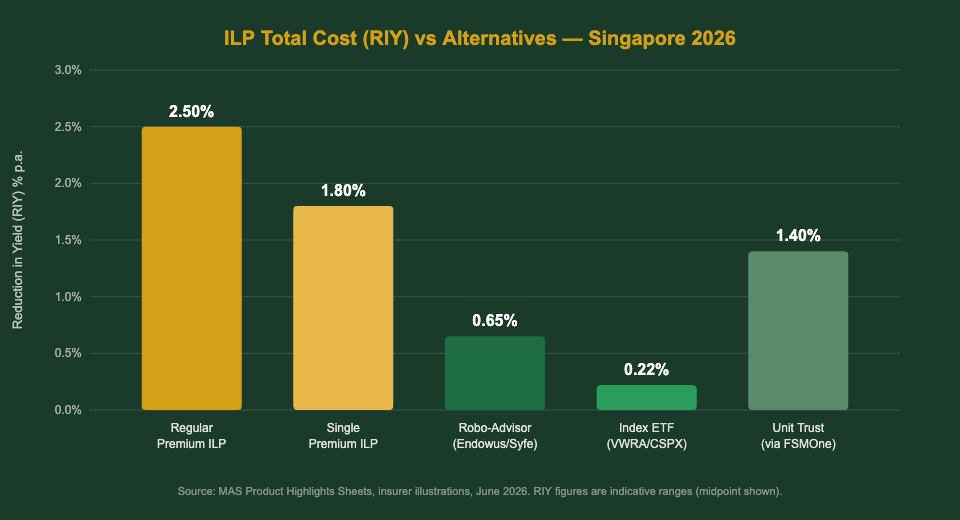
The Reduction in Yield (RIY) is the best single metric to compare ILP cost drag. A typical ILP has an RIY of 1.5%–3.0% p.a. — meaning if your sub-funds grow at 6% p.a., your net return is only 3%–4.5% p.a.
For comparison, a low-cost ETF like CSPX has a total expense ratio of just 0.07% p.a. Over 20 years, this difference compounds dramatically. See our ETF Expense Ratio Impact Calculator to model the exact impact on your portfolio.
Best ILPs in Singapore 2026: Top 5 Compared
Here are the five best ILPs in Singapore based on sub-fund range, fees, flexibility and insurer strength. All five are from MAS-licensed insurers with strong financial ratings.
| Plan | Insurer | Type | Sub-Funds | Min Premium | Key Feature |
|---|---|---|---|---|---|
| AIA Pro Achiever 3.0 | AIA Singapore | Regular | 60+ funds | S$300/mth | Loyalty bonus units from year 2; waiver of premium on TPD |
| Prudential PRULink Investor Account | Prudential Singapore | Single Premium | 50+ funds | S$5,000 lump sum | Low front-end cost; flexible top-ups; SRS eligible |
| Great Eastern GREAT Flexi Plus | Great Eastern | Regular | 40+ funds | S$200/mth | Bonus units from year 3; lowest min entry; CI rider available |
| Manulife InvestReady Wealth II | Manulife Singapore | Regular / Single | 50+ funds | S$300/mth or S$30,000 | Premium waivers on death/TPD; SRS eligible; loyalty bonuses |
| NTUC Income Gro Invest Saver | NTUC Income | Regular | 25+ funds | S$100/mth | Lowest min premium in market; co-op structure; CPF/SRS eligible |
Source: Insurer product pages and MAS Product Highlights Sheets, June 2026. Fund counts are approximate and subject to change.
AIA Pro Achiever 3.0
AIA is Singapore’s largest insurer by total weighted new business. The Pro Achiever 3.0 is their flagship regular premium ILP. Its loyalty bonus structure — where extra units are added from year 2 onwards — helps offset some of the early-year fee drag. You can choose from over 60 sub-funds including global equities, regional equity, fixed income and ESG funds.
Prudential PRULink Investor Account
If you have a lump sum to invest (S$5,000 minimum), Prudential’s single premium ILP is one of the cleanest structures in the market. It has a relatively low front-end charge compared to regular premium ILPs and no surrender penalty after year 2. It is also SRS eligible — useful if you are using your SRS quota for investment. Check our SRS Tax Savings Calculator to see how much tax you can defer.
Great Eastern GREAT Flexi Plus
Great Eastern’s entry is notable for its S$200/month minimum — the lowest among major insurers for a regular premium ILP. It starts adding bonus units from year 3, which helps reduce the effective cost over time. Suitable for younger investors who want to start small and build up coverage and savings.
Manulife InvestReady Wealth II
Manulife offers both regular and single premium options under InvestReady Wealth II, which gives flexibility. The waiver of premium benefit — where Manulife continues to invest on your behalf if you suffer death or TPD — is a meaningful insurance value-add versus a standalone investment account.
NTUC Income Gro Invest Saver
NTUC Income’s co-operative structure means it does not have external shareholders to pay dividends to — which can translate to lower costs over time. Gro Invest Saver has the lowest minimum premium at S$100/month, making it accessible for new investors. However, its sub-fund range is more limited than AIA or Prudential.
Top ILP Sub-Fund Returns in Singapore 2026
The sub-fund you choose inside an ILP matters as much as the ILP itself. Here are the top-performing ILP sub-funds available to Singapore investors, based on 1-year and 3-year returns as at Q1 2026.
| Sub-Fund | Insurer | Asset Class | 1Y Return | 3Y p.a. | TER |
|---|---|---|---|---|---|
| AIA Acorns of Asia Fund | AIA | Asia Equity | +18.4% | +9.2% | 1.50% |
| PRUlink Global Equity | Prudential | Global Equity | +22.1% | +11.5% | 1.75% |
| Manulife Asia Pacific REIT Fund | Manulife | Asia Pacific REIT | +12.3% | +5.8% | 1.20% |
| GE Lion Global Global Technology | Great Eastern | Global Tech Equity | +31.2% | +14.8% | 1.90% |
| NTUC Income Global Balanced Fund | NTUC Income | Global Balanced | +9.7% | +6.4% | 1.15% |
| Manulife Tiger Asia Growth Fund | Manulife | Asia ex-Japan Equity | +16.8% | +8.1% | 1.60% |
| PRUlink Sustainable Global Bond | Prudential | Global Bond (ESG) | +4.1% | +2.9% | 0.95% |
Source: Insurer fund fact sheets and MAS fund summaries, Q1 2026. Past performance is not indicative of future returns.
Note that sub-fund TERs (0.95%–1.90%) are additional to the policy-level fees. Your total cost of investing inside an ILP is the sum of all these layers. If you prefer lower-cost market exposure, you can access similar global equity and REIT exposure via our Singapore REIT ETF guide at a fraction of the cost.
ILP vs Term Life + ETF: Which Wins?
This is the most common question about ILPs — and the honest answer is: for most people in Singapore, buying term life insurance and investing the rest separately wins on pure numbers.
Here is a worked example for a 30-year-old male non-smoker investing S$500/month for 25 years:
| Strategy | Cost of S$500k Coverage | Amount Invested Monthly | Assumed Net Return | Est. Value at Age 55 |
|---|---|---|---|---|
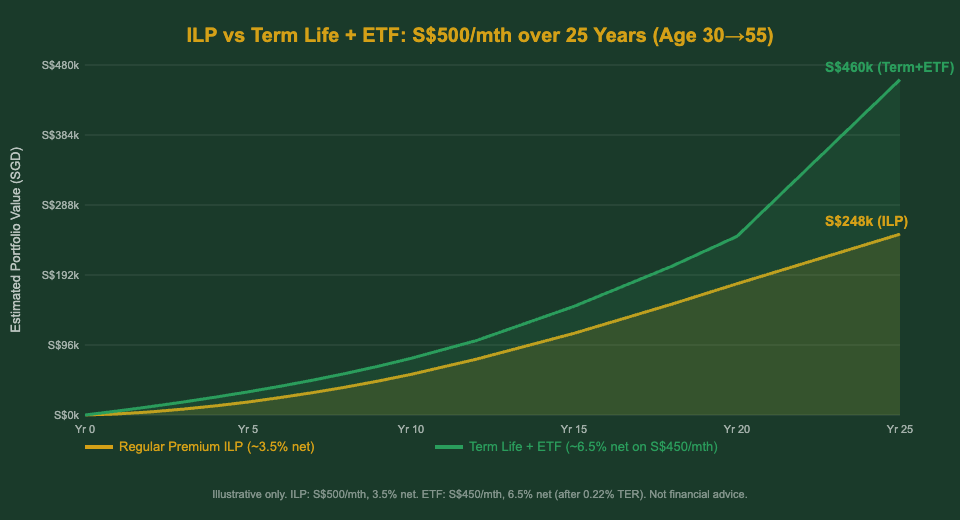
| Regular Premium ILP | Bundled in premium | S$500/mth (all-in) | ~3.5% p.a. net of fees | ~S$248,000 |
| Term Life (25yr) + ETF | ~S$50/mth (term premium) | S$450/mth into ETF | ~6.5% p.a. net of 0.22% TER | ~S$460,000 |
Illustrative only. Term premium estimate based on 25-year S$500k plan, age 30 male non-smoker, June 2026. ETF return based on VWRA historical avg; past performance does not guarantee future returns.
However, ILPs do have genuine advantages in specific situations. They are not universally bad — they just need to be the right tool for the right job.
When you use platforms like Endowus (referral code 2V343) or Syfe (referral code SRPRFFFCD), you can invest through CPF OA, SRS, or cash at much lower costs — starting from 0.3%–0.65% p.a. in advisory fees, plus underlying fund costs. Use our Singapore retirement calculator to model which strategy gets you to your retirement goal faster.
Who Should (and Should Not) Buy an ILP
An ILP is not for everyone — but it does suit specific investor profiles. Here is a clear decision framework:
| Profile | ILP Suitable? | Reasoning |
|---|---|---|
| Young professional wanting bundled coverage and forced savings | ✅ Possibly yes | Simplicity value — one product, one adviser, regular disciplined saving |
| Investor with investable lump sum (S$50k+) and existing term coverage | ❌ No | Use ETF/robo for much lower fees; insurance already covered |
| CPF/SRS user wanting tax-advantaged investment growth | ⚠️ Compare to Endowus/Syfe SRS first | SRS single premium ILP can work, but robo platforms often cheaper |
| Person who cannot stay disciplined with manual investments | ✅ Possibly yes | ILP auto-deduction creates forced savings; surrender penalty discourages withdrawal |
| Close to retirement (age 55+) with short investment horizon | ❌ No | Short horizon — fee drag is not recoverable; COI also rises steeply |
| Self-employed with flexible income and CI coverage need | ✅ Consider with care | Premium holidays and adjustable protection are useful for irregular income |
Source: TKN analysis based on MAS guidelines and typical ILP product structures, June 2026.
If you are unsure about your coverage gap, use our free Insurance Gap Calculator to estimate how much life insurance you actually need before committing to any ILP. For a deeper comparison, read our full Investment-Linked Policy Singapore 2026 guide.
How to Buy an ILP in Singapore (6 Steps)
If you have decided an ILP is right for you, here is the step-by-step process.
Step 1: Define your goal. Are you primarily buying for insurance protection with investment as secondary? Or is investment the primary goal with minimal insurance? This determines whether regular or single premium suits you.
Step 2: Calculate your insurance need. Use the DIME method (Debt + Income replacement + Mortgage + Education) or our Life Insurance Needs Calculator to figure out your target sum assured.
Step 3: Compare at least 3 insurers. Get Product Highlights Sheets and Benefit Illustrations from AIA, Prudential, Great Eastern, Manulife and NTUC Income. Focus on the Reduction in Yield (RIY) figure at year 10 and year 20 — the lower the better.
Step 4: Choose your sub-funds. Ask for the fund fact sheet for each sub-fund. Check the TER, Sharpe ratio, and 5-year track record. A global equity fund tracking developed markets is a sensible default for most investors.
Step 5: Apply through a licensed financial adviser. MAS requires an FA to conduct a needs analysis before recommending an ILP. You can also apply direct via insurer apps (AIA+, Prudential e-Application) for some single premium products.
Step 6: Review annually. Unlike ETFs, ILPs need active management. Review your sub-fund performance, cost of insurance, and total account value vs total premiums paid every 12 months. To compare how your CPF investment strategy fits into the bigger picture, read our CPF investment strategy guide.
Start Investing the Lower-Cost Way
Before committing to an ILP, compare with lower-cost alternatives — invest through CPF OA or SRS via Endowus or Syfe at a fraction of the fee.
Frequently Asked Questions: Best ILP in Singapore
What is the best ILP in Singapore in 2026?
The best ILP in Singapore in 2026 depends on your needs. For regular premium ILPs, AIA Pro Achiever 3.0 and Great Eastern GREAT Flexi Plus stand out for loyalty bonuses and wide sub-fund range. For single premium ILPs, Prudential PRULink Investor Account offers one of the cleanest fee structures. NTUC Income Gro Invest Saver has the lowest minimum premium at S$100/month, suitable for new investors.
What is the difference between an ILP and an endowment plan?
An endowment plan guarantees a minimum sum at maturity through a participating fund managed conservatively by the insurer. Returns are partly guaranteed, partly non-guaranteed bonuses. An ILP invests your premium in market-linked sub-funds you choose — returns are fully market-dependent with no guarantee. ILPs offer more growth potential but also more risk; endowment plans offer more certainty but lower upside.
Can I use CPF or SRS to buy an ILP in Singapore?
Yes — some ILPs are SRS-eligible and CPFIS-approved. Single premium ILPs are more commonly available under CPF Investment Scheme (CPFIS-OA). Regular premium ILPs are typically cash-funded. Check the insurer’s CPFIS and SRS eligibility before applying. Using SRS to fund a single premium ILP can be tax-efficient as SRS contributions reduce your taxable income.
What happens if I stop paying my ILP premium?
Most regular premium ILPs allow a premium holiday — you temporarily stop paying but the policy continues. During the holiday, the insurer deducts the cost of insurance and policy fees from your existing account value by selling sub-fund units. If your account value falls too low, the policy may lapse. Always check your policy’s premium holiday terms and minimum account value requirements before stopping premiums.
What is Reduction in Yield (RIY) in an ILP?
Reduction in Yield (RIY) is the annual percentage by which ILP fees reduce your investment return. For example, if your sub-fund grows at 6% p.a. but the RIY is 2.5%, your net return is approximately 3.5% p.a. RIY accounts for all policy charges including front-end loads, COI, policy fees, and sub-fund TER. It is the single best number to compare the true cost between ILPs. A lower RIY means more of your money stays invested.
Is buying an ILP the same as buying unit trusts?
Not exactly. An ILP invests in sub-funds which are similar to unit trusts, but they are wrapped inside an insurance policy. This means you get life insurance coverage alongside investment, but also pay additional charges on top of the sub-fund’s own TER. You do not directly own units in the underlying fund. Unit trusts bought directly (e.g. via FSMOne) have no additional insurance charges and are generally cheaper for pure investment.
What happens to my ILP if I die?
On death, your ILP typically pays the higher of the sum assured (death benefit) or the account value (current sub-fund value). For regular premium ILPs, the sum assured is usually a multiple of your annual premium (e.g. 125% or 500%). Death proceeds are paid to your nominated beneficiaries and are generally not subject to Singapore estate duty (abolished in 2008).
Can I switch sub-funds inside my ILP?
Yes — most ILPs allow you to switch between sub-funds, typically with the first 6–12 switches per year free, and a fee of S$25–S$50 per switch thereafter. Switching does not trigger income tax in Singapore. This flexibility is useful if your investment outlook changes — for example, reducing equity exposure as you approach retirement and shifting into bond or balanced funds.
Should I surrender my ILP if it is not performing?
Surrendering early (especially within the first 5 years) usually means receiving much less than you put in, due to front-end charges and surrender penalties. Before surrendering, consider switching to lower-risk sub-funds, requesting a premium holiday to pause costs, or doing a policy review with your adviser. If the policy has significant investment value built up (e.g. after 10+ years), run the numbers carefully before deciding to surrender for reinvestment elsewhere.
Get Free Insurance Advice
Speak with a licensed insurance advisor. No obligation, no cost.
By submitting this form, you agree to our Privacy Policy.
This article was researched with the help of AI. While we strive to keep all information accurate and up to date, there may be errors. If you notice any discrepancies, please contact us.