ILP vs Buy Term Invest the Rest (BTIR): Which Is Right for You? (2026 Singapore Guide)
A neutral, data-driven comparison — real fees, worked SGD examples, and what r/singaporefi actually says about both approaches.
Investment-Linked Policies (ILPs) and Buy Term Invest the Rest (BTIR) are two fundamentally different ways to combine life insurance with wealth building in Singapore. ILPs bundle insurance coverage and investment into a single product managed by your insurer. BTIR separates them — you buy a cheap term life policy for protection and invest the premium savings yourself, typically into low-cost ETFs like VWRA. Neither approach is universally “better.” The right choice depends on your financial literacy, discipline, and personal circumstances.
Not financial advice. All figures are for educational reference only. Data as at June 2026 unless noted.
- ILP suits you if: You want a single product that combines insurance + investment, you value forced savings, and you’re unlikely to invest consistently on your own
- BTIR suits you if: You’re comfortable managing your own investments, you understand fees matter, and you have the discipline to actually invest the difference every month
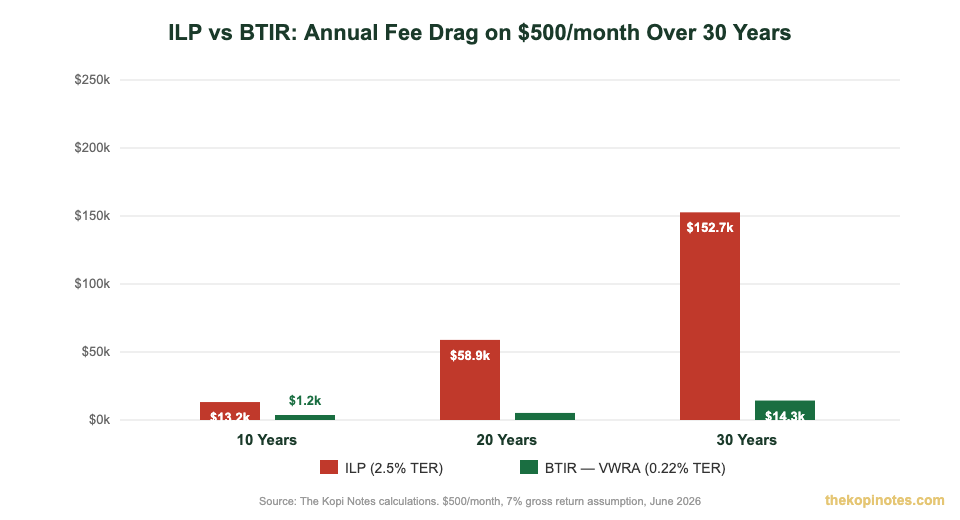
- The fee difference is real: Over 30 years, a typical ILP’s 2.5% TER costs roughly $138,000 more in fees than BTIR with VWRA (0.22% TER) on the same $500/month budget
Table of Contents
Contents — Click to expand
What Is an ILP (Investment-Linked Policy)?
An Investment-Linked Policy is a life insurance product that bundles insurance coverage with investment. Your monthly premium gets split into two portions: one pays for life insurance protection (death, total and permanent disability, and sometimes critical illness), and the other is invested into sub-funds managed by the insurer.
Think of it as a two-in-one product. You get insurance coverage and your money is invested — all managed through a single policy statement from one insurer. The investment portion is denominated in “units,” similar to unit trusts.
ILPs are regulated by the Monetary Authority of Singapore (MAS) under the Guidelines on Investment-Linked Policies. Every insurer must provide a Product Highlights Sheet (PHS) and Product Summary that disclose all fees.
Here’s the important nuance most people miss: not all ILPs are created equal. There are “regular premium” ILPs (monthly contributions, often with high front-end loading) and “single premium” ILPs (lump-sum investment with typically lower fees). The debate around ILP costs mostly centres on regular premium ILPs.
What Is Buy Term Invest the Rest (BTIR)?
BTIR is a strategy, not a product. The idea is simple: instead of buying an ILP or whole life plan, you buy the cheapest term life insurance that covers your protection needs. Then you invest the difference in premiums yourself.
For example, if an ILP costs $500/month and a term life policy costs $50/month for the same death coverage, you invest the remaining $450/month into low-cost instruments like index ETFs. This way, your insurance and investments are completely separate.
The appeal of BTIR comes down to cost. Term life insurance is pure protection — no cash value, no investment component. It’s dramatically cheaper than ILPs or whole life policies for the same coverage amount. A 30-year-old non-smoking male can get $500,000 of death and TPD (Total and Permanent Disability) coverage for around $30–$50/month with a best term life insurance Singapore plan.
The “invest the rest” part usually means putting money into a low-cost global ETF like VWRA (Vanguard FTSE All-World UCITS ETF) with a TER of just 0.22% per year — a fraction of what most ILP sub-funds charge. You can start investing in VWRA through brokers like Interactive Brokers or through a robo-advisor. If you’re exploring brokerage options, our best brokerage account Singapore comparison can help.
What r/singaporefi Actually Says
The ILP vs BTIR debate is one of the most heated topics on Reddit’s Singapore personal finance communities. Here’s a fair summary of what both camps argue — and where they have a point.
The Anti-ILP Camp
“The fees are a wealth destroyer.” This is the most common argument. Reddit users frequently point out that ILP sub-funds charge 1.5%–3% in total annual fees (including fund management fees, policy administration charges, and insurance coverage charges). Over decades, this fee drag compounds into a massive difference. One popular Reddit post calculated that a 2.5% TER costs you nearly $150,000 more over 30 years compared to a 0.22% ETF. The maths checks out — we’ll show you the exact numbers below.
“Your agent earns a year’s premium in commission.” According to MoneySense (Singapore Government), ILP distribution costs — including agent commissions — are funded by the sale of units in the early years. For a $500/month ILP, agent commission is typically worth $6,000 or more. Many Redditors argue this creates a conflict of interest: the product that pays the agent the most isn’t necessarily the best for you.
“Just buy term + VWRA and chill.” The r/singaporefi community generally favours a simple portfolio: term life for protection, and a globally diversified UCITS ETF like VWRA or IWDA for long-term wealth building through your Endowus referral code or a direct brokerage account.
The Pro-ILP Camp (Yes, It Exists)
“Forced savings actually works for most people.” This counterargument is underrated. Pro-ILP commenters point out that many Singaporeans who choose BTIR never actually invest “the rest.” They buy the cheap term policy, then spend the savings on lifestyle upgrades. An ILP forces you to save and invest every month through automatic premium deductions. For someone with low financial discipline, this forced structure can outperform BTIR in practice — even if BTIR wins on paper.
“Not everyone wants to manage a portfolio.” Some Redditors acknowledge that not everyone has the interest or confidence to open a brokerage account, research ETFs, and execute trades. An ILP offers simplicity: one product, one statement, one contact person. For someone who finds investing intimidating, this convenience has real value.
“Newer ILPs have improved.” A smaller group points out that some newer ILPs — particularly single-premium and low-cost variants — have reduced their TERs. While they’re still more expensive than buying a passive ETF directly, the gap has narrowed for certain products. The best ILP in Singapore 2026 options now include some with lower fee structures.
The Nuanced Middle Ground
“It depends on the person.” The most helpful Reddit comments acknowledge that ILP vs BTIR isn’t a one-size-fits-all answer. If you score high on financial literacy, investment discipline, and comfort with DIY investing, BTIR almost always wins mathematically. However, if you genuinely won’t invest on your own, an ILP — despite its higher fees — might produce a better outcome than buying term and spending the rest.
Head-to-Head Comparison: ILP vs BTIR
| Feature | ILP | BTIR |
|---|---|---|
| Annual Fees (TER) | 1.5%–3.0% | 0.22% (VWRA) |
| Insurance Coverage | Bundled — death, TPD, CI (varies) | Separate term policy — death, TPD |
| Investment Flexibility | Limited to insurer’s sub-funds | Full choice — any ETF, stock, bond |
| Forced Savings | Yes — automatic | No — requires self-discipline |
| Returns Potential | Lower (after fees) | Higher (lower fees compound) |
| Liquidity | Low — surrender charges apply | High — sell ETFs anytime |
| Complexity | Low — one product | Moderate — manage 2 products |
| Surrender Penalty | Yes — typically 5–7 years | None (ETFs sell at market price) |
| Tax Efficiency (SG) | Insurance payouts tax-free | No capital gains tax in SG |
| Transparency | Multiple fee layers | Single TER, publicly disclosed |
| Bid-Offer Spread | ~5% on purchase | Near zero (exchange-traded) |
Source: MoneySense (MAS), insurer Product Highlight Sheets, fund factsheets. As at June 2026.
The Real Cost Comparison: ILP vs BTIR Over 30 Years
Let’s run the numbers with a realistic scenario. Meet Sarah — a 30-year-old non-smoking Singaporean female with a $500/month budget for insurance and investments.
Path A: ILP at 2.5% TER
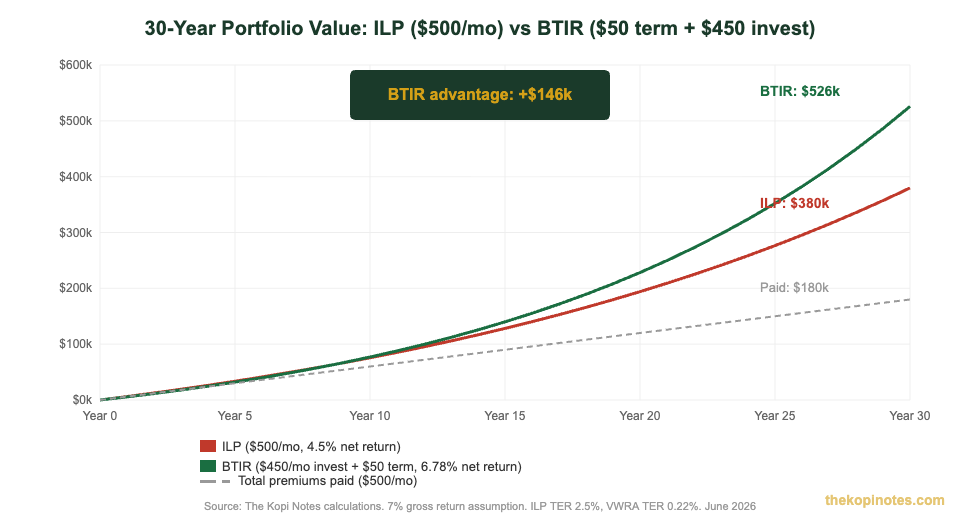
Sarah puts $500/month into a regular-premium ILP. Her insurer charges a Total Expense Ratio of 2.5% (including fund management fees of ~1.25%, policy administration charges of ~1.0%, and insurance coverage charges deducted from units). Assuming a 7% gross market return, her net annual return after fees is approximately 4.5%.
Path B: BTIR — Term Life + VWRA
Sarah buys a term life policy for $50/month (covering $500,000 death + TPD for 30 years) and invests the remaining $450/month into VWRA through Interactive Brokers. VWRA charges 0.22% TER. Her net annual return after fees is approximately 6.78%.
| Metric | ILP ($500/mo) | BTIR ($50 term + $450 invest) | Difference |
|---|---|---|---|
| Total Premiums Paid (30 yrs) | $180,000 | $180,000 | $0 |
| Amount Actually Invested | $500/mo (minus fees) | $450/mo | — |
| Net Annual Return | ~4.5% | ~6.78% | 2.28% |
| Portfolio at Year 10 | ~$75,600 | ~$78,400 | +$2,800 |
| Portfolio at Year 20 | ~$197,800 | ~$230,500 | +$32,700 |
| Portfolio at Year 30 | ~$392,000 | ~$530,000 | +$138,000 |
| Insurance Coverage | Included in ILP | $500k term life | Comparable |
Source: The Kopi Notes calculations. 7% gross return assumption, ILP TER 2.5%, VWRA TER 0.22%. Term life premium estimated at $50/month for 30-year-old female, $500k coverage, 30-year term. June 2026.
The difference is striking. Over 30 years, BTIR produces approximately $138,000 more than an ILP — even though BTIR invests $50 less per month (because $50 goes to term insurance separately). That’s the power of compounding fee differences over time.
However, here’s what the table doesn’t show: the ILP provides insurance coverage that adjusts with your investment value, and the BTIR investor must have the discipline to actually invest $450 every single month for 30 years. If you “buy term and spend the rest,” the maths flips entirely. Use our Singapore retirement calculator to model your own scenario.
When ILP Actually Makes Sense
Despite the fee disadvantage, there are legitimate situations where an ILP can be the right choice. Being honest about this matters — dismissing ILPs entirely ignores how real people behave with money.
1. You genuinely won’t invest on your own. This is the strongest case for ILPs. Studies consistently show that many people intend to invest but never follow through. If you know yourself well enough to admit that a $450/month “investment fund” would gradually become a “lifestyle fund,” an ILP’s forced savings mechanism has genuine value. A guaranteed 4.5% net return beats a theoretical 6.78% return that never materialises.
2. You want maximum simplicity. One product, one statement, one advisor to call. For someone who finds investing stressful or confusing, the simplicity of an ILP means they’re more likely to stick with it for the full 20–30 years. The best ILP is the one you actually hold long enough to benefit from.
3. Certain low-cost ILPs have narrowed the gap. Not all ILPs charge 2.5% TER. Some newer single-premium ILPs and insurance savings plans have TERs closer to 1.0%–1.5%. While still higher than a passive ETF, the gap shrinks meaningfully. If you’re comparing a 1.2% ILP vs a BTIR investor who pays 0.22% TER plus $15/trade brokerage fees on small monthly amounts, the effective difference narrows.
4. Estate planning and nomination benefits. ILP payouts to nominated beneficiaries bypass the estate and probate process. This can be useful if your family situation is complex. Term life policies also offer nomination, but the ILP’s investment component follows the same streamlined path.
5. You’re uncomfortable with market volatility. ILP sub-funds include conservative and balanced options. If the thought of checking your VWRA portfolio during a 30% market crash makes you panic-sell, a managed ILP where someone else handles the allocation might produce better behavioural outcomes — even if the gross returns are lower.
When BTIR Is Better
For many Singaporeans — particularly those in the r/singaporefi community — BTIR is the clearly superior approach. Here’s when it shines.
1. You’re financially literate and willing to learn. If you understand what an expense ratio is, can open a brokerage account, and know how to buy an ETF, you’re already equipped for BTIR. The learning curve isn’t steep — once you’ve set up a monthly DCA (Dollar Cost Averaging) into VWRA or a similar fund, the ongoing effort is minimal. You can explore options through a Syfe referral code and sign-up bonus for a guided robo-advisor experience.
2. You have the discipline to invest consistently. BTIR only works if you actually invest the difference. If you can set up a standing instruction to transfer $450/month to your brokerage and buy ETFs on autopilot, you’ll almost certainly come out ahead over 20–30 years.
3. You’re cost-conscious. The 2.28% annual fee difference between a typical ILP and VWRA compounds dramatically over decades. As our worked example showed, that’s roughly $138,000 over 30 years. If fees matter to you — and they should — BTIR wins decisively.
4. You want flexibility and liquidity. Life is unpredictable. With BTIR, you can pause investments during tough months, sell ETF units for emergencies, or adjust your portfolio anytime — with no surrender penalties. With an ILP, surrendering in the first 5–7 years often means losing a significant chunk of your money.
5. You want to separate insurance from investment. This is a philosophical point, but a good one. When your insurance and investments are separate products, you can optimise each independently. You can shop for the cheapest term life policy every few years, and independently choose the best-performing, lowest-cost investment vehicle.
Decision Framework: Which Should You Choose?
Instead of a blanket recommendation, use this checklist to figure out which approach suits you. Be honest with yourself — the right answer depends on self-knowledge, not just maths.
- You’ve tried to save/invest before but couldn’t stick with it
- You prefer someone else to manage your money
- You want one product and one statement to track
- You find the idea of opening a brokerage account intimidating
- You’re okay paying higher fees for convenience and structure
- You’ve compared ILP options and found one with a TER below 1.5%
- You understand basic investing concepts (ETFs, TER, diversification)
- You can commit to auto-investing a fixed amount each month
- You’ve already opened or are willing to open a brokerage account
- You want maximum control over your money
- The fee difference matters to you (it should — $138k over 30 years)
- You won’t panic-sell during market downturns
The grey area is real. Some people fall between both camps. If that’s you, consider a hybrid approach: buy term insurance for protection, put a portion into a low-cost ILP or insurance savings plan for forced savings, and invest the rest into ETFs yourself. This isn’t theoretically optimal, but it’s practically resilient — it hedges against your own behavioural weaknesses.
Common Mistakes With Both Approaches
ILP Mistakes
Not checking the TER before buying. Many ILP buyers never look at the Product Highlights Sheet. They focus on projected returns (which are hypothetical) and ignore the guaranteed fees (which are real). Always ask your advisor: “What is the total annual cost, including fund management fees, policy charges, and insurance deductions?”
Surrendering too early. ILPs are designed for long-term holding. If you surrender within the first 5–7 years, front-end loading means you may get back significantly less than you put in. According to MoneySense, the premium allocation rate in early years can mean less than half your premium buys actual investment units.
Ignoring the insurance cost escalation. ILP insurance charges increase with age. By your 50s and 60s, the monthly insurance deduction from your units can be substantial — eating into your investment returns. Many policyholders are surprised when their unit balance stagnates or shrinks in later years despite positive market performance.
BTIR Mistakes
Buying term but never investing the rest. This is the #1 failure mode of BTIR. The strategy literally depends on the “invest the rest” part. If you buy a $50/month term plan and spend the other $450 on dining, travel, and gadgets, you’ll reach 65 with no coverage (term expired) and no savings. Set up automatic monthly investing the day you buy your term policy.
Overcomplicating the investment side. Some BTIR adopters fall down a rabbit hole of stock-picking, crypto trading, and market timing. The beauty of BTIR is simplicity: buy one global ETF consistently. If you’re spending hours a week on your portfolio, you’re doing it wrong. A single VWRA holding or even a robo-advisor like Syfe keeps it simple.
Letting the term policy lapse by accident. If you stop paying your term life premium, your coverage ends. Unlike whole life or ILPs (which have cash value to sustain the policy briefly), term life has no buffer. Set up GIRO and never cancel it until you’ve consciously decided you no longer need life insurance.
Not reviewing coverage as life changes. Your insurance needs change over time. When you get married, have kids, or take on a mortgage, you might need to increase your term coverage. BTIR requires you to actively manage this — unlike an ILP where your advisor might prompt a review. If you’re assessing your insurance needs, our guide on insurance surrender value explains what happens if you need to exit an existing policy.
Not financial advice. The information above is for educational purposes only. Consider consulting a licensed financial advisor for personalised recommendations.
Frequently Asked Questions
What is the main difference between ILP and Buy Term Invest the Rest in Singapore?
An ILP bundles insurance and investment into a single product managed by your insurer, with typical annual fees of 1.5%–3.0%. BTIR separates them — you buy cheap term life insurance for protection (around $30–$50/month for a 30-year-old) and invest the premium savings yourself into low-cost ETFs like VWRA (0.22% annual fee). The key difference is cost: BTIR is significantly cheaper in fees, but requires financial discipline and investment knowledge. ILP offers convenience and forced savings at a higher cost.
How much does an ILP really cost in Singapore compared to BTIR?
A typical ILP in Singapore charges a Total Expense Ratio (TER) of 1.5%–3.0% per year, which includes fund management fees, policy administration charges, and insurance coverage charges. On top of this, there’s often a bid-offer spread of around 5% on purchases. In contrast, BTIR with VWRA costs just 0.22% TER. On a $500/month budget over 30 years, the fee difference works out to approximately $138,000 — money that stays invested and compounds in the BTIR approach. ILP distribution costs, including agent commissions worth roughly one year’s premium, are also funded from your early policy years.
Is BTIR always better than ILP?
No. BTIR is mathematically better if you actually follow through on the “invest the rest” part. However, research and real-world experience show that many people buy term insurance but never invest the savings. If you know you lack the discipline to invest consistently every month for decades, an ILP’s forced savings structure may produce a better outcome for you in practice — even though it loses on paper. The best strategy is the one you’ll actually stick with for 20–30 years.
What happens if I surrender my ILP early?
Surrendering an ILP in the first 5–7 years typically results in significant losses. ILPs have front-end or back-end loading structures that fund distribution costs (including agent commissions) in the early years. According to MoneySense (Singapore Government), the premium allocation rate means that in early years, only a portion of your premium actually buys investment units. For example, after paying $6,000/year for 6 years ($36,000 total), your guaranteed surrender value might be only $7,000–$15,000. If you’re considering surrendering, weigh the remaining surrender charges against the ongoing fee drag of keeping the ILP.
Can I do BTIR using a robo-advisor like Syfe or Endowus instead of buying ETFs directly?
Yes, and for many Singaporeans this is a practical middle ground. Robo-advisors like Syfe, Endowus, and StashAway charge management fees of 0.2%–0.65% on top of the underlying fund fees. While this is slightly more expensive than buying VWRA directly (0.22% TER), it’s still significantly cheaper than an ILP’s 1.5%–3.0% TER. Robo-advisors also handle rebalancing, tax optimisation, and portfolio construction — making the “invest the rest” part easier. It’s a solid option if you want BTIR’s cost advantage without managing your own brokerage account.
What does r/singaporefi recommend — ILP or BTIR?
The Reddit r/singaporefi community overwhelmingly favours BTIR. The most common recommendation is to buy the cheapest term life insurance for your protection needs and invest the savings into a global UCITS ETF like VWRA (Vanguard FTSE All-World) through Interactive Brokers. However, more nuanced commenters acknowledge that BTIR requires discipline, and that ILPs serve a purpose for people who won’t invest on their own. The key Reddit consensus: if you’re financially literate enough to be reading r/singaporefi, you’re almost certainly better off with BTIR.
How much term life insurance does a 30-year-old Singaporean need?
A common rule of thumb is 9–12x your annual income. For a 30-year-old earning $5,000/month ($60,000/year), that means $540,000–$720,000 in coverage. You should also factor in outstanding debts (mortgage, car loan) and dependent needs (children’s education, elderly parents’ care). A 30-year-old non-smoking male can get $500,000 of term life coverage for approximately $30–$50/month, depending on the insurer and coverage term. Compare plans from Singapore’s major insurers to find the best rate for your profile.
Are there any good ILPs in Singapore with low fees?
Some ILPs have lower fees than the industry average. Single-premium ILPs and certain insurance savings plans (like Singlife’s offerings) tend to have lower total costs than traditional regular-premium ILPs. However, even “low-cost” ILPs typically charge 1.0%–1.5% TER — still several times more expensive than buying a passive ETF directly at 0.07%–0.22%. If you’re drawn to the convenience of an ILP, look for products with no bid-offer spread, low policy administration charges, and competitive fund management fees. Always check the Product Highlights Sheet for the full fee breakdown.
Ready to Start Investing?
Whether you choose ILP or BTIR, the most important step is starting. Use our tools and referral links to get the best deals.
Get Free Insurance Advice
Speak with a licensed insurance advisor. No obligation, no cost.
By submitting this form, you agree to our Privacy Policy.
This article was researched with the help of AI. While we strive to keep all information accurate and up to date, there may be errors. If you notice any discrepancies, please contact us.