Insurance Surrender Value Singapore 2026: Complete Guide
How to calculate your surrender value, when it’s worth surrendering, and what you’ll actually lose — explained in plain English.
Insurance surrender value is the cash amount your insurer pays you when you cancel a life insurance or savings policy before it matures. In Singapore, surrender values are typically zero in the first year or two, then grow slowly — most policies only return 100% of premiums after 7–10 years. Surrendering early can mean losing 20–50% of every premium you’ve paid. Knowing your policy’s surrender schedule before you sign is essential.
Not financial advice. All figures are for educational reference only. Data as at June 2026 unless noted.
- Surrender value = the cash you get back if you cancel your policy early — almost always less than what you paid in
- Most endowment and whole life policies only break even on surrender value after 7–10 years of paying premiums
- Before surrendering, check your policy illustration for the exact surrender value table, then compare alternatives (premium holiday, policy loan, partial withdrawal)
Table of Contents
Contents — Click to expand
- What Is Insurance Surrender Value?
- How Is Surrender Value Calculated in Singapore?
- Surrender Value by Policy Type
- Typical Surrender Value Timeline (Illustrative)
- When Does Surrendering Make Sense?
- Alternatives to Surrendering Your Policy
- How to Request Your Surrender Value in Singapore
- Tax Treatment of Surrender Proceeds in Singapore
- Frequently Asked Questions
What Is Insurance Surrender Value?
When you buy a life insurance, endowment, or savings plan in Singapore, you’re entering a long-term contract. You agree to pay premiums for a set number of years. The insurer invests those premiums and promises to pay you a lump sum at maturity.
But what if you need the money earlier — or simply can’t afford the premiums anymore?
That’s where surrender value comes in. Surrender value (also called cash surrender value or CSV) is the amount your insurer will pay you if you voluntarily cancel the policy before it matures. It’s essentially the “exit payout”.
The key thing to understand: surrender value is almost always less than what you’ve paid in — especially in the early years. Insurers deduct upfront costs, agent commissions, mortality charges, and administrative fees from the fund before they can pay you anything back.
Surrender value is a feature of participating (par) policies — products that build cash value over time. These include endowment plans, whole life insurance, Investment-Linked Policies (ILPs), universal life insurance, and insurance savings plans. Pure term life insurance has no surrender value, since it only pays out on death or total permanent disability.
How Is Surrender Value Calculated in Singapore?
There is no single universal formula. Each insurer sets its own surrender value schedule, and the exact amounts are disclosed in your policy illustration — the document you should receive before you sign.
That said, the general structure works like this:
Surrender Value = Guaranteed Surrender Value + Non-Guaranteed Surrender Value (Bonus)
Here’s what each component means:
| Component | What It Is | Guaranteed? |
|---|---|---|
| Guaranteed Surrender Value (GSV) | The minimum amount the insurer promises to pay — regardless of market conditions | ✓ Yes |
| Non-Guaranteed Surrender Value | Accumulated bonuses declared by the insurer based on par fund performance — can be higher or lower than illustrated | ✗ No |
| Policy Loan Outstanding | If you’ve taken a loan against your policy, this is deducted from the surrender payout | N/A |
| Surrender Charge | A penalty deducted in early years — some policies charge 5–15% in Year 1–5 | Varies |
Source: MAS Policy Illustration Guidelines, LIA Singapore 2026
The guaranteed surrender value is typically a percentage of the total premiums you’ve paid. In Year 3, this might be 30–40% of premiums paid. By Year 10, it could be 70–80%. The non-guaranteed component adds on top if the insurer’s participating fund has performed well.
This is why you must read your policy illustration carefully. On page 3–5 of most illustrations, there’s a table showing the projected surrender values year by year — both at the 4.25% and 3.00% illustrated investment return scenarios required by MAS.
Surrender Value by Policy Type
Different insurance products in Singapore build surrender value at very different rates. Here’s how they compare:
| Policy Type | Has Surrender Value? | Typical Break-Even Year | Key Risk |
|---|---|---|---|
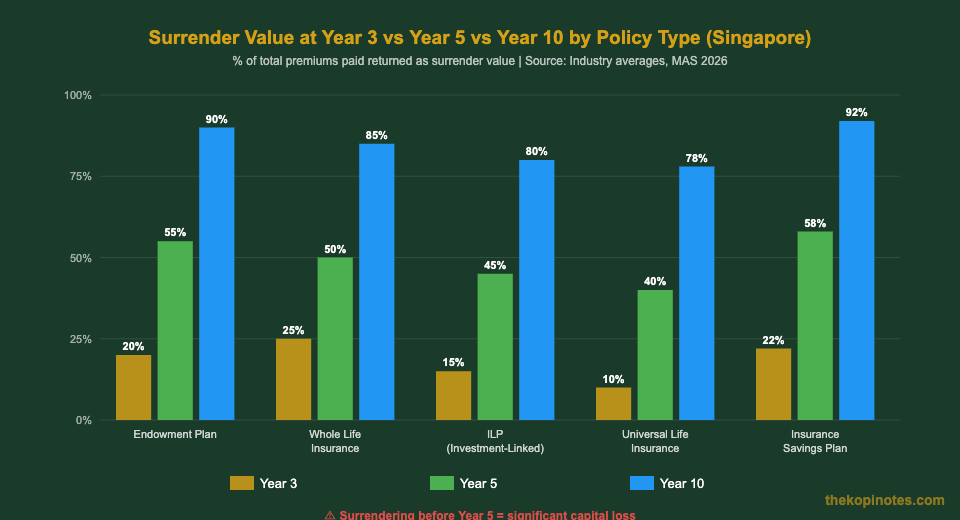
| Endowment Plan | Yes | Year 7–10 | Surrender early → lose 30–50% of premiums |
| Whole Life Insurance | Yes | Year 8–12 | Also lose life coverage permanently |
| ILP (Investment-Linked Policy) | Yes | Year 6–10 | High upfront fees eat into sub-fund value |
| Universal Life Insurance | Yes | Year 8–12 | Surrender charges can last 15+ years |
| Insurance Savings Plan | Yes | Year 6–9 | Often no partial withdrawal allowed |
| Term Life Insurance | No | N/A | No cash value — just pure protection |
Source: LIA Singapore, insurer policy illustrations, MAS guidelines 2026
Notice that term life insurance has no surrender value at all. If you stop paying premiums on a term policy, the coverage simply lapses. There’s no cash back. That’s actually one reason term life is so much cheaper than whole life — you’re paying purely for protection, not building a cash reserve.
For whole life policies, surrendering is a double hit: you lose the cash value built up AND you permanently lose your life coverage. If you’re older and in poorer health, getting a new policy later will be significantly more expensive — or may not be possible at all.
Typical Surrender Value Timeline (Illustrative)
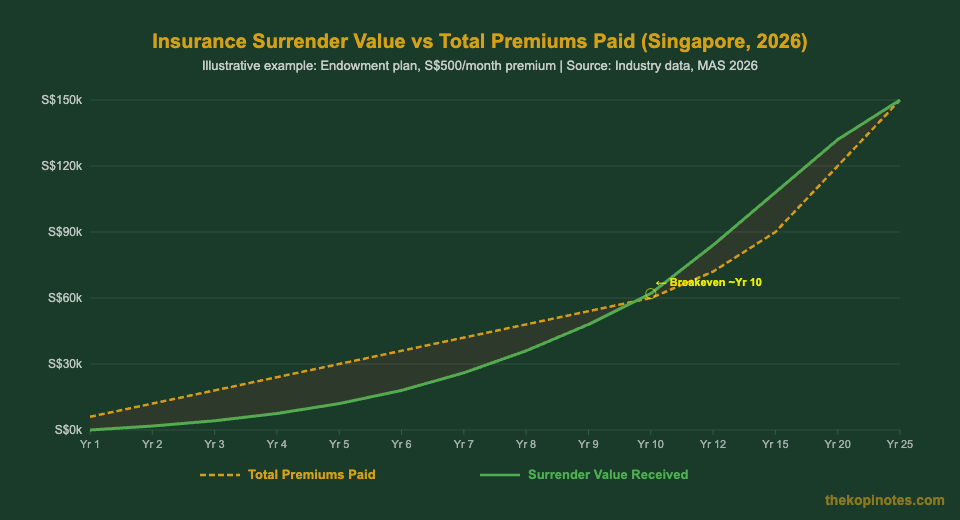
To make this concrete, here’s what a typical Singapore endowment plan paying S$500/month (S$6,000/year) might look like over 25 years. These are illustrative figures based on industry averages — your actual policy will differ.
| Policy Year | Total Premiums Paid | Surrender Value (Guaranteed) | Surrender Value (Projected) | % of Premiums Returned |
|---|---|---|---|---|
| Year 1 | S$6,000 | S$0 | S$0 | 0% |
| Year 2 | S$12,000 | S$1,800 | S$2,100 | 15–18% |
| Year 3 | S$18,000 | S$4,500 | S$5,200 | 25–29% |
| Year 5 | S$30,000 | S$16,500 | S$18,200 | 55–61% |
| Year 7 | S$42,000 | S$31,500 | S$35,700 | 75–85% |
| Year 10 | S$60,000 | S$54,000 | S$63,000 | 90–105% |
| Year 15 | S$90,000 | S$85,500 | S$108,000 | 95–120% |
| Year 25 (Maturity) | S$150,000 | S$150,000 | S$178,000 | 100–119% |
Illustrative example only: S$500/month endowment plan, 25-year tenor. Guaranteed values at 0% bonus; projected values at 4.25% illustrated rate. Your actual policy will differ. Source: Industry averages, LIA Singapore 2026.
The table tells a clear story. Surrender in Year 3 and you get back roughly S$5,200 on S$18,000 paid — a loss of S$12,800. Wait until Year 10 and you start to break even or even turn a modest profit on the guaranteed portion.
This is why financial advisers generally say: if you can hold to maturity, you should. But life doesn’t always cooperate with 25-year plans.
When Does Surrendering Make Sense?
Surrendering should be a last resort, not a first response to a cash crunch. But sometimes it genuinely is the right call. Here’s a framework to decide:
Surrendering may be the right move if:
- You genuinely cannot afford the premiums and have exhausted all alternatives (see below)
- The policy no longer serves its original purpose (e.g. you’re now uninsurable anyway, so the life cover component doesn’t matter)
- You’ve discovered a much better alternative that will clearly outperform — after accounting for the surrender loss — over the same time horizon
- The policy was mis-sold or you genuinely didn’t understand what you were buying (contact your insurer’s complaints team or seek help from MAS first)
- You’ve held it long enough (Year 10+) that the surrender loss is minimal
Do NOT surrender just because:
- The stock market is doing well and you want to invest instead — account for the guaranteed loss first
- You read that “insurance is a bad investment” — for you personally, that ship has sailed; the sunk cost is already spent
- You need a holiday or short-term purchase — this is what personal loans or emergency funds are for
A simple rule of thumb: add up the surrender loss (premiums paid minus surrender value), then ask whether the alternative investment can make up that loss plus beat the policy’s projected return. For a 5-year-old policy where you’d lose S$12,000, your alternative needs to earn back that S$12,000 on top of regular returns. That’s a high bar.
If you’re torn, consider speaking to an independent financial adviser (IFA) — not your existing agent, who has a conflict of interest. Use the MAS Financial Adviser directory to find an IFA.
You can also use our Singapore retirement calculator to model what your long-term financial picture looks like with and without surrendering — that can make the trade-off concrete.
Alternatives to Surrendering Your Policy
Before you pull the trigger on surrendering, explore these options. Most insurers will offer them — you just need to ask.
| Option | How It Works | Best For | Downside |
|---|---|---|---|
| Premium Holiday | Pause premium payments for 3–12 months — policy stays in force, future benefits may be reduced | Temporary cash flow problem | Not all policies allow it; reduces final payout |
| Policy Loan | Borrow against your surrender value — typically up to 80–90% of CSV, at 5–6% p.a. interest | One-off cash need, intend to repay | Interest compounds if not repaid; reduces death benefit |
| Partial Withdrawal | Take out part of the cash value while keeping the policy active — available on some ILPs and ULPs | Need partial cash without cancelling | Reduces sum assured; may trigger surrender charges |
| Reduced Paid-Up | Stop paying premiums; policy converts to a smaller paid-up policy with no more premiums required | Want to keep some coverage without paying more | Sum assured drops significantly |
| Extended Term | Use CSV to buy a term extension — same death benefit, no more premiums, shorter coverage period | Need the life cover, not the savings element | Not available on all policy types |
Source: LIA Singapore, insurer product guides 2026
The policy loan is often underrated. If you need cash urgently and have sufficient surrender value built up, borrowing against the policy lets you access funds without cancelling the policy — you keep the long-term compounding intact. Just be disciplined about repaying the loan, because the interest does compound.
Compare this to alternatives like passive income from Singapore investments or higher-yield savings instruments. For example, the Singapore Savings Bonds currently offer 2.8–3.0% with full capital guarantee — useful context when evaluating whether your policy’s projected return is still competitive.
How to Request Your Surrender Value in Singapore
The process is straightforward, though it takes a bit of paperwork.
Step 1: Check your policy illustration. Your original policy documents include a surrender value table. Find it and note the guaranteed surrender value for your current policy year. This is the floor — you’ll likely get more once non-guaranteed bonuses are added.
Step 2: Request a surrender value quotation. Call or email your insurer’s customer service team. Ask for a written surrender value quote as at today’s date. They’re obliged to provide this. The quote will typically be valid for 30–60 days.
Step 3: Complete the surrender form. Your insurer will send a surrender/termination request form. You’ll need to sign it and provide your NRIC, policy number, and bank account details for the payout.
Step 4: Wait for processing. Most Singapore insurers process surrenders within 7–14 business days. The proceeds will be credited to your nominated bank account.
Step 5: Confirm in writing. Once processed, you should receive a written confirmation and tax statement (if applicable). Keep these records.
Major Singapore insurers — AIA, Prudential, Great Eastern, NTUC Income, Manulife, and Singlife — all have online or phone-based surrender request processes. Some, like AIA and Prudential, allow you to initiate through their apps or online portals.
If you’re unsure whether to proceed, consider speaking to an independent financial adviser before submitting the form. Surrender is irreversible. Once you cancel, there’s no getting the policy back.
It’s also worth thinking about where to redeploy the proceeds. If your goal is long-term wealth building, options like Endowus (referral code 2V343) or Syfe (referral code SRPRFFFCD) let you invest surrendered proceeds into globally diversified portfolios with low management fees — including via SRS if you’re in a higher tax bracket.
Tax Treatment of Surrender Proceeds in Singapore
Good news: Singapore has no capital gains tax and no dividend tax. This applies to insurance surrender proceeds as well.
In most cases, your surrender payout is not subject to income tax in Singapore, even if the amount you receive exceeds the total premiums you paid (i.e. you made a “gain”).
However, there are two situations where tax may arise:
- SRS-funded policies: If you funded the policy using Supplementary Retirement Scheme (SRS) contributions, withdrawals from SRS (including surrender proceeds credited back to SRS) are subject to income tax at the point of withdrawal. The 50% tax concession applies if you withdraw after the statutory retirement age.
- Business-owned policies: If your company owns the policy (common for keyman insurance), the tax treatment is different and depends on the purpose for which premiums were deducted. Consult a tax adviser.
For the vast majority of individual policyholders in Singapore, surrender proceeds are tax-free. You can confirm this with IRAS or your insurer’s customer service team.
One more thing: if you funded your policy through CPF investment, the surrender proceeds must be returned to your CPF account — you don’t receive them in cash directly. This is a common surprise for policyholders who invested CPF OA funds into endowment plans.
Not financial advice. Always consult a qualified financial adviser and check with IRAS for your specific situation. Data as at June 2026.
Frequently Asked Questions
What is the surrender value of an insurance policy in Singapore?
The surrender value is the cash amount your insurer pays you when you cancel a life insurance or savings policy before it matures. It consists of a guaranteed portion (stated in your policy illustration) plus any non-guaranteed bonuses declared by the insurer. In the first 1–2 years, surrender value is usually zero. Most policies only return 100% of premiums paid after 7–10 years.
How do I find out my insurance surrender value in Singapore?
The easiest way is to check your original policy illustration — it has a year-by-year surrender value table on one of the first few pages. For a current quote (which includes any non-guaranteed bonuses accrued to date), call your insurer’s customer service line or log in to their app/portal and request a surrender value quotation. They’re required to provide this in writing. The quote is typically valid for 30–60 days.
What happens to my insurance if I stop paying premiums without surrendering?
It depends on the policy. Most participating policies (endowment, whole life) will lapse after a grace period (usually 30 days), but if you’ve built up sufficient cash value, the insurer may automatically apply a premium loan — using your surrender value to keep the policy in force temporarily. After cash value is exhausted, the policy lapses. Always contact your insurer before simply stopping payments — ask about premium holiday or reduced paid-up options instead.
Is the surrender value taxable in Singapore?
In most cases, no. Singapore does not tax capital gains, and insurance surrender proceeds received by individual policyholders are generally not subject to income tax — even if you receive more than the total premiums you paid. The exception is SRS-funded policies: proceeds returned to your SRS account are eventually taxed when you make SRS withdrawals (with a 50% concession after statutory retirement age). CPF-invested proceeds are returned to your CPF account, not paid in cash.
Can I surrender only part of my insurance policy?
Partial surrender (partial withdrawal) is available on some policy types — mainly ILPs (Investment-Linked Policies) and Universal Life policies — where you can withdraw a portion of the sub-fund or account value without cancelling the whole policy. However, most traditional endowment plans and whole life policies do not allow partial withdrawal. Instead, they offer policy loans (borrowing against the surrender value) as an alternative. Check your policy terms or ask your insurer directly.
Should I surrender my insurance policy to invest in ETFs or REITs?
This is a common question — and the answer depends on where you are in the policy’s surrender value timeline. If you’re in Year 1–5, surrendering to invest typically makes mathematical sense only if your alternative investment can recover the surrender loss (often 30–50% of premiums) AND then outperform the policy’s projected return over the remaining term. That’s a high bar. If you’re in Year 8+, the loss is smaller and redeployment into S-REITs or diversified ETFs might make sense, especially if the policy’s projected return is below current market rates. Get an independent adviser’s view before deciding.
What is the difference between surrender value and cash value?
In Singapore insurance terminology, these terms are often used interchangeably, but technically: cash value (or accumulated value) is the total amount built up inside your policy — including guaranteed and non-guaranteed components. Surrender value is what you actually receive after deducting any outstanding surrender charges, policy loans, or administrative fees. So surrender value ≤ cash value. In the early years especially, surrender charges can significantly reduce what you get versus what the policy has accumulated.
How long does it take to receive the surrender value payout?
Most Singapore insurers process surrenders within 7–14 business days after receiving your completed surrender request form and required documents (NRIC, policy documents, bank account details). Some insurers with online portals (AIA, Prudential, Singlife) can process faster. You’ll receive the payout via bank transfer to your nominated account, plus a written confirmation and tax statement for your records.
Thinking of Redeploying Your Surrender Proceeds?
If you do decide to surrender, make sure the proceeds work harder. These platforms offer diversified investing with low fees — and sign-up bonuses with our referral codes.
Get Free Insurance Advice
Speak with a licensed insurance advisor. No obligation, no cost.
By submitting this form, you agree to our Privacy Policy.
This article was researched with the help of AI. While we strive to keep all information accurate and up to date, there may be errors. If you notice any discrepancies, please contact us.