Investment Linked Policy Singapore 2026: Best ILPs, Fees & Is It Worth It?
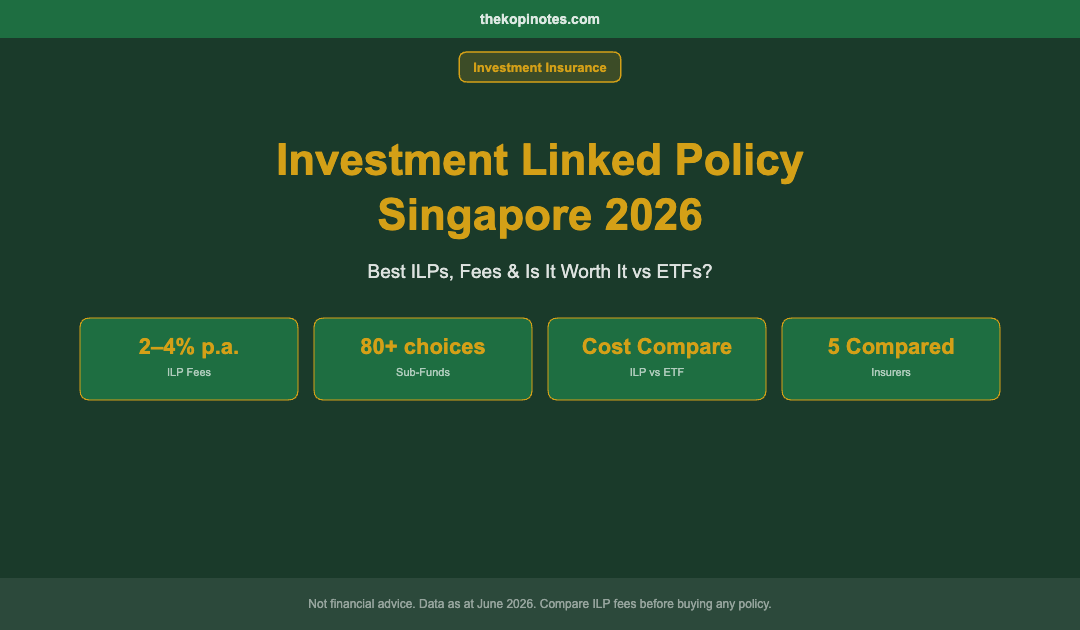
Compare investment linked policy Singapore plans from AIA, Prudential, Great Eastern, Manulife and NTUC Income — with a clear fee breakdown and honest ILP vs ETF verdict.
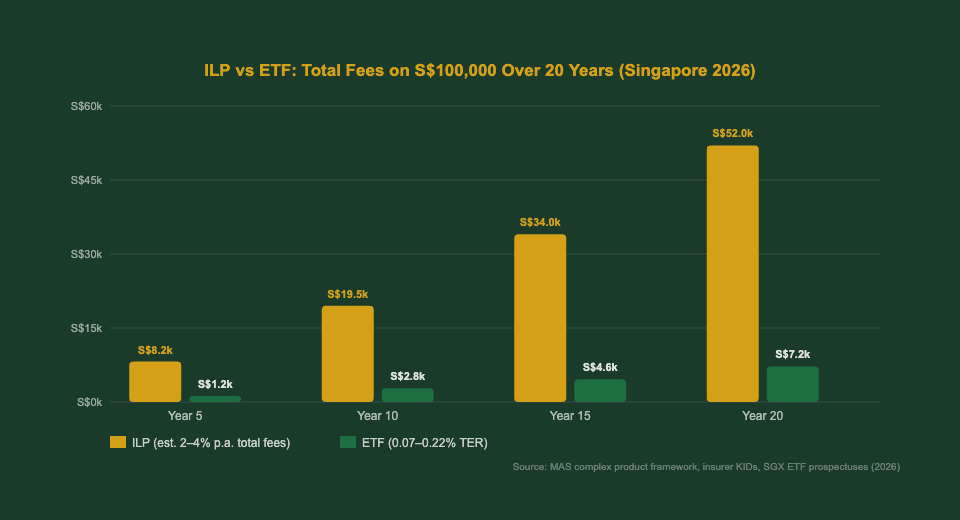
An investment linked policy (ILP) Singapore combines life insurance coverage with an investment component — your premiums buy units in sub-funds managed by the insurer. In theory, you get protection and growth. In practice, the fee structure is complex and the long-term cost gap versus a DIY ETF portfolio can exceed S$40,000 on a S$100,000 investment over 20 years.
This guide cuts through the jargon: what a Singapore investment linked policy actually costs, how MAS’s 2026 complex product rules affect buyers, which ILP sub-funds have performed best, and when (if ever) an ILP makes sense in your financial plan.
Disclaimer: This article is for educational purposes only and does not constitute financial advice. Past sub-fund returns do not guarantee future performance. Consult a MAS-licensed financial adviser before purchasing any ILP. Data as at June 2026.
Table of Contents
What Is an Investment Linked Policy?
A Singapore investment linked policy (ILP) is an insurance product regulated by MAS under the Insurance Act. When you pay premiums, a portion deducts insurance charges (mortality & expense risk) while the remainder purchases units in one or more sub-funds chosen from the insurer’s fund menu.
There are two main types:
| Type | How It Works | Typical Use Case |
|---|---|---|
| Regular Premium ILP | Monthly/annual premiums; insurance charges deducted first, balance invested | Long-term wealth accumulation with protection |
| Single Premium ILP (SPILP) | Lump-sum investment; lower insurance element; acts more like a unit trust wrapper | Lump-sum investors seeking fund access via insurance wrapper |
MAS classifies regular premium ILPs as complex investment products (2026 framework). Insurers must now provide a Product Summary and a Key Information Document (KID) with a standardised cost disclosure using the Reduction in Yield (RIY) metric — making it easier to compare the true cost of an ILP against alternatives.
The key MAS rule: insurers must now show a “projected total cost” figure under the new framework, expressed as the annual RIY (%). For most regular premium ILPs, the RIY ranges from 2.5% to 4.5% per annum in the early years when surrender charges apply.
ILP Fee Breakdown: What You Actually Pay
The true cost of a Singapore ILP is layered — and this is where most buyers get caught out. Here’s every fee you’ll encounter:
| Fee Type | Typical Range | When It Applies | Impact |
|---|---|---|---|
| Premium Allocation Charge | 0–100% of premium (yr 1–2) | Front-loaded in early years | High — reduces units bought in yr 1 |
| Policy Fee | S$6–S$10/month | Monthly for life of policy | Medium — fixed admin cost |
| Fund Management Charge (FMC) | 0.75–2.50% p.a. | Deducted daily from sub-fund NAV | High — compounds over time |
| Mortality & Expense (M&E) Charge | Varies by age/sum assured | Monthly unit deduction | High for older policyholders |
| Surrender Charge | 5–15% (yr 1–5) | Only if you surrender early | Critical — locks you in |
| Switching Fee | 0–S$25 per switch | When changing sub-funds | Low — usually 2–4 free switches/yr |
| Bid-Offer Spread | 0–5% | On every premium payment | Medium — effectively a sales load |
Key insight: In year 1 alone, a typical regular premium ILP may allocate only S$0 to S$500 out of S$2,400 in annual premiums to investment — the rest goes to fees and insurance charges. It typically takes 3–7 years just to break even against the cost of buying the same funds via a unit trust or ETF.
Compare: A low-cost ETF like VWRA on FSMOne charges ~0.22% TER with zero surrender charges. An ILP sub-fund investing in the same underlying index may charge 1.5–2.5% FMC plus M&E charges — creating a fee gap of 1.3–2.3% annually that compounds significantly over 20 years.
ILP vs ETF vs Endowment: Full Comparison
| Feature | Regular ILP | Low-Cost ETF | Endowment Plan |
|---|---|---|---|
| Annual cost (est.) | 2.5–4.5% RIY | 0.07–0.22% TER | N/A (par fund spread) |
| Investment risk | 100% policyholder | 100% investor | Partially insurer |
| Life coverage | Yes (built-in) | None | Yes (built-in) |
| Liquidity | Low (surrender charges 1–5 yrs) | High (sell anytime) | Low (surrender penalties) |
| Guaranteed returns | None | None | Partial (guaranteed + non-guaranteed) |
| CPF / SRS eligible | SRS only (select plans) | CPFIS + SRS | SRS (most plans) |
| MAS protection | PPF up to S$100k | SIPF up to S$100k | PPF up to S$100k |
| Best for | Combined insurance + growth (long horizon >20 yrs) | Pure investment, cost-conscious | Capital preservation + some growth |
Verdict: For pure wealth accumulation, a diversified ETF portfolio (e.g., VWRA + CLR via Endowus referral code 2V343 or Syfe code SRPRFFFCD) will almost always outperform an ILP after fees. The only scenario where an ILP wins is when you genuinely need combined insurance + investment in one vehicle and cannot afford separate term life + index fund premiums.
Best ILP Sub-Funds Singapore 2026
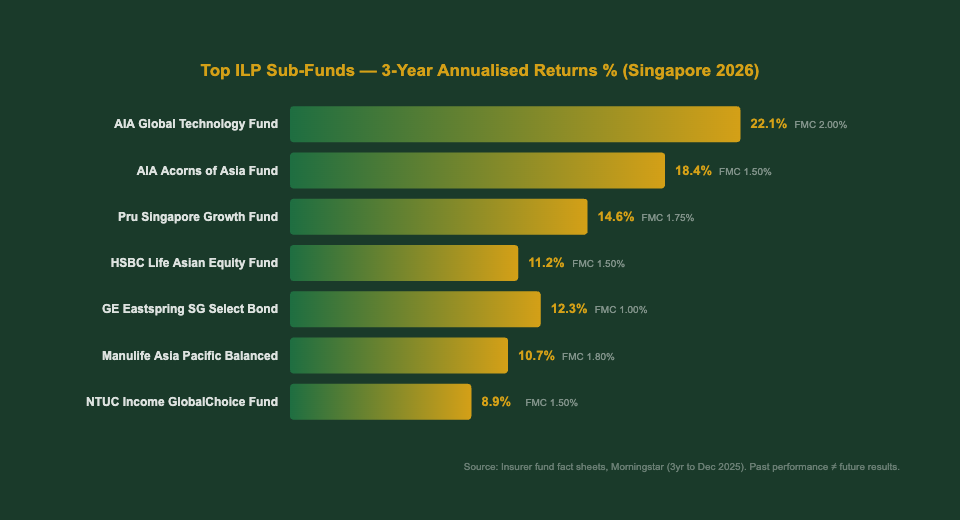
Every ILP insurer offers a menu of sub-funds ranging from money market to equity. The following table shows the top-performing sub-funds across Singapore insurers based on 3-year annualised returns (to December 2025), as reported in insurer fund fact sheets:
| Sub-Fund | Insurer | Category | 3-yr Return (ann.) | FMC p.a. |
|---|---|---|---|---|
| Acorns of Asia Fund | AIA | Asia Equity | 18.4% | 1.50% |
| Singapore Growth Fund | Prudential | SG Equity | 14.6% | 1.75% |
| Eastspring SG Select Bond | Great Eastern | SG Bond | 12.3% | 1.00% |
| Asia Pacific Balanced Fund | Manulife | Asia Balanced | 10.7% | 1.80% |
| GlobalChoice Fund | NTUC Income | Global Equity | 8.9% | 1.50% |
| Global Technology Fund | AIA | Global Tech Equity | 22.1% | 2.00% |
| Asian Equity Fund | HSBC Life | Asia Equity | 11.2% | 1.50% |
Important caveat: Past performance does not predict future results. High-performing sub-funds (like global tech) carry higher risk and FMC. After deducting a 1.5–2.0% FMC and M&E charges, the net return to policyholders is materially lower than the gross sub-fund return shown above.
For comparison: the MSCI World Index returned ~12.4% p.a. over the same 3-year period. A VWRA ETF tracking a similar index would deliver close to that gross return with only ~0.22% in annual costs — versus a 1.5–2.0% FMC for the ILP sub-fund equivalent.
Top 5 ILP Providers Compared
Here’s how the major investment linked policy Singapore providers stack up across the key variables that matter to buyers:
| Insurer | Key ILP Product | Min. Premium | No. of Sub-Funds | Free Switches/yr | SRS Eligible | Highlight |
|---|---|---|---|---|---|---|
| AIA | AIA Pro Achiever 3.0 | S$200/mth | 80+ | 4 | Yes | Largest fund menu; data centre & AI sub-funds |
| Prudential | PRUlink Investor Account | S$300/mth | 60+ | 4 | Yes | Strong SG equity & bond sub-funds |
| Great Eastern | FlexiChoice | S$200/mth | 55+ | 4 | Yes | Eastspring sub-fund tie-up; competitive FMC |
| Manulife | ManualLife ReadyBuilder | S$250/mth | 50+ | 4 | Yes | Strong Asia Pacific funds; CPFIS (selected sub-funds) |
| NTUC Income | VivoLink | S$200/mth | 40+ | 2 | Yes | Co-operative ownership; lower FMC on select funds |
All five insurers are licensed by MAS and have their policies covered under the Singapore Deposit Insurance Corporation (SDIC) / Policy Owners’ Protection (PPF) Scheme up to S$100,000 per policy owner per insurer for life insurance benefits.
Using CPF & SRS with ILPs
Unlike endowment plans, most regular premium ILPs are not eligible for CPF OA investment under CPFIS because they are classified as complex investment products. There are a few exceptions where specific CPFIS-approved ILPs allow CPF OA or SA funds.
SRS (Supplementary Retirement Scheme) is the more common route for ILP investors wanting tax benefits:
| Route | Annual Contribution Limit | Tax Relief | ILP Eligible? |
|---|---|---|---|
| SRS (Singapore Citizens/PR) | S$15,300/yr | Up to S$15,300 @ marginal rate | Yes (most regular ILPs) |
| SRS (Foreigners) | S$35,700/yr | Up to S$35,700 @ marginal rate | Yes (most regular ILPs) |
| CPF OA (CPFIS) | Investable OA balance | Not additional relief (CPF contribution already relieved) | Select CPFIS-approved ILPs only |
For a Singapore investor in the 11.5% marginal tax bracket, contributing S$15,300/yr to SRS and investing in an ILP saves S$1,759.50 in income tax annually — but this tax saving can be eroded by the higher ILP fee structure over time compared to simply buying ETFs in an SRS account via Endowus (code 2V343) or Syfe (code SRPRFFFCD).
When Does an ILP Make Sense?
Despite the higher cost, an investment linked policy Singapore can still be the right tool in specific circumstances:
| Scenario | ILP Suitable? | Why |
|---|---|---|
| Need insurance + investment in one premium | ✅ Yes | Combined product reduces admin burden; suitable if self-discipline to maintain separate term + ETF is low |
| Long investment horizon (>20 years) | ✅ Possibly | Surrender charges dissolve over time; compounding can overcome early fee drag if sub-fund outperforms |
| Access to unique sub-funds | ✅ Sometimes | Certain insurers offer institutional-class sub-funds not available as retail ETFs in Singapore |
| SRS tax savings needed | ✅ Yes | ILP + SRS gives insurance + tax relief — but compare vs buying ETFs via SRS on Endowus first |
| Short investment horizon (<10 years) | ❌ No | Surrender charges + early premium allocation drag will hurt returns |
| Pure wealth accumulation goal | ❌ No | Low-cost ETF portfolio will almost always outperform after ILP fees |
| Poor health / uninsurable via term life | ✅ Possibly | ILP underwriting is sometimes less stringent; may be able to get life cover when term life declined |
Bottom line: If you need pure investment growth, use a robo-advisor or buy ETFs directly. See our Singapore REIT ETF guide and Best S-REITs 2026 for income-focused alternatives. If you genuinely need insurance + investment together, run the numbers with MAS’s standardised RIY comparison tool before signing.
How to Buy an ILP in Singapore (6 Steps)
- Get your coverage needs right first. Use our free Insurance Gap Calculator to know how much life cover you actually need before bundling it into an ILP.
- Compare the RIY (Reduction in Yield). Under MAS’s 2026 complex product rules, all ILP KIDs must show the RIY. Pick the ILP with the lowest RIY for your intended holding period.
- Check the sub-fund menu. Look for sub-funds with low FMC (under 1.5%) and consistent long-term performance. Avoid switching fees traps by picking an insurer with at least 4 free switches/year.
- Run a break-even analysis. Ask the financial adviser to show you the projected account value net of all charges at years 5, 10, 15, and 20. Compare with a term life + ETF scenario.
- Consider SRS for tax relief. If you’re paying income tax above 7%, fund the ILP via SRS for additional annual tax savings. Open an SRS account via Endowus (code 2V343) or MariBank (code 2DCT80WQ).
- Review annually. Unlike endowments, ILPs let you switch sub-funds. Review your allocation yearly and rebalance toward lower-risk sub-funds as you near your goal.
Prefer Lower Fees? Invest via Robo-Advisors
If you decide an ILP isn’t for you, start investing in diversified ETFs with zero sales charges via our referral partners:
Frequently Asked Questions
What is an investment linked policy in Singapore?
Is an ILP a good investment in Singapore 2026?
What are ILP fees in Singapore?
Can I use SRS for an ILP in Singapore?
What is the difference between an ILP and an endowment plan?
Can I use CPF to buy an ILP?
What is the surrender value of an ILP?
How do I switch ILP sub-funds?
Is an ILP better than term life insurance + ETF?
Which ILP provider is best in Singapore 2026?
Get Free Insurance Advice
Speak with a licensed insurance advisor. No obligation, no cost.
By submitting this form, you agree to our Privacy Policy.
This article was researched with the help of AI. While we strive to keep all information accurate and up to date, there may be errors. If you notice any discrepancies, please contact us.