Single Premium Endowment Plan Singapore 2026: Best Plans, Returns & Complete Buyer’s Guide
Everything you need to know before putting a lump sum into a single premium endowment plan.
A single premium endowment plan in Singapore is a life insurance savings product where you pay one lump-sum premium upfront and receive a guaranteed maturity payout plus non-guaranteed bonuses at the end of a fixed tenor (typically 5-25 years). Plans from NTUC Income, Etiqa, Manulife, AIA, Prudential, and Great Eastern offer guaranteed returns of 2-3% p.a., with total projected returns of 3-4.5% p.a. when non-guaranteed bonuses are included. They are capital-safe and MAS-regulated, making them a popular alternative to fixed deposits and Singapore Savings Bonds for lump-sum savings goals.
Not financial advice. All figures are for educational reference only. Data as at June 2026 unless noted.
Table of Contents
Show Table of Contents
- What Is a Single Premium Endowment Plan?
- How Single Premium Endowment Plans Work
- Best Single Premium Endowment Plans in Singapore 2026
- Returns Comparison: Guaranteed vs Projected
- Single Premium Endowment vs Alternatives
- Using SRS for Single Premium Endowments
- Who Should Buy?
- How to Buy: Step-by-Step
- FAQ
What Is a Single Premium Endowment Plan?
A single premium endowment plan (SPE) is a type of participating life insurance policy where you pay a single lump sum premium at inception and receive a maturity payout at the end of a predetermined tenor – typically 5, 10, 15, or 25 years. Unlike regular endowment plans that require monthly or annual premium payments, SPEs suit investors with a cash lump sum (from a property sale, inheritance, CPF refund, or savings) who want a structured, disciplined savings vehicle.
Under MAS regulations, SPEs issued in Singapore are underwritten by MAS-licenced life insurers. The guaranteed maturity benefit is contractually binding, while the non-guaranteed component – typically paid as reversionary and terminal bonuses from the insurer’s participating (par) fund – depends on investment performance. Key characteristics:
- One upfront payment – no ongoing premium commitments
- Fixed tenor – 5 to 25 years, chosen at inception
- Guaranteed + non-guaranteed returns – guaranteed maturity value plus bonus potential
- Life coverage – typically 101-105% of single premium on death
- Capital preservation – MAS Policy Owners’ Protection Scheme covers up to S$500,000
- Surrender value – available after lock-in period (usually 2-3 years), though early surrender typically incurs losses
How Single Premium Endowment Plans Work
When you invest in a single premium endowment plan, your lump sum is split by the insurer across two components: a risk-free component that guarantees your contractual maturity value, and the remainder pooled into the insurer’s participating (par) fund – a diversified portfolio of bonds, equities, and real estate. The par fund generates returns which the insurer distributes as reversionary bonuses (credited annually and cannot be taken away once declared) and a terminal bonus (paid at maturity). MAS requires insurers to illustrate returns at both 3.25% and 4.75% investment return scenarios.
Par Fund Mechanics (S$100,000 Single Premium, 10-Year Tenor)
| Component | 3.25% Scenario | 4.75% Scenario |
|---|---|---|
| Guaranteed Maturity Value | S$106,500-S$107,500 | S$106,500-S$107,500 |
| Non-Guaranteed Bonuses | S$3,000-S$5,000 | S$7,000-S$10,000 |
| Total Projected Maturity | S$109,500-S$112,500 | S$113,500-S$117,500 |
| Effective Annual Return | ~0.93-1.18% p.a. | ~1.31-1.62% p.a. |
Source: Illustrative figures based on insurer product disclosures. June 2026.
Best Single Premium Endowment Plans in Singapore 2026
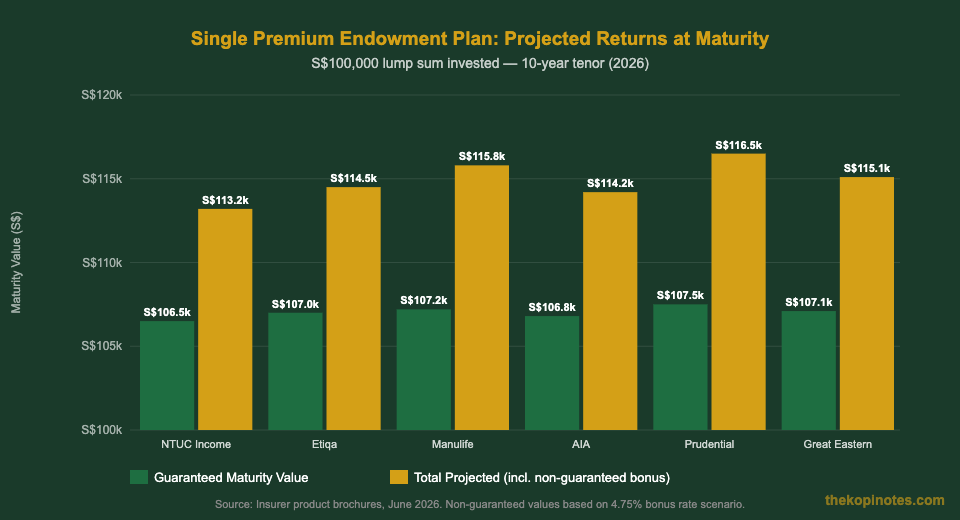
The following table summarises key features of leading single premium endowment plans available in Singapore as at June 2026. All figures are based on a S$100,000 single premium, 10-year tenor, for a 40-year-old non-smoker.
| Insurer / Plan | Min Premium | Guaranteed Value | Projected Value (4.75%) | SRS Eligible |
|---|---|---|---|---|
| NTUC Income Gro Capital Ease | S$20,000 | S$106,500 | S$113,200 | Yes |
| Etiqa EtiGrow | S$5,000 | S$107,000 | S$114,500 | Yes |
| Manulife SavePlus | S$10,000 | S$107,200 | S$115,800 | Yes |
| AIA Smart Growth | S$15,000 | S$106,800 | S$114,200 | Yes |
| Prudential PRUWealth Plus | S$10,000 | S$107,500 | S$116,500 | Yes |
| Great Eastern GREAT Wealth Multiplier | S$10,000 | S$107,100 | S$115,100 | Yes |
Source: Insurer product brochures, June 2026. Values illustrative for S$100,000 single premium, age 40. Non-guaranteed values at 4.75% par fund scenario. Always request a Benefits Illustration document before committing.
Complement your endowment plan with a robo-advisor account via Syfe referral code and sign-up bonus for the growth portion of your portfolio. The key differentiator across plans is the guaranteed maturity value (contractual) and the insurer’s par fund track record.
Returns Comparison: Understanding Guaranteed vs Projected Returns
The guaranteed maturity value is a contractual obligation – it will be paid regardless of market conditions. For most 10-year SPEs, the guaranteed maturity payout on S$100,000 is approximately S$106,500-S$107,500, representing an effective guaranteed yield of ~0.63-0.72% p.a. The non-guaranteed component can significantly boost total return. At the 4.75% par fund scenario, total projected values typically reach S$113,000-S$116,500.
Worked Example: S$100,000 into Prudential PRUWealth Plus (10 Years)
| Year | Guaranteed Surrender Value | Total Projected Value (4.75%) | Effective Return |
|---|---|---|---|
| Year 1 | S$91,000 | S$93,000 | -7.0% (loss if surrendered) |
| Year 3 | S$97,500 | S$101,200 | ~0.4% p.a. |
| Year 5 | S$102,000 | S$107,500 | ~1.5% p.a. |
| Year 10 (Maturity) | S$107,500 | S$116,500 | ~1.55% p.a. |
| Year 25 (Long Tenor) | S$126,000 | S$168,000 | ~2.1% p.a. |
Source: Illustrative values, Prudential PRUWealth Plus, 4.75% scenario. June 2026.
Key takeaway: Single premium endowment plans reward patience. The longer the tenor, the higher the effective annual return. Surrendering early – especially in the first 3 years – typically results in a capital loss as the terminal bonus is only paid at maturity.
Single Premium Endowment vs Alternatives for Singapore Investors
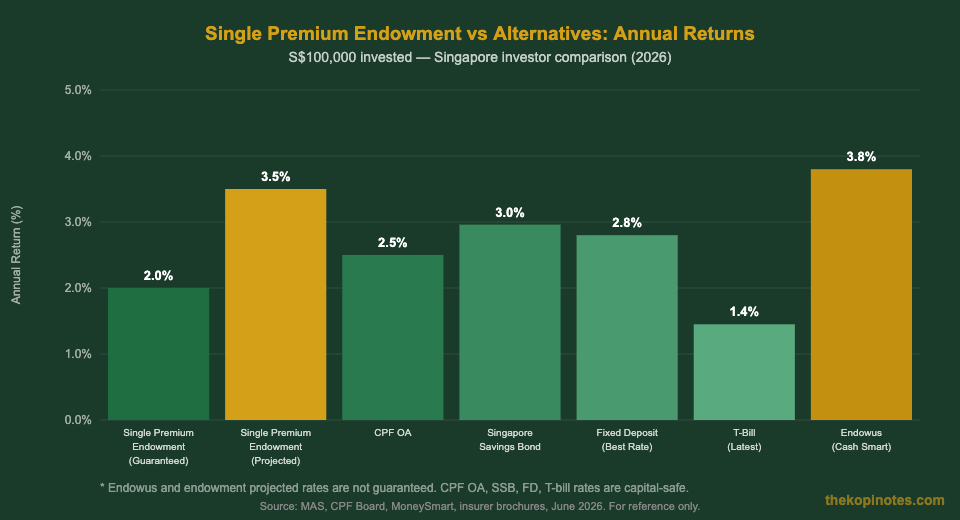
| Product | Effective Return | Capital Guaranteed? | Liquidity | SRS/CPF? |
|---|---|---|---|---|
| Single Premium Endowment (10yr) | 1.0-1.6% p.a. (projected 2.5-3.5%) | Yes (at maturity) | Low | Yes |
| Singapore Savings Bond | 2.96% p.a. (10yr avg, Jun 2026) | Yes | High | No |
| T-Bill (6-month) | 1.45% p.a. (latest) | Yes | Medium | CPFIS-OA only |
| Fixed Deposit (12 months) | 2.5-2.8% p.a. | Yes (SDIC) | Medium | No |
| CPF OA | 2.5% p.a. (guaranteed) | Yes | Very low | CPF only |
| Robo-Advisor (Endowus Cash Smart) | ~3.6-4.0% p.a. (not guaranteed) | No | High | Yes |
| S-REIT ETF (dividend yield) | 5-7% p.a. (not guaranteed) | No | High (SGX daily) | Yes (CPF/SRS) |
Source: MAS, CPF Board, MoneySmart, SGX, insurer product disclosures. June 2026.
Single premium endowment plans are not return maximisers. Their core value is capital preservation with a forced savings structure and life coverage. Investors wanting higher returns should consider the Singapore REIT ETF guide or use the Endowus referral code for CPF/SRS investing. For risk-averse investors – particularly retirees or those near a defined financial goal – SPEs provide a predictable, capital-safe outcome.
Using SRS to Buy a Single Premium Endowment Plan
All major insurers accept SRS funds for their SPE products – making this one of the most tax-efficient strategies for Singapore investors. A Singapore citizen aged 40 in the 22% income tax bracket who contributes the maximum S$15,300 per year to SRS earns S$3,366 in annual tax savings. After accumulating S$100,000 in SRS, deploying into a single premium endowment plan provides guaranteed capital-safe growth. At maturity, only 50% of the SRS withdrawal is taxable – typically resulting in minimal to zero tax for retirees with lower income.
| SRS SPE Strategy | Cash Investment | SRS Investment |
|---|---|---|
| Single Premium | S$100,000 | S$100,000 (from SRS) |
| Annual Tax Savings | S$0 | S$3,366/yr x years contributed |
| Projected Maturity (10yr, 4.75%) | S$116,500 | S$116,500 |
| Tax on Withdrawal | S$0 (gains not taxed) | 50% concession – tax on S$58,250 only |
Source: IRAS SRS rules, insurer product illustrations. June 2026. 22% marginal tax rate assumed.
To maximise SRS before deploying into an endowment plan, park SRS funds in a liquid robo-advisor like Endowus (referral code 2V343) while accumulating. Check the SRS tax savings calculator to model your personalised tax relief. For broader CPF investing, see the CPF investment strategy guide.
Who Should (and Should Not) Buy a Single Premium Endowment Plan?
Good Fit For:
- Retirees or near-retirees with a lump sum (CPF refund, property sale, matured FD) who want capital-safe, predictable growth without equity market exposure
- Risk-averse investors who prefer a “set it and forget it” approach without market volatility stress
- SRS contributors looking to lock in predictable returns before statutory withdrawal age
- Investors with a defined spending goal in 5-25 years – education fund, property down payment
- Those wanting life coverage alongside savings – SPEs provide 101-105% of premium as death benefit
NOT a Good Fit For:
- Long-term growth investors – a diversified ETF or best S-REITs in Singapore 2026 will likely outperform SPE returns significantly over 20+ years
- Investors needing liquidity – surrendering in the first 3 years typically incurs a capital loss of 5-10%
- Those without an emergency fund – always maintain a buffer first. Use the emergency fund calculator to verify your buffer is adequate
- Young investors under 40 with a long time horizon – opportunity cost of locking S$100,000 at 2% vs equities is substantial over 20+ years
How to Buy a Single Premium Endowment Plan: Step-by-Step
- Assess your liquidity needs – confirm you can lock the lump sum for the full tenor without needing access. Run the Singapore retirement calculator to verify your plan.
- Compare guaranteed maturity values – get product illustrations from at least 3 insurers. Focus on the guaranteed component at 3.25% scenario, not just the projected 4.75% figure.
- Check the insurer’s par fund track record – ask for historical bonus declaration rates over the past 10 years.
- Match tenor to your goal – retirement at 65 from age 50 means a 15-year plan. Child’s university fund in 5 years means a 5-year SPE.
- Decide on funding source – if you have SRS funds, strongly consider SRS-funded SPE for the upfront tax relief.
- Apply via insurer or MAS-licenced financial adviser – all SPEs require a product knowledge assessment (PKA). Use FSMOne referral code for a broker account for ETF and REIT investing alongside your plan.
For growth-oriented investments alongside your SPE, consider Syfe (referral code SRPRFFFCD) for equity and REIT portfolios, and track your overall income goals with the passive income Singapore 2026 guide.
Start Investing Your Lump Sum Wisely
Pair your single premium endowment plan with growth-oriented robo-advisor accounts for a complete wealth strategy.
Frequently Asked Questions
What is the minimum amount for a single premium endowment plan in Singapore?
The minimum single premium varies by insurer: Etiqa starts at S$5,000, NTUC Income requires S$20,000, and most plans from Manulife, AIA, Prudential, and Great Eastern have minimums of S$10,000-S$15,000. Always check the current product brochure as minimums can change.
Are single premium endowment plans safe?
Yes. All MAS-licenced insurers participate in the Policy Owners’ Protection Scheme (PPF), which protects guaranteed benefits up to S$500,000 per life insured. The guaranteed maturity value will be paid in full regardless of market conditions. The non-guaranteed bonus component is not protected – if the par fund performs poorly, total maturity may be lower than illustrated.
Can I surrender a single premium endowment plan early?
Yes, but you will likely receive less than your original premium if you surrender in the first 3-5 years. Most plans have a surrender penalty where the surrender value is below the single premium during early years. After the lock-in period (typically 3 years), the surrender value should exceed your original premium, but you forfeit the terminal bonus which is only paid at maturity.
Is the maturity payout of a single premium endowment plan taxable in Singapore?
No – for cash-funded plans, the maturity proceeds are not subject to income tax in Singapore. Singapore does not impose capital gains tax or tax on insurance policy proceeds. For SRS-funded plans, the maturity payout is counted as an SRS withdrawal and taxed at 50% concession (only 50% is taxable) – typically resulting in low or zero tax for retirees.
What happens if I die during the policy term?
Most single premium endowment plans include a death benefit of 101-105% of the single premium paid, or the guaranteed surrender value at the time of death – whichever is higher. This is paid to the nominated beneficiary. Use the insurance gap calculator to assess your full life coverage needs alongside the SPE.
Can I use SRS funds to buy a single premium endowment plan?
Yes. All major insurers accept SRS funds for single premium endowment plans. Benefits: (1) SRS contributions earn an upfront tax deduction at your marginal income tax rate, and (2) SRS withdrawals at retirement age (62 for Singapore citizens) receive a 50% tax concession. This makes SRS-funded endowment plans particularly tax-efficient for investors in the 22%+ tax bracket.
How do single premium endowment plans compare to fixed deposits?
Fixed deposits currently offer 2.5-2.8% p.a. for 12-month tenors (June 2026) – higher than the guaranteed component of most 10-year SPEs. However, FDs have no life coverage, no non-guaranteed upside from a par fund, and are limited to 12-month tenors. For long-term (10-25 year) lump-sum savings goals, an SPE’s projected total return of 2.5-3.5% p.a. can be competitive with rolling FD ladders – especially when SRS tax savings are factored in.
Which insurer offers the best single premium endowment plan?
There is no single best plan – it depends on your tenor, premium amount, and risk tolerance. Prudential PRUWealth Plus and Manulife SavePlus tend to have slightly higher projected maturity values at 4.75% scenario, while Etiqa EtiGrow offers the lowest minimum at S$5,000. Always compare Benefits Illustrations side-by-side, focusing on guaranteed values, not just projected ones.
What is the difference between a single premium and a regular premium endowment plan?
A single premium endowment plan requires one lump-sum payment at inception, while a regular premium plan requires ongoing annual or monthly payments over the policy term. Single premium plans suit investors with existing capital to deploy; regular premium plans suit those who want to build savings systematically from income. Single premium plans also tend to have lower effective costs as there are no premium allocation charges across multiple payment periods.
Get Free Insurance Advice
Speak with a licensed insurance advisor. No obligation, no cost.
By submitting this form, you agree to our Privacy Policy.
This article was researched with the help of AI. While we strive to keep all information accurate and up to date, there may be errors. If you notice any discrepancies, please contact us.