
ETF Expense Ratio Impact Calculator Singapore 2026
See exactly how fund fees erode your wealth over time — free calculator showing the true cost of expense ratios in SGD.
ETF Expense Ratio Impact Calculator
For illustration only. Not financial advice. Results in SGD.
Understanding ETF Expense Ratios for Singapore Investors
Every ETF and unit trust charges an annual management fee — called the expense ratio or Total Expense Ratio (TER). This fee is deducted daily from the fund’s Net Asset Value (NAV) before you ever see it, which is exactly why it’s so easy to overlook. According to MAS guidelines, all Singapore-listed funds and Ireland-domiciled ETFs accessible via the SGX or local brokerages must disclose their TER in their prospectus. Yet many retail investors focus only on entry price and dividend yield, and underestimate the compounding damage that even a 1% difference in fees can cause over a 20–30 year investment horizon.
This calculator lets you compare two ETFs or funds side by side to see exactly how much wealth each fee level leaves on the table — in real SGD terms. Not financial advice. All figures are for educational reference only. Data as at Q2 2026 unless noted.
What Is an Expense Ratio?
An expense ratio is the annual percentage of your fund’s assets deducted to cover management, administration, legal, and marketing costs. For example, iShares Core MSCI World ETF (IWDA) charges 0.20% per year, while the SPDR S&P 500 ETF (SPY) charges 0.0945%. By contrast, many actively managed unit trusts sold in Singapore charge 1.0%–2.0% per year — sometimes more when you add sales charges and platform fees. Because the fee is charged on the total portfolio value (not just gains), it compounds negatively every single year.
Why the Fee Gap Matters More in Singapore
Singapore investors benefit from zero capital gains tax and no dividend withholding tax on Singapore-listed instruments — but this advantage is partially eroded for investors in high-fee products. A Singaporean investing S$500/month for 25 years at 7% gross return loses approximately S$80,000 more in a 1.5% expense ratio fund compared with a 0.20% ETF. That gap — roughly equivalent to 13 years of monthly contributions — underscores why the TER is arguably the single most controllable variable in long-term portfolio building.
How to Use This ETF Expense Ratio Calculator
- Initial Investment: Enter the lump sum you’re starting with in SGD — e.g. S$10,000 from your savings or a SRS contribution.
- Monthly Contribution: Add any regular top-ups — e.g. S$500/month via a regular savings plan on Syfe or Endowus.
- Annual Return: Set the expected gross return before fees. A commonly used long-run assumption for global equities is 7%–8%.
- ETF A Expense Ratio: Enter the TER of your low-cost option — e.g. 0.07% for CSPX or 0.20% for IWDA.
- ETF B Expense Ratio: Enter the TER of the higher-cost option you’re comparing — e.g. 1.50% for a typical Singapore unit trust.
- Investment Horizon: Drag to match your intended holding period — 20 years is a typical retirement horizon for a 40-year-old Singaporean.
The calculator instantly shows the final portfolio value after fees, total fees paid, and the absolute SGD difference between the two options.
Pro tip: Combine this tool with our DCA Investment Calculator to model a full regular savings plan with your chosen ETF’s actual expense ratio.
What Is an ETF Expense Ratio?
An expense ratio (also called Total Expense Ratio or TER) is the annual percentage fee charged by a fund to cover its operating costs. It is expressed as a percentage of the fund’s average Net Asset Value (NAV) and is deducted automatically from the fund’s daily NAV — meaning you never write a cheque, but you also never see the money compounding for you. Common cost components include investment management fees, custodian fees, administration fees, and where applicable, marketing or distribution fees (known in Singapore as trailer fees, which MAS banned for wrap-fee platforms from 2021 onwards).
For Singapore investors, expense ratios are particularly important because we pay zero capital gains tax, which makes pre-fee return the primary driver of wealth accumulation. Ireland-domiciled ETFs like IWDA (0.20% TER) and CSPX (0.07% TER) are especially popular on platforms like IBKR, Tiger Brokers, and FSMOne because they avoid US dividend withholding taxes for non-US investors, while keeping TERs low. Meanwhile, the Singapore REIT ETF and passive income options offer different fee profiles. The key rule: every basis point saved in fees is a basis point that stays in your portfolio compounding for the next 20–30 years.
How Expense Ratios Compound Over Time: The Maths
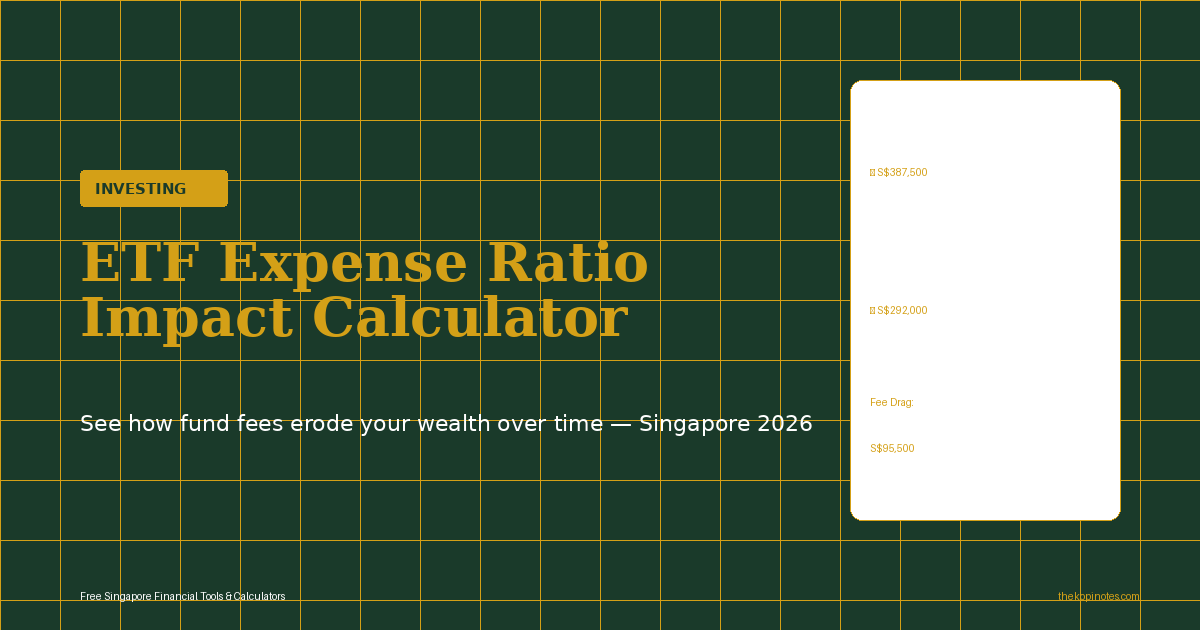
The compounding damage of fees is multiplicative, not additive. If the market returns 7% per year and your ETF charges 0.20% TER, your net return is 6.80%. Over 20 years, S$100,000 at 6.80% grows to approximately S$373,000. At 7.00% without fees, it reaches S$387,000 — a S$14,000 difference. But compare 7% gross to a 1.5% TER fund delivering only 5.5% net: the same S$100,000 grows to just S$292,000, a shortfall of S$95,000 — nearly the entire original investment.
The maths uses the standard future value formula: FV = PV × (1 + r_net/12)^(n×12) + PMT × [((1 + r_net/12)^(n×12) − 1) / (r_net/12)], where r_net = gross return − expense ratio. The calculator uses monthly compounding as a practical approximation. What this means: for a 30-year SRS investor making regular contributions, choosing a 0.07% TER ETF over a 1.5% unit trust could result in a difference of S$150,000 or more at retirement — enough to fund several years of retirement income.
Low-Cost ETF vs Unit Trust in Singapore
The table below compares indicative expense ratios for popular investment products accessible to Singapore retail investors as at Q2 2026:
| Product | Type | TER (approx) | SG Accessible |
|---|---|---|---|
| CSPX (iShares Core S&P 500, LSE) | ETF | 0.07% | IBKR, Tiger |
| IWDA (iShares Core MSCI World, LSE) | ETF | 0.20% | IBKR, FSMOne |
| VWRA (Vanguard FTSE All-World, LSE) | ETF | 0.22% | IBKR, Tiger |
| Lion-Phillip S-REIT ETF (CLR, SGX) | ETF | 0.60% | Most SG brokers |
| Endowus Fund Smart (equity funds) | Unit Trust | 0.30%–0.85% | Endowus |
| Typical SG active equity unit trust | Unit Trust | 1.25%–2.00% | Banks, FAs |
Key insight: even some robo-advisor portfolios in Singapore layer additional platform fees (0.25%–0.65%) on top of the underlying fund TERs. Always look at the all-in cost. Syfe and Endowus both publish their all-in fee schedules transparently.
Best Platforms to Buy Low-Cost ETFs in Singapore
Interactive Brokers (IBKR) remains the gold standard for cost-conscious investors. Commissions for US/LSE ETFs start at USD 1–1.50 per trade for small orders. IBKR provides access to CSPX, IWDA, VWRA, and thousands of global ETFs.
Tiger Brokers and moomoo are popular for their user-friendly apps and commission-free trading on US ETFs like VOO and QQQ. Excellent for dollar-cost averaging smaller monthly amounts.
FSMOne offers a Regular Savings Plan (RSP) for ETFs like IWDA from S$50/month with low transaction fees — ideal for automated monthly contributions. Check the FSMOne referral page for current promotions.
Endowus provides access to institutional-class unit trusts with trailer fees rebated back to investors, effectively reducing the all-in cost for CPF and SRS money. See the Endowus referral page for onboarding bonuses.
SRS & CPF Investment Scheme: Fee Impact
For Singapore investors using the Supplementary Retirement Scheme (SRS) or CPF Investment Scheme (CPFIS), expense ratios matter even more — because these accounts have decades-long investment horizons. The SRS Tax Savings Calculator shows the upfront tax relief, but the downstream wealth accumulation depends heavily on what you invest in after contributing.
Under CPFIS, your CPF OA already earns a guaranteed 2.5% p.a. — this is the hurdle rate any CPFIS investment must beat after fees and risk. A CPFIS unit trust charging 1.5% TER targeting 5% gross return delivers only 3.5% net — just 1% above the risk-free CPF OA rate. Running the fee calculator with these inputs shows why many Singapore investors leave CPF OA in its default guarantee rather than pay high fees for marginal outperformance. Use the CPF OA/SA Allocation Calculator and the CPFIS Calculator to model your specific scenario.
Building Passive Income with Low-Fee ETFs
Low-cost ETFs are a cornerstone of passive income strategies for Singapore investors at every wealth-building stage. Accumulation-phase ETFs like IWDA and VWRA reinvest dividends automatically, maximising compounding while keeping TERs minimal. For investors closer to retirement wanting income distributions, dividend-paying ETFs balance yield with fee efficiency.
The practical strategy: front-load low-fee accumulating ETFs during working years and gradually rotate into distributing ETFs or S-REITs as retirement approaches. Use the Retirement Planning Calculator to model your target nest egg, then work backwards using this expense ratio calculator to see how your fund choice affects the final number. The difference between a 0.2% TER and a 1.5% TER over a 30-year career can represent 3–5 additional years of financial runway in retirement.
Frequently Asked Questions
What is a good expense ratio for an ETF in Singapore?
For equity ETFs, a good expense ratio is 0.30% or below. Ireland-domiciled ETFs like IWDA (0.20%) and CSPX (0.07%) represent best-in-class for Singapore investors. S-REIT ETFs typically run 0.50%–0.65% TER, which is still far below the 1.25%–2.00% charged by most actively managed unit trusts. Any product above 1.00% TER warrants careful justification in terms of expected excess return.
How much does a 1% expense ratio difference cost over 20 years in Singapore?
As a rough illustration: a Singapore investor with S$10,000 initial and S$500/month contributions at 7% gross return for 20 years would have approximately S$289,000 with a 0.20% TER ETF versus S$256,000 with a 1.20% TER fund — a difference of roughly S$33,000. Over 30 years the gap widens to over S$100,000. Use the sliders above to model your exact scenario.
Is IWDA or VWRA better for Singapore investors?
Both are excellent low-cost ETFs. IWDA (iShares Core MSCI World) covers developed markets at 0.20% TER, while VWRA (Vanguard FTSE All-World) includes emerging markets at 0.22% TER. The 0.02% fee difference is negligible; the choice comes down to whether you want emerging market exposure. Many Singapore investors pair IWDA with a small allocation to an emerging markets ETF for more control over regional weights.
Can I use CPF to invest in low-cost ETFs in Singapore?
Yes, under CPFIS you can invest CPF Ordinary Account funds in approved ETFs including the Nikko AM Singapore STI ETF and several bond ETFs. However, your CPF OA already earns a guaranteed 2.5% p.a. — any ETF investment must deliver meaningfully higher returns after fees to justify the switch. CPF Special Account funds cannot be invested in equities.
Does Endowus or Syfe offer lower-fee ETF investing in Singapore?
Both offer competitive all-in fee structures. Endowus rebates trailer fees from unit trusts, bringing effective costs below 1% for CPF and SRS money. Syfe REIT+ and Core portfolios charge 0.35%–0.65% platform fees on top of ETF TERs — competitive for investors who prefer a managed, hands-off approach over self-directed ETF buying.
Are expense ratios tax-deductible in Singapore?
No. Expense ratios are not tax-deductible for individual investors in Singapore. For SRS investors, the tax benefit comes from the SRS contribution itself (which reduces assessable income), not from the fund fees. Every percentage point of TER is a direct reduction in your actual net wealth accumulation — there is no tax offset for high fund costs.
What return rate should I use in the ETF expense ratio calculator for Singapore?
For long-term global equity ETFs (IWDA, VWRA, CSPX), a commonly cited assumption is 7%–8% annualised gross return, in line with long-run MSCI World historical returns. For Singapore REITs or the STI ETF, 6%–8% total return is a reasonable base case. Conservative retirement planning often uses 5%–6% to account for sequence-of-returns risk.
How does a high expense ratio affect my SRS retirement savings in Singapore?
SRS accounts typically have a 10–30 year investment horizon, maximising the compounding damage of high fees. An SRS investor contributing S$15,300/year who invests in a 1.5% TER fund rather than a 0.20% ETF could forfeit S$80,000–S$150,000 over 25 years — money that could fund 2–3 extra years of retirement income. Always compare all-in costs (platform fee + TER) when selecting SRS investment products.
Ready to Build a Low-Cost ETF Portfolio?
Now you know the fee impact — use our free tools and referral bonuses to start investing smarter in Singapore today.