REITs Symposium 2026 Singapore: What to Expect, Key Themes & Best REITs to Watch
REITs Symposium 2026 takes place on Saturday, 23 May 2026 at Suntec Singapore Convention & Exhibition Centre (Level 3, Summit 1 & 2). Organised by ShareInvestor, InvestingNote, and REITAS, it is Singapore’s largest annual conference dedicated to S-REIT investing — bringing together REIT CEOs, analysts, and thousands of retail investors for a full day of insights, panel discussions, and direct access to REIT management teams.
Not financial advice. All figures are for educational reference only. Data as at May 2026 unless noted.
Table of Contents
Click to expand Table of Contents
- What Is the REITs Symposium?
- REITs Symposium 2026: Key Details
- Key Investment Themes for 2026
- S-REIT Sectors to Watch in 2026
- CPF Interest Rates Q2 2026: What It Means for REIT Investors
- How to Prepare as a Retail Investor
- S-REIT Yield Snapshot: May 2026
- Where to Start Investing in S-REITs
- Frequently Asked Questions
What Is the REITs Symposium?
The REITs Symposium is Singapore’s premier annual event dedicated entirely to Real Estate Investment Trusts. Since its inception, it has grown into a must-attend event for retail investors, institutional participants, and REIT management teams alike. The symposium is co-organised by ShareInvestor, InvestingNote, and REITAS (REIT Association of Singapore) — giving it both industry authority and retail investor accessibility.
Unlike generic investing conferences, the REITs Symposium is laser-focused on the Singapore REIT sector. Attendees get direct access to REIT CEOs and CFOs through booths and panels, hear analyst outlooks on individual S-REITs, and gain insights into macro factors — interest rates, property cycles, and global economic trends — that drive REIT valuations and distributions.
For a Singapore retail investor building a dividend income portfolio, there is arguably no more valuable single day in the investing calendar. The ability to ask REIT management teams questions directly — and hear their responses in a room of informed investors — provides context that no annual report or earnings call can replicate.
If you are already exploring S-REITs as part of your portfolio, check out our guide to the best S-REITs in Singapore 2026 for a data-driven starting point before attending.
REITs Symposium 2026: Key Details
Here is everything you need to know about attending the REITs Symposium 2026:
| Detail | Information |
|---|---|
| Date | Saturday, 23 May 2026 |
| Time | 10:00 AM – 5:00 PM (7 hours) |
| Venue | Suntec Singapore Convention & Exhibition Centre, Level 3, Summit 1 & 2 |
| Organisers | ShareInvestor, InvestingNote, REITAS |
| Format | In-person; panel discussions, REIT booths, networking |
| Tickets | Available via Eventbrite |
Source: REITs Symposium official website & Eventbrite, May 2026
The event runs for a full 7 hours, combining keynote addresses, panel discussions with REIT management and analysts, and an exhibition floor where individual REITs set up booths for investor Q&A. Past editions have featured CEOs and senior management from CapitaLand Integrated Commercial Trust, Mapletree Industrial Trust, Frasers Centrepoint Trust, Keppel DC REIT, Parkway Life REIT, and many more.
Key Investment Themes for 2026
Given the macro backdrop heading into May 2026, here are the major investment themes likely to dominate discussions at REITs Symposium 2026:
1. Interest Rate Trajectory and REIT Valuations
The single biggest driver of S-REIT performance over 2023–2025 has been the interest rate cycle. With the US Federal Reserve maintaining elevated rates longer than many expected, S-REIT valuations compressed significantly from their 2021 peaks. Heading into 2026, the key question is whether rate cuts are finally flowing through to lower debt costs — and whether REIT distributions can recover.
Expect in-depth panel discussions on how individual REITs have refinanced debt, what their weighted average interest cost looks like today versus 2022, and how a gradual rate normalisation will flow through to Distribution Per Unit (DPU) growth over 2026–2028.
2. AI and Data Centre Demand
Singapore’s position as Southeast Asia’s data centre hub has made data centre REITs a standout thematic play. Keppel DC REIT and Digital Core REIT are the two pure-play data centre S-REITs listed on SGX. The AI infrastructure buildout — driven by hyperscaler demand from Microsoft, Amazon, and Google — has kept data centre occupancy and rental rates elevated.
Investors attending REITs Symposium 2026 should expect sessions on data centre supply constraints, power availability in Singapore, and whether current premium valuations in the sector are sustainable. Our Singapore REIT ETF guide covers how to gain diversified exposure to data centre REITs through ETFs.
3. Retail and Suburban Mall Recovery
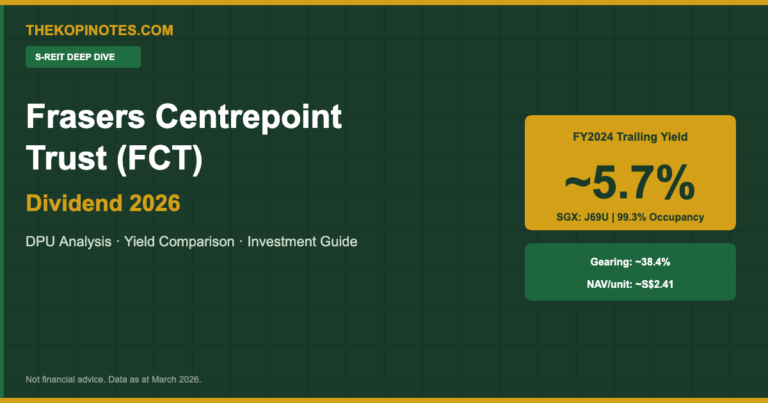
Singapore’s retail REITs — particularly those anchored by suburban malls — have shown resilient occupancy and positive rental reversions in 2025 and into 2026. Frasers Centrepoint Trust (FCT) and CapitaLand Integrated Commercial Trust (CICT) both reported strong Q1 2026 results, with NPI growth driven by higher shopper traffic and the absence of the post-COVID normalisation drag that weighed on 2023 results.
The narrative at REITs Symposium 2026 is likely to include whether suburban retail can continue outperforming CBD office — which remains structurally challenged by hybrid work patterns — and what the next cycle of asset enhancement initiatives (AEI) looks like.
4. Industrial and Logistics REITs: Resilience in Uncertainty
Industrial REITs have been the bedrock performers of the S-REIT sector through the rate cycle. Mapletree Industrial Trust (MIT), AIMS APAC REIT, and ESR-LOGOS REIT benefitted from strong demand for logistics and light industrial space driven by e-commerce and supply chain reshoring.
In 2026, the question is whether new supply — particularly in Singapore’s industrial parks — will pressure occupancy rates and cap rental reversion upside. Symposium panels typically feature industrial REIT management who provide on-the-ground visibility on leasing pipelines and development activity.
5. Hospitality REITs: Post-Pandemic Normalisation Complete?
Singapore’s hospitality sector recovered sharply through 2023–2024 as international travel normalised. CDL Hospitality Trusts, Far East Hospitality Trust (FEHT), and CapitaLand Ascott Trust all benefitted from record RevPAR (Revenue Per Available Room) as global travel demand exceeded pre-COVID levels. The key 2026 question: with travel normalised, can these REITs grow DPU from here — or is the easy post-COVID recovery now priced in?
S-REIT Sectors to Watch in 2026
Not all S-REIT sectors are created equal heading into the symposium. Here is a quick sector-by-sector scorecard based on the macro environment as at May 2026:
| Sector | Key REITs | 2026 Outlook | Yield Range |
|---|---|---|---|
| Industrial/Logistics | MIT, AIMS APAC, ESR-LOGOS | Stable; positive rental reversions | 5.5%–7.5% |
| Data Centre | Keppel DC REIT, Digital Core | Strong demand; premium valuation | 4.0%–5.5% |
| Retail (Suburban) | FCT, CICT, Lendlease REIT | Resilient; positive reversions | 5.0%–6.5% |
| Healthcare | Parkway Life REIT, First REIT | Defensive; long WALE | 3.5%–5.0% |
| Hospitality | FEHT, CDL HT, Ascott Trust | Normalising; RevPAR plateauing | 5.5%–7.5% |
| Office | Keppel REIT, OUE REIT | Headwinds; hybrid work structural drag | 6.0%–8.0% |
Source: SGX, individual REIT annual reports, The Kopi Notes analysis, May 2026. Yield ranges are indicative.
To build a diversified view of passive income across these sectors, explore our passive income Singapore 2026 guide for a curated portfolio framework.
CPF Interest Rates Q2 2026: What It Means for REIT Investors
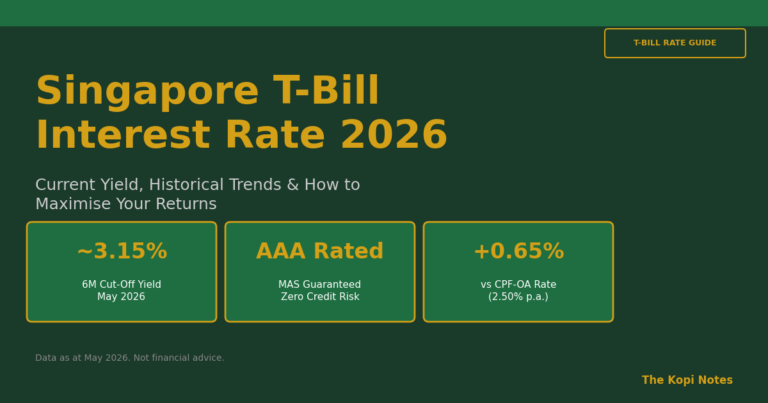
One of the constant reference points for S-REIT valuation is the CPF Ordinary Account (OA) interest rate. Because CPF OA funds can be invested in S-REITs via the CPF Investment Scheme (CPFIS), retail investors must weigh REIT yield against the risk-free OA return.
For Q2 2026 (1 April – 30 June 2026), CPF interest rates are as follows:
| CPF Account | Q2 2026 Rate (p.a.) | Notes |
|---|---|---|
| Ordinary Account (OA) | 2.5% | Floor rate; unchanged |
| Special Account (SA) | 4.0% | Floor rate; unchanged |
| MediSave Account (MA) | 4.0% | Floor rate; unchanged |
| Retirement Account (RA) | 4.0% | Floor rate; unchanged |
Source: CPF Board press release, March 2026
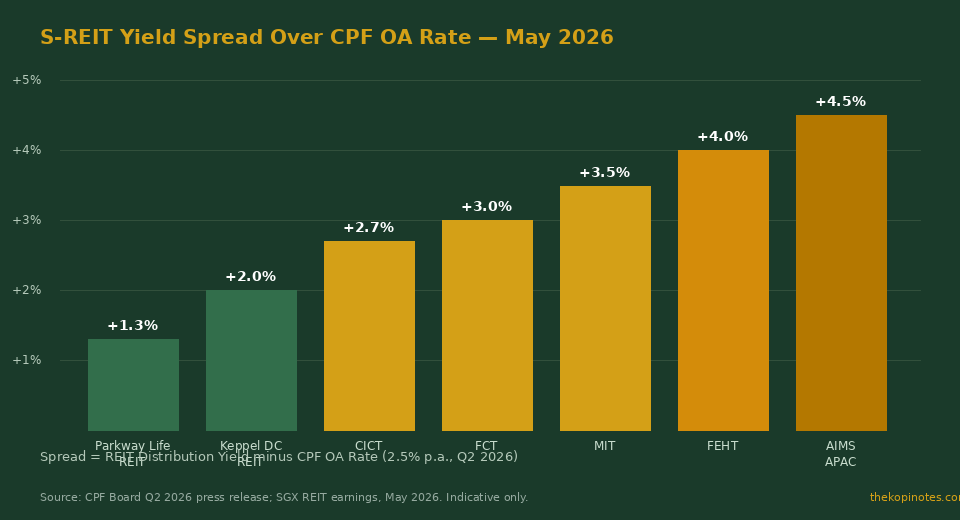
For REIT investors, the key benchmark is the OA rate of 2.5% p.a. For a REIT to justify the additional risk over simply leaving CPF in the OA, it should ideally offer a yield premium of at least 200–300 basis points — i.e., a distribution yield of 4.5%–5.5% or above. Most S-REITs currently trade at yields of 5%–7%, providing a healthy spread over the CPF OA rate.
Additionally, members below age 55 earn an extra 1% p.a. on the first S$60,000 of combined CPF balances — effectively earning 3.5% on OA funds up to this threshold. This further narrows the relative appeal of CPFIS equity investments for smaller portfolios. If your CPF savings are below S$60,000, it may be more prudent to let the guaranteed 3.5% work for you before deploying into S-REITs via CPFIS.
For a deeper dive into optimising your CPF for investing, read our CPF investment strategy guide.
How to Prepare as a Retail Investor
Getting the most out of REITs Symposium 2026 requires preparation. Here is a practical checklist for retail investors attending the event on 23 May:
Before the Symposium
1. Review recent REIT earnings. Most S-REITs have reported Q1 2026 results by May. Read the key metrics — DPU, NPI, occupancy rate, gearing, and weighted average interest cost — for the REITs you own or are considering. This allows you to ask informed questions at the booths rather than generic queries the management team has heard a hundred times.
2. Shortlist 3–5 REITs to visit. The exhibition floor has dozens of REIT booths. Without a plan, it is easy to spend 7 hours chatting without getting actionable intelligence. Prioritise REITs where you have unanswered questions — AEI timelines, debt refinancing plans, tenant retention rates — that management can address directly.
3. Prepare specific questions. Booth staff appreciate specific, informed questions. Examples: “What is your WACD after the refinancing you completed in Q4 2025?” or “How much of your portfolio has CPI-linked rent escalation clauses?” These signal you have done your homework and often get more candid, detailed answers.
4. Run the numbers on your target REITs. Use our Singapore retirement calculator to stress-test how S-REIT income fits into your overall retirement income plan — especially if you are within 5–10 years of your target retirement date.
At the Symposium
5. Attend the panel discussions, not just the booths. The panel sessions — typically featuring REIT analysts, fund managers, and REIT CEOs — offer sector-wide perspective that individual booth conversations cannot. The moderators often push panellists on hard questions around debt, valuations, and macro risks.
6. Take notes and photos of key data slides. Speakers frequently show performance attribution charts, NAV bridge analyses, and forward guidance slides that are not always replicated verbatim in post-event materials.
7. Network with other investors. REITs Symposium draws a highly engaged community of income investors. Conversations with experienced fellow attendees can surface perspectives — on specific REITs or sectors — that are genuinely additive to your research process.
S-REIT Yield Snapshot: May 2026
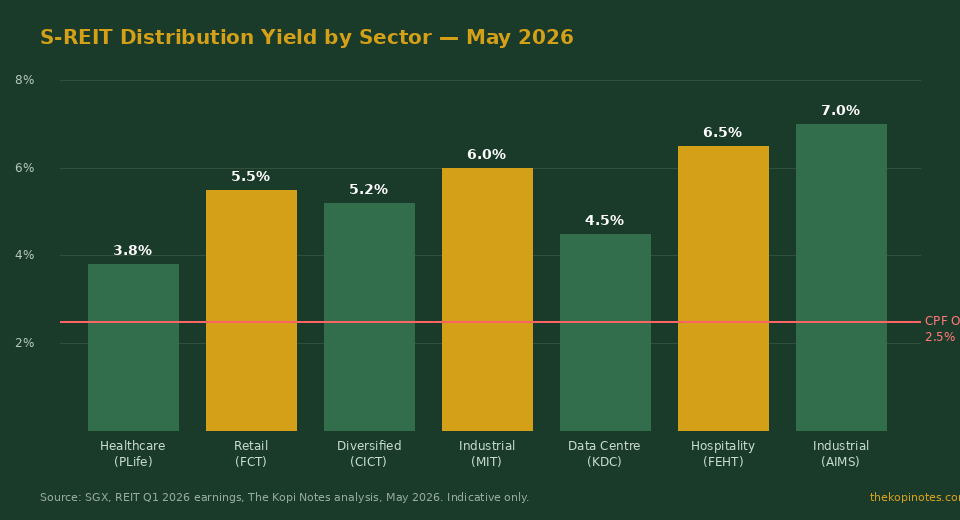
To help you calibrate expectations before attending the symposium, here is a snapshot of indicative distribution yields for key S-REITs as at May 2026. Use this as a starting reference — always verify against the latest SGX announcements before making investment decisions.
| REIT | Sector | Indicative Yield (May 2026) | Gearing (approx.) |
|---|---|---|---|
| Parkway Life REIT | Healthcare | ~3.8% | ~35% |
| Frasers Centrepoint Trust | Retail (Suburban) | ~5.5% | ~38% |
| CapitaLand Integrated Commercial Trust | Diversified (Retail + Office) | ~5.2% | ~40% |
| Mapletree Industrial Trust | Industrial / Data Centre | ~6.0% | ~37% |
| Keppel DC REIT | Data Centre | ~4.5% | ~36% |
| Far East Hospitality Trust | Hospitality | ~6.5% | ~33% |
| AIMS APAC REIT | Industrial/Logistics | ~7.0% | ~36% |
Source: SGX announcements, individual REIT Q1 2026 earnings, The Kopi Notes analysis, May 2026. Yields are indicative only and will change with share price movements. Not financial advice.
Where to Start Investing in S-REITs
Whether you are attending REITs Symposium 2026 as a complete beginner or as an experienced REIT investor, having the right brokerage platform matters. Here are the most popular options among Singapore retail investors in 2026:
Syfe (for Managed REIT Portfolios)
If you want S-REIT exposure without stock-picking individual REITs, Syfe’s REIT+ portfolio provides diversified exposure to the iEdge S-REIT Leaders Index. It is ideal for investors who want the yield of S-REITs with automatic rebalancing and dividend reinvestment. Use our Syfe referral code and sign-up bonus to get a fee waiver on your first deposit.
Endowus (for CPF and SRS Investing)
Endowus is Singapore’s only digital wealth platform licensed to invest CPF and SRS funds. If you plan to deploy CPF Ordinary Account savings into REIT-focused funds or income portfolios, Endowus is the most cost-efficient route. Get started with our Endowus referral code for your first S$10,000 managed free for 6 months.
FSMOne (for DIY REIT Stock Picking)
For investors who want to handpick individual S-REITs after doing their research at the symposium, FSMOne offers low-cost SGX equity trading with a clean platform. Their regular savings plan (RSP) is also available for REITs. Use our FSMOne referral code to get started with reduced fees.
Frequently Asked Questions
When and where is REITs Symposium 2026?
Who organises REITs Symposium?
Is REITs Symposium suitable for beginners?
Can I buy S-REITs using CPF funds?
What S-REIT sectors are most attractive in 2026?
How do CPF interest rates affect S-REIT valuations?
What is a good REIT gearing ratio?
Disclaimer: This article is for informational and educational purposes only. It does not constitute financial advice. All data and yield figures are indicative as at May 2026 and subject to change. Always do your own due diligence before investing. The Kopi Notes may earn referral fees from platforms linked in this article.
This article was researched with the help of AI. While we strive to keep all information accurate and up to date, there may be errors. If you notice any discrepancies, please contact us.