Suntec REIT Dividend History & Yield Guide 2026
DPU trends, distribution yield, payout schedule, and what Singapore investors need to know.
Suntec REIT (SGX: T82U) is one of Singapore’s oldest diversified S-REITs, owning premium office and retail assets across Singapore, Australia, and the UK. As at May 2026, its trailing distribution yield is approximately 6.0–6.5%, based on a FY2025 DPU of around 6.0–6.2 Singapore cents. While DPU has declined from its 2019 peak due to rising interest costs and asset repositioning, Suntec REIT remains a high-yield, SGX Mainboard-listed trust with semi-annual payouts and no withholding tax for Singapore tax-resident investors.
Not financial advice. All figures are for educational reference only. Data as at May 2026 unless noted.
1. Suntec REIT Overview
Suntec REIT was listed on the Singapore Exchange (SGX) in December 2004 and is managed by ARA Trust Management (Suntec) Limited, a subsidiary of ESR Group. It is Singapore’s first composite REIT — owning a combined office and retail portfolio — and one of the largest S-REITs by market capitalisation.
As at Q1 2026, Suntec REIT’s portfolio comprises:
- Singapore: Suntec City (office towers and mall), One Raffles Quay, MBFC Properties (Marina Bay Financial Centre Towers 1 and 2, and Marina Bay Link Mall), 21 Harris Street (Sydney is separate), and 477 Collins Street (Melbourne)
- Australia: 477 Collins Street (Melbourne), 55 Currie Street (Adelaide), Olderfleet (Melbourne)
- United Kingdom: The Nova Properties (London Victoria), Nova South and Nova North office towers
The SG portfolio contributes approximately 70–75% of net property income, with overseas assets providing geographic diversification. The trust trades under ticker T82U on SGX Mainboard.
| Key Metric | Value (as at Q1 2026) |
|---|---|
| SGX Ticker | T82U |
| REIT Manager | ARA Trust Management (Suntec) Limited |
| Sponsor | ESR Group |
| Asset Class | Composite (Office + Retail) |
| Portfolio AUM | ~S$11.4 billion |
| Number of Properties | 11 properties across SG, AU, UK |
| Gearing Ratio | ~42.5% (as at Dec 2025) |
| Distribution Frequency | Semi-annual (H1 and H2) |
Source: Suntec REIT FY2025 annual results, SGX filings, May 2026
2. DPU History (2019–2025)
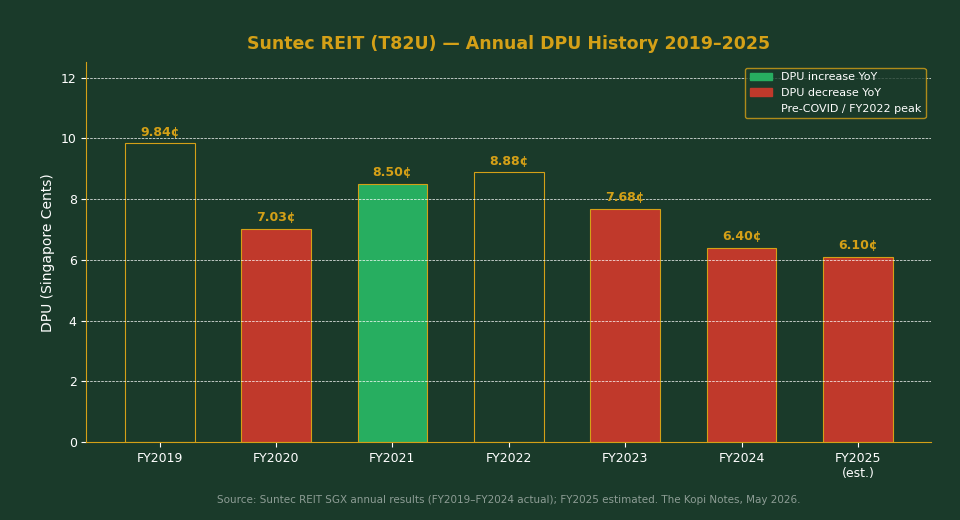
Suntec REIT’s Distribution Per Unit (DPU) has seen significant fluctuations over the past several years. The primary drivers of decline from the 2019 peak include the COVID-19 pandemic’s impact on retail and office occupancy (2020–2021), rising interest rates from 2022 onwards which increased financing costs, and the dilutive effect of overseas asset acquisitions partially funded by equity.
Below is Suntec REIT’s full-year DPU track record from FY2019 to FY2025:
| Financial Year | Total DPU (S¢) | YoY Change |
|---|---|---|
| FY2019 | 9.843¢ | — |
| FY2020 | 7.027¢ | −28.6% |
| FY2021 | 8.498¢ | +20.9% |
| FY2022 | 8.877¢ | +4.5% |
| FY2023 | 7.682¢ | −13.5% |
| FY2024 | 6.404¢ | −16.6% |
| FY2025 (est.) | ~6.0–6.2¢ | ~−3 to −6% |
Source: Suntec REIT SGX annual results announcements, FY2019–FY2024 (actual); FY2025 based on management guidance and analyst estimates as at May 2026
The DPU decline from FY2022 to FY2024 was driven primarily by:
- Higher financing costs: Suntec REIT’s all-in cost of debt rose from ~2.8% in FY2021 to ~4.0–4.2% by FY2024 as floating-rate debt repriced upward with global interest rate hikes
- Overseas currency headwinds: AUD and GBP depreciation against SGD reduced the SGD value of Australian and UK income
- Retail tenant mix normalisation: Suntec City Mall underwent tenant remixing in 2022–2023, temporarily reducing occupancy
- Higher gearing: The gearing ratio climbed to ~42.5%, leaving less distributable income after debt service
For Singapore investors who held Suntec REIT since 2019, the cumulative DPU has still provided meaningful passive income — approximately 48¢ in total distributions over FY2019–FY2024 — even as the unit price has declined alongside the broader S-REIT sector. Investors considering entry should weigh the current elevated yield against the structural pressures on DPU recovery.
[/et_pb_section]
3. Current Distribution Yield
As at May 2026, Suntec REIT’s unit price has been trading in the range of approximately S$1.00–1.10. Based on an estimated FY2025 DPU of around 6.0–6.2 cents, the trailing distribution yield works out to:
| Unit Price | FY2025 DPU (~6.1¢) | Trailing Yield |
|---|---|---|
| S$0.95 | 6.1¢ | 6.4% |
| S$1.00 | 6.1¢ | 6.1% |
| S$1.05 | 6.1¢ | 5.8% |
| S$1.10 | 6.1¢ | 5.5% |
Source: The Kopi Notes calculations; DPU estimate based on Suntec REIT H1 2025 results and management guidance. Yield is indicative only — check live prices on SGX before investing.
At roughly 6%, Suntec REIT offers one of the higher trailing yields among large-cap S-REITs, but this is partly a reflection of market scepticism about DPU recovery. A higher yield is not necessarily better — it may signal that the market expects DPU to fall further, compressing both price and income. Investors should look at the distribution payout ratio and distributable income trend when assessing whether the yield is sustainable.
Suntec REIT’s distributable income for FY2024 was approximately S$231 million, down from ~S$248 million in FY2023 and ~S$290 million in FY2022. The trend is negative, though the rate of decline has begun to slow as interest rate cuts gradually reduce financing costs and Suntec City’s mall occupancy approaches stabilisation near 98%.
For context on how Suntec’s yield compares to the broader S-REIT universe and Singapore government bonds, you can use the S-REIT Yield vs SGS Bond Spread Calculator to model the spread at current market levels.
4. Dividend Payout Schedule
Suntec REIT distributes income to unitholders on a semi-annual basis — once for the first half (H1: January–June) and once for the second half (H2: July–December) of each financial year. The financial year runs on a calendar-year basis (January to December).
The typical timeline for each distribution cycle is:
- Results announcement: Within 2 months of half-year end (typically August for H1, February for H2)
- Ex-dividend date (XD): Usually within 1–2 weeks of the results announcement
- Books closure date: 2–3 business days after the XD date
- Payment date: Approximately 1 month after the books closure date
For FY2024, the actual payout dates were as follows:
| Distribution | DPU (S¢) | XD Date | Payment Date |
|---|---|---|---|
| FY2024 H1 | 3.212¢ | Aug 2024 | Sep 2024 |
| FY2024 H2 | 3.192¢ | Feb 2025 | Mar 2025 |
| FY2024 Total | 6.404¢ | — | — |
Source: Suntec REIT SGX announcements, FY2024 distribution notices
Key practical point for investors: To receive the distribution, you must own Suntec REIT units before the ex-dividend date. Buying on or after the XD date means you will not receive the upcoming distribution. Always check the SGX announcement for the exact XD date for each semi-annual period.
Suntec REIT does not operate a distribution reinvestment plan (DRIP), so all distributions are paid in cash to unitholders’ CDP accounts. You can model the impact of reinvesting these cash distributions manually using the Dividend Reinvestment (DRIP) Calculator.
5. What Drives Suntec REIT’s DPU?
Understanding what determines Suntec REIT’s distribution helps investors forecast whether DPU is likely to recover, stabilise, or decline further. The key drivers are:
5a. Office Portfolio Occupancy and Rents
Singapore office space — particularly Grade A CBD assets like MBFC and Suntec City office towers — commands strong rental premiums. As at Q1 2026, Singapore office occupancy in the Suntec REIT portfolio was approximately 96–98%, with positive rental reversions as expiring leases reset to current market rents. Singapore office rents have been relatively resilient despite global tech sector headwinds, supported by demand from financial services, legal, and commodities firms.
5b. Suntec City Mall Occupancy and Shopper Traffic
The retail component — Suntec City Mall — contributes a meaningful share of gross revenue. After a period of tenant remixing and AEI (asset enhancement initiatives), the mall’s occupancy had recovered to approximately 98% by end-2024. Shopper traffic and tenant sales are gradually recovering to pre-pandemic levels, though the trade mix shift away from F&B toward experiential retail has affected average rents per square foot.
5c. Overseas Asset Performance (AUD & GBP)
Approximately 25–30% of Suntec REIT’s net property income comes from its Australian and UK assets. Currency movements materially affect the SGD-equivalent income. A 10% depreciation in AUD reduces Suntec REIT’s distributable income by approximately 2–3%, all else equal. The trust uses natural hedging (AUD-denominated debt) and currency forward contracts to partially mitigate this risk, but residual currency exposure remains.
5d. Financing Costs (All-In Cost of Debt)
This has been the single largest drag on DPU since 2022. Suntec REIT’s all-in cost of debt rose from ~2.8% in FY2021 to ~4.0–4.2% by FY2024 as SORA-linked and SOFR-linked borrowings repriced upward. With the US Federal Reserve having cut rates modestly and the Singapore interbank rate stabilising, Suntec’s refinancing cost is expected to ease gradually through 2025–2026 as higher-cost debt matures and is replaced at current rates.
As at December 2025, approximately 55–60% of Suntec’s borrowings were on fixed rates, providing partial protection against further rate volatility.
5e. Gearing and Capital Management
Suntec REIT’s aggregate leverage stood at approximately 42.5% as at December 2025, well above the sector median of ~36–38%. At current gearing, any equity fundraising (private placement or rights issue) could dilute DPU per unit. The trust has limited financial flexibility for acquisitions without either asset disposals or equity raising. Management has indicated a focus on organic growth and debt reduction rather than large-scale acquisitions in the near term.
[/et_pb_section]
6. Tax Treatment for Singapore Investors
One of the most attractive features of S-REITs for Singapore-based investors is the tax treatment of distributions. For individual investors who are Singapore tax residents, distributions from Suntec REIT are tax-exempt at the individual level.
This works because S-REITs receive a tax transparency treatment under the Income Tax Act — meaning the REIT itself is not taxed on income it distributes, and individual unitholders receive distributions gross (no withholding tax deducted at source). This is distinct from dividends from regular Singapore-listed companies, which are paid from after-tax profits.
| Investor Type | Tax Treatment on Suntec REIT Distributions |
|---|---|
| Singapore individual (tax resident) | Tax-exempt — received gross, no WHT deducted |
| Singapore company | Subject to corporate income tax at 17% |
| Foreign individual investor | 10% withholding tax deducted at source |
| Foreign non-individual (e.g. foreign company) | 10% withholding tax deducted at source |
Source: IRAS S-REIT tax guide; MAS REIT guidelines
The 0% effective tax rate on S-REIT distributions for Singapore individuals is a significant advantage compared to investing in foreign REITs or ETFs, where dividends may be subject to withholding tax of 15–30%. For example, US-listed REITs typically deduct 30% WHT for non-US investors (reducible to 15% under the US-SG tax treaty with a W-8BEN form). Singapore investors in Suntec REIT face none of this friction — the full 6+ cents of DPU lands in their CDP account.
For a deeper look at withholding tax on dividends across different investment types, see our Withholding Tax on Dividends Calculator.
7. Peer Yield Comparison — Suntec REIT vs Similar S-REITs
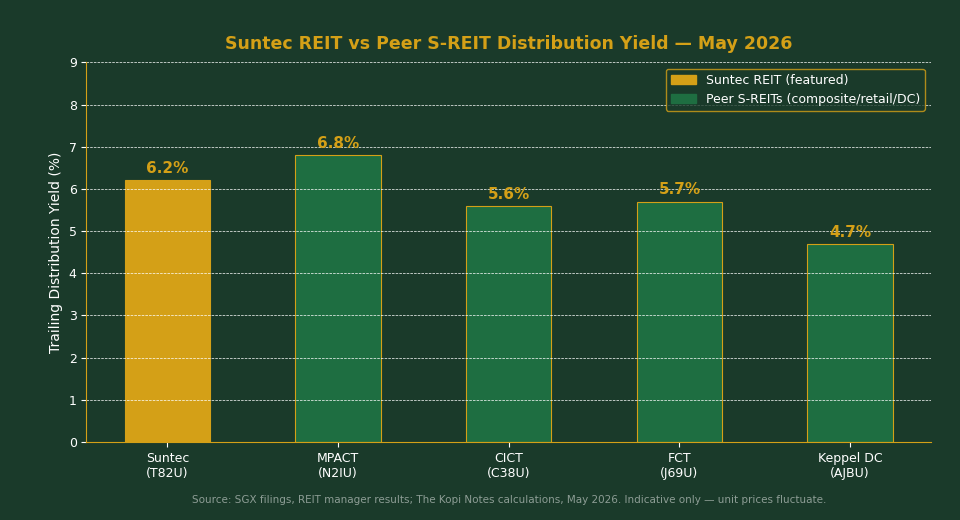
How does Suntec REIT’s dividend yield stack up against other large S-REITs with similar asset profiles? The table below compares trailing FY2025 distribution yields across a selection of SGX-listed REITs as at May 2026. Note that unit prices and DPUs change daily — always verify with live SGX data before investing.
| REIT | Sector | Est. FY2025 DPU | Approx. Yield |
|---|---|---|---|
| Suntec REIT (T82U) | Office + Retail | ~6.1¢ | ~6.0–6.5% |
| Mapletree Pan Asia Commercial Trust (N2IU) | Office + Retail | ~7.5¢ | ~6.5–7.0% |
| CapitaLand Integrated Commercial Trust (C38U) | Office + Retail | ~10.7¢ | ~5.5–5.8% |
| Frasers Centrepoint Trust (J69U) | Suburban Retail | ~12.2¢ | ~5.5–6.0% |
| Keppel DC REIT (AJBU) | Data Centres | ~9.6¢ | ~4.5–5.0% |
Source: SGX, REIT manager results announcements; yield calculations by The Kopi Notes as at May 2026. Figures are indicative — unit prices and DPUs fluctuate. Not financial advice.
Suntec REIT’s yield is broadly in line with peers in the office and retail composite segment. However, it trades at a slight premium yield to CICT (which has a stronger balance sheet and more defensive sub-urban retail exposure) and a slight discount to MPACT (which has higher Asia-Pacific diversification and DPU pressure from overseas assets). The yield premium relative to CICT reflects Suntec’s higher gearing and ongoing DPU headwinds.
For a broader comparison of S-REIT yields including industrial, hospitality, and healthcare sectors, see our guide to the best S-REITs in Singapore 2026.
8. How to Invest in Suntec REIT for Dividends
Suntec REIT (T82U) is listed on the SGX Mainboard and can be purchased through any brokerage account that supports SGX equities. The minimum board lot size is 100 units. Here is the step-by-step process for Singapore investors:
- Open a brokerage account — choose a platform with competitive SGX trading commissions. FSMOne, Syfe Trade, and IBKR are popular among Singapore retail investors. See our FSMOne referral code for a sign-up bonus if you’re new to FSMOne.
- Ensure you have a CDP account — direct SGX purchases settle into a Central Depository (CDP) account, which holds your shares and receives dividend payments. Apply through CDP directly or through your broker.
- Research the XD date — before buying, check the next ex-dividend date on SGX or the REIT manager’s investor relations page. If you buy on or after the XD date, you will not receive the upcoming distribution.
- Place a buy order — enter the ticker T82U on your brokerage platform and place a market or limit order for the number of lots (100 units each) you wish to purchase.
- Receive distributions via CDP — distributions are paid directly to your CDP-linked bank account on the payment date, typically 3–4 weeks after the ex-dividend date.
If you prefer a more diversified approach rather than holding individual REITs, platforms like Syfe offer S-REIT portfolio products (e.g. Syfe REIT+) that provide exposure to a basket of S-REITs with automatic rebalancing. Check the Syfe referral code and sign-up bonus if you’re considering this route.
For investors who are using CPF Ordinary Account funds, Suntec REIT may be eligible under the CPF Investment Scheme (CPFIS), subject to prevailing CPF Board rules and the REIT’s inclusion on the CPFIS-approved list. Verify eligibility on the CPF Board website before investing CPF funds. For more on CPF-linked investing strategies, see our CPF investment strategy guide.
To calculate how much passive income a position in Suntec REIT would generate at current yields, use the Dividend Portfolio Yield Calculator.
Frequently Asked Questions — Suntec REIT Dividend
What is Suntec REIT's current dividend yield?
How often does Suntec REIT pay dividends?
Has Suntec REIT's DPU been declining?
Is Suntec REIT dividend tax-free for Singapore investors?
What is Suntec REIT's gearing ratio and does it affect dividends?
How do I check the Suntec REIT ex-dividend date?
Is Suntec REIT a good investment for passive income in 2026?
Disclaimer: This article is for informational and educational purposes only and does not constitute financial advice. All figures are sourced from publicly available SGX filings and REIT manager announcements and are accurate as at May 2026 to the best of our knowledge. Past DPU performance is not indicative of future distributions. Investing in S-REITs involves risk, including the risk of capital loss and DPU reduction. Always conduct your own due diligence or consult a licensed financial adviser before making investment decisions.
This article was researched with the help of AI. While we strive to keep all information accurate and up to date, there may be errors. If you notice any discrepancies, please contact us.