How Much Critical Illness Insurance Do You Need? Singapore 2026 Guide
A step-by-step coverage calculator guide for Singapore residents — LIA benchmarks verified
The Life Insurance Association (LIA) Singapore recommends 3.9× to 5× your annual income as your critical illness (CI) insurance target — enough to cover 3–5 years of recovery, lost income, and treatment bills. Your exact number depends on your age, dependants, CPF savings, and lifestyle costs. This step-by-step guide shows you how to calculate the right CI coverage for your situation.
Not financial advice. All figures are for educational reference only. Data verified as at 4 September 2026 unless noted.
- LIA benchmark: 3.9× to 5× annual income in CI coverage (e.g. S$234k–S$300k for S$5k/month earner)
- CI insurance pays a lump sum on diagnosis — it supplements, not replaces, your hospitalisation plan
- Your coverage need rises with age, dependants, and outstanding liabilities — recalculate every 5 years
Table of Contents
- What Critical Illness Insurance Actually Pays For
- How Much CI Coverage Do You Need?
- Step-by-Step: Calculate Your CI Coverage
- CI Coverage by Life Stage
- 5 Factors That Change Your Coverage Needs
- What Major Illnesses Actually Cost in Singapore
- CI Insurance vs Term Life: The Key Difference
- Common Mistakes When Choosing CI Coverage
- Frequently Asked Questions
What Critical Illness Insurance Actually Pays For
Critical illness (CI) insurance pays you a lump sum — upfront, tax-free — when you are diagnosed with a covered condition. You don’t submit receipts. You don’t wait for treatment to finish. The insurer pays once the diagnosis is confirmed, and you decide how to use the money.
Most Singaporeans use a CI payout for three things: medical bills not covered by their Integrated Shield Plan (ISP), living expenses while they’re too ill to work, and repaying loans or debts so family members aren’t burdened.
Under the LIA CI Framework 2024, all insurers in Singapore cover a standardised list of 37 severe-stage critical illness conditions. Cancer, heart attack, and stroke together account for the majority of CI claims in Singapore — which is why most policies price the cancer risk heavily.
This is different from your hospitalisation plan (ISP), which reimburses actual medical bills. Your ISP handles the surgery. Your CI policy handles everything else — the months of lost income, the home nursing care, the mortgage while you recover.
How Much CI Coverage Do You Need?
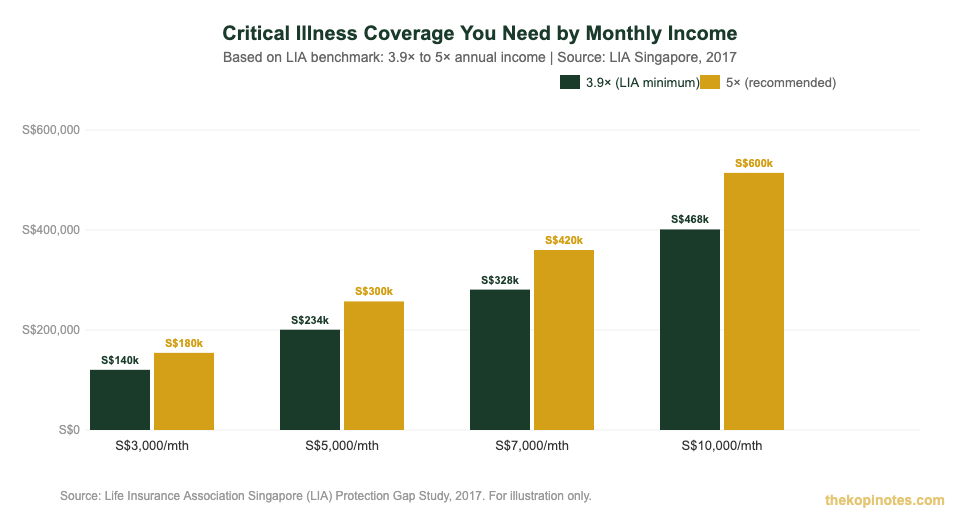
The LIA Basic Financial Planning Guide recommends aiming for 3.9× to 5× your annual income in CI coverage. This figure assumes a recovery period of 3–5 years — the typical window before most CI survivors can return to work or reach a stable income plateau.
Here’s how that translates into actual dollar amounts:
| Monthly Income | Annual Income | Minimum (3.9×) | Recommended (5×) |
|---|---|---|---|
| S$3,000 | S$36,000 | S$140,400 | S$180,000 |
| S$5,000 | S$60,000 | S$234,000 | S$300,000 |
| S$7,000 | S$84,000 | S$327,600 | S$420,000 |
| S$10,000 | S$120,000 | S$468,000 | S$600,000 |
Source: LIA Singapore Basic Financial Planning Guide. Figures for illustration only.
Step-by-Step: Calculate Your CI Coverage
The income-multiple is a useful starting point. But your real CI coverage need is more precise than a formula. Here’s the method financial planners use.
Step 1 — Estimate your annual expenses. Add up rent or mortgage, utilities, groceries, transport, children’s school fees, and your regular bills. This is what you need to maintain your lifestyle if you can’t work.
Step 2 — Multiply by your recovery window. Most CI survivors need 3–5 years of runway. Multiply your annual expenses by 4 (middle of the range) as your baseline.
Step 3 — Add treatment costs not covered by ISP. Your hospitalisation plan reimburses hospital bills, but it doesn’t cover lost income, home nursing, or overseas treatment. Add a buffer of S$30,000–S$80,000 depending on your ISP coverage and health risk profile.
Step 4 — Subtract your safety net. Deduct existing emergency savings, CPF Ordinary Account balance (if you’ll use it), and any existing CI coverage you already hold.
Step 5 — That’s your gap. If the number is positive, that’s the CI coverage you need. If it’s negative — congratulations, you’re covered.
For example: A 35-year-old earning S$6,000/month with S$3,500/month in expenses and S$50,000 in savings would calculate: (S$42,000 × 4) + S$50,000 buffer − S$50,000 savings = S$168,000 in CI coverage needed.
CI Coverage by Life Stage
Your CI coverage need is not static. It peaks in your late 30s and 40s — when you have the most financial dependants and the highest debt load — and can be scaled back after 60 when your savings are larger and your children are financially independent.
| Life Stage | Typical Coverage Need | Key Drivers |
|---|---|---|
| 25–35 (Young Professional) | S$150k–S$250k | Low savings, early career income, student loans |
| 35–50 (Peak Earner) | S$250k–S$500k | Mortgage, young children, highest income to protect |
| 50–60 (Pre-Retirement) | S$200k–S$400k | Elevated illness risk, lower debt, growing CPF/savings |
| 60+ (Retirement) | S$100k–S$250k | Wealth preservation, elderly care costs, reduced income need |
Estimates based on LIA planning guidelines. Adjust for individual circumstances.
5 Factors That Change Your CI Coverage Needs
1. Number of dependants. Every child or elderly parent you support adds roughly 12–18 months of living expenses to your coverage need. If you have two young children, add S$50,000–S$80,000 to your baseline.
2. Outstanding mortgage. If you have a home loan and your spouse cannot service it alone, factor in 2–3 years of mortgage payments. For a S$3,000/month HDB mortgage, that’s an extra S$72,000–S$108,000.
3. Self-employment or variable income. Salaried employees have some employment protection during illness. Freelancers and self-employed Singaporeans have none. Aim for the higher end of the 5× multiplier if your income isn’t guaranteed.
4. Family health history. A strong family history of cancer, heart disease, or stroke is a signal to increase your coverage — not just because you face higher risk, but because premiums may rise or conditions may become excluded if you wait to buy.
5. Existing CI coverage from group insurance. Some employers provide basic CI coverage — typically S$50,000–S$100,000. Check your policy schedule. Group CI coverage usually ceases when you leave the job, so don’t rely on it as your long-term plan.
For more on how CI insurance interacts with your broader insurance stack, read our life insurance comparison guide for Singapore 2026.
What Major Illnesses Actually Cost in Singapore
Here’s the sobering part. Treatment costs vary widely depending on cancer type, treatment protocol, and whether you use public or private hospitals. The figures below are estimates based on publicly available MOH and hospital data — your ISP will cover part of these, but the gap can still be significant.
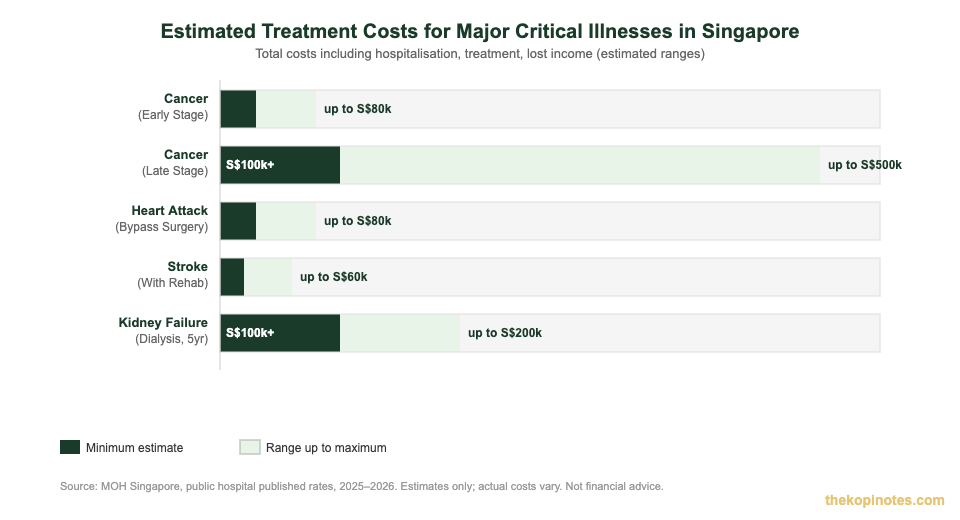
These numbers highlight why a CI lump sum matters even when you have a good hospitalisation plan. Your ISP covers the hospital bill. Your CI coverage covers the 12 months you can’t work while undergoing chemotherapy, or the private rehabilitation specialist your ISP doesn’t include.
For a deeper look at how disability coverage fits into this picture, see our guide on disability income insurance vs CPF DPS in Singapore.
CI Insurance vs Term Life: What’s the Difference?
This is the most common confusion among first-time insurance buyers. Here’s the short version.
Term life insurance pays a lump sum if you die during the policy period. It protects your dependants after you’re gone. Your life insurance comparison guide covers the four main insurance types in detail.
CI insurance pays a lump sum if you are diagnosed with a critical illness and survive. It protects you — and your family — while you’re alive but seriously ill.
You need both. A 40-year-old with S$500,000 in term life and zero CI coverage is well-protected if they die — but financially exposed if they survive cancer for 5 years and can’t work. For insights on CI insurance and tax relief eligibility in Singapore, check our dedicated guide.
If budget is tight, prioritise CI coverage earlier. You are statistically more likely to be diagnosed with a critical illness in your 40s than to die.
Common Mistakes When Choosing CI Coverage
Underinsuring to keep premiums low. Buying S$100,000 in CI coverage when your need is S$300,000 leaves a S$200,000 gap you’ll need to fill from savings — at the worst possible time. Prioritise adequate coverage over lowest premium.
Forgetting to review coverage as life changes. Got married? Had a child? Took on a mortgage? These all increase your CI coverage need. Review your coverage every 3–5 years or after any major life event.
Relying solely on early CI coverage. Early CI plans cover conditions at an earlier stage, but often pay a partial benefit (e.g. 25% of sum assured). For your core coverage, you need a full-payout severe-stage plan. Our guide on CI rider vs standalone CI plan explores when each makes sense.
Ignoring the premium commitment. CI premiums rise with age. If you buy at 45 instead of 30, the same S$300,000 coverage could cost 2–3× more per year. Locking in coverage early is usually the most cost-effective decision.
If you’re weighing whether to invest the premium difference, you might find our guide to the Singapore retirement planning calculator useful for modelling both scenarios.
When you’re ready to start comparing CI plans, Syfe and Endowus offer guided insurance review tools alongside their investment platforms.
Frequently Asked Questions
Get Free Insurance Advice
Speak with a licensed insurance advisor. No obligation, no cost.
By submitting this form, you agree to our Privacy Policy.
This article was researched with the help of AI. While we strive to keep all information accurate and up to date, there may be errors. If you notice any discrepancies, please contact us.